ColestZen Ingredients: All Eighteen Names in Two Short Tables
Nine botanicals and nine micronutrients, each named exactly as the order page names them. Here is the checklist to read before your first capsule.
- Written by
- HealthCure Guide Editorial Team
- Reviewed by
- HealthCure Guide Editorial Team
- Updated
- Reading time
- 7 min read
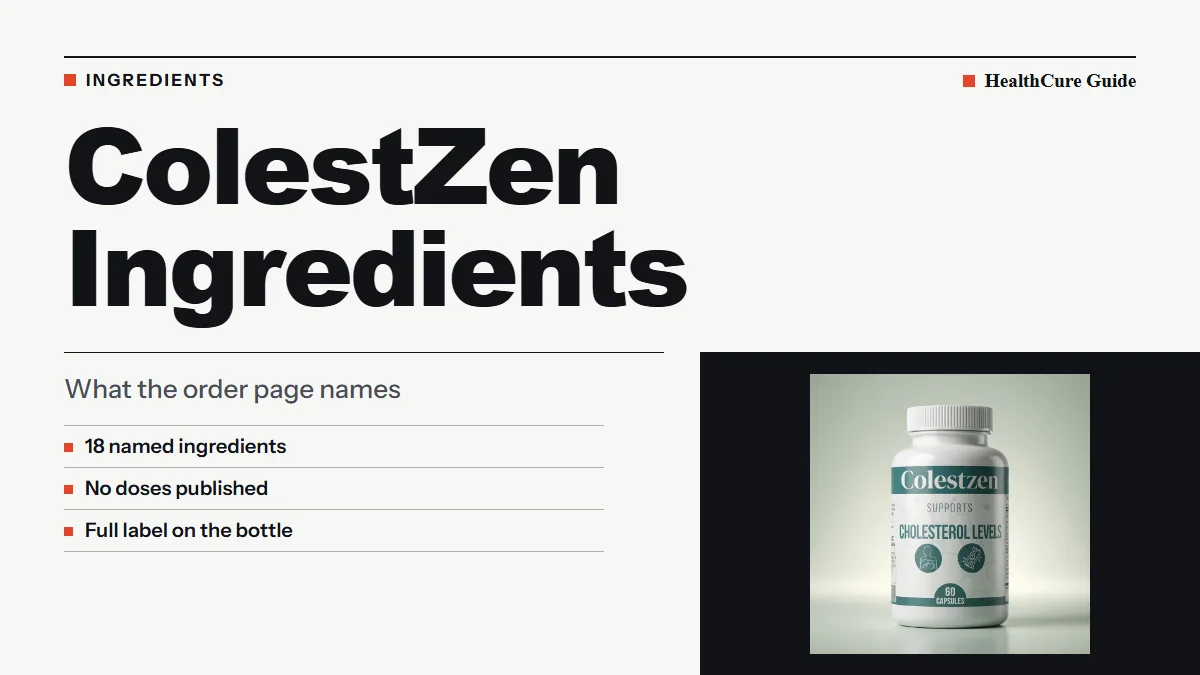
The ColestZen ingredients come first for anyone planning a daily capsule, and the list is easy to check. Its order page names eighteen ingredients, which gives you a specific checklist to bring to a doctor. This guide sets out every name in two tables, says what each item is and explains the one gap you should know about before you read the list.
The eighteen ColestZen ingredients
The order page sorts the list into two groups. The first is nine botanicals: plant material from fruit, bark, root, leaf and herb. The second is nine micronutrients, which are amino-acid-type compounds, vitamins and minerals. Each name appears below exactly as the page writes it.
The nine botanicals
| Ingredient, as named | What it is |
|---|---|
| Bitter Melon Extract | Fruit extract |
| Cinnamon | Bark spice |
| Licorice Extract | Root extract |
| Gymnema sylvestre Powder | Powdered leaf |
| Banaba Extract | Leaf extract |
| Mulberry Fruit Powder | Powdered fresh fruit |
| Yarrow Herb Powder | Powdered whole herb |
| Cayenne Pepper Extract | Extract of the cayenne pepper |
| Juniper Berry Powder | Powdered berry |
The nine micronutrients
| Ingredient, as named | What it is |
|---|---|
| L-Taurine | An amino-acid-type compound |
| Alpha Lipoic Acid | A sulfur-containing acid compound |
| Vitamin C | A vitamin |
| Vitamin E | A vitamin |
| Biotin | A B vitamin |
| Magnesium | A mineral |
| Zinc | A mineral |
| Manganese | A mineral |
| Chromium | A mineral |
These notes say what each item is and nothing more. They do not describe what any ingredient does, and nothing in the tables implies a benefit.
What the list does not tell you
No amount is published for any of the eighteen. That rules out a milligram-by-milligram comparison with another formula, and the list cannot reveal how much of one name a capsule holds. Read the bottle label once it arrives, then line its names up against the tables. Any disagreement goes to [email protected], with the confirmation email kept on file.
Matching names across labels
Two labels can write the same ingredient differently. Compare the name first, then the form the label gives, such as extract, powder or whole herb. Form matters, because an extract and a powder are different materials, even when they come from the same plant. If two names look close but are not identical, ask a pharmacist before you assume they match.
The badges and the seller’s wording
The page displays three badges: Natural Formula, Non-GMO and No Stimulants. Its FAQ adds that manufacturing takes place in the USA at an FDA-registered facility. Those are the seller’s words, and we repeat them as such. The formula is presented as a blend meant to support healthy cholesterol levels and circulation within a healthy routine. Read that as a stated aim rather than a measured effect.
Reading the two groups side by side
The botanical group is plant material taken from fruit, bark, root, leaf and herb. The micronutrient group is made of compounds, vitamins and minerals. Read together, the eighteen names describe what the formula is made of, and nothing more. The order page does not rank the entries, and it does not attach an amount or an outcome to any of them.
If you compare this formula with another one, use the same two-group layout. Line up botanicals against botanicals and micronutrients against micronutrients, so each comparison is like for like.
Directions to read beside the list
The dose is two capsules daily, taken with a generous amount of water. Steps on the order page suggest a morning routine. Each bottle contains 60 capsules, enough for 30 days at that rate. The seller recommends a span of three to six months, and we report that as its advice.
Notes for your doctor
Take the exact names to the appointment, since precision matters here. Bitter melon, Gymnema sylvestre, banaba, cinnamon, alpha lipoic acid and chromium may lower blood sugar and may interact with diabetes medicines. Licorice may raise blood pressure and may interact with certain prescriptions. Cayenne and juniper may bother the stomach. Anyone pregnant or nursing consults a clinician before starting. Prescriptions stay as directed, including any for cholesterol or blood pressure, and a capsule is never the reason to alter one. The seller’s FAQ suggests the bottle be shown to a doctor beforehand.
Why the bottle label matters more than this page
This page lists names, but it cannot state the amount in one capsule, and that number drives any fair comparison. The bottle label is the document that holds it, so read it when the order lands. Compare its names with the tables above, and note any mismatch. A mismatch is a reason to write to [email protected] before the first dose and to keep your confirmation email.
Questions to bring to the appointment
- Do any of the botanicals overlap with the medicines I already take?
- Is chromium or alpha lipoic acid a concern alongside my diabetes medicine?
- Is licorice a concern with my blood pressure medicine?
- Is there a reason to wait, given my pregnancy, nursing or health history?
Reading the list with your medicine list
Write out every prescription and every other supplement you take. Then go through the eighteen names and mark any that match an item on your list, or that sit in the same plant family as something you already take. Next to each mark, write the question you want answered. A pharmacist can work through that short list quickly, and it gives your doctor a precise starting point rather than a general worry.
Using the tables at your appointment
Print the two tables or keep them open on your phone. Circle every name that matches a medicine you take, and write down whether your doctor wants to review that pairing before the first dose. Ask whether any of the names need a check during the routine, and note the answer next to the name. A clear answer on each line is more useful than a long general discussion of the formula.
Keeping the list with your records
Save a copy of the two tables with your medicine list, so both documents travel together. When the bottle arrives, compare its label with the copy and note any difference, the date you noticed it and the name involved. If the label changes later, update the copy at once. A record that matches the label is far easier to hand to a pharmacist than a memory of the order page.
Reading the list with a pharmacist
Pharmacists check interactions as a routine part of their work, so the tables suit a pharmacy visit well. Bring the printed tables, your medicine list and, once it arrives, the bottle itself. Ask the pharmacist to flag any name that needs a doctor’s sign-off before the first dose, and to note the answer on the same page.
Where the page and the bottle can differ
The order page describes the formula, and the bottle is what actually arrives. Read both, and check the ColestZen hub for the product facts that sit beside them. If the bottle lists a name the tables do not show, or spells one differently, that is a question for support and for your pharmacist, not something to settle by guessing.
Our take on the ingredient list
Eighteen named ingredients with no published amounts give your doctor something concrete to review, which is a sound starting point. The six-bottle option drops to $49 a bottle, ships free within the US and adds three digital guides. The catalog ingredients page repeats the names in brief, and the ColestZen hub covers everything else. For a fuller safety discussion see our side effects guide, and the how to take guide walks through the routine.
Good to know:
- No amounts are printed on the order page, so the bottle label is the reference.
- Keep prescriptions as they are, and review interactions with a doctor or pharmacist.
- Pregnancy, nursing or ongoing care means a clinician should weigh in before the first dose.
Common questions
What are the ColestZen ingredients?
The seller names eighteen ingredients: nine botanicals, including bitter melon extract, cinnamon and licorice extract, and nine micronutrients, including L-Taurine, vitamin C and magnesium. Both tables above list every name.
Does ColestZen publish ingredient amounts?
No. The seller does not publish an amount for any ingredient on the pages we read, and the full label is printed on the bottle. Check the label when the bottle arrives.
Which ColestZen ingredients can affect blood sugar?
Bitter melon, Gymnema sylvestre, banaba, cinnamon, alpha lipoic acid and chromium can lower blood sugar and can interact with diabetes medicines. Ask a doctor before you start if you take one.
Does ColestZen contain licorice?
Yes, as licorice extract from the root, on the seller's list. Licorice can raise blood pressure and can interact with some medicines, so raise it with your doctor or pharmacist.
Are the ColestZen ingredients non-GMO?
The seller shows a Non-GMO badge on its page. We report that as the seller's own statement, and the bottle label is the place to confirm the ingredient details.
How do I take ColestZen with these ingredients in mind?
The directions are two capsules every day with a big glass of water. Show the bottle and the ingredient list to your doctor before the first dose, and keep any prescribed medicine as directed.