Eastern Astrology Explained, Plus the Eastern Astrology Language Reading
A friendly beginner's guide to the Chinese system behind your zodiac animal. Learn how the animals, elements and lunar years fit together, find your own sign, and see where a personal reading comes in.
- Written by
- HealthCure Guide Editorial Team
- Reviewed by
- HealthCure Guide Editorial Team
- Updated
- Reading time
- 9 min read
This guide contains affiliate links. If you buy through them we earn a commission at no extra cost to you. It does not change the verdict. Disclosure.
Most of us grew up knowing our sun sign, then one day a friend says, “Oh, you’re a Dragon,” and a whole new set of ideas opens up. Eastern astrology is older, more cyclical and, for many people, more playful than the Western version. It is also easy to learn the basics in one sitting, which is what this guide is for. It also points to the Eastern Astrology Language Reading for readers who want a personal chart.
Full disclosure: this is an independent guide and we don’t sell readings ourselves. If you buy through a button below, the retailer pays us a modest fee, and what you pay stays the same.
What is Eastern astrology?
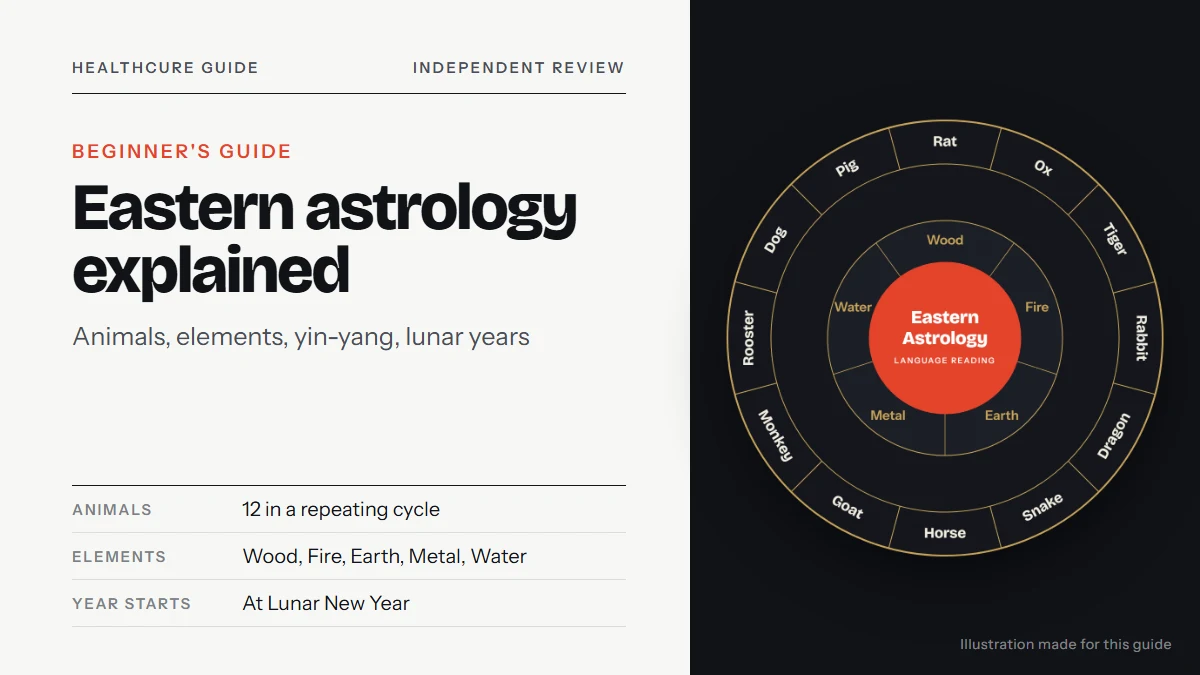
Eastern astrology, often called Chinese astrology, is a tradition that has been part of East Asian culture for centuries. Instead of 12 sun signs tied to months, it describes people through cycles of years. Each year has an animal, an element and a yin or yang quality, and a fuller chart also looks at your birth month, day and hour.
Today, many people treat it as a cultural practice, a conversation starter and a gentle reflection tool. It is not a science, and no chart can predict your future. Its appeal lies in the rich imagery and the way it invites you to think about your own character and timing.
The 12 zodiac animals
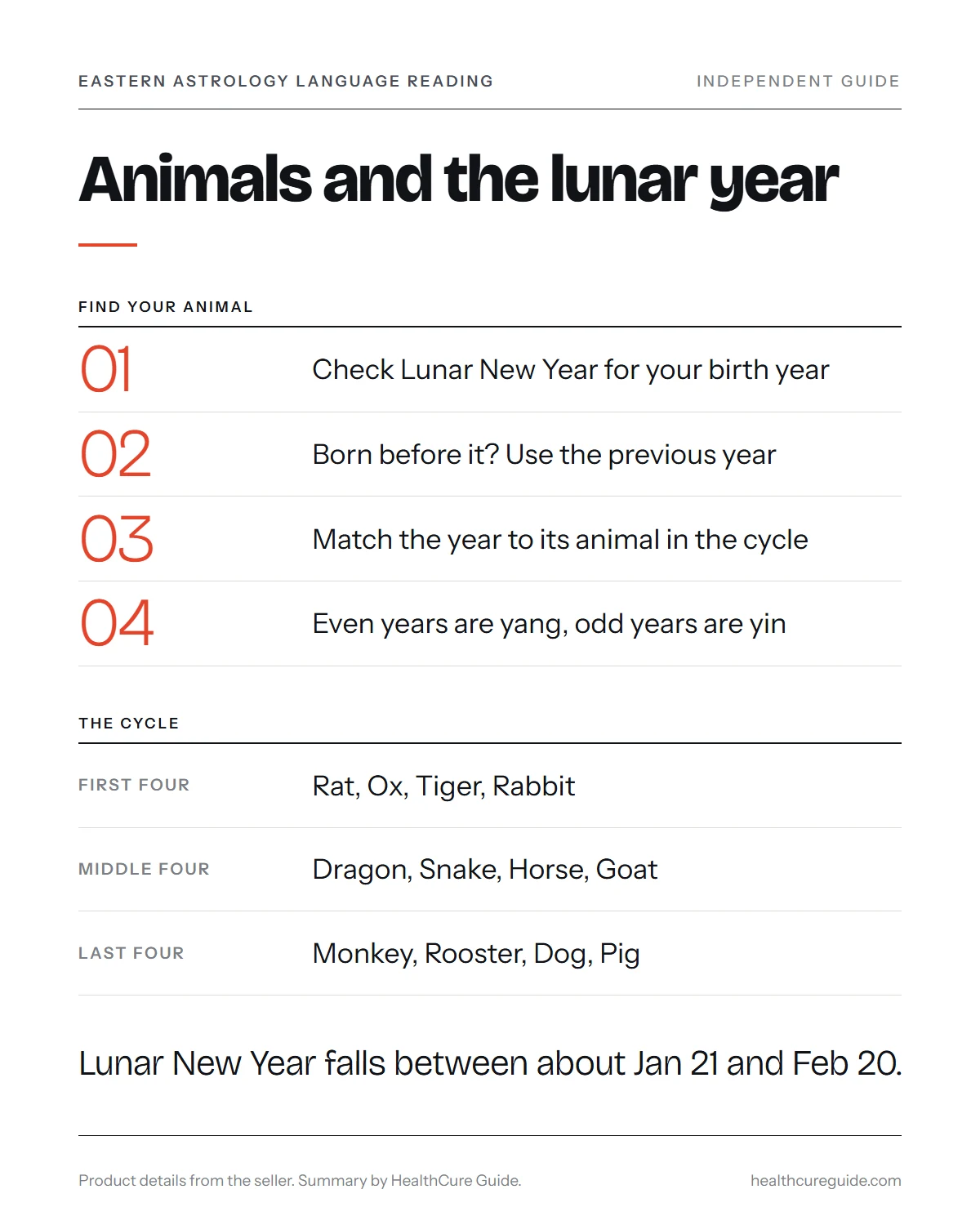
The Chinese zodiac has 12 animals. They follow a fixed order: Rat, Ox, Tiger and Rabbit come first, then Dragon, Snake, Horse and Goat follow, and the cycle closes with Monkey, Rooster, Dog and Pig. Once the Pig year ends, the whole sequence begins afresh at the Rat.
A popular legend explains the order as the result of a race organized by the Jade Emperor, with the Rat arriving first. Whether or not you love the story, it is a charming way to remember the sequence.
Every animal has traditional associations, such as the Dragon with ambition or the Rabbit with gentleness. People like to compare them with friends and family, which is where much of the fun begins.
The lunar year: why January 1 does not decide your sign
This is the part that surprises most beginners. The Chinese year starts at Lunar New Year, not on January 1. The date moves each year, landing anywhere between about January 21 and February 20.
So if you were born in January or early February, you might belong to the animal of the previous year. For example, someone born in January 2000, before Lunar New Year that February, would be counted in the year 1999.
A handy habit: look up the Lunar New Year date for your birth year first, then pick your animal.
The five elements
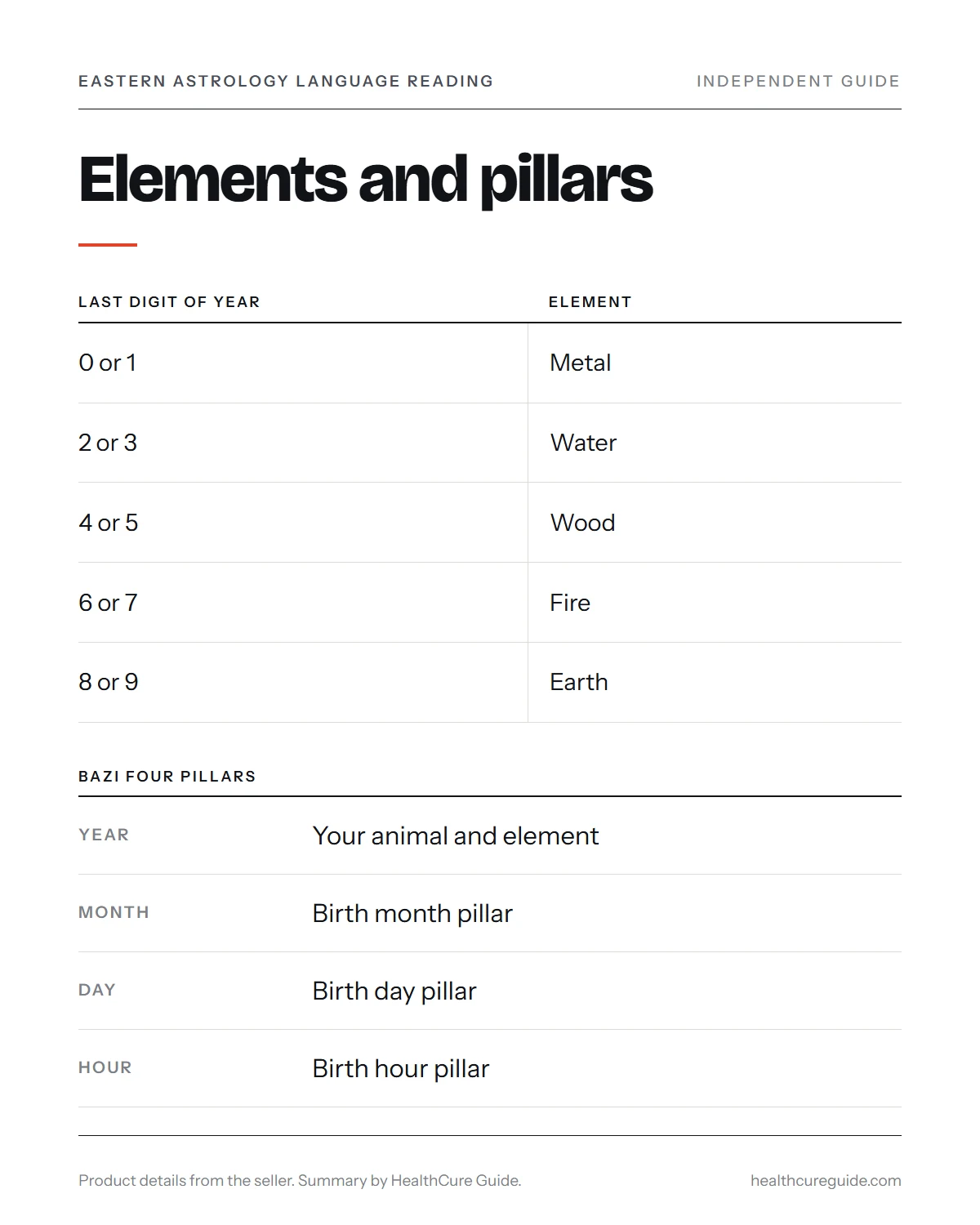
Each year also has a partner to its animal, one of the five elements: Wood, Fire, Earth, Metal or Water. In the tradition, the element adds a flavor to the animal, much as a seasoning changes a dish. The element comes from the last digit of the year.
| Last digit of the year | Element |
|---|---|
| 0 or 1 | Metal |
| 2 or 3 | Water |
| 4 or 5 | Wood |
| 6 or 7 | Fire |
| 8 or 9 | Earth |
Remember to use the lunar year here as well. A person born in January before Lunar New Year takes the element of the earlier year too.
Yin and yang
Yin and yang describe two complementary qualities that appear throughout Chinese thought. Years alternate between them: even-numbered years are yang and odd-numbered years are yin. Tradition links yang to outward, active energy, and yin to inward, receptive energy.
Combine animal, element and polarity and you get descriptions such as “Yang Fire Horse”. It reads like a short poem about a person, and many people love that part of it.
The 60-year cycle
Twelve animals multiplied by five elements gives 60 combinations, and that is why the traditional cycle runs for 60 years. A Wood Dragon year comes round only once in each cycle. This is also why people sometimes speak of a 60th birthday as a “return” to the year of birth, a milestone in many Chinese families.
BaZi: your chart is bigger than your year
Here is where Eastern astrology becomes personal. BaZi, which means “eight characters”, is built from four pillars: the year, month, day and hour of birth. Each pillar has its own animal and element, so a full chart has several layers.
| Pillar | Based on | Often discussed for |
|---|---|---|
| Year | Your birth year | Public image, family background |
| Month | Your birth month | Career and growing up |
| Day | Your birth day | The self and close relationships |
| Hour | Your birth hour | Later life and inner hopes |
These labels reflect traditional readings, and different teachers emphasize different things. The main point is that your zodiac animal is only the first pillar of a much larger picture.
How to find your animal and element
You can do it yourself in four steps.
- Check Lunar New Year for your birth year and decide which lunar year you belong to.
- Look up the animal for that year in the 12-animal cycle.
- Use the last digit of that year to find the element in the table above.
- Note the polarity: even is yang, odd is yin.
For example, 1990 was a Metal Horse year: the last digit 0 gives Metal, and 1990 sits on the Horse in the cycle. Try your own and see whether it feels like a fit.
Common beginner mix-ups
A few small stumbling blocks catch almost everyone at first. Knowing them saves a lot of confusion.
- “I was born in January, so I am this year’s animal.” Not necessarily. If your birthday fell before Lunar New Year, you belong to the earlier lunar year.
- “My element is the same as my animal.” The animal and the element are two separate labels. A Dragon can be Wood, Fire, Earth, Metal or Water, depending on the year.
- “The zodiac is only about the year.” The year is the best-known part. A full BaZi chart also looks at the month, day and hour.
- “Yin means bad and yang means good.” Neither is better. They describe two complementary qualities, like day and night.
- “My sign decides my fate.” Most people treat it as a lens for reflection and fun, not as a verdict.
Eastern astrology in everyday culture
Part of the charm of this tradition is how visible it is. Lunar New Year is celebrated with family gatherings, shared meals and red envelopes, and each year is greeted by the name of its animal. Many families know at a glance which animal each relative belongs to, and the years of the animals appear on calendars, greeting cards and decorations.
Tradition also holds that your own animal year, which comes round every twelve years, deserves special care, and some people wear something red to mark it. Whether or not you follow customs like that, they show how naturally the zodiac fits into everyday life in many communities.
How people use Eastern astrology
Most readers are not looking for a prediction. They enjoy it in a few popular ways:
- As a conversation starter at family gatherings and around Lunar New Year.
- As a reflection tool, using a chart’s themes to think about goals, relationships and timing.
- As a gift, because a reading based on a birth date feels personal.
- As cultural curiosity, exploring a tradition that shapes festivals and naming in many communities.
Seen this way, it is a lovely hobby that rewards curiosity. Keep your own judgment in charge and use it for inspiration.
Getting a reading made for you
Looking up your sign takes two minutes. A personal chart goes deeper by working through all four pillars, your element and the topics people ask about most, from money to romance to timing.
If you would like one, the Eastern Astrology Language Reading is a popular option. It opens with a free 9-question quiz (name, email and date of birth), shows a short reading, and then offers the full chart. The seller describes the chart as 50+ pages. Essential costs $19 and VIP costs $47, with three bonuses, 12-hour delivery and priority support. A 60-day money-back guarantee backs both.
Want a closer look first? Read our guide to the paid chart in detail, our step-by-step look at the quiz, or our full review.
Good to know:
- Eastern astrology is a cultural tradition, and readings are offered for entertainment and personal reflection.
- Software and astrological calculations sit behind the seller’s readings, which it presents as entertainment and a nudge toward reflection.
- A chart cannot promise a result, so use it as inspiration alongside sensible real-world choices.
Quick reference to save
If you only remember a few things from this guide, make them these:
- The zodiac has 12 animals, and each year belongs to one of them.
- The year begins at Lunar New Year, so early-year birthdays need a double check.
- Each year also has one of five elements, set by the last digit.
- Even years are yang and odd years are yin.
- A full chart, called BaZi, uses four pillars, not just the year.
- It is a tradition to enjoy and reflect on, not a science or a promise.
Screenshot that list, send it to a friend, and you will have started a very good dinner conversation.
Where to go next
Now that you know the animals, the elements and the lunar year, your own birth date is a fun puzzle to solve. Look up your sign tonight, share it with a friend, and see how the description lands. If you want to go further, a full chart is only a short quiz away.
Common questions
What is Eastern astrology in simple terms?
It is the traditional Chinese system of reading a birth date through zodiac animals, five elements, yin and yang, and the four pillars of year, month, day and hour. Where Western astrology centers on sun signs and planets, Eastern astrology works on a repeating cycle of years. People enjoy it as a cultural tradition and a prompt for reflection.
How do I find my Chinese zodiac animal?
Look up the animal for your birth year, but check the date of Lunar New Year in that year first. If you were born before it, your animal belongs to the previous year. Lunar New Year falls between about January 21 and February 20, so January and early February birthdays are the ones to double-check.
Does the Chinese zodiac year start on January 1?
No. The traditional year begins at Lunar New Year, which moves each year within a window between late January and mid February. That is why two people born in the same January can have different animals. Always compare your birth date with the Lunar New Year date before you decide on your sign.
What are the five elements in Chinese astrology?
They are Wood, Fire, Earth, Metal and Water. Each year carries one of them in addition to its animal, so you can be a Wood Dragon or a Fire Horse, for example. Tradition says the element adds a flavor to your animal's character, which is why two people with the same animal can feel quite different.
What do yin and yang mean for my sign?
Years alternate between yang and yin. Even-numbered years such as 2024 are yang, and odd-numbered years such as 2025 are yin. Tradition describes yang as outward and active, and yin as inward and receptive. Treat it as a poetic way to describe tendencies, not as a rule that fixes how you must behave.
What does BaZi add beyond my zodiac animal?
Your animal comes from the year pillar alone. BaZi, meaning eight characters, adds the month, day and hour pillars, each with its own animal and element. The result is a fuller picture than a single sign and gives a chart reader far more to discuss. Many people find that layered view the most interesting part.
Where can I get my own Eastern Astrology Language Reading?
One option is the Eastern Astrology Language Reading. It begins with a free 9-question quiz and a short reading, then offers a 50+ page chart from $19 that the seller describes as built from your birth date. A 60-day money-back guarantee applies through the seller's Terms and ClickBank.