Eastern vs Western Astrology and the Eastern Astrology Language Reading
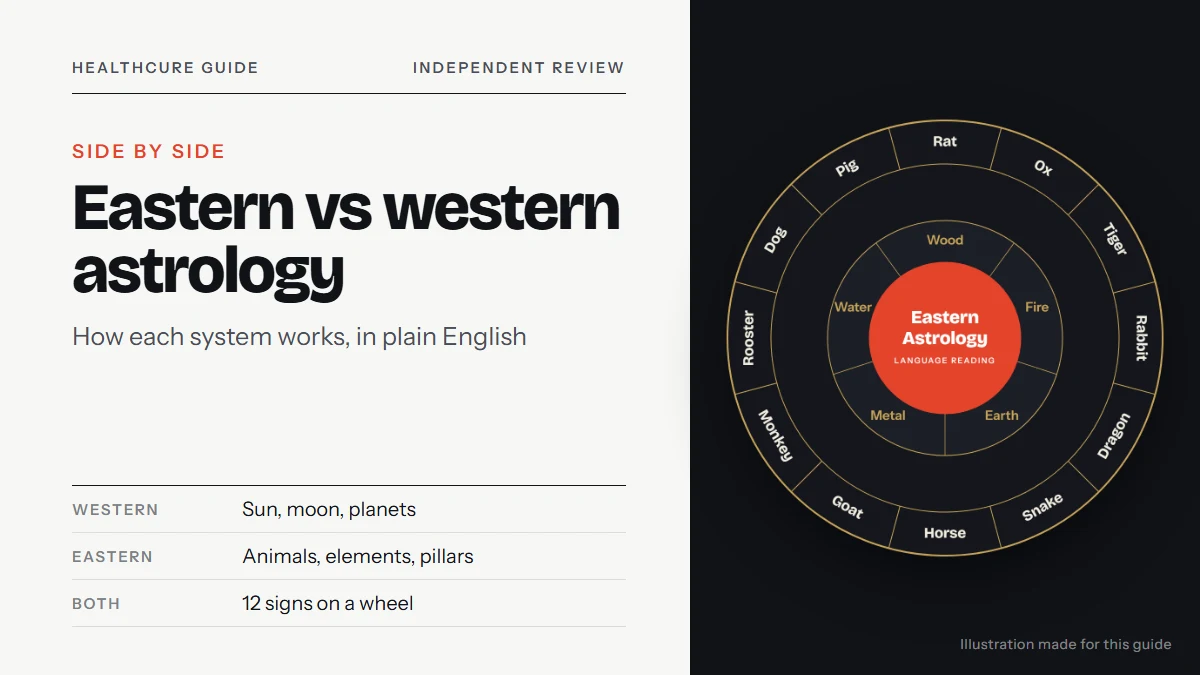
One system sorts people by birth year into twelve animals and five elements. The other tracks the sun, moon and planets through twelve signs. Here is how each one is built, in plain English, with a side-by-side table.
- Written by
- HealthCure Guide Editorial Team
- Reviewed by
- HealthCure Guide Editorial Team
- Updated
- Reading time
- 10 min read
This guide contains affiliate links. If you buy through them we earn a commission at no extra cost to you. It does not change the verdict. Disclosure.
If you have ever known your sun sign for years and then wondered what animal you are in the Chinese zodiac, you have already met the two big systems. Eastern vs western astrology is a favorite question because the two look similar from far away, twelve signs on a wheel, and turn out to be built on very different ideas. It also helps to know where a personal chart such as the Eastern Astrology Language Reading fits.
This guide walks through how each one works, where they overlap, and what each asks from you when you want a chart. If you want to jump straight to your Eastern side, the Eastern Astrology Language Reading quiz is linked below.
Eastern vs western astrology at a glance
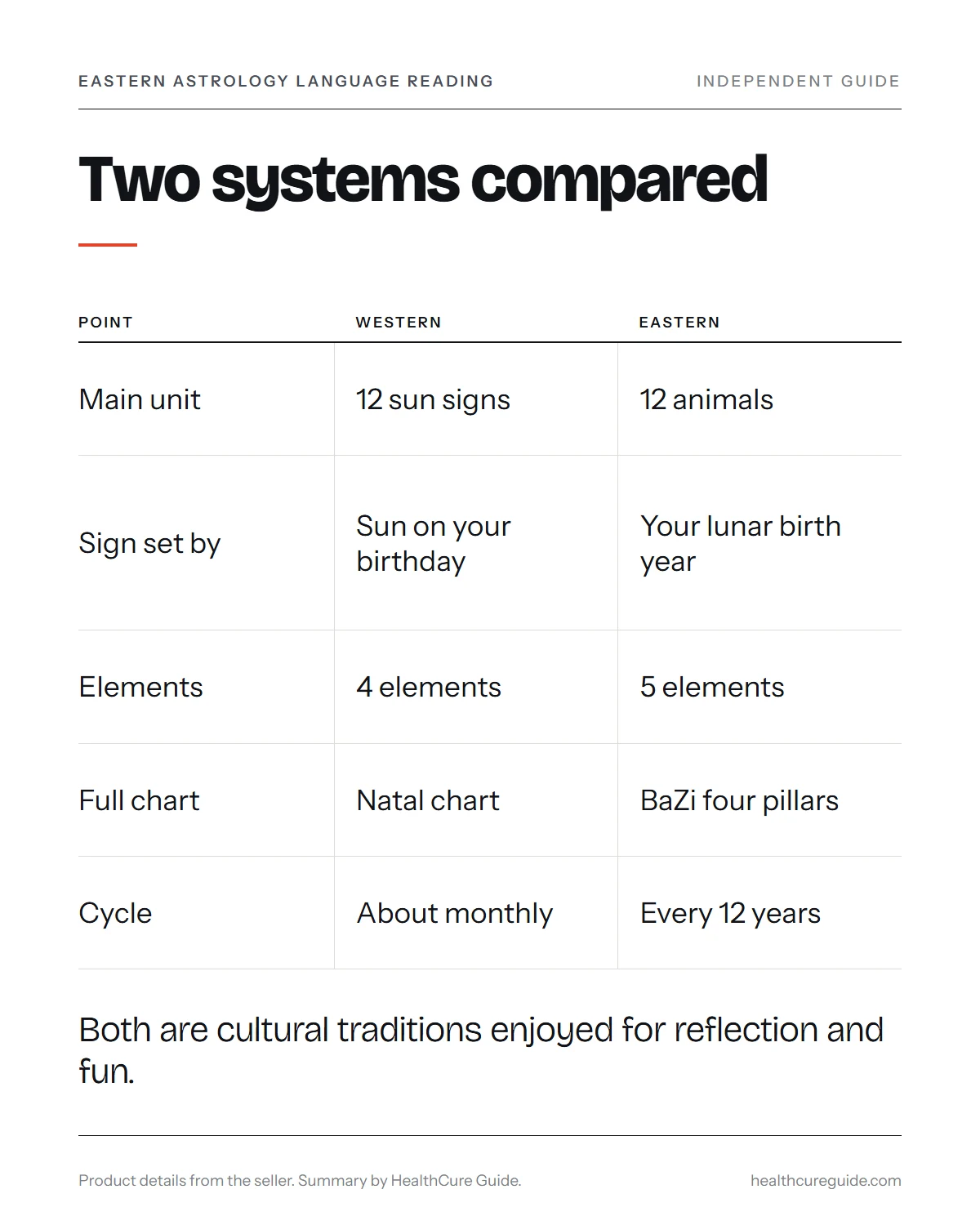
| Feature | Western astrology | Eastern (Chinese) astrology |
|---|---|---|
| Main unit | 12 sun signs, from Aries to Pisces | 12 animals, from Rat to Pig |
| What picks your sign | Where the sun was on your birth date | Your birth year in the lunar calendar |
| Time cycle | The sign changes about monthly | The animal changes yearly, repeating every 12 years |
| Elements | Four: Fire, Earth, Air, Water | Five: Wood, Fire, Earth, Metal, Water |
| Polarity | Signs are grouped as active or receptive | Yin and yang run through years and pillars |
| Full chart | Natal chart with planets, houses and a rising sign | BaZi chart with four pillars: year, month, day, hour |
| Data needed | Date, exact time and birthplace for a full chart | Date for the basics, time for the hour pillar |
| Typical use | Daily horoscopes, personality talk, timing | Yearly forecasts, family traits, festive customs |
The rest of this post takes each row and gives it a little room.
Two traditions with different roots
Western astrology grew out of ancient Mesopotamian sky-watching and was shaped for centuries by Greek, Roman and later European and Arabic scholars. Its focus has always been the sky: where the sun, moon and visible planets sit against the zodiac belt at a given moment.
Chinese astrology developed in a different setting, alongside a calendar that tracks both the moon and the sun. Its focus is the pattern of time itself, with animals, elements and yin and yang repeating in cycles. Over the centuries, the animal signs became part of everyday culture: family conversations, festivals and sayings.
Neither tradition grew out of the other. That is why they feel so different, even though both use a wheel of twelve.
How Western astrology works
Your sun sign is the one most people know, and it depends on your birthday. Aries begins around March 21, Taurus around April 20, and so on through the year, with the exact change dates shifting slightly from one year to the next.
A full Western birth chart, called a natal chart, goes much further:
- Planets. The Sun, Moon, Mercury, Venus, Mars, Jupiter and Saturn, plus Uranus, Neptune and Pluto in modern practice, each placed in a sign.
- The rising sign. The sign on the horizon at the moment and place of your birth, which is why the time matters.
- Houses. Twelve areas of life, such as home, work and relationships.
- Aspects. Angles between planets, such as trines, squares and oppositions, that astrologers read as relationships between themes.
That is why two Leos can read quite differently once the moon and rising sign are added.
How Eastern astrology works
Eastern astrology, in its Chinese form, works from time. The most famous layer is the zodiac animal, assigned by birth year and repeating every twelve years. Everyone born in the same lunar year shares it.
On top of the animal sit more layers:
- Five elements. Wood, Fire, Earth, Metal and Water, assigned across years in pairs.
- Yin and yang. Each year is either one or the other, so the same animal and element combine in different flavors.
- The 60-year cycle. Twelve animals combined with the elements and yin-yang cycle through a full round of sixty years.
- BaZi, the four pillars. A chart for the year, month, day and hour of birth. The name means “eight characters”, because each pillar has two.
So a person might be called a Wood Dragon or a Metal Horse, which is already a richer label than the animal alone.
The calendar behind each system
The deepest difference may be the calendar. Western signs follow the sun through the seasons, so they line up with months. If you were born in late March, you are an Aries, no matter what year it is.
Eastern astrology uses a lunar-solar calendar. The new year arrives with Lunar New Year, which lands on a new moon between about January 21 and February 20. That is why a January birthday can still belong to the previous animal. Some BaZi practitioners also use the solar term “Start of Spring”, around February 4, to mark the year pillar, so two methods may give a different answer for people born in that short window. When it matters to you, check your exact date against a chart.
Two birthdays, side by side
Here is how the same two people look in each system.
| Born March 3, 1995 | Born January 10, 1995 | |
|---|---|---|
| Western sun sign | Pisces | Capricorn |
| Chinese year | Lunar New Year was January 31, 1995, so the Pig year had begun | The Dog year had not yet ended |
| Chinese animal and element | Wood Pig | Wood Dog |
| Lesson | The date came after the Eastern new year, so the year’s own animal applies | The date came before the Eastern new year, so the previous animal applies |
The January example shows why Eastern astrology asks you to check one extra date. Born ten weeks apart in the same calendar year, these two people belong to different animals.
What each chart needs from you
For the basics, both systems are friendly.
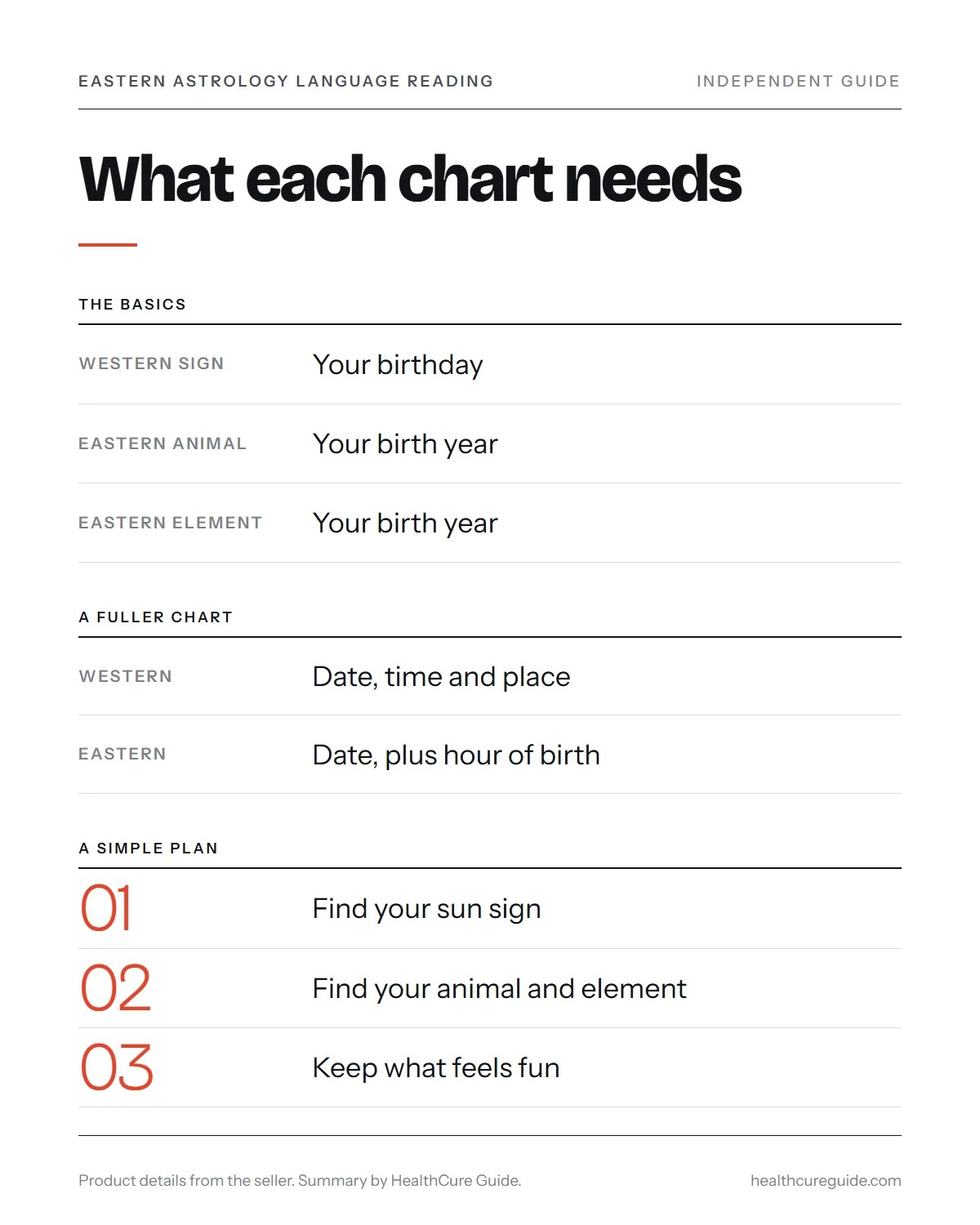
- Western basics: your birthday gives your sun sign.
- Eastern basics: your birth year, with the Lunar New Year check, gives your animal and element.
For the full chart, expect to need more.
- Western full chart: birth date, time and place.
- Eastern full chart: birth date, plus the hour if the chart includes the hour pillar.
Many people start with the basics for both and add depth later, which leads naturally to what a personalized report can add.
Four elements or five?
Both traditions use elements, but they do different jobs.
| Western elements | Chinese elements | |
|---|---|---|
| List | Fire, Earth, Air, Water | Wood, Fire, Earth, Metal, Water |
| Attached to | Signs (three signs per element) | Years, months, days, hours and pillars |
| Role | Describe a sign’s temperament | Describe cycles of feeding and restraining |
| Example | Aries, Leo and Sagittarius are Fire signs | 2024 was a Wood year, 2026 is a Fire year |
In short, a Western element tells you about the sign’s flavor, while a Chinese element tells you about the quality of a stretch of time.
Fixed snapshots or moving cycles
Western astrology often pairs a birth chart with the sky as it moves now. Astrologers talk about planets “in transit” over your natal chart, and many daily horoscopes come from that idea.
Eastern astrology tends to talk in cycles. Each year has an animal and an element. People look at how their own animal relates to the year’s animal, which is where ideas like clash years and lucky years appear. If you like the idea of looking ahead at a year in advance, this is a popular entry point.
Common mix-ups to avoid
A few misunderstandings come up again and again when people compare the two.
- “My Chinese sign is my month.” It is not. The Chinese animal comes from the year, while the Western sign comes from the date within the year.
- “The elements match.” Western Fire and Chinese Fire share a word, not a meaning.
- “January 1 starts the Chinese year.” It does not. Lunar New Year does.
- “One is the ancient system and the other is the modern copy.” Both are old, and both grew separately.
Clearing these up makes comparing the two much more fun, and it helps you read descriptions of each sign with the right frame.
Where a personalized Eastern chart fits in
Finding your animal and element takes a minute. A fuller chart is where people often look for help. On its order page, the Eastern Astrology Language Reading appears as a personalized report of 50+ pages drawn from your birth date. It is said to cover your animal, your element and your BaZi pillars, along with themes such as money, romance and lucky days.
The path is quiz first, then a choice of two packages. For a closer look at both, see the post on what the chart covers.
| Package | Price | What you receive, per the seller |
|---|---|---|
| Essential Reading | $19 | The full chart by email, usually within 48-72 hours; optional extras appear at checkout |
| VIP Reading | $47 (shown beside a crossed-out $97) | The Essential chart plus three bonuses, a 12-hour delivery promise and priority support |
VIP buyers also receive three extras: an energy clearing kit, a compatibility map for soulmate questions and a morning energy audio. The seller attaches worth-figures of $67, $47 and $33 to them, which are its own valuations.
The reassuring part is the 60-day money-back guarantee. Try the chart for a while, and if it turns out not to suit you, a refund request within 60 days of purchase is what the seller’s Terms and the ClickBank checkout allow.
Which should you start with?
You do not have to choose one forever. A simple plan:
- Look up your sun sign if you do not know it, and keep your birth time handy.
- Take the quiz to see your animal and element.
- Compare what resonates, and keep what is fun.
Treat both as lenses for thinking about yourself, not as rulebooks.
Good to know
- Per the seller’s disclaimer, the readings are built with software and astrological calculations and are offered as entertainment and for personal reflection. See also our site disclaimer.
- The quiz asks for your full date of birth and an email address. Uncheck the pre-selected newsletter box if you prefer.
- Treat astrology as a cultural tradition, not as a source for health, legal or financial decisions.
Related reading
Common questions
What is the main difference between Eastern and Western astrology?
Western astrology centers on the positions of the sun, moon and planets at your birth, sorted into twelve sun signs by date. Eastern astrology centers on the year, month, day and hour of birth, expressed as animals, elements and yin and yang. One tracks the sky in detail, the other works with repeating cycles of time.
Do the two systems use the same twelve signs?
No. Both happen to use twelve, but the signs are different and are assigned differently. Western signs follow the sun through the year, roughly one per month. Eastern animals follow a twelve-year cycle, so everyone born in the same lunar year shares an animal. The matching number is a coincidence.
Why does Eastern astrology have five elements while Western has four?
Western tradition uses Fire, Earth, Air and Water. The Chinese system uses Wood, Fire, Earth, Metal and Water and describes how they feed and restrain one another in cycles. They come from different traditions of thought, so they are not meant to line up one for one.
Which system needs my birth time?
Western charts need birth time and place to find your rising sign and house layout. A full Eastern BaZi chart uses the hour of birth as the fourth pillar. Both can still give you a basic sign from the date alone: a sun sign in the West, and a year animal and element in the East.
Is my Chinese zodiac animal the same if I was born in January?
Maybe not. The Chinese year starts at Lunar New Year, between about January 21 and February 20. If your birthday falls before that date, your animal is usually the one from the previous year. Check the Lunar New Year date for your birth year before deciding.
Can I read my Eastern chart myself, or do I need a report?
You can find your animal and element yourself from a year chart, and that is a nice start. A fuller chart with pillars and themes is easier with a personalized report. The seller of the Eastern Astrology Language Reading describes a 50+ page chart built from your birth date, which many people use for a fuller picture.
What happens when I take the seller's quiz?
You answer nine short questions in roughly a minute, giving a first name, an email address and your full birth date. A brief free reading appears, followed by the paid options. The newsletter checkbox is selected in advance, so deselect it if you would rather not receive the seller's emails.
What is the refund policy on the Eastern Astrology Language Reading?
The seller's Terms and the ClickBank checkout both describe 60 days. Inside that period you can ask for your money back through ClickBank or by emailing the seller's support. Because ClickBank handles the payment, your total may include local tax or a different currency.