Glucotide Ingredients: The Full Label, Line by Line, in Plain English
Seven nutrients, a 12-ingredient blend and four capsule ingredients. Here is everything printed on the Glucotide label, and why the seller's page shows a shorter list.
- Written by
- HealthCure Guide Editorial Team
- Reviewed by
- HealthCure Guide Editorial Team
- Updated
- Reading time
- 8 min read
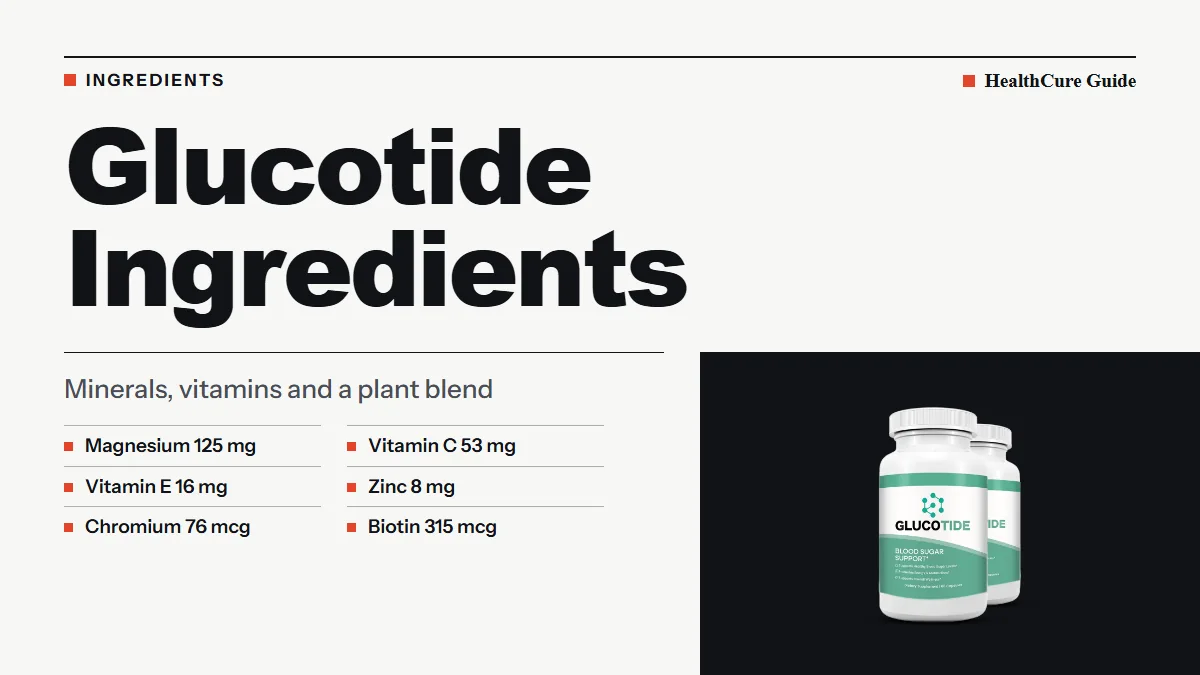
A good supplement label does not hide behind slogans. Glucotide prints its amounts, and that makes it a pleasure to explain. If you are comparing formulas, this page walks through the Glucotide ingredients, every line of the Supplement Facts panel, tells you what each ingredient is generally known for, and points out one detail that surprises many shoppers: the seller’s page and the bottle do not list quite the same things.
For the wider overview of the capsule, visit our Glucotide hub.
Glucotide ingredients: the Supplement Facts panel
One serving is two capsules, and the 60 capsules in a bottle make 30 servings.
| Nutrient or blend | In one serving |
|---|---|
| Magnesium (as oxide) | 125 mg |
| Chromium (as amino acid chelate) | 76 mcg |
| Biotin | 315 mcg |
| Vitamin C | 53 mg |
| Zinc (as oxide) | 8 mg |
| Vitamin E | 16 mg |
| Manganese (as sulfate) | 1 mg |
| Proprietary blend | 82 mg in total |
Inside the blend, in alphabetical order, you will find alpha lipoic acid, banaba leaf extract, bitter melon fruit extract, cayenne pepper, cinnamon bark, guggul gum resin, gymnema sylvestre leaf, juniper berry, licorice root extract, taurine, white mulberry leaf and yarrow flower.
Everything else on the label is structural: microcrystalline cellulose, the gelatin that forms the capsule shell, magnesium stearate and silicon dioxide.
Six highlighted, more on the label
Here is the detail worth knowing. The seller’s page spotlights six nutrients: chromium, magnesium, zinc, biotin, vitamin C and vitamin E. The Supplement Facts panel goes a step further and adds manganese and the plant blend. Neither list is wrong; one is the short version for the sales page and the other is the full Supplement Facts panel. When you compare Glucotide with another product, use the label, because it is the complete picture.
The vitamins and minerals
These are the nutrients with a stated amount each, and the roles below are general ones, not promises.
- Magnesium, 125 mg. The largest single line on the panel. The mineral is involved in how cells make energy and handle glucose, a big reason it turns up in many blood sugar formulas.
- Chromium, 76 mcg. A trace mineral that is studied for its link with glucose metabolism. Here it comes as an amino acid chelate.
- Zinc, 8 mg. Involved in normal metabolism and immune function.
- Manganese, 1 mg. A trace mineral that supports a range of enzyme activity in the body.
- Vitamins C (53 mg) and E (16 mg). A pair of familiar antioxidant vitamins associated with general wellness.
- Biotin, 315 mcg. A B vitamin that helps the body turn food into usable energy.
What sits in the blend
The blend totals 82 mg per serving. The label does not split that figure by plant, and we will not invent amounts. What we can do is describe what each ingredient is known for, using general, attributed language.
- Cinnamon bark. A kitchen spice that researchers have looked at in relation to glucose handling.
- Bitter melon fruit extract. A fruit used in traditional cooking and herbal practice; researchers have examined it for glucose support.
- Gymnema sylvestre leaf. A climbing plant with a long history in traditional herbal use, and another that researchers have looked at for glucose support.
- Banaba leaf extract. Taken from a tropical tree and often included in blood sugar formulas.
- White mulberry leaf. A traditional leaf ingredient, also found in supplements built for glucose metabolism.
- Alpha lipoic acid. A compound the body makes in small amounts, known as an antioxidant.
- Taurine. An amino-acid-like compound found in many foods.
- Licorice root extract. A well-known botanical, and the one that comes with a caution (see below).
- Guggul gum resin, juniper berry, cayenne pepper and yarrow flower. Four more botanicals with long histories in herbal practice.
Reading this list as a whole, the seller’s design is easy to see: minerals and vitamins as the foundation, and a wide spread of plants with traditional ties to glucose metabolism and energy.
Why this formula is built the way it is
Many people want a routine covering several bases at once instead of juggling separate bottles. Glucotide goes for breadth: minerals that take part in glucose metabolism, antioxidant vitamins, and a plant blend with the ingredients most often discussed in this area. Because everything arrives in a pair of capsules, the daily habit stays short.
At breakfast or lunch, have your two capsules with a meal and 8 oz of water, and a bottle lasts 30 days. On cost, the six-bottle order at $49 a bottle comes to about $1.63 a day ($49 divided by 30). Our price guide lays out the other packages, and the product hub has the rest of the story.
How to read a proprietary blend
A proprietary blend lists the ingredients in the mix and the combined weight, but not the weight of each one. That is common on supplement labels, and it is the case here: 82 mg in total, shared among twelve ingredients. Two practical points follow.
First, you can still see exactly which ingredients are in the blend, and that is what matters for allergies, personal preferences and conversations with your doctor. Second, you can see the amounts of every vitamin and mineral outside the blend, and those are printed to the milligram or microgram. Anyone comparing formulas can line up those seven figures directly.
What a day with Glucotide looks like
The directions are brief. Pick breakfast or lunch, swallow two capsules alongside your meal with 8 oz of water, and you are finished. The serving delivers the figures in the table above, a bottle lasts 30 days, and the three or six bottle packages stretch that to 90 or 180.
As the capsules join a meal, the habit hooks onto something you already do. Many people find that is the difference between a supplement they buy and a supplement they actually keep taking. If you would like to see how the cost works out per day, six bottles come to about $1.63 and three bottles to about $2.30.
Questions about the label
Where do the numbers come from? From the Supplement Facts panel as the seller publishes it. Check them against your own bottle when it arrives, and contact support if anything looks different.
Why are taurine and alpha lipoic acid listed with the plants? They sit in the same proprietary blend as the botanicals, so we describe them together, even though they are not plants.
Is the formula aimed at adults? Yes. The seller asks anyone under 18 to show the label to a doctor first.
Does it contain gelatin? Yes, the capsule shell is gelatin, so it is not a vegetarian product.
Can I compare it with another formula? Yes, line by line. Our main review shows how we weigh a label like this one.
A calm safety note
Glucotide is a supplement and never a stand-in for something your doctor prescribed. Stay on your prescribed medicines. Before you begin, check with your doctor, above all if diabetes medicines are on your list: cinnamon, gymnema, bitter melon and chromium have all been studied for glucose support, so they could add to those medicines. Licorice can affect blood pressure, which is worth mentioning if that is a concern for you. The seller also wants a doctor to see the label first when someone is pregnant, nursing, under 18 or living with a medical condition. Our safety page covers the cautions in one place.
Good to know:
- Take the label to your doctor or pharmacist so they can check it against your medicines.
- According to the seller, the capsules are produced in the USA, in an FDA-registered facility, using naturally derived ingredients.
- Individual results differ.
Common questions
What are the Glucotide ingredients?
Per two capsules: vitamin C 53 mg, vitamin E 16 mg, biotin 315 mcg, magnesium 125 mg, zinc 8 mg, manganese 1 mg, chromium 76 mcg and a proprietary blend of 82 mg in total that contains 12 plant and nutrient ingredients.
Why does the seller's page list fewer ingredients than the label?
The seller's page highlights six nutrients: magnesium, vitamin C, vitamin E, zinc, chromium and biotin. The label also lists manganese and the plant blend, so the label is the complete list.
How much of each plant is in the blend?
The label gives one total of 82 mg for the whole blend and does not state an amount for each plant. We do not guess at figures the label does not print.
What is in the capsule besides the actives?
Microcrystalline cellulose, gelatin (the capsule shell), magnesium stearate and silicon dioxide. Because of the gelatin, it does not suit vegetarians.
Is Glucotide safe with my medicines?
Keep taking everything your doctor prescribed and ask your doctor first, especially if you use diabetes medicines. Chromium, bitter melon, gymnema and cinnamon are studied for glucose support and may add to them, and licorice can affect blood pressure.
How do I take it?
Two capsules a day with food and an 8 oz glass of water, at breakfast or lunch. A bottle has 60 capsules, which is 30 servings.