GRS Ultra Ingredients: The Three Named Components and What Is Not Published
Three named components, no published amounts and a bottle that carries the full panel. Here is what the brand names, what we can and cannot tell you and what to bring to your pharmacist.
- Written by
- HealthCure Guide Editorial Team
- Reviewed by
- HealthCure Guide Editorial Team
- Updated
- Reading time
- 8 min read
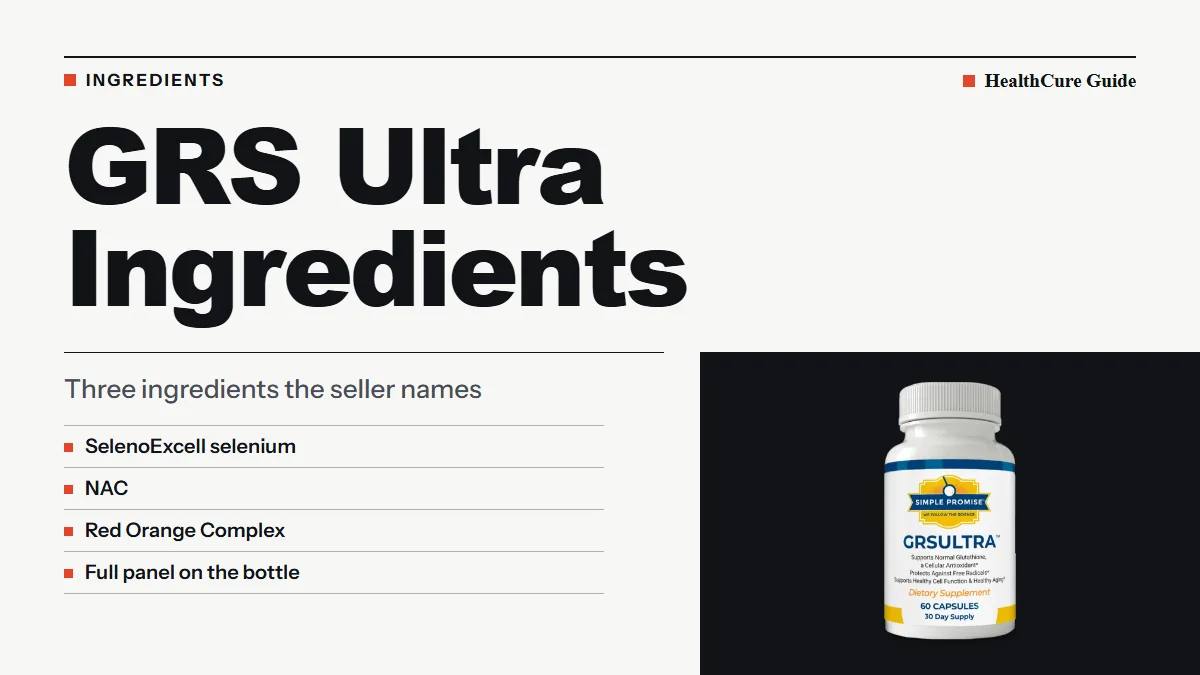
GRS Ultra ingredients are unusually easy to pin down, because the brand names each component it highlights. That gives you a concrete list to carry into a pharmacy. The brand’s central message is that the capsule supports your body’s own glutathione, a cellular antioxidant, and the three named components are the ones it puts forward for that job. This page explains each name, what the brand does and does not publish and which questions to take to a professional. For the broader product, the GRS Ultra hub is the right next stop.
GRS Ultra ingredients, one by one
| Component | Brand’s description | Plain-language note |
|---|---|---|
| SelenoExcell selenium | A branded selenium ingredient | Selenium is a trace mineral; this is the brand’s proprietary form |
| N-acetyl-cysteine (NAC) | Listed as a standalone component | A derivative of the amino acid cysteine |
| Red Orange Complex (ROC) | A branded blood-orange extract | Sourced, per the brand, from Moro, Tarocco and Sanguinello oranges |
Our notes describe what each item is, not what it accomplishes. We attach no benefit to any of them, because the material we reviewed offers no benefit we could verify.
What is published, and what is missing
The brand publishes the three names. It does not publish amounts on the pages we read. No milligram or microgram figure appears beside any component, and the marketing graphics include no Supplement Facts panel. The brand says the complete panel is printed on the bottle you receive, which makes that label the document to rely on. We have not held one of those bottles, so we cannot describe its layout. Once it arrives, read the panel and bring any question you have to support.
The GRS Ultra ingredients page in our product hub repeats the three names with the same caveat about amounts.
Amounts matter because two products that list the same names can still differ in strength. A list of names cannot reveal which product is stronger, so do not use it as a comparison tool. If the amount question decides your purchase, ask the brand before you order.
Glutathione in plain terms
Glutathione is a compound made by your body, and it is found in many tissues. The bottle states that the capsule supports normal glutathione, a cellular antioxidant. The brand adds that GRS Ultra is not glutathione itself but three nutrients meant to support your body’s own production of it. Those are the brand’s statements, and we report them as such, with no added result.
Reading a Supplement Facts panel on your own
A Supplement Facts panel usually opens with a serving size and the number of servings in the container, then lists each ingredient with its amount per serving and, where one exists, a percent of the daily value. Read it in that order, because the serving size comes first and every amount relates to it. Look for each of the three names. If one of them is missing from the panel, or appears under a different label, ask the brand before the first use. Keep a photo of the panel with your order confirmation so you can compare it later.
Comparing a panel with another product
If another product lists the same ingredient names, compare the panels line by line. Matching names with different amounts are different products, and only the panel can tell you which is which. Names alone rarely settle a comparison, which is why the panel matters more than the list on any marketing page.
Other ingredients: what we did not find
Beyond the three named components, the pages we read list no other ingredients, no allergen statement and no sourcing claim, so we describe none. An allergy or a sensitivity is a reason to read the full panel line by line and to ask a doctor before the first use. If the panel shows a name you do not recognize, pause and ask a pharmacist. For the wider safety picture, our side effects guide covers the questions people ask most often.
What to write down for your pharmacist
Note the brand name, the three component names, the bottle count you bought and the date you began. Then add every medicine, vitamin, herbal tea and other supplement you use, with the amount and the time of day you take each one. Pharmacists check interactions from the full list, so an omission matters more than people expect. If you are pregnant or breastfeeding, say so at the start of the conversation rather than at the end.
Questions for your pharmacist
Bring the three names and your current medicine list to the counter, and ask the questions that matter for you:
- Do any of the three names interact with medicines already on my list?
- Does a medical condition, pregnancy or breastfeeding change the answer?
- Am I taking a blood thinner or nitroglycerin, and does that change anything?
- What else does the full panel on my bottle list?
Write the answers down and keep them with your confirmation email. Five minutes of conversation now beats guessing later.
Who the formula is for
Adults who want a daily capsule built around glutathione support, and who like to see the components named before buying, will find the brand’s approach clear. The product is intended for adults. Anyone who is pregnant, nursing, taking prescribed medicine or facing surgery should speak with a doctor first. For a balanced look at the trade-offs, read our GRS Ultra reviews article, and keep the GRS Ultra hub open beside it for the full product picture.
Putting ingredients next to price
A short ingredient list is one input among several. Price, guarantee and shipping matter too. Six bottles cost $199.95, or $33.33 each, and the guarantee covers every package. Across a thirty-day supply per bottle, the six-pack comes to roughly $1.11 a day. Our GRS Ultra price guide breaks down each pack line by line, which helps you match a pack size to the length of routine you have in mind.
A word on branded names
The brand describes SelenoExcell and Red Orange Complex with branded names rather than plain ingredient terms. Branded ingredients usually come with their own supplier specifications, so the plain name and the brand name are two different things to look up. Use independent sources as a second opinion, and let your pharmacist make the final call on how the names fit your situation.
Short answers
Does the brand publish amounts for the three components? Not on the pages we read. The bottle’s panel is the place to look.
Are caffeine or stimulants part of the formula? The brand’s pages list none, so we do not claim any.
Can the three names alone guide a decision? They are a starting point for a pharmacist conversation, not a complete description of the product.
Do the three names have any known cautions? That is a question for your pharmacist, who can check each name against your medicines and conditions. Our notes above attach no caution and no benefit to any single name.
Good to know: continue all prescribed medicines, check with a doctor or pharmacist before starting, and keep the bottle away from children. On the brand’s disclaimer, its statements were not assessed by the FDA and the product is not meant to diagnose, treat, cure, or prevent any disease.
If you want to check a detail before ordering, the bottle itself is the final word. The seller names SelenoExcell selenium, NAC and its Red Orange Complex on the sales page, and the full Supplement Facts panel, with amounts, is printed on the label. Read it when the parcel arrives, follow the directions printed there, and bring the bottle to your doctor or pharmacist if you take any prescribed medicine.
Common questions
What are the GRS Ultra ingredients?
The brand names three: SelenoExcell selenium, N-acetyl-cysteine (NAC) and Red Orange Complex.
Does the brand publish amounts?
Not on the pages we read. The three names appear with no amounts, and the brand says the full Supplement Facts panel is printed on the bottle.
Where does the Red Orange Complex come from?
According to the brand, it is made from three Sicilian blood oranges: Moro, Tarocco and Sanguinello.
Is glutathione an ingredient?
No. Glutathione is a compound your body makes. The brand says the capsules hold three nutrients that support your body in making it.
Are there other ingredients beyond the three?
The brand's pages list no others, so we do not describe any. The panel on your bottle is the place to check the full list.
Should I ask my pharmacist about the three names?
Yes. Bring the three names and your current medicine list before you begin.