Gut Save Ingredients: Label Amounts, Allergens and Directions
A one-capsule formula that prints an amount for every active ingredient. Here is the panel in plain terms, with the allergens and the doctor lines that go with it.
- Written by
- HealthCure Guide Editorial Team
- Reviewed by
- HealthCure Guide Editorial Team
- Updated
- Reading time
- 7 min read
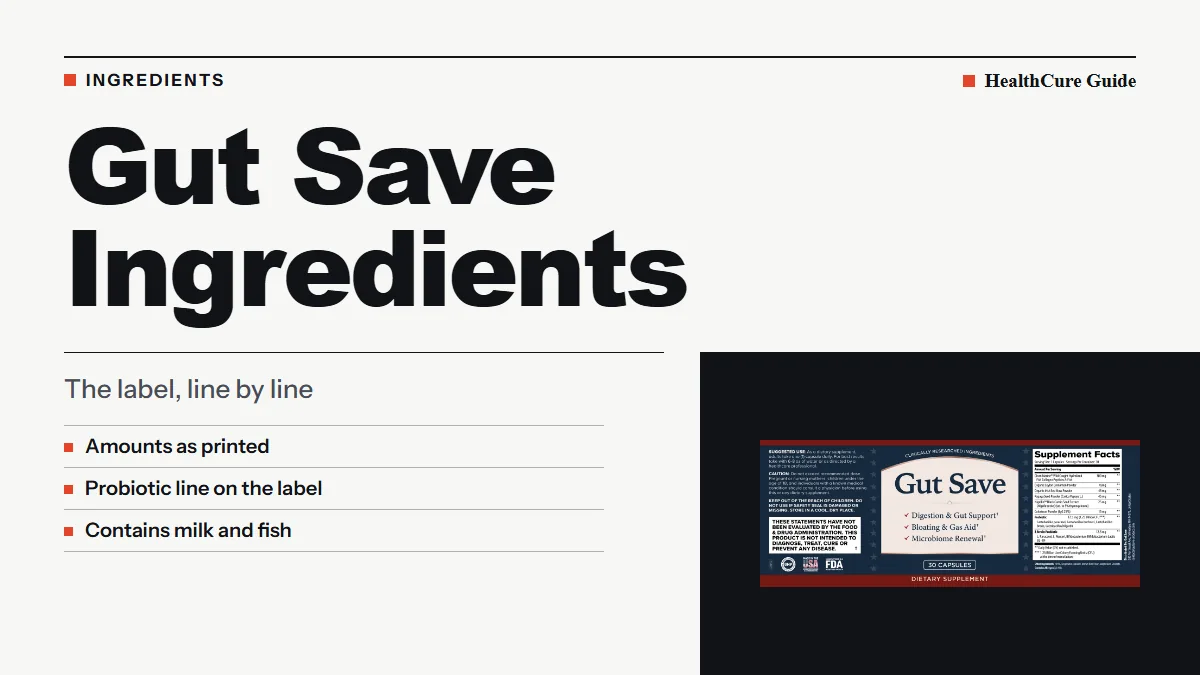
Reading an ingredient list well takes three steps: identify each item, check how much of it sits in one capsule, and note any allergen or medicine caution. Gut Save makes the first two easy, because its printed panel gives an amount for every active ingredient. The table below repeats that panel in shorter form. The Gut Save hub covers the product more broadly.
Gut Save ingredients, amount by amount
| Entry | What it is | Amount |
|---|---|---|
| Fish collagen peptides (wild caught, hydrolyzed) | Collagen broken down into peptides, sourced from wild-caught fish | 300 mg |
| Ceylon cinnamon powder (organic) | Powder made from the bark of Ceylon cinnamon | 45 mg |
| Irish sea moss powder (organic) | Powder made from a sea vegetable | 45 mg |
| Papaya seed powder | Ground seeds of the papaya fruit | 45 mg |
| Black cumin seed extract | Nigella sativa seed extract, set to 5% thymoquinone | 25 mg |
| Colostrum powder (IgG 25%) | Milk-derived powder with IgG at 25% | 15 mg |
| Probiotic, first line | Four Lactobacillus strains, rated at 1.25 billion CFU when made | 12.5 mg |
| Probiotic, second line (3 Strain Probiotic) | Two Lactobacillus strains plus Bifidobacterium lactis BL-04 | 12.5 mg |
The panel describes a serving as one capsule, with 30 servings in each container. It shows no Daily Value, because none has been established for these ingredients.
Reading the panel line by line
Each row names a substance and gives its amount in milligrams. The fish collagen row carries the largest figure at 300 mg. The plant rows and the black cumin extract sit between 25 and 45 mg, the colostrum powder is 15 mg and both probiotic rows are 12.5 mg. Because the milligram column is printed beside every row, you can see the make-up of a capsule at a glance rather than guessing from a list of names. The rows keep the order the panel prints them, so the collagen comes first.
The two probiotic lines
The first line lists four Lactobacillus strains: paracasei, buchneri, brevis and hilgardii. The panel rates it at 1.25 billion CFU when the product is made, and the line carries 12.5 mg.
The second line is headed 3 Strain Probiotic and also lists 12.5 mg. Its strains are two Lactobacillus species, paracasei and reuteri, plus Bifidobacterium lactis BL-04. Lactobacillus paracasei appears on both lines, so together they name six distinct strains. A quick reading can make the two lines look like one, but the panel keeps them apart, and the table above does the same.
What the probiotic count means
CFU stands for colony-forming units, a count of live cells that can grow into colonies under laboratory conditions. The panel gives the count at the time of manufacture, and that is the figure to read. It describes the product when it was made rather than promising the same count on the day you open the bottle.
Other ingredients and allergens
The remaining items are the vegetable capsule (HPMC), brown rice flour and magnesium stearate.
The allergens are direct. The colostrum powder is milk-derived, so the product contains milk, and the collagen comes from fish, so it contains fish. A milk or fish allergy means this product is not the right fit. The allergen line is the one to read first when someone in the household has a food allergy.
The order page’s ingredient list is worded differently from the label, so use the printed panel as your reference. Those other items are listed so you can see every line of the capsule. If your bottle’s wording departs from the table above, email [email protected] before the first capsule.
Directions and the label’s caution
The label asks adults for one capsule daily, taken with 6-8 oz of water or as a health professional directs. The seller’s FAQ favours the morning and a large glass of water, which gives the habit an easy anchor. The label itself leaves the time of day open, so picking a fixed moment, such as breakfast, is a matter of routine rather than a rule.
The label adds its own caution. Stick to the recommended dose. Speak with a physician before use if you are pregnant, nursing, under 18 or living with a known medical condition. Keep the bottle away from children, skip it when the seal is broken or missing, and keep it somewhere cool and dry.
Medicine checks and doctor lines
The seller’s FAQ recommends that anyone with a medical condition, or anyone on prescription medicine, show a doctor the bottle. Keep prescribed medicine on schedule, and never trade it for a capsule.
Cinnamon and black cumin seed may interact with certain drugs, including blood sugar medicines and anticoagulants, so a doctor should look at that pairing before you begin. Probiotics may not suit someone whose immunity is compromised or who is seriously ill, so raise that with your doctor. If an allergy applies, ask a clinician about the milk and fish content.
Identity notes for each row
Collagen peptides are protein fragments, made by breaking collagen into smaller pieces. Cinnamon powder is ground bark, and sea moss powder is ground from a seaweed. Papaya seed powder is ground seed from the fruit, while black cumin extract is a concentrated preparation from Nigella sativa seed. Colostrum is the first milk produced after birth, and the powder is dried from it. The probiotic lines are cultures of named bacterial strains.
Comparing this panel with another
When you set this formula beside another, compare the milligram figures rather than the names. Two labels may spell an ingredient differently, but an amount is easy to line up. Check whether each probiotic count is given at manufacture or on another date, and confirm each allergen line on the bottle you actually hold. A table like the one above is a shortcut only, and the printed panel stays the source.
A checklist for the bottle on your table
- Find the Supplement Facts panel and match it to the table above.
- Confirm the serving is one capsule and the container holds 30.
- Check the allergen wording for milk and fish.
- Read the directions and the caution as they are printed.
- Write down any prescribed medicine you take, and bring that list to your doctor.
If you take more than one prescribed medicine, list each one, since a pharmacist can check the whole set at once. Cautions and warning signs are covered in the safety guide, while the catalog ingredients page mirrors this panel. Readers who want the product’s wider picture can also check the Gut Save reviews.
Serving size and supply
The panel counts one capsule as a serving and counts 30 servings in each container, which matches the 30 capsules in a bottle. A bottle is therefore a 30-day supply at the label’s directions. Six bottles cover 180 days, three cover 90 and two cover 60. The grid’s daily figures simply divide each bottle price across those 30 days. Because no Daily Value has been established, we do not measure these amounts against a daily target. Check that the count printed on your bottle matches the one on the panel, since that is the figure the table reflects.
Why the label is the right reference
A panel that gives an amount for each item lets you check the formula against your own plan, which a bare list cannot do. The capsule is one a day, the directions are short and the allergens are named. Taken together, those details make the six-bottle option our pick, at $49 a bottle and about $1.63 a day, with shipping free within the US. The Gut Save hub has the rest of the product facts.
Good to know:
- The label is the reference for your bottle, so check it when the parcel arrives.
- Milk and fish are both present, so an allergy to either means skipping the product.
- Pregnant, nursing or on prescription medicine? Speak with a doctor before the first capsule.
Common questions
What are the main Gut Save ingredients?
The Supplement Facts panel lists fish collagen peptides, Ceylon cinnamon powder, Irish sea moss powder, papaya seed powder, black cumin seed extract, colostrum powder and two probiotic lines. Each line has its own amount in milligrams.
How much probiotic is in one Gut Save capsule?
The first probiotic line is 12.5 mg and is rated at 1.25 billion CFU when the product is made. The second line, headed 3 Strain Probiotic, is also 12.5 mg.
Does Gut Save contain milk or fish?
Yes. The colostrum powder is milk-derived, and the collagen comes from fish. Anyone with a milk or fish allergy should not take the product.
Why does the order page list ingredients differently from the label?
The order page's ingredient list is worded differently from the label. Use the label printed on your bottle as the reference for what is in each capsule.
How should I take Gut Save?
Adults take one capsule daily. The label asks for 6-8 oz of water or the direction of a health professional, and the seller's FAQ favours the morning.
Can I take Gut Save with prescribed medicine?
Keep taking prescribed medicine as directed and ask a doctor first. Cinnamon and black cumin seed can interact with some medicines, including blood sugar medicines and anticoagulants.
Should pregnant women take Gut Save?
The label asks pregnant or nursing mothers to speak with a physician before use. Ask your doctor before the first capsule.