iGenics Ingredients: Every Label Entry, Its Amount and Its Role
Twelve entries, twelve amounts. Here is what each iGenics ingredient is, how much the label lists per serving and the soft, seller-attributed role it plays in the formula.
- Written by
- HealthCure Guide Editorial Team
- Reviewed by
- HealthCure Guide Editorial Team
- Updated
- Reading time
- 8 min read
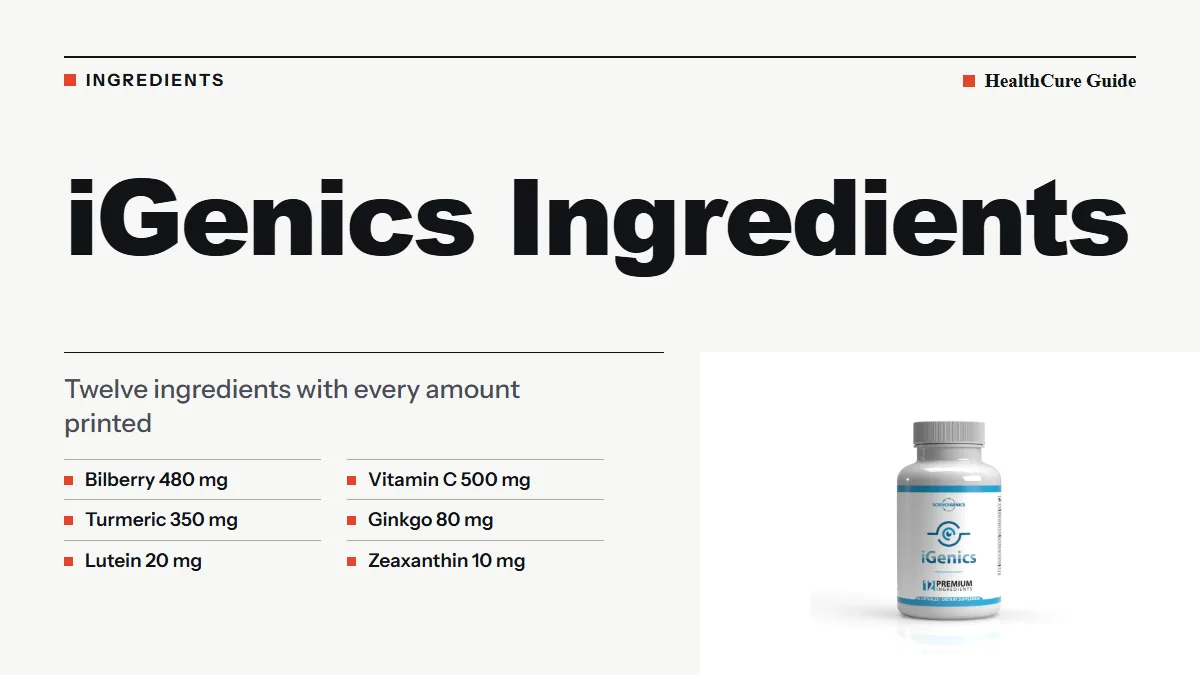
A good supplement label is a pleasure to read, because it tells you exactly what you are getting. Many eye formulas hide their amounts behind a vague blend. The iGenics ingredients do the opposite, and that is what this page walks through: each entry on the panel, how much of it you get in a serving and the modest role the seller gives it.
iGenics is taken two capsules at a time. That pair is the label’s serving, so a 60-capsule bottle gives 30 servings. All the roles below are described softly and attributed, because a supplement supports a routine and does not promise a result.
iGenics ingredients at a glance
Per serving of two capsules, the label lists these amounts.
| Amount | Ingredient |
|---|---|
| 20 mg | Lutein, from marigold flower |
| 10 mg | Zeaxanthin, from marigold flower |
| 480 mg | Bilberry fruit extract |
| 20 mg | Saffron flower |
| 350 mg | Turmeric root extract, 95% |
| 20 mg | Black pepper fruit extract |
| 80 mg | Ginkgo biloba leaf powder |
| 900 mcg | Vitamin A as retinyl palmitate |
| 500 mg | Vitamin C as calcium ascorbate |
| 0.268 mg | Vitamin E, d-alpha tocopheryl acetate form |
| 20 mg | Zinc as bisglycinate chelate (TRAACS) |
| 2 mg | Copper as bisglycinate chelate (TRAACS) |
Nothing else is listed except hypromellose, which is the capsule shell. In the seller’s words, the formula is plant-based and made from natural vegan ingredients with zero fillers.
The two carotenoids: lutein and zeaxanthin
Lutein at 20 mg and zeaxanthin at 10 mg are both taken from marigold flowers. They are carotenoids, the plant pigments you may know from colorful vegetables, and they appear in many formulas aimed at eye nutrition. The seller counts them among the AREDS2-type nutrients in the capsule.
Together they make up the core of the formula. They are the first ingredients most readers look for on an eye supplement label, and here each has its own stated amount.
The botanicals: bilberry, saffron and ginkgo
Bilberry extract (480 mg) is a concentrate from a dark berry that has a long history in eye-focused products. It is the largest botanical amount on the panel.
Saffron (20 mg) is the dried flower better known as a prized spice. The seller includes it as part of the formula’s plant-based lineup.
Ginkgo biloba leaf powder (80 mg) is the one the seller calls its main ingredient. Ginkgo is a familiar botanical, and as a plant that is taken seriously, it is one reason to talk to your doctor first when blood thinners are part of your routine.
The duo: turmeric and black pepper extract
Turmeric extract at 95% (350 mg) is a concentrated version of the golden root. Next to it stands black pepper extract (20 mg), a pairing that is common in turmeric supplements. The seller places this duo behind the formula’s goal of supporting a healthy inflammatory response.
Three vitamins
Vitamin A (900 mcg) comes as retinyl palmitate. Vitamin C (500 mg) comes as calcium ascorbate. Vitamin E (0.268 mg) comes as d-alpha tocopheryl acetate. These are familiar nutrients, and the seller includes them to help top up key vitamins as part of the formula.
Vitamin A earns a mention in the safety paragraph further down, because it is among the reasons to check with a doctor before starting.
The minerals: zinc and copper
Zinc at 20 mg and copper at 2 mg each appear as bisglycinate chelate in the TRAACS form. The two minerals are often found together in formulas, and here they sit beside the vitamins and carotenoids.
What AREDS2-inspired means
You may see the formula described as AREDS2-inspired. The reason is simple: it includes nutrients of the kind used in the AREDS2 research, which means lutein, zeaxanthin, both of the vitamins C and E, zinc and copper. That is where the comparison stops. The amounts on the iGenics label are its own, and we are not claiming they match those used in the study.
It is a fair description of the family of nutrients, nothing more. Bilberry, saffron, ginkgo and turmeric are extras the seller layers on top of that base.
Reading the amounts
Numbers on a label are only useful when you can place them. A few observations help.
The biggest figures belong to bilberry extract at 480 mg, vitamin C at 500 mg and turmeric extract at 350 mg. Those are the heavy hitters by weight. The carotenoids are smaller, at 20 mg for lutein and 10 mg for zeaxanthin, which is normal for pigments. Saffron and black pepper extract are both listed at 20 mg, and ginkgo sits at 80 mg.
Vitamin A is expressed in micrograms, at 900 mcg, while vitamin E is a small 0.268 mg. Zinc is 20 mg and copper is 2 mg. Seeing them together shows a formula that touches many nutrients without leaning on a single one.
A simple habit for reading any supplement label
If you want to evaluate iGenics against any other formula, a short routine works. Check that every active ingredient has an amount. Check the serving size and the number of servings per bottle. Check the form of each nutrient, such as chelate or extract. And check what the seller claims, so you can separate their words from yours.
On those four points the iGenics panel gives you plenty to work with: amounts for all twelve entries, a serving of two capsules, named forms and a clear description from the seller.
Why the formula hangs together
Read the label as a whole and a pattern shows up. Carotenoids and botanicals form the eye-nutrition core. Vitamins and minerals fill out the base. Turmeric with black pepper extract speaks to the seller’s inflammatory-response goal. And the whole thing is in a vegetable capsule, two a day.
That is a coherent plan, and the open amounts let you judge it. Our catalog carries a compact ingredients page for iGenics, the review page sums up the offer, and our full iGenics review explains who it suits.
How iGenics fits with food and everyday habits
A capsule is a small part of a bigger picture. Lutein and zeaxanthin are pigments found in colorful plants, bilberry is a berry, saffron is a spice and turmeric is a kitchen staple, so the label echoes things that appear on a plate. That is one reason the formula feels familiar.
The seller’s e-books lean the same way, with eight exercises in one and seven foods in the other. Alongside the capsule, steady habits such as screen breaks, good lighting and regular eye exams round out a sensible routine.
Keep in mind that a label is a snapshot of one serving, not a promise of any outcome. It tells you precisely what goes into your body each day, and that clarity is the real value of reading it closely.
Before you take it
With vitamin A, zinc, ginkgo and turmeric in the mix, anyone using blood thinners or other prescribed medicines, and anyone pregnant or nursing, should get a doctor’s opinion first. Carry on with all prescriptions. A change in how you see calls for an eye doctor, and prescribed drops or treatment go on as directed. For more on this, read our guide to iGenics side effects.
The offer, briefly
| Package | Total | Per bottle | Shipping |
|---|---|---|---|
| 6 bottles | $234 | $39 | Free |
| 3 bottles | $147 | $49 | $9.99 |
| 1 bottle | $59 | $59 | $9.99 |
The six-bottle order includes two e-books and a free Intelligen bottle, and every package sits under the 180-day money-back guarantee.
For the whole offer next to the label, visit the iGenics hub page.
Good to know:
- The seller describes the roles of ingredients, and results vary.
- Check with your doctor first, particularly on prescription medicine.
- Prescribed eye drops or treatment carry on, and an eye doctor should see any vision change.
Common questions
What are the main iGenics ingredients?
Lutein, zeaxanthin, bilberry extract, saffron, turmeric extract with black pepper extract, ginkgo leaf powder, vitamins A, C and E, zinc and copper.
How many capsules make one serving?
Two capsules. A bottle holds 60 capsules, which makes 30 servings, or 30 days.
Which ingredient does the seller call its main one?
Ginkgo. The label lists ginkgo biloba leaf powder at 80 mg per serving.
What does AREDS2-inspired mean here?
The formula includes nutrients of the type used in AREDS2: lutein, zeaxanthin, vitamin C, vitamin E, zinc and copper. The amounts are not the study's amounts.
What is the capsule made of?
Hypromellose, a vegetable capsule. The seller also says the formula is plant-based with natural vegan ingredients and zero fillers.
Should I check with a doctor before taking it?
Yes. The capsule contains vitamin A, zinc, ginkgo and turmeric, so ask a doctor first, especially on blood thinners or other prescription medicine, or if pregnant or nursing.