Ikaria Lean Belly Juice Ingredients: Every Name on the Label, Explained
Four blocks, each with a printed total, and every ingredient inside named. This is a plain-language walk through the Supplement Facts panel.
- Written by
- HealthCure Guide Editorial Team
- Reviewed by
- HealthCure Guide Editorial Team
- Updated
- Reading time
- 8 min read
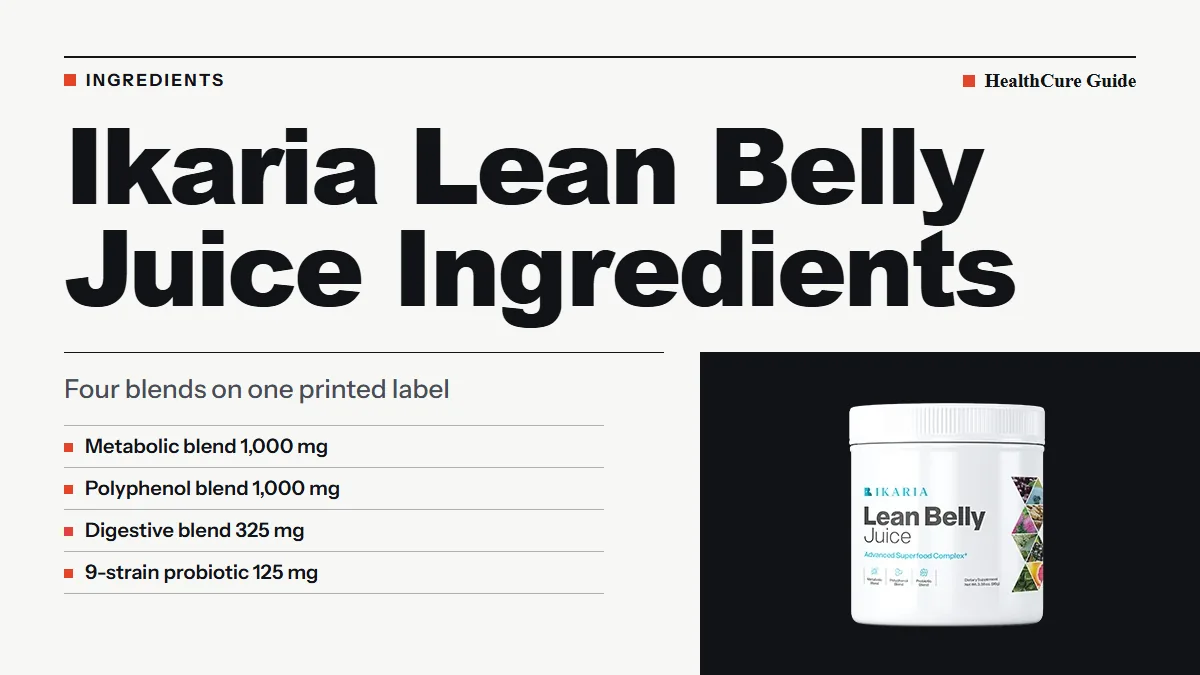
A supplement label should leave you better informed, not more puzzled. This one mostly does. The panel for Ikaria Lean Belly Juice ingredients shows four blocks, gives every block a total and then names what sits inside. Below we read it aloud in plain words, so the label can sit in front of you while you decide.
First, the basics. Ikaria Lean Belly Juice is a powder drink mix that comes with a scoop, 30 servings to a tub. The seller built it with metabolism, energy and digestion in mind, as one part of a weight-management routine. Every role we describe below is either the seller’s intent or a traditional use. None of it is a promise of results.
Ikaria Lean Belly Juice Ingredients: Reading the Supplement Facts Panel
The panel is written per scoop. Daily Values are not established for any block, so you will see totals and no percentages.
| What the panel prints | Milligrams per scoop |
|---|---|
| 9 Strain Probiotic | 125 (3 billion CFU when it was made) |
| Digestive Blend | 325 |
| Polyphenol Blend | one thousand |
| Metabolic Blend | one thousand |
One important detail: these are totals for whole blends. The label does not say how much of any single ingredient is inside, so we will not guess at amounts. What it does give you is a full list of names, and names are what you need to check against your own medicines and sensitivities.
Fiber Corner: What Is in the Digestive Blend
The smallest block holds just two fibers. Inulin is taken from jerusalem artichoke root (Helianthus tuberosus), and oat fiber powder is its partner. The seller files this block under digestion, alongside the probiotic.
Nine Strains in the Probiotic
The probiotic names nine cultures. Six are Lactobacillus: reuteri, fermentum, rhamnosus, plantarum, salivarius and acidophilus. Three are Bifidobacterium: longum, bifidum and lactis. The panel counts 3 billion CFU as of manufacture, and that is the number the seller prints, not a promise about how many are alive on the day you open the tub.
Colorful Powders: The Polyphenol Blend
Here the label turns to fruit, flowers and roots. Eleven names appear: pomegranate, raspberry, grapefruit, cranberry, blueberry and black currant powders, acai and strawberry juice powders, hibiscus flower powder, beet root powder and an African mango extract made from Irvingia gabonensis seed. The seller calls the group an antioxidant-style mix. Grapefruit is in the list, which is one more reason to speak with your doctor if you take regular medicine.
The Longest List: The Metabolic Blend
Nine ingredients make up the block the seller connects with its healthy-metabolism goal. Eight of them are the names the seller puts in the spotlight, and turmeric is the ninth.
- Green tea extract (leaf) is described as standardized to 98% polyphenols, 50% EGCG and 80% catechins. It also carries the label’s trace of caffeine, under 1%, which is worth remembering if you are sensitive.
- Kelp extract (Laminaria japonica) is standardized to 10% fucoxanthin.
- Panax ginseng (root powder) is a traditional herbal root.
- Japanese knotweed extract (Polygonum cuspidatum root) is standardized to 98% resveratrol.
- Milk thistle extract (seed) is standardized to 80% silymarin.
- Black pepper extract (fruit) is standardized to 95% piperine, which the seller names Bioperine.
- Dandelion root powder appears under the seller’s Latin name, Taraxacum.
- Turmeric root powder is listed without a standardization note.
- Citrus pectin is a fiber from citrus.
The seller sums the whole formula up as a proprietary blend of eight super antioxidants, and we pass on that wording as the seller’s. The percentages in the list are standardization figures printed beside each name. They do not tell you how much of that ingredient is in your scoop.
Everything Outside the Four Blocks
Four more items close out the label: citric acid, stevia leaf extract, maltodextrin and natural flavors. The seller adds that the mix is free from gluten, dairy, soy, wheat, barley and animal products, and that production takes place in a US facility registered with the FDA that follows GMP. Both points are the seller’s statements.
What the Label Means for You
When you read any supplement panel, one question does most of the work: is there anything here that does not fit my situation? The names above are exactly what you need to answer it. Ginseng, green tea extract, kelp, resveratrol, milk thistle, black pepper extract, turmeric and grapefruit are the ones we would show your doctor if you use anticoagulants, diabetes drugs or blood-pressure drugs, or have a thyroid, liver or gallbladder issue.
The seller itself asks anyone who is pregnant, nursing, on medication or living with a medical condition to see a physician first, and says not to double up with other supplements containing similar ingredients. Please carry on with every medicine you have been prescribed. If your weight shifts and you do not know why, that calls for a doctor’s visit. Our side effects guide adds more, and the ingredients page on our hub shows the label image.
Why a Powder Is Such an Easy Routine
You stir one scoop into roughly 6 oz of water each morning, and the seller’s contact page suggests an hour or so after breakfast. That is about as light as a supplement routine gets. Three or six bottles bring Energy Boosting Smoothies, Anti-Aging Blueprint and VIP Coaching along with them. Six bottles cost $234, which is $39 a bottle, or $1.30 per day, and the US shipping fee disappears.
The Promise Behind the Label
If the drink is not right for you, a half-year refund promise covers every package. Write to [email protected] with Refund Request as the subject line, wait until an agent replies, then post the bottles back paying the postage yourself. The seller takes them back used up or untouched. Our guarantee guide lists each step.
Three Habits for Reading Any Label
Whatever you take, a few habits make labels friendlier.
- Begin with the serving. Check the scoop size and the count: 3.2 g, 30 to a tub.
- Respect the totals. A blend total says how much of the scoop the whole group occupies. It does not split that weight among the names.
- Take the list to a pharmacist. A two-minute chat can catch what you might have missed.
How the Four Blocks Fit Together
Step back and the design is easy to describe. Two plant-heavy blends take up most of the scoop: one packed with metabolism-minded ingredients, the other with fruit and plant powders. A fiber blend and a probiotic fill in the rest. The seller presents the combination as aimed at metabolism, steady energy and digestion inside a weight-management plan, with meals and movement doing the heavy lifting.
That is the seller’s design, and we label it as such. Your own experience depends on your habits, and the guarantee window of 180 days lets you find out at your own pace.
The Probiotic and the Fiber Work as a Pair
Digestion is one of the three goals the seller names, and the probiotic and the fiber blend share that job. Nine strains at 125 mg sit next to inulin and oat fiber at 325 mg, so the formula pairs a fiber with live cultures. Whether that pairing does anything for you is a personal matter. We describe it as the seller’s design and nothing more.
Questions About the Ingredients
Is anything in it a stimulant? The green tea extract brings a trace of caffeine, listed at under 1%. The seller also describes the drink as not a stimulant and not habit-forming.
Why are individual doses missing? The label prints blend totals only, and the amounts inside each blend are not published. The guarantee gives you six months to decide anyway.
Does it contain animal products? The seller says it does not, and also names gluten, dairy, soy, wheat and barley as absent.
Ready to Try It
The label is on the table, the names are plain and half a year of cover lets you judge the routine for yourself.
For the complete overview of the drink, see our Ikaria Lean Belly Juice hub.
Common questions
What are the Ikaria Lean Belly Juice ingredients?
The label prints four blocks per scoop: a 1,000 mg Metabolic Blend, a 1,000 mg Polyphenol Blend, a 325 mg Digestive Blend and a 125 mg 9 Strain Probiotic (3 billion CFU at the time of manufacture). Other ingredients are maltodextrin, natural flavors, citric acid and stevia leaf extract.
Does the label show the dose of each ingredient?
It shows a total for each blend, with the ingredients inside named. The amount of each individual ingredient within a blend is not printed.
Does it contain caffeine?
The green tea extract brings a trace. The label lists it as under 1% caffeine.
Which probiotic strains are named?
L. acidophilus, L. salivarius, L. plantarum, L. rhamnosus, B. lactis, B. bifidum, L. fermentum, L. reuteri and B. longum, nine in all.
Does it contain gluten, dairy or soy?
The seller says the drink is free from gluten, dairy, soy, wheat, barley and animal products.
Should I ask my doctor about the ingredients?
Yes, particularly if you take regular medicine. Keep taking what you are prescribed, and ask first about blood thinners, diabetes or blood-pressure medicine, or thyroid, liver or gallbladder conditions.