Kidney Disease Solution: What's Inside the 123-Page Guide
Before you pay, you want to know what turns up. Here is every part the seller lists, how the pages are meant to be read, and what the guide deliberately does not include.
- Written by
- HealthCure Guide Editorial Team
- Reviewed by
- HealthCure Guide Editorial Team
- Updated
- Reading time
- 8 min read
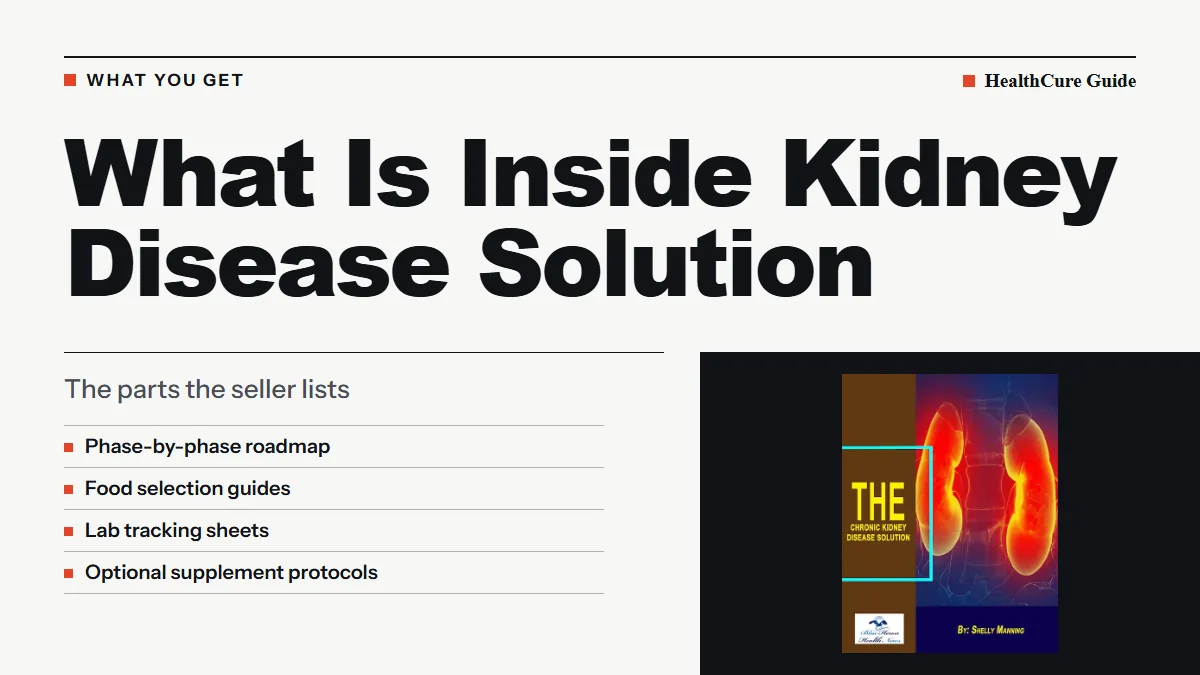
Few people like paying before they know what turns up. With this guide the answer is refreshingly short, and it is worth reading carefully, because what is inside Kidney Disease Solution decides whether it suits the way you like to learn.
We read the seller’s pages on 11 November 2026 and listed every part below. We have not tested the guide, so everything about the contents is the seller’s own description.
What is inside Kidney Disease Solution: the list

| Part | What the seller says |
|---|---|
| The guide | The Chronic Kidney Disease Solution, 123 pages by the seller’s count |
| Roadmap | A phase-by-phase route through the reading |
| Food selection guides | Reading on food choices |
| Lab tracking sheets | Pages for your own figures |
| Supplement protocols | Optional, skippable if you would rather stay with food alone |
| Citations | Over 400, by the seller’s count |
| Access | Instant, digital |
Nothing else is listed, so there is nothing extra to discover at checkout. Our what’s included page shows the same list in catalog form.
The roadmap
The roadmap is the backbone. It gives the reading an order, so you never wonder where you are. According to the seller, the guide is organised in three phases, each with its own diet and lifestyle steps, and the roadmap shows you where each one begins.
What the roadmap gives you as a reader is a sequence to follow and a structure to hang your questions on.
The food selection guides
The guide includes food selection guides. We pass on no food advice from it and add none of our own, because what suits one person with CKD can be wrong for another. Think of this part as reading to talk through with a kidney dietitian, who knows your labs and your limits.
The lab tracking sheets
Tracking sheets give you a single place for the figures your clinic hands you. Printed or kept on a screen, they let you start each appointment from one page. They are only as good as the numbers you enter, and those should come from your clinic and nowhere else.
The optional supplement protocols
The seller says you can leave these out for anyone who chooses food alone. That choice is yours as a reader. Taking a supplement or herb is a different matter and belongs to your nephrologist, because many are unsafe in kidney disease or alongside certain prescribed medicines. Reading about a protocol and acting on it are two separate steps.
The research citations
The seller counts over 400 citations in the guide. We have not checked that number, and a long list of references is not a promise about anything. We mention it because it is on the contents list and you may like to know the guide cites its sources.
How the guide is read
It is digital, with instant access, and the seller does not name a file type, so we do not guess one. You read it on a screen at whatever speed suits you. A relaxed routine fits the format:
- Skim the roadmap first for the overall shape.
- Read a section at a time, with a pen beside you.
- Mark passages you want explained.
- Fill in the tracking sheets with figures from your clinic.
- Take your questions to the next appointment.
The seller’s footer also shows a members login, but its pages do not say how that fits the delivery, so check the order page when you buy.
How the pieces fit together
The contents list reads like five separate items, but it behaves more like one loop. The roadmap tells you where you are. The food selection guides give you topics to discuss. The tracking sheets hold your own figures. The optional protocols are a section you can leave alone. The citations sit behind the whole thing as the seller’s list of sources.
For a reader, the loop looks like this: read a section, note your questions, record your figures, take both to the clinic and return with answers. The guide supplies the structure, and your kidney team supplies everything medical. That division of labour is the centre of how we suggest you use it.
A suggested first week
These steps are our own, not the seller’s, and they ask nothing of your body.
- Day one. Save your confirmation, skim the roadmap and note three questions.
- Midweek. Read one section properly, pen in hand.
- Later in the week. Open the tracking sheets and enter figures your clinic has given you, nothing else.
- At the weekend. Tidy your questions into a list for your next appointment.
By the end of the week you have a shape for the rest of your 60 days, and you know whether the format suits you.
Questions the contents list leaves open
The seller’s pages do not answer everything, and we would rather say so. They do not name a file type. They do not explain how the members login in the footer fits with delivery. They do not say when the 60 days begin. None of these is a reason to hesitate, but all of them are fair questions for the seller’s support team, which answers email within 24 hours per its contact page.
Reading on different screens
The seller names no file type, so we cannot promise how the guide looks on every device. A laptop or tablet gives the tracking sheets room to breathe, while a phone suits a quick read between appointments. Whatever you choose, check the first pages soon after you pay, and if anything displays badly, ask the seller’s support team in your first week, well inside the 60 days.
What the order does not include
- A live coach. You read this one.
- Personal medical advice. Your nephrologist and kidney dietitian give that.
- A subscription. The seller shows one payment.
- Sessions to attend. There is no schedule.
- Extras. None are named in what we read.
The price and the refund, briefly
The $49 is a single payment, and the seller says there are no renewal fees. A 60-day money-back promise applies: you email the Blue Heron Health News support team through its contact page, and by the seller’s account you keep the guide. Our price post and money-back guarantee post go through both.
Where to spend your reading time
You do not have to give every part equal attention. If you like order and structure, spend longest on the roadmap. If you like to prepare for appointments, spend longest on the lab tracking sheets and the questions they raise. If you enjoy detail, the food selection guides are a good place to collect topics to discuss with a kidney dietitian. If you would rather leave the supplement protocols alone, the seller says that is fine. The format puts you in charge of the pace, and our main guide shows how the parts relate.
Who it suits
- You want one organised guide to read after a CKD diagnosis.
- You like walking into appointments with notes.
- You prefer reading to attending sessions.
- You want a single payment and 60 days to decide.
If that sounds like you, the next step is easy. Our overview of the Kidney Disease Solution has the full picture, and the benefits page explains what the reading itself can give you.
Common questions
What is inside the Kidney Disease Solution?
A digital reading guide of 123 pages by Shelly Manning. The seller lists a phase-by-phase roadmap, food selection guides, lab tracking sheets, optional supplement protocols and over 400 research citations.
Can I skip the supplement protocols?
The seller says they are skippable if you prefer food only. Take any supplement or herb to your nephrologist first, because many are unsafe in kidney disease.
What file type is the guide?
The seller does not state one, so we say only that it is a digital guide with instant access. Check the order page when you buy.
Are there extras beyond the guide?
The pages we read list none. The order page showed one option at $49, paid once.
Is there a coach or a live session?
No. It is a guide you read at your own pace, so there is no schedule and nothing to attend.
Does it replace advice from my kidney team?
No. It is educational reading, and the seller itself says to keep working with your nephrologist and keep taking prescribed medication.