Last Wish Program: How The Last Wish Compares With Goal Research
A side-by-side look at what the nightly listening routine asks of you and what psychology studies suggest actually helps people reach goals, with a free five-minute plan you can use either way.
- Written by
- HealthCure Guide Editorial Team
- Reviewed by
- HealthCure Guide Editorial Team
- Updated
- Reading time
- 9 min read
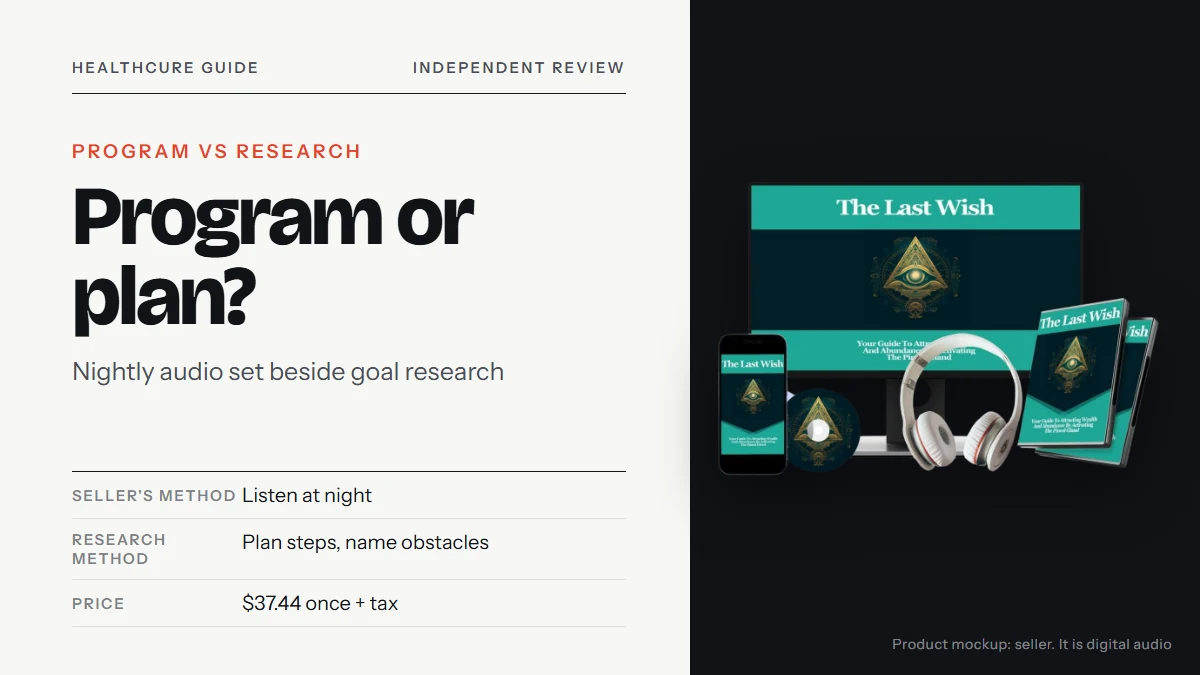
People who search for the last wish program often ask a more useful question underneath: will this actually help me get what I want? This page answers that by setting the seller’s approach next to what psychology studies of goals report, then sorting out who might enjoy the product and who should pass.
Disclosure: we are an independent review site rather than the seller. We have not bought or heard the recordings. Our facts come from the seller’s order page, video page, Terms and the ClickBank checkout, read on 2026-10-09, plus general research context.
What the Last Wish program asks you to do
The seller sells a set of digital recordings, described as pineal gland activating audio meant to help you attract wealth and abundance. In the video, the instructions are short: headphones, a seated position, a dark room, 11 minutes a night, and regular use. The order page, by contrast, talks about the mind waking up in under 7 minutes.
The pitch is also notable for what it leaves out. The narrator adds that you need none of prayer, meditation, visualization or effort, and that this is not the law of attraction. In other words, the program is built around you doing very little beyond listening.
That design choice is the crux of this comparison. Almost everything the goal research finds helpful involves something you do while awake: choosing a target, thinking through steps, preparing for setbacks. The program removes all of that from the equation.
What research supports for reaching goals
Psychology has studied how people turn intentions into action for decades. Three tools come up again and again.
| Technique | What you do | What studies suggest |
|---|---|---|
| Picturing the steps | Imagine, in order, the actions you will take | Helps people plan and follow through |
| Mental contrasting | Picture the goal, then the main obstacle | Linked with better follow-through |
| If-then plans | Write “if X happens, then I will do Y” | Helps people follow through |
None of these is exotic. Each asks you to think concretely about what you will do and what could go wrong. Studies on them are about helping people follow through on everyday goals, not about attracting windfalls.
Here is a small example. Suppose the goal is saving $500 in three months. Picturing the steps means imagining each small transfer as it happens. Mental contrasting adds the obstacle: an expensive dinner with friends. The if-then plan says that when you are invited out and have already spent your fun money, you will suggest coffee at home instead.
Picturing the prize is not the same as picturing the path
There is a catch that matters for any manifestation product. Studies have linked purely positive fantasizing about an outcome with less effort in some cases. If your mind already feels the glow of having the money, the push to do the dull work can fade.
That does not make hopeful thinking bad. Hope is a good fuel. The finding is narrower: dwelling only on the result, without contrasting it with obstacles or planning steps, is not what helped people most.
The Last Wish program leans toward the first type. Its promise is that you “just receive” what you want. We state that as the seller’s claim. Nothing we found shows money or events arriving because someone wished, played audio or “activated” a gland.
Side by side: the program and the research
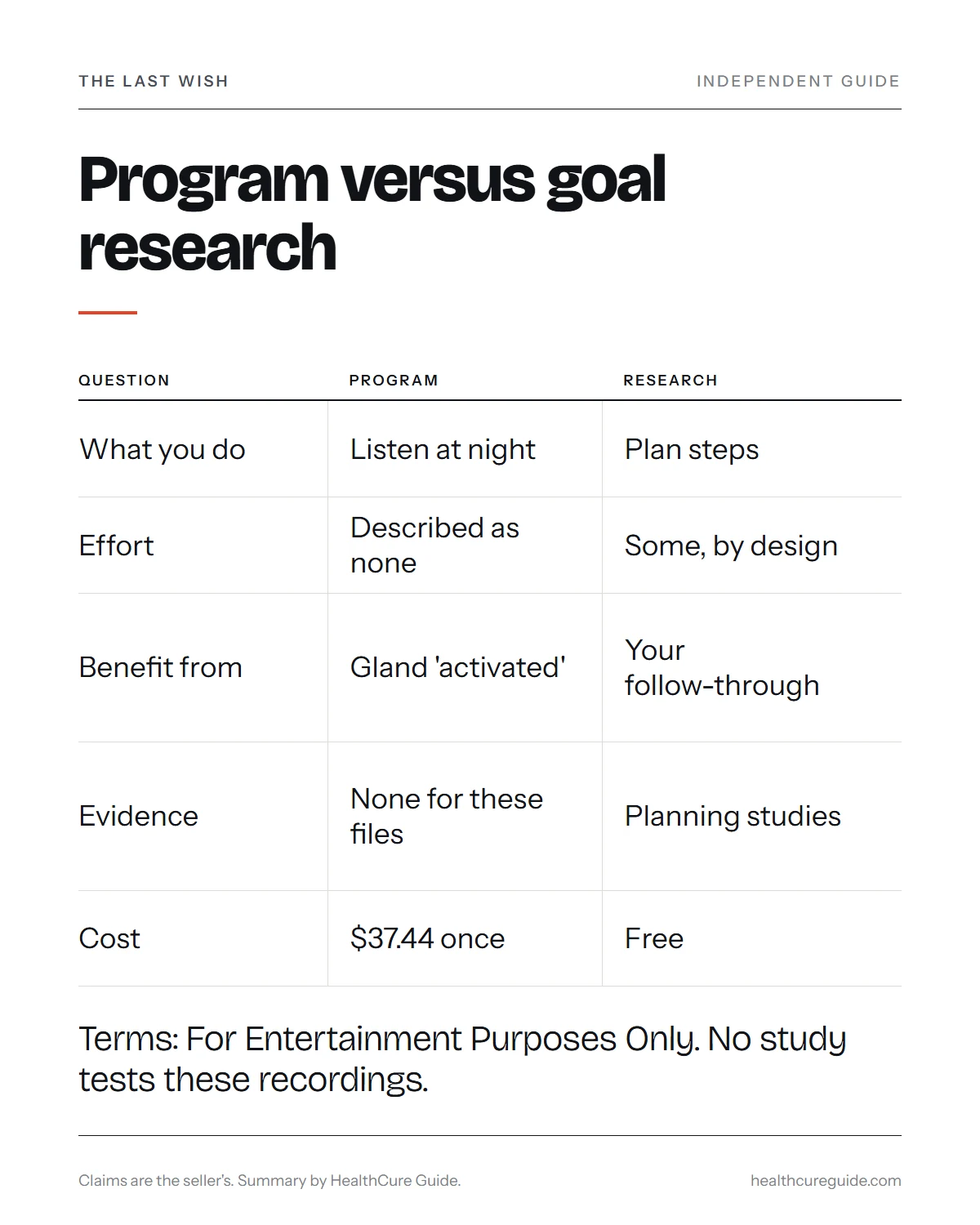
| Question | The Last Wish program | Goal research |
|---|---|---|
| What do you do? | Listen at night | Plan steps, name obstacles |
| Effort needed | Described as none | Some, by design |
| Where does the benefit come from? | A gland “activated” by sound | Your own follow-through |
| Evidence | None for these recordings | Studies on planning methods |
| Cost | $37.44 once | Free |
| Risk | Money and email lists | Little beyond time |
The comparison is not unfair to the program. The two cover different ground. One is an evening ritual with a big promise attached, the other is a work method with modest, tested claims.
What audio research does and does not show
We cover the wider verdict in our Last Wish review; this section stays on the audio claim.
In the video, the claim is that calcite crystals inside the gland react strongly to sound, so particular frequencies can switch it on. We found no published evidence that sound makes those deposits vibrate or switches the gland on, and none that the gland affects money.
We could not confirm that the recordings use binaural beats, so that literature is only background. Results point in both directions. One pooled analysis from 2019 reported a medium overall effect for certain outcomes, whereas a 2023 review of entrainment studies found that most did not show brainwaves actually shifting. No study tests this product.
There is one fair point in the program’s favor. A short nightly routine of quiet listening in the dark may feel relaxing, in the same way any wind-down habit can. If that is what you want from it, the claim is modest enough to be reasonable.
Who might still enjoy the Last Wish program
| It might suit you if | Skip it if |
|---|---|
| You want a fixed evening wind-down ritual | You expect the audio to produce money |
| You enjoy spiritual or reflective themes | You are short of cash this month |
| You will also make a real plan for your goal | You tend to buy under countdown pressure |
| You can accept that it is entertainment | You want proof or published results |
| You will track your use and use the refund if needed | You have seizure or hearing concerns and no doctor’s advice |
Respect runs both ways here. Many people find meaning in prayer, ritual and sacred imagery, and a product that borrows that language can feel comforting. That feeling is real. It is just separate from the question of whether a recording moves money.
Using both without fooling yourself
If you want the recordings and the plan, a few habits keep your judgment clear. Write down, before you buy, what would make the $37.44 feel worthwhile. For some people that is simply falling asleep with less restlessness. For others it is a nightly pause. Money should not be on that list, because nothing supports it.
Then separate the two tracks in your notes. One column is how the evenings felt. The other is what you actually did toward your goal that week. If the second column grows and the first stays flat, the plan is doing the work, and the recordings are optional. If you enjoy the first column and nothing moves in the second, you have a pleasant habit and an unchanged goal, which is useful to know.
The Terms say “For Entertainment Purposes Only,” and that is a fair way to hold the whole thing: something you may enjoy, with a plan beside it doing the serious part.
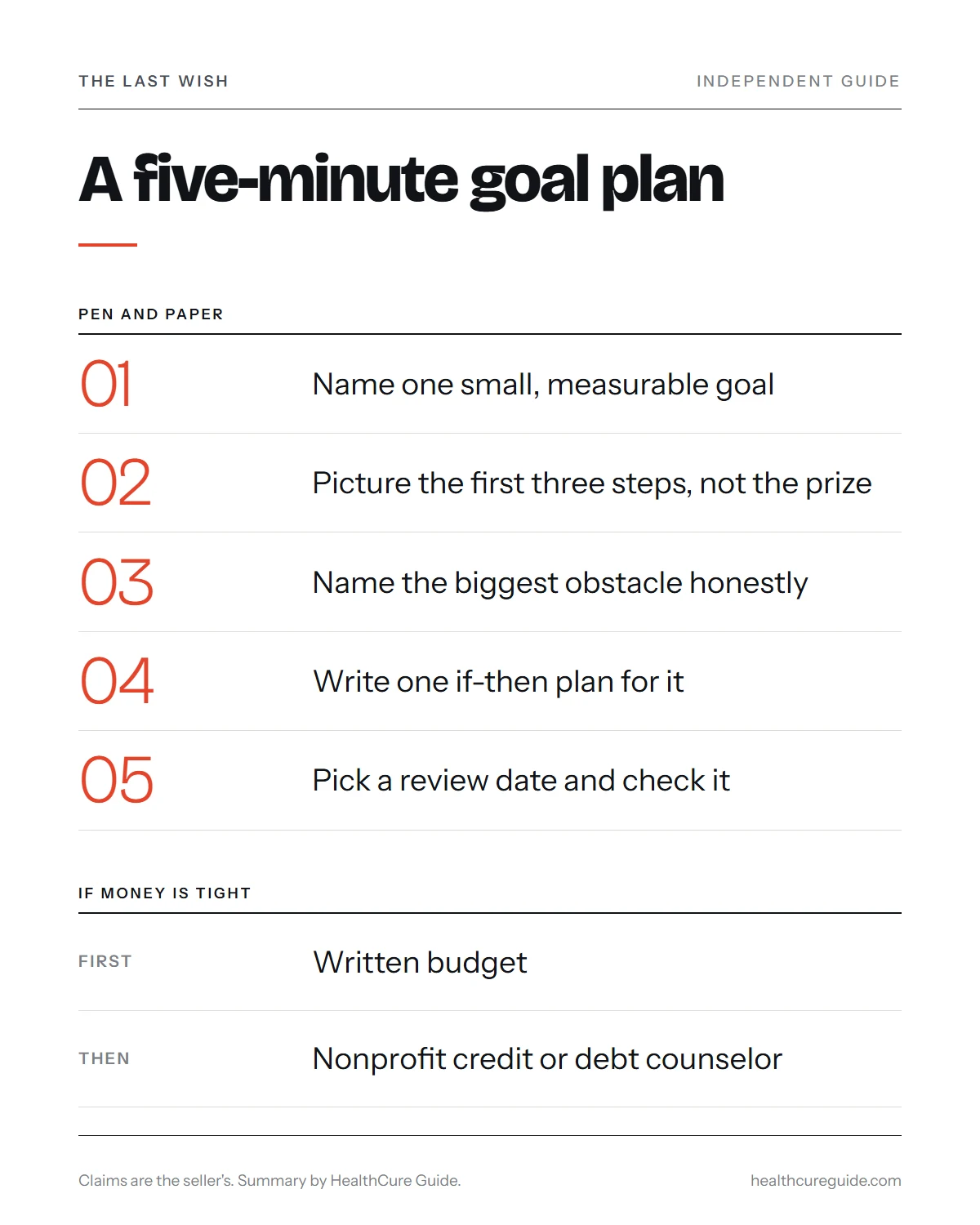
A five-minute goal plan you can do tonight, free
You do not need to buy anything to use the research. Take a pen and a page.
- Name one goal. Make it specific and small enough to measure, like “pay off the $300 card balance by March.”
- Picture the first three steps. Not the result: the actions, in order.
- Name the biggest obstacle. Be honest. Time, temptation, tiredness, a bill you forgot.
- Write one if-then plan. “If it is the first of the month, then $50 goes to savings before any other spending.”
- Pick a review date. Put it in your calendar and check what actually happened.
If you do buy the program, do this first. Then listening becomes a relaxing add-on rather than the whole strategy.
Money, refund and fine print in brief
The price is $37.44 once. At checkout it appears in your local currency with tax, and from India we saw ₹4,039.62 plus ₹727.13 tax. Two later offers may follow, at $97.19 and $47.19, and both are optional.
The refund situation is where careful buyers should slow down. The Terms and ClickBank checkout say 60 days. The sales pages show a 365-day badge with no supporting text. The video page’s footer points to terms on another company’s site, abundant-life.co, that offer 90 days but attach conditions, including proof of thirty days of use. Our advice: use ClickBank’s refund route, keep your receipt, and decide well inside 60 days.
Also expect marketing email. Buyers may be added to lists that can promote third-party offers. A ticking clock, a “Today Only” price and a hint that the page may disappear are all selling techniques. None tells you anything about real availability.
Claims we leave out of the comparison
Some of the video’s content cannot be tested, so we kept it out. The man on screen introduces himself as Danny Kelly, a name the Terms say may be a pen name, and the Terms also allow dramatized scenes. So the personal story and the tale of a priest and a Vatican parchment are unverified. The income anecdotes (earning $3,617 in a day, collecting a $10,137 IRS refund, winning $2,000 on a scratch-off ticket) are stories from the seller’s side, not results. And the Harvard and Michigan line cannot be checked because the page names no study.
Our verdict in words
Judged as a way to reach goals, the program falls behind a free pen-and-paper plan, because the plan uses methods with research behind them and the recordings do not. Judged as a quiet nightly habit with a refund window, it is a small, low-risk purchase for someone who understands it is entertainment.
The practical rule: never let a recording replace the plan. If money is the goal and money is tight, start with a budget and a nonprofit credit or debt counselor, who can do things a recording cannot.
Related reading
Common questions
Is the Last Wish program based on scientific research?
The order page says it is backed by research from Harvard and the University of Michigan and confirmed by modern neuroscience. It names no study, author or link, and we found no published study that tests these recordings. The Terms also label the content as entertainment. Treat the research claim as unsupported until the seller shows its sources.
What is mental contrasting in plain words?
It is a three-part exercise from goal research. You picture the goal you want, then picture the obstacle that is most likely to get in your way, then write an if-then plan for handling that obstacle. Studies of this method link it with better follow-through. It takes about five minutes and costs nothing to try.
Does picturing a wish coming true help or hurt?
It depends on what you picture. Imagining the steps you will take, such as the first phone call or the weekly deposit, has research support. Daydreaming only about the finished outcome has been linked to less effort in some studies. Nothing shows that a wish alone, or a recording played at night, makes events or money appear.
Can I use the Last Wish recordings and a goal plan together?
Yes, if you keep their jobs separate. Use the listening as a quiet wind-down, and use the plan for the actual goal. Do not let the recordings stand in for the plan. The seller says the program works without effort, which is exactly the claim research does not back. A plan with dated steps is where progress usually comes from.
Do binaural beats work the way the program suggests?
The research is mixed. A 2019 meta-analysis found a medium overall effect on some outcomes, while a 2023 review found that most studies of brainwave entrainment did not show the brainwave change. We could not confirm that the recordings use binaural beats, and no study tests them, so these studies are background, not proof.
Who should skip the Last Wish program?
Skip it if you are short on money and hoping the audio will fix that, if you cannot spare $37.44, or if sales pressure such as countdown timers makes you spend impulsively. Also skip it without a doctor's advice if you have a seizure history or hearing problems. In each case a budget or a counselor is the better first step.
What if I am in money trouble right now?
Start with real help rather than a recording. Write down income and bills, call creditors before you miss a payment, and talk to a nonprofit credit or debt counselor, who can often help you build a repayment plan. The Terms say the content is not a substitute for professional financial advice, and we agree with that.