LeanBiome Ingredients: The Label Line by Line, With Printed Amounts
The Supplement Facts panel in plain English: seven printed lines, the seven strains that share one blend dose and the seller's soft, attributed reason for each ingredient.
- Written by
- HealthCure Guide Editorial Team
- Reviewed by
- HealthCure Guide Editorial Team
- Updated
- Reading time
- 7 min read
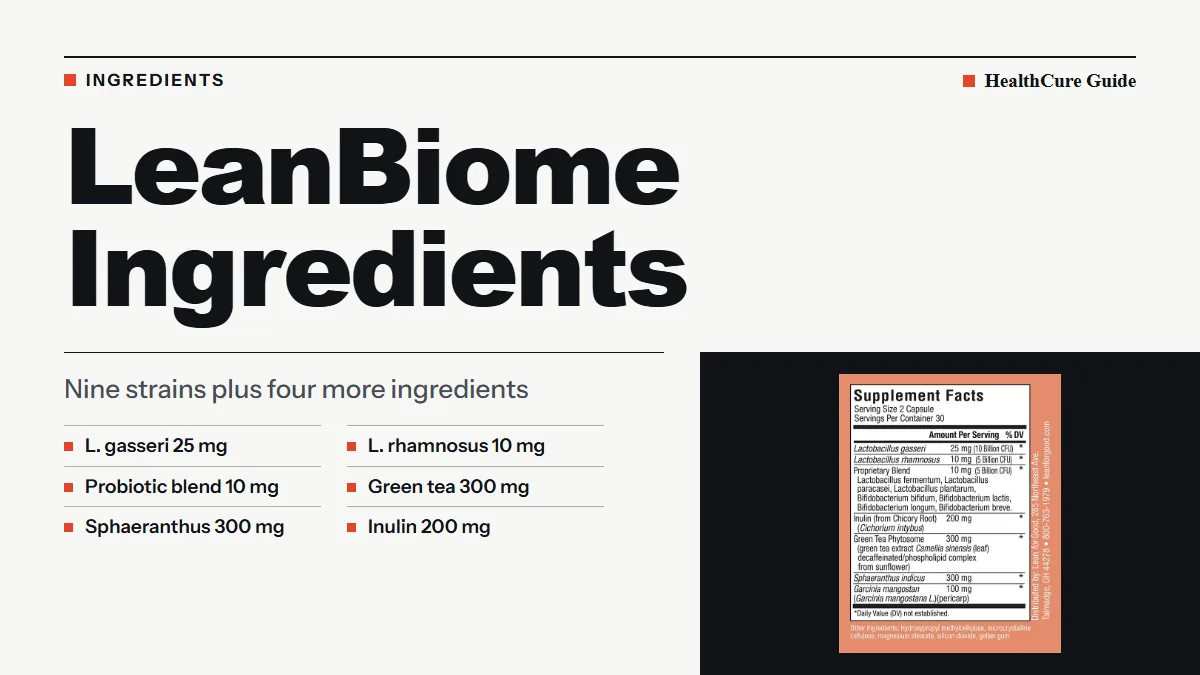
Reading a label before you buy is a sign of a careful shopper, and LeanBiome gives you plenty to read. This guide goes down the LeanBiome ingredients panel one line at a time, with the amount printed beside each, and adds the seller’s own reason for including it. Every role below is the seller’s framing, and none of it is a promise of a result.
The label says “Biome” by Lean for Good, and searches also use Lean Biome or Lean for Good Biome, but the capsule is the same. The seller describes it as aimed at gut balance within a weight-management routine.
LeanBiome ingredients on the Supplement Facts panel
A serving is two capsules, and a bottle of 60 holds 30 servings. No Daily Value is established for these lines.
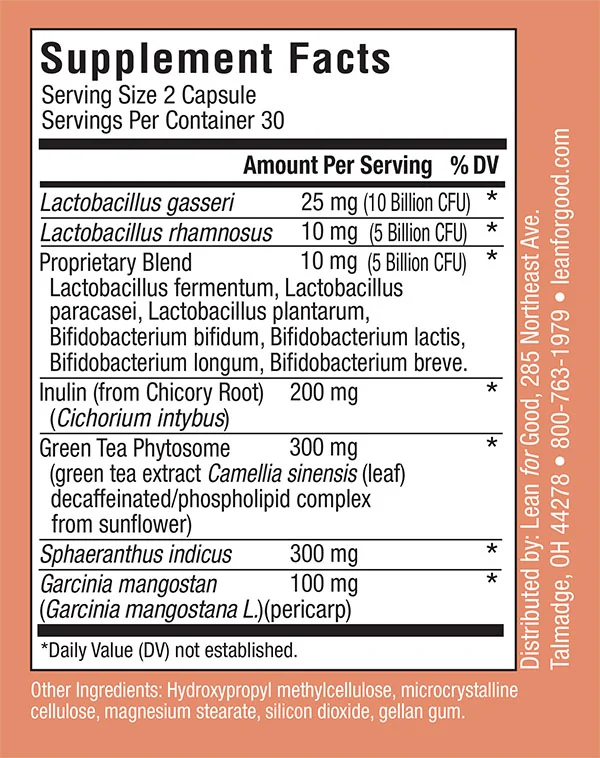
| Per serving | Ingredient | Why the seller includes it |
|---|---|---|
| 300 mg | Green tea phytosome (decaf green tea extract with sunflower phospholipid) | A caffeine-free green tea component of the formula |
| 300 mg | Sphaeranthus indicus | A plant extract in the seller’s formula |
| 200 mg | Inulin from chicory root | A fiber placed beside the live strains |
| 100 mg | Garcinia mangostana, pericarp | A second plant extract in the formula |
| 25 mg, 10 billion CFU | L. gasseri | Heads the probiotic lines |
| 10 mg, 5 billion CFU | L. rhamnosus | A second strain with its own line |
| 10 mg, 5 billion CFU | Blend of L. fermentum, L. paracasei, L. plantarum, B. bifidum, B. lactis, B. longum and B. breve | Seven strains on one shared line |
Add the three probiotic lines and you reach 20 billion CFU. That total is our own arithmetic from the printed numbers, not a separate figure on the label.
One thing worth knowing about the blend
Look at the last row again. Seven strains share a single 10 mg line, with 5 billion CFU for the group. Each strain is named, but no individual amount is printed for them. Every other line has its own dose, so the sentence that holds true is this: a dose appears on every label line, and the seven blend strains split one of those lines between them.
That is a useful way to read any multi-strain label. Names tell you what is inside, and amounts tell you how much, and here the panel gives you both for every line, with the group figure for the blend.
What each line is there for
Lactobacillus gasseri
It leads the probiotic lines at 25 mg and 10 billion CFU. The seller describes the whole capsule as a live-bacteria formula, and this strain carries the biggest share of the count.
Lactobacillus rhamnosus
A second strain with its own line, 10 mg and 5 billion CFU. Having two strains printed separately gives you two clear reference points before the blend.
The seven-strain blend
Seven strains share one heading: L. fermentum, L. paracasei, L. plantarum, Bifidobacterium bifidum, B. lactis, B. longum and B. breve. The seller uses them to widen the range of strains in the capsule. Between them they account for 10 mg and 5 billion CFU.
Inulin from chicory root
A fiber, listed at 200 mg. The seller places it in the capsule next to the live strains as part of the gut-focused design.
Green tea phytosome
300 mg of decaffeinated green tea extract bound to sunflower phospholipid. The seller names it Greenselect Phytosome. If you avoid caffeine, the label’s decaffeinated description is helpful to know.
Sphaeranthus indicus and Garcinia mangostana
Two plant extracts, 300 mg and 100 mg respectively. The Garcinia comes from the pericarp. Both belong to the seller’s formula, and the seller presents them as part of the weight-management side of the design.
How to read CFU on a probiotic label
CFU stands for colony-forming units, a count of live bacteria. On the LeanBiome panel it appears on the three probiotic lines: 10 billion for Lactobacillus gasseri, 5 billion for Lactobacillus rhamnosus and 5 billion for the seven-strain blend. The milligram figure beside each tells you the weight of the ingredient, and the CFU figure tells you the live count. Reading both together gives a fuller picture than either one alone.
Three questions work on any probiotic label, and LeanBiome answers each of them on the panel:
- Which strains are named? All nine are, by genus, species and abbreviation.
- Is there an amount? Yes, on every line, with a group amount for the blend.
- What else is in the capsule? Five capsule and filler ingredients, listed at the bottom.
The capsule and the coating
The capsule base adds gellan gum, silicon dioxide, magnesium stearate, microcrystalline cellulose and hydroxypropyl methylcellulose. The shell is delayed-release; the seller says its acid-resistant coating helps the live bacteria reach the gut, which is the seller’s explanation and not ours.
The seller calls the capsules vegan-friendly, in line with the vegan badge on the label, and says a US facility it describes as FDA-inspected and cGMP-certified makes them. These are the seller’s statements. Our LeanBiome ingredients catalog page shows the same panel with extra notes, and the LeanBiome hub gives the full picture of price and guarantee.
How it is taken
The label direction is two capsules daily, taken with water, ideally before breakfast, never above the recommended amount. A bottle lasts 30 days, and six last 180. Lean for Good’s own guidance is three to six months of regular use, as the research it quotes ran about 90 days. Six bottles cost $49 each, ship free inside the US and bring free digital bonuses, among them a smoothie eBook with 21 gut-friendly recipes.
A short word on suitability
The label sends pregnant or nursing mothers, children under 18 and people with a known medical condition to a physician before use. Our own general advice: probiotics can bring mild digestive changes for a few days at the start, and a weakened immune system, immune-suppressing medicine or serious illness is a reason to ask a doctor first. Bring the label to that conversation; the panel above is all they need. Our LeanBiome side effects guide covers it in more detail.
Good to know: this is a supplement, so results differ from person to person. Ask your doctor before starting, and keep taking whatever they prescribed.
Putting the numbers into a morning
Boil the table down to a daily routine and it is short: two capsules, one glass of water, a moment before breakfast. Within that small act sit 300 mg of green tea phytosome, 300 mg of Sphaeranthus indicus, 200 mg of inulin, 100 mg of Garcinia mangostana and three probiotic lines carrying 20 billion CFU in all.
None of that asks for a measuring spoon or a shaker. The label does the work of explaining the formula, and the routine stays as light as a vitamin. Pair it with meals, movement and sleep, because it is designed to support a weight-management routine and not to replace one.
Reading a blend line
A blend line is the one place where a label asks for a little interpretation. LeanBiome’s seven-strain blend names every strain and gives one weight and one CFU figure for the group. You therefore know who is in the blend and how much the group weighs, but not the share of each member. It is worth knowing that distinction before buying, and the panel makes it easy to see. Everything else on the label is a single ingredient with a single amount, so the blend line is the only one to read twice.
Why a printed label helps your decision
A product you swallow daily should come with information you can check. With LeanBiome you can match each line against the panel, read the seller’s explanation and set the formula beside any other you are considering. The guarantee then does the rest: 180 days from the order date, with the seller saying a finished supply still qualifies for a refund of the purchase price. For the full price ladder, see our LeanBiome price guide and the LeanBiome hub.
Common questions
What are the LeanBiome ingredients?
Each two-capsule serving holds seven printed lines: L. gasseri (25 mg), L. rhamnosus (10 mg), a seven-strain probiotic blend (10 mg), chicory-root inulin (200 mg), green tea phytosome (300 mg), Sphaeranthus indicus (300 mg) and Garcinia mangostana pericarp (100 mg).
How many probiotic strains does it contain?
Nine in all. Two sit on lines of their own, and the other seven share a blend line. Add the three probiotic lines and you get 20 billion CFU, our own sum.
Does each strain have its own dose?
Two do. The seven blend strains share a single 10 mg line, so no separate figure is printed for each. A dose does appear on every label line.
Is the green tea caffeinated?
Per the label, the green tea phytosome is decaffeinated and bound to sunflower phospholipid.
What else is in the capsule?
The capsule base uses gellan gum, silicon dioxide, magnesium stearate, microcrystalline cellulose and hydroxypropyl methylcellulose.
Should I show the label to my doctor?
Yes. Prescribed medicines carry on, and your doctor hears about LeanBiome first, above all in pregnancy, while nursing, under 18, with weak immunity or with a medical condition.