Livarix Ingredients: All Eight Named, With the Amounts Listed
Eight named ingredients, every amount printed in the seller's text, and a plain explanation of what each one is. Here is the list, line by line.
- Written by
- HealthCure Guide Editorial Team
- Reviewed by
- HealthCure Guide Editorial Team
- Updated
- Reading time
- 7 min read
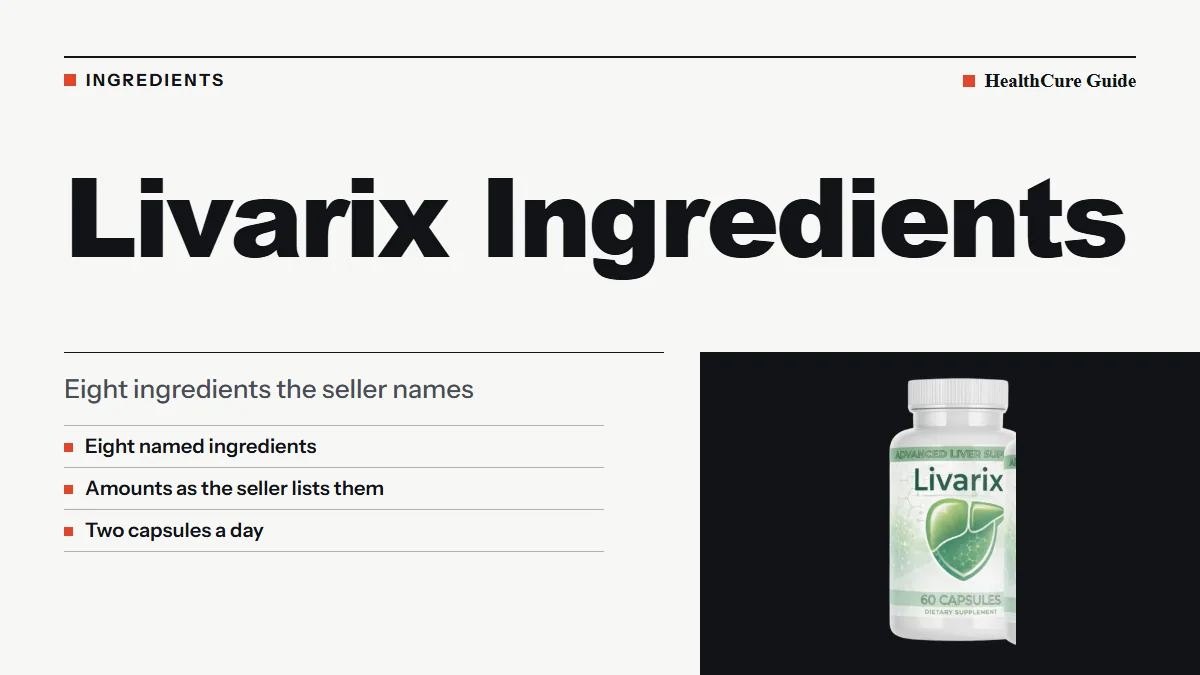
Reading the ingredient list comes first for anyone planning to take a capsule every day. Livarix names all eight of its components and attaches a milligram figure to each. Below you will find every line, a plain description of what each component is, and the cautions worth reviewing before the first dose.
Livarix ingredients as the seller lists them
Milligram figures appear in the text of the page, yet no Supplement Facts image accompanies them, so a printed panel does not exist. We reproduce the names and numbers exactly as given. The page does not state whether a figure refers to one capsule or to the full two-capsule daily dose, so we do not convert anything.
| Ingredient, as named | Listed amount | Identity |
|---|---|---|
| Turmeric Powder (root) | 300 mg | Milled turmeric root |
| Beet Root Powder | 200 mg | Dried, ground beet root |
| Dandelion Powder (leaf) | 100 mg | Dried, ground dandelion leaf |
| Artichoke Extract | 50 mg | Extract taken from artichoke plant material |
| Ginger Powder (root) | 50 mg | Ground ginger root |
| Milk Thistle Powder | 50 mg | Ground milk thistle plant material |
| Alfalfa Powder (leaf) | 20 mg | Ground alfalfa leaf |
| L-Cysteine HCl | 10 mg | Hydrochloride salt of L-cysteine, an amino acid |
The page adds that the artichoke extract is standardized to 5% cynarin. It describes the blend as a proprietary formula, and each amount above is the only figure it gives for that line. Keep the bottle label beside you when you compare.
What each component is
These notes say what each item is and go no further:
- Turmeric and ginger both come from root, and both appear here as ground material.
- Beet root is a garden vegetable, here dried and powdered.
- Dandelion leaf and alfalfa leaf are leafy plants, supplied as powders.
- Artichoke extract is a concentrate made from the artichoke plant.
- Milk thistle is a flowering plant, supplied as a powder.
- L-cysteine HCl is an amino acid in hydrochloride form.
For what the company says the formula is designed to support, see the Livarix product page.
The badges and the formula wording
Three badges appear on the page: Natural Formula, Non-GMO and No Stimulants. A FAQ entry adds that the capsules are made in the USA in an FDA-registered facility. Those statements belong to the company. The product is described as a two-capsule daily liver-support formula that is designed to support healthy liver function and metabolic balance, again in its own words.
Daily directions
Two capsules every day, swallowed with a large glass of water and ideally taken in the morning with food: that is the routine the FAQ describes. A bottle contains 60 capsules, which gives 30 days at that rate. The company also recommends a span of at least three to six months. We repeat that as its recommendation, not as our own finding.
Ingredient cautions
- Turmeric, ginger, artichoke and milk thistle are the names to raise with a prescriber if you take blood thinners or diabetes medicines.
- Artichoke and dandelion call for a doctor’s sign-off when gallstones or bile-duct trouble are present.
- Anyone with an allergy to the daisy or ragweed family should be cautious around dandelion, artichoke and milk thistle.
- Pregnancy and breastfeeding both call for a doctor’s advice before starting.
Show the bottle to your physician before the first dose, as the FAQ suggests, and keep every prescription running as written.
Reading amounts without a panel
A missing Supplement Facts panel leaves the page text as the only source for the milligram figures. That is worth saying openly. Each line still names its ingredient in full, so matching the list against a doctor’s questions is straightforward. If a future label arrives with a different layout, compare names first and amounts second, and contact support if anything disagrees before you begin.
Comparing this list with other labels
Line up names before amounts. Two products can share an ingredient but label it differently, and form matters: here the page writes L-cysteine as a hydrochloride and artichoke as an extract, while the rest arrive as ground material. Note each name so you can match it to another label, and ask a pharmacist whenever two names look close without being identical.
Questions about the list
Is the list complete? It contains the eight components the page names, with the figures from its text. Nothing has been added.
Why no per-capsule figures? The page does not say how amounts split across capsules, so they stay as printed.
What should I raise first? Blood thinners and diabetes medicines bring turmeric, ginger, artichoke and milk thistle to the top of the list. Gallstones or a bile-duct problem move artichoke and dandelion up.
Using the list as a checklist
Think of the table as a checklist rather than a verdict. It tells you what the page names and how much it says each one contains. Whether the formula suits you is a question for you and your doctor, and the list makes that conversation shorter and more specific. Two minutes with the list before you order is time well spent.
Who should read the list twice
Anyone taking a prescription every day, anyone with a known plant-family allergy, and anyone who is pregnant or breastfeeding should read the table twice. In those cases it works as a starting point for a conversation with a clinician or pharmacist, not a closing answer. Save a copy on your phone so it is at hand during the appointment.
A quick way to use this table
Print the table or keep it in your notes. Mark each ingredient that matches a medicine you take, and write the matching question beside it. One pass with a pen often shortens a long label to a few questions, and that short list is the most helpful thing to take into an appointment.
Making the list work for you
Bring the table to your next appointment, and compare the bottle label with it once the order arrives. The catalog ingredients page restates the list briefly. For the cost side, our Livarix price guide works out what one day costs on each pack, and our side effects guide covers the remaining cautions.
Good to know:
- The amounts come from the page text, since no Supplement Facts image is published.
- Keep taking prescribed medicines, and check interactions with your doctor or pharmacist.
- Pregnant, breastfeeding or under medical care? Ask a clinician before the first dose.
Reading the formula at a glance
Three groups stand out on the list. The root group is turmeric and ginger, which together carry 350 mg in the page text. The leaf group is dandelion and alfalfa, at 120 mg combined. The remaining four, beet root, artichoke, milk thistle and L-cysteine, make up the plant and amino acid group. Seeing the list in those clusters can make it easier to map each group onto your medicine list with your doctor.
The grouping is our own reading aid, not the seller’s, and it says nothing about what any group does. It only helps you find the lines worth a question.
Keep the list handy when you talk to your pharmacist, and mention the amounts exactly as printed, so nothing gets lost between the bottle and the conversation. If a pharmacist asks which figure applies to which capsule, say that the page does not specify, so the answer can allow for that uncertainty.
Our take
A list of eight named ingredients, with amounts given in the page text, is a clear place to start. The six-bottle pack offers 180 days of the same formula at $49 a bottle, with free US shipping and three free digital guides. The Livarix product page gathers everything else in one spot.
Common questions
What are the Livarix ingredients?
Eight named ingredients, as the seller's page lists them: Turmeric Powder (root) 300 mg, Beet Root Powder 200 mg, Dandelion Powder (leaf) 100 mg, Artichoke Extract 50 mg, Ginger Powder (root) 50 mg, Milk Thistle Powder 50 mg, Alfalfa Powder (leaf) 20 mg and L-Cysteine HCl 10 mg.
Is there a Supplement Facts panel for Livarix?
No Supplement Facts image is published. The amounts above come from the page text, and the page does not say whether they apply to one capsule or to the daily dose.
Does Livarix contain stimulants?
The seller lists a No Stimulants badge. We pass that on as the seller's own wording.
Is Livarix non-GMO?
The seller lists a Non-GMO badge, which we report as the seller's claim.
Can I take Livarix with my medicines?
Keep taking prescribed medicines as directed, and ask your doctor or pharmacist first. Turmeric, ginger, artichoke and milk thistle can interact with some medicines, including blood thinners and diabetes medicines.
How do I take Livarix each day?
The directions are two capsules every day with a big glass of water, preferably in the morning with food. A bottle holds 60 capsules, which is 30 days.