My Shed Plans Bonuses: The Four Extras You Get With Your Order
Four extras arrive alongside the shed library. Here is what each one holds, when it earns its place on your bench and how it works next to the main plans.
- Written by
- HealthCure Guide Editorial Team
- Reviewed by
- HealthCure Guide Editorial Team
- Updated
- Reading time
- 6 min read
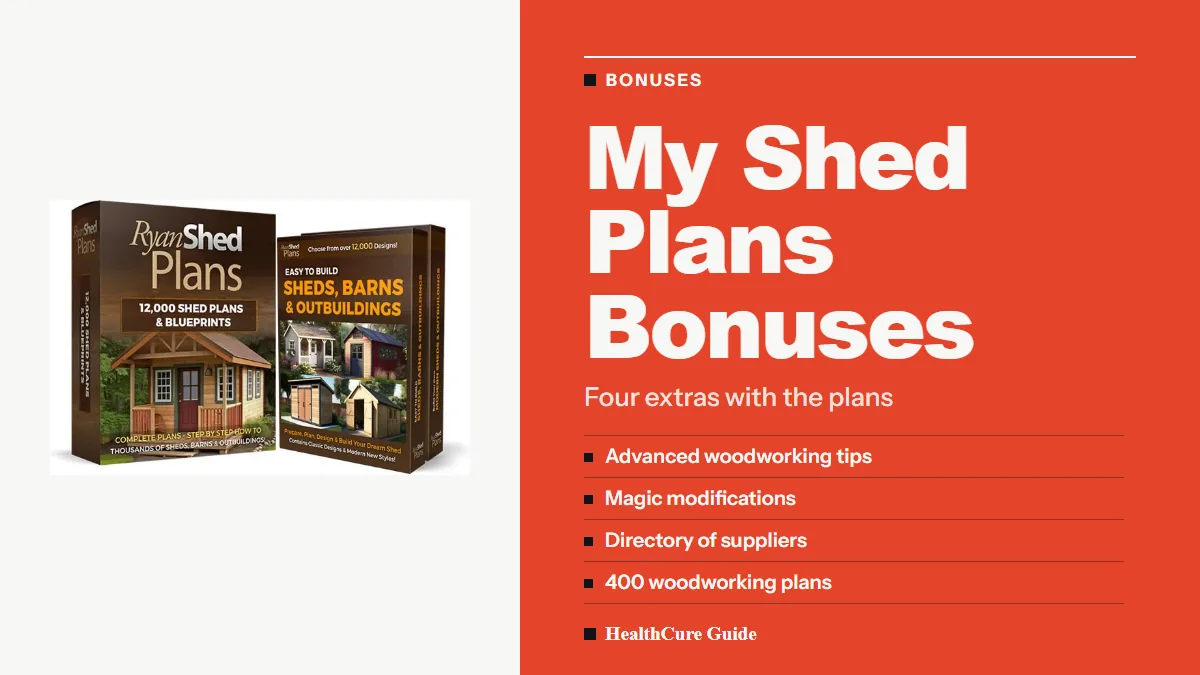
The My Shed Plans bonuses are easy to skim past on an order page, yet they change how a shed project feels once the library is open. Four extras arrive with the main set of plans: a techniques book, a dimension worksheet, a supplier directory and a further batch of woodworking plans. Together they make the $37 single payment go further in the workshop, and they are named on the order page without any figures attached to them.



My Shed Plans bonuses, one line each
Here is the short version. Advanced Woodworking Tips is a book on techniques beyond the basics. Magic Modifications is a worksheet for changing the dimensions of a shed plan. Directory of Suppliers lists woodworking suppliers and wholesalers. 400 Woodworking Plans adds more than four hundred woodworking plans, according to the seller. The table below sets each one beside the job it does on a real project.
| Bonus | What the seller says it is | Where it helps on a build |
|---|---|---|
| Advanced Woodworking Tips | A book on advanced woodworking techniques | Once the first shed is up and you want cleaner joints |
| Magic Modifications | A worksheet for changing a plan’s dimensions | When a design fits the style but not the footprint |
| Directory of Suppliers | Woodworking suppliers and wholesalers | Before a lumber and hardware run |
| 400 Woodworking Plans | Over 400 more woodworking plans | Browsing ideas for later projects |
Turning a close plan into your exact size
Few builders find a plan that matches their yard to the inch. A design may have the right roof and the right door, yet sit a foot too long for the space between the fence and the patio. The Magic Modifications worksheet is built for that moment. It walks you through changing the dimensions of a plan so the design can fit your ground, instead of forcing you to redraw from scratch.
Use the worksheet before you touch the lumber. Write down the new width, length and height, then note which parts of the cutting list will change as a result. Rafters, wall studs and the floor framing all move when the footprint shifts, so a single change can ripple through the materials list. Check the revised numbers against the local size limit and the setback from any property line, because a larger footprint can cross a rule that the original plan never touched.
Using the supplier directory on a lumber run
The Directory of Suppliers is the bonus that pays off in the car. A materials list tells you what to buy, and the directory helps you pick where to buy it. It lists woodworking suppliers and wholesalers, which can be useful when you want to compare a local yard with a specialist supplier for hardwood, hardware or roofing sheets.
Build a short list before you shop. Pick the three suppliers closest to your site, note which ones carry the sizes in your materials list and call ahead about the quantities you need. A phone call can reveal stock, delivery terms and cut-to-size options, which saves a second trip. Keep those notes with the plan so the whole shopping plan lives in one folder.
Using the extra plans for the next project
The 400 Woodworking Plans bonus is a longer shelf of designs. The seller describes them as woodworking plans rather than shed plans, so they may cover projects beyond a garden building. That makes the set useful after your first shed is finished. A bench, a storage unit or a planter stand can be a satisfying next build, and the extra plans give you a supply of ideas that match the same style of instructions.
Treat the extra plans the same way you treat the shed designs. Read the materials list, check the cutting list against the tools you own, and look for any step that needs a helper or a specialist tool. A plan for a piece of furniture still needs a steady surface, sharp blades and eye and hearing protection, so do not skip those simply because the project is small.
The advanced techniques book, after the basics
Advanced Woodworking Tips is the bonus for the second project rather than the first. The seller describes it as a book on advanced woodworking techniques, so it suits a builder who has already cut a few frames and wants to refine the work. Read it between builds, not during one, and keep notes on the techniques you plan to use on the next design.
Practice on scrap before you use a technique on a finished piece. Clamp a sample joint, check it with a square and adjust the saw or the jig until the fit is right. A book can show you a method, but it cannot tell you how your own wood and tools behave, so the scrap pile is still the best teacher.
Using the extras together on one project
A bonus earns its place only when it fits the way you work. Keep the extras open beside the shed plan you picked, not in a separate folder you forget. When you change a dimension with the worksheet, open the supplier directory at the same time, because a new length changes the lumber list, and the revised list changes which suppliers are worth a call.
Think of the four extras as tools for three different jobs. The worksheet handles the drawing, the directory handles the buying and the book handles technique. The extra plans cover the project after the shed. Keeping those jobs apart makes it easy to find the right tool when you are stuck halfway through a frame.
The My Shed Plans hub sums up the order in one place, and it is a sensible page to return to once the extras are in your folders.
Where the bonuses fit with the main library
The bonuses sit alongside the shed library in the members area, so the same sign-in gives you access to the plans and the extras. The hub page lists the full order. Nothing about the bonuses changes the library’s core job, which is to give you drawings, materials lists, cutting lists and staged instructions for shed designs. The extras support that work rather than replacing it.
It helps to keep a simple folder structure. Put the main plan in one folder, the modification worksheet in the same folder, the supplier directory in a shared folder for all projects and the extra plans in a separate folder for later. That arrangement means you can open the shed plan, the worksheet and the supplier list at once, which is how most of the planning really happens.
After each bonus, write one line in the margin of the plan about what changed in your build and why. Those notes turn a stack of extras into a record of your own choices, and they make the next project faster to plan.
The extras also work well for a second look at a finished section. Reading the modification worksheet after one wall is framed can show where a different size would have spared a cut on the next wall, which is the kind of lesson a library cannot give you on its own.
What the bonuses do not do
Honest limits matter here too. The bonuses do not check your local rules. Your town may limit the size of a shed, require a permit for a small structure or set a minimum distance from a property line. A changed plan, a supplier’s stock and a technique from a book all sit on top of those rules, not above them.
Before you dig, call the utility locator line, 811 in the United States, so that buried lines are marked. Follow each tool’s manual, wear eye and hearing protection, and ask a helper to lift wall frames and roof parts. Those steps keep the build safe, whichever bonus you use along the way.
Good to know
- The four bonuses are named by the seller and come with the same members-area access as the main library.
- The order page we read names the bonuses without separate prices, so this guide adds none.
- Read the what’s included page for the full list of parts that come with the order.
Ready to see how the bonuses sit beside the core plans? The price guide lays out the single payment, and our overview of what the library is explains how the members area works. The full review gives our editorial score, labelled as ours.
Common questions
How many bonuses come with My Shed Plans?
Four, as the seller names them: Advanced Woodworking Tips, Magic Modifications, Directory of Suppliers and 400 Woodworking Plans.
Is there a price listed for each bonus?
No. The order page we read names the bonuses without separate prices, so we do not add figures of our own.
What is the Magic Modifications worksheet for?
The seller describes it as a worksheet for changing the dimensions of a shed plan, which helps when a design is close to what you need but not the exact size.
Are the 400 extra plans shed plans?
The seller describes them as woodworking plans, over 400 in number. They are separate from the shed designs in the main library.
Do the bonuses replace local building rules?
No. Permits, size limits, setback rules and foundation requirements still apply to any structure you build from any plan.
Where are the bonuses delivered?
They sit alongside the library in the members area, so the same sign-in gives you access to the plans and the extras.