NeuroPrime Ingredients: A Plain-English Tour of All Nine Plants
Moringa, pine bark extract, ginkgo, tamarind, lion's mane, chlorella, bacopa, spirulina and neem: what each plant is, why a seller might include it and what to know before you buy.
- Written by
- HealthCure Guide Editorial Team
- Reviewed by
- HealthCure Guide Editorial Team
- Updated
- Reading time
- 8 min read
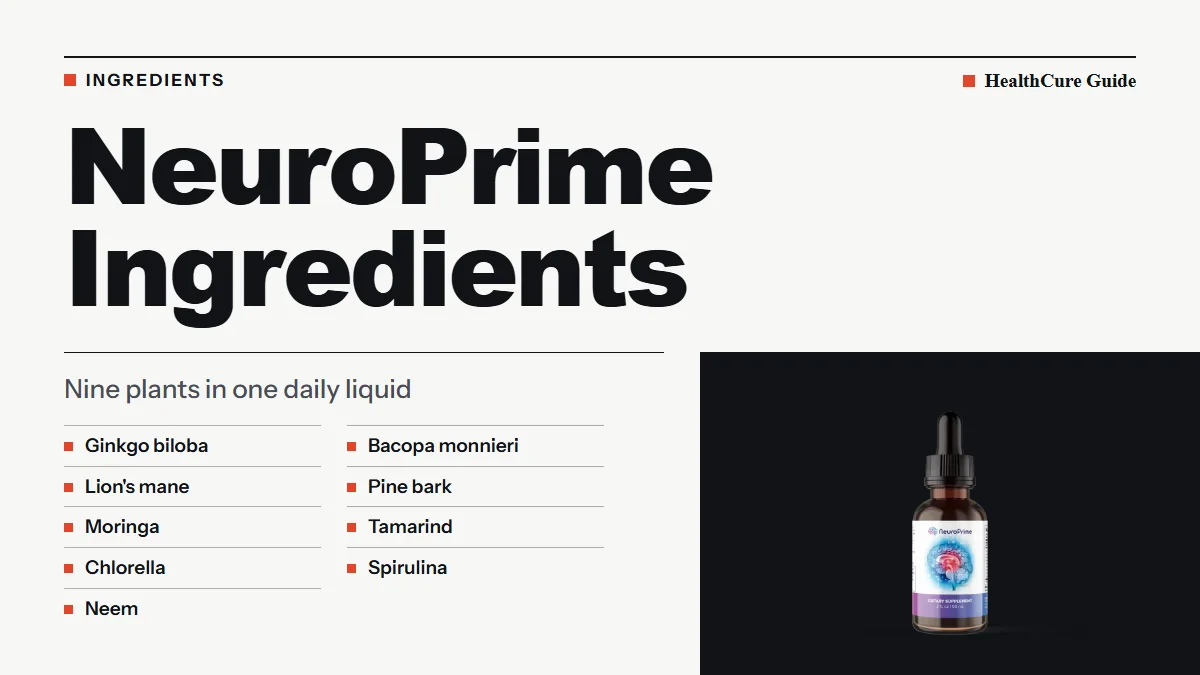
Before you try any supplement, it makes sense to read what is in it. Good news: the NeuroPrime ingredients are easy to read, because the seller names every plant. This guide walks through all nine in plain English, says what each one is, why a formula might include it and what to keep in mind. We stick to general, soft descriptions and attribute anything that comes from the seller.
The nine plants at a glance
| Plant | Kind of plant | Where it comes from |
|---|---|---|
| Ginkgo biloba | Tree | Leaf extract |
| Bacopa monnieri | Herb | The whole creeping plant, traditionally |
| Lion’s mane | Mushroom | The shaggy white fruiting body |
| Pine bark extract | Tree | Extract of the bark |
| Moringa | Tree | The leaves, often dried and ground |
| Tamarind | Tree | The sticky fruit pulp |
| Chlorella | Alga | Grown in fresh water |
| Spirulina | Alga | A blue-green microalga |
| Neem | Tree | Leaves and bark, traditionally |
No amounts are printed for these plants, so we quote none. What we can give you is context: what each plant is and how it is generally known.
The herbal and mushroom trio
Ginkgo biloba. Ginkgo is a famously old tree species, and its leaf extract is a household name in the supplement aisle, with a long history in herbal traditions. Because it is a name people recognise, it is also the one most often discussed with doctors, which is why we flag it in the safety note below.
Bacopa monnieri. Also called brahmi in some traditions, bacopa is a small creeping herb of wet ground, long used in Ayurvedic practice. Like ginkgo, it is worth mentioning to a doctor when you take regular medicine.
Lion’s mane mushroom. A white, shaggy mushroom that is eaten in cooking and has a place in traditional practice in parts of Asia. It is a favorite in the wellness world, and it forms part of the NeuroPrime blend.
The plant-extract and fruit group
Pine bark extract. A concentrated extract drawn from pine tree bark and known as a source of plant polyphenols. People who follow plant-based wellness will recognise it from other labels.
Moringa. Moringa, also known as the drumstick tree, grows in warm regions, and its leaves are eaten fresh or dried and ground. It is widely sold as a nutrient-rich green.
Tamarind. The brown, sticky pulp of a pod fruit with a sweet-and-sour taste, used in kitchens across many cuisines.
The green algae pair
Chlorella. A single-celled green alga that grows in fresh water and is typically marketed as a green superfood.
Spirulina. A blue-green microalga also sold as a green supplement, widely sold in many forms.
Both are familiar to anyone who has browsed the green-food shelf, and both are plant-based, which fits the seller’s description of the formula.
And then neem
Neem. A tree from the Indian subcontinent whose leaves and bark have a place in traditional Ayurvedic practice. It carries the one clear caution in the list: pregnancy, nursing and trying to conceive are all reasons to hold off unless a doctor approves.
What the seller says about the formula as a whole
The seller’s own summary is short: a natural, plant-based, non-GMO liquid, no stimulants, no chemicals, ingredients tested for purity and contaminants, and a purpose of supporting memory. Those are claims we pass along as the seller’s. We add nothing to them and promise no result from any single plant.
That restraint matters. We do not say that any one plant does something specific for your memory. The sensible view is of one blend of nine plants, used together as a daily routine.
A formula that fits a daily ritual
The liquid format earns its place here. NeuroPrime arrives as a 2 fl oz bottle with a dropper and is meant for once-a-day use, best in the morning. Take it neat, or stir it into tea, coffee, juice or whatever you drink. Give the bottle a shake beforehand, and follow the label for the amount. A bottle lasts a month.
That matters for ingredients because a plant liquid that vanishes into your coffee is easier to take every day than something you have to remember separately. You can read more about the product as a whole in our NeuroPrime reviews article.
Why a blend of nine, and not just one
A formula built on a single plant is simple to describe, but a blend lets a seller combine different kinds of plants in one daily routine. NeuroPrime brings together a leaf extract, a marsh herb, a mushroom, a bark extract, a fruit pulp, two algae and two more trees. The result is a rounded plant formula rather than a one-ingredient product.
For you as a buyer, that means two things. First, there is more to read, which is why we have taken the plants one by one. Second, no single plant should be treated as the whole story. If a page or a person tells you that one particular ingredient will transform your memory, be careful, because neither we nor the seller make that claim.
How to use the ingredient list well
Treat the list as a conversation starter, not a verdict. Taking regular prescribed medicine? Bring the nine names to your doctor or pharmacist. With ginkgo and bacopa in the blend, blood thinners, antidepressants and thyroid treatment are the usual reasons to ask first, and prescribed medicines should carry on as before. Our side effects guide covers this calmly and in detail, and the ingredients page in our catalog gives a short summary.
The openness of the list is a real strength. Many supplement labels hide behind proprietary blends, and a seller who lists nine plants plainly makes your due diligence a ten-minute job.
What we would like to see
Printed amounts beside each plant would be welcome, and we say so plainly, because they would make comparison easier. In the meantime, a named list, a purity statement from the seller and a year-long refund route give you a low-risk way to form your own view.
Reading the label like a pro
If you enjoy a little label detective work, here is how to get more from the ingredient list. Look at the names first and ask whether you recognise them. For NeuroPrime, you probably know at least a few, such as ginkgo, spirulina or moringa. Next, check whether any of them matter for your own circumstances, such as medicines you take or a pregnancy. Finally, look at what the seller says about quality, which in this case is that the ingredients are tested for purity and contaminants.
That three-step habit works for any supplement, and it takes minutes. It keeps you in charge of the decision and gives your doctor or pharmacist exactly the information they need.
A note on quality claims
The seller says its ingredients are tested for purity and contaminants, and we report that as the seller’s statement. We do not describe certifications or manufacturing standards that have not been stated, and you should be cautious about any page that does. What you can rely on is the plain list of nine plants and the guarantee that lets you test the routine for yourself.
Good to know
Ginkgo, bacopa and neem each justify a short chat with a doctor. Prescription users, especially on blood thinners, antidepressants or thyroid drugs, should ask before starting and stay on their medicines. Anyone expecting, nursing or planning a pregnancy should wait for approval. Whatever you decide, memory changes belong in a doctor’s office. Our NeuroPrime guide sets the formula in the context of the whole product.
The bottom line on NeuroPrime ingredients
Nine plants, all named, in a liquid for daily use. The seller describes the formula as natural, plant based and non-GMO, with purity-tested ingredients. Choose the six-bottle package and each bottle costs $39 with delivery included, while twelve months of guarantee leave time to see how the routine fits. Our NeuroPrime overview has the full picture.
Common questions
What are the NeuroPrime ingredients?
Nine plants: moringa, pine bark extract, ginkgo biloba, tamarind, lion's mane mushroom, chlorella, bacopa monnieri, spirulina and neem.
Does the seller print an amount for each ingredient?
The seller names the nine plants but does not print an amount for each, so we do not quote any.
Does NeuroPrime contain stimulants or chemicals?
According to the seller, no. It describes a natural, plant-based, non-GMO formula with no stimulants and no chemicals, and says the ingredients are tested for purity and contaminants.
Which ingredients matter for people on medicine?
Ginkgo and bacopa in particular. People on blood thinners, antidepressants, thyroid or other prescription medicine should ask a doctor first and keep taking what they were prescribed.
Is neem safe in pregnancy?
Neem is not for anyone who is pregnant, nursing or trying to conceive without a doctor's approval.
Is NeuroPrime a liquid or something I swallow whole?
It is a liquid in a 2 fl oz (60 mL) dropper bottle. Take it once a day, ideally in the morning, straight or mixed into a drink, and follow the label for the exact amount.