NeuroSalt Ingredients: What Is in Each Capsule, Amount by Amount
Five plants, five printed amounts, one two-capsule routine. Here is what each botanical is, where it comes from and why the seller combined them.
- Written by
- HealthCure Guide Editorial Team
- Reviewed by
- HealthCure Guide Editorial Team
- Updated
- Reading time
- 8 min read
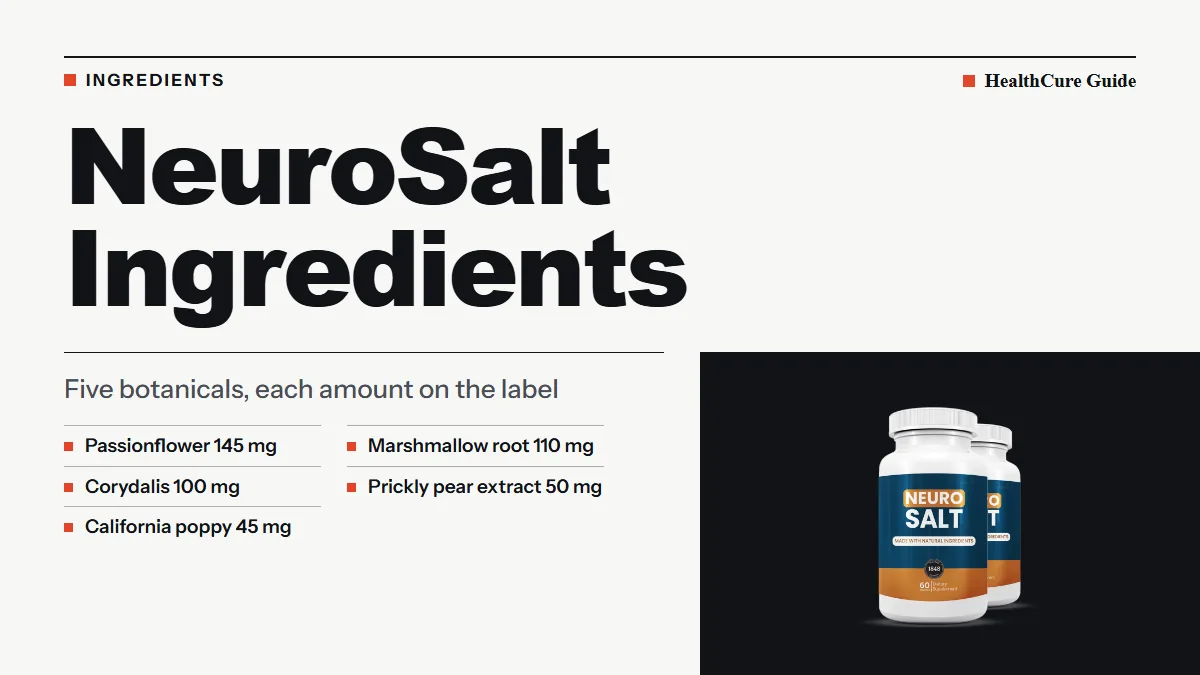
When you reach for a nighttime routine, you want to know exactly what you are swallowing. The NeuroSalt ingredients list makes that easy, because it is short, it is all plants, and every line carries a number. Below, we take the label one botanical at a time, in plain language.
The seller positions NeuroSalt as a daily aid for nerve comfort, a settled nervous system and more restful nights. The descriptions below rely on how these plants are traditionally used and on the seller’s wording. They are background, not a promise about what the capsules will do for you.
NeuroSalt supplement facts
One serving is two capsules. With 60 capsules in a bottle, you get 30 servings.
| Per serving | Plant | Latin name | Form used |
|---|---|---|---|
| 145 mg | Passionflower | Passiflora incarnata | Plant material |
| 110 mg | Marshmallow | Althaea officinalis | Root |
| 100 mg | Corydalis | Corydalis yanhusuo | Powder |
| 50 mg | Prickly pear | Opuntia phaeacantha | 20:1 extract |
| 45 mg | California poppy | Eschscholzia californica | Seed |
Non-active ingredients: the capsule shell is hydroxypropyl methylcellulose, and the label adds microcrystalline cellulose and magnesium stearate. The same panel appears in short form on our ingredients page.
Added together, the five plants come to 450 mg in each serving, and none of them hides inside a proprietary blend. You can hold the bottle beside this page and tick off each line.
Passionflower: the largest line
Passionflower is a climbing vine, and its leaves and flowers have a long history in evening herbal teas and relaxation routines. At 145 mg it is the largest line in the table, and that tells you where the seller put the weight: calm first. It is also one of the herbs that may cause drowsiness, a point we return to below.
Marshmallow root: the soothing plant
Marshmallow (Althaea officinalis) is not the campfire treat. The root is rich in a gel-like plant fiber, and herbal traditions use it in gentle, soothing preparations. At 110 mg it is the second-largest line in NeuroSalt, and it rounds out a formula that otherwise leans on calming flowers and seeds.
Corydalis: a traditional herb from East Asia
Corydalis yanhusuo is a small flowering plant whose tuber appears in traditional Chinese herbal practice, where it is known as yan hu suo. NeuroSalt uses 100 mg of the powdered form. It sits with the calming herbs in the formula, so the same drowsiness note applies.
Prickly pear extract: the cactus ingredient
Prickly pear (Opuntia phaeacantha) is a cactus found in dry regions of the Americas, and people eat its fruit and pads. Here you get 50 mg of a 20:1 extract, meaning a concentrate made from a much larger amount of the plant. It brings a different kind of botanical into a blend that otherwise leans on calming herbs.
California poppy seed
California poppy (Eschscholzia californica) is the state flower of California, and in herbal tradition it is used as a gentle calming plant. NeuroSalt includes 45 mg of the seed, the smallest of the five amounts. As with passionflower and corydalis, sleepiness is possible.
Why these five together
Step back and a pattern shows. Corydalis, passionflower and California poppy are the calming trio. Marshmallow is the soothing root, and prickly pear is the cactus extract. The seller sells that mix as an evening-friendly routine for nerve comfort and restful sleep. No stimulant is listed, and the shell is plant-based hydroxypropyl methylcellulose, so there is no gelatin.
Much of the appeal is simplicity: two capsules, one glass of water and an ingredient list you can read in thirty seconds. Buy six bottles and each day costs around $1.63 ($49 divided by 30). All three packages are laid out in the price guide.
How to read the label like a pro
Start with the serving size. It is two capsules, so every amount in the table belongs to the pair together. Next, the servings per container: 30. Finally, glance at the other ingredients, which are the capsule shell and flow agents rather than active plants.
Each active line names the plant, its Latin name, the part used and the amount. A careful buyer wants exactly that detail, which is why we call this a clear label. For the wider picture, open our NeuroSalt review.
Putting the amounts in perspective
Line the five plants up from largest to smallest and the shape of the formula appears: passionflower at 145 mg, marshmallow root at 110 mg, corydalis at 100 mg, prickly pear at 50 mg and California poppy seed at 45 mg. The top three account for most of the weight in each serving, while the last two are smaller supporting lines. Nothing here is a mega-dose and nothing is hidden, which is exactly what makes the panel easy to understand. Two capsules deliver the whole serving, so you do not have to count or split anything.
Questions about the label
Is there a hidden blend? No. A proprietary blend lumps ingredients under one total, but this panel gives each plant its own milligram figure, so you can see how the formula is built.
What does 20:1 mean? It describes the extract. As a rule of thumb, roughly twenty parts of the plant go into one part of extract, which makes the prickly pear line more concentrated than a plain powder of the same weight.
Is the capsule shell animal-derived? The label names hydroxypropyl methylcellulose, a plant-based material, so the shell is not gelatin.
How do I compare it with another product? Put the labels side by side and check four things: the amount of each plant, the form used (powder, extract or seed), the serving size and the non-active ingredients. A fair comparison needs the same serving size on both sides. Our NeuroSalt hub lists the formula and packages together if you want everything on one screen.
How to take it
The directions are short. Swallow two capsules once a day with 8 oz of water, and do not exceed that. If you already take other herbal or calming products, compare their labels and ask your pharmacist how they fit together.
Safety notes worth knowing
Three of the herbs here have a calming reputation, and calm can slide into sleepiness. Leave alcohol and sedatives out of the picture, and if you feel heavy-eyed, stay out of the driver’s seat. Never drop a prescribed medicine for a supplement. Doctors should hear about this one first when your regimen includes anything for nerve pain, diabetes, blood pressure, blood thinning or sleep. The seller’s FAQ also asks anyone pregnant, nursing, under 18 or living with a medical condition to show the label to a doctor before starting. Our safety summary keeps these points in one place.
Where it is made
Production happens in the USA, in a facility registered with the FDA, and the ingredients are naturally derived. Those are the seller’s words about its own manufacturing, and we relay them as such.
Is this formula right for you?
Adults who prefer a plant-based daily habit and a label they can follow are the natural audience. It is not a quick fix, and the seller does not pitch it as one. Because the guarantee covers 60 days after purchase (with at least 30 days of use requested before you write to support), the first step carries little risk. Study the label, give the routine a go, and make your own call.
Good to know:
- Your doctor comes first. Continue prescribed medicines and ask before you begin.
- Herbs that calm can also make you drowsy, so plan your first evenings accordingly.
- Individual results differ.
Common questions
What are the NeuroSalt ingredients?
Per two-capsule serving the label lists passionflower 145 mg, marshmallow root 110 mg, corydalis powder 100 mg, prickly pear 20:1 extract 50 mg and California poppy seed 45 mg.
What are the other ingredients?
Microcrystalline cellulose, hydroxypropyl methylcellulose (the capsule shell) and magnesium stearate.
How do I take NeuroSalt?
Two capsules a day with an 8 oz glass of water. A bottle holds 60 capsules, which is 30 servings or 30 days.
Can the herbs make me drowsy?
Passionflower, California poppy and corydalis are calming herbs and may cause drowsiness. Avoid alcohol and sedatives with NeuroSalt and do not drive if you feel drowsy.
Who should ask a doctor first?
Anyone who takes medicines for nerve pain, diabetes, blood pressure, blood thinners or sleep, and anyone pregnant, nursing, under 18 or living with a medical condition. Keep taking your prescribed medicines.
Where is NeuroSalt made?
According to the seller, in the USA in an FDA-registered facility, from naturally derived ingredients.