Phytomem One Side Effects: A Calm Guide to Safe Use
Careful shoppers ask about safety before they ask about price. Here is what the label and the seller say, who should speak to a doctor first, and how to begin sensibly.
- Written by
- HealthCure Guide Editorial Team
- Reviewed by
- HealthCure Guide Editorial Team
- Updated
- Reading time
- 8 min read
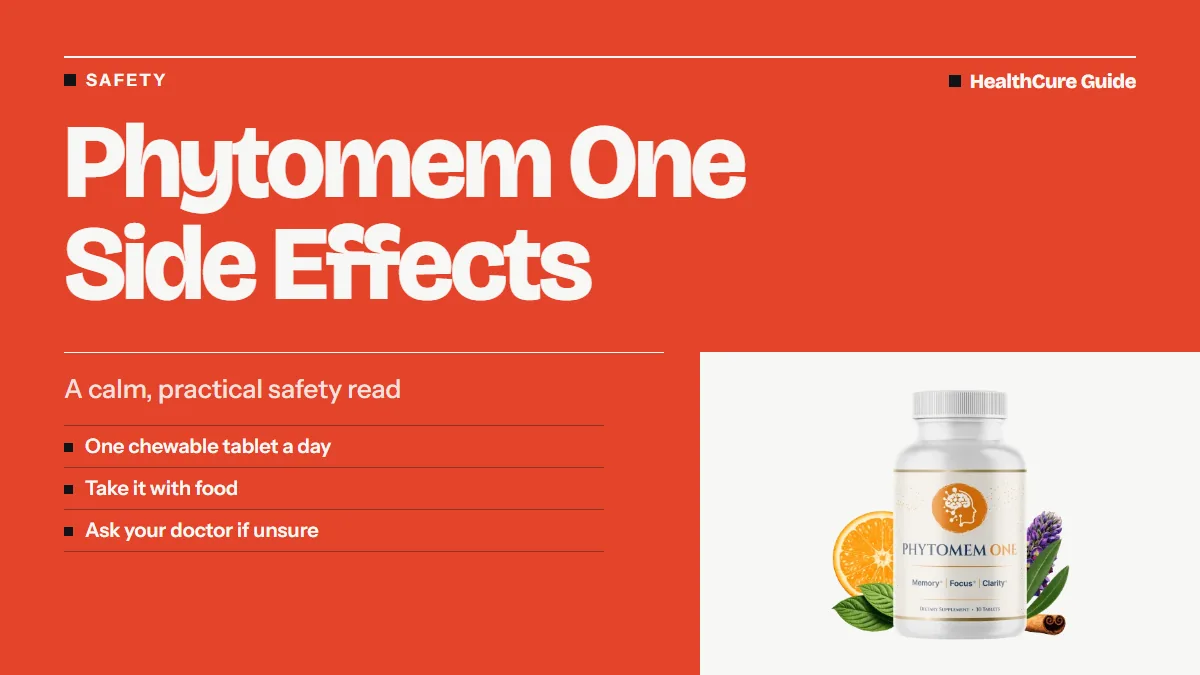
It is a good sign when someone asks about safety before they buy. Anyone who is going to take a tablet every day should know what is in it and who it is meant for. This guide takes the question of Phytomem One side effects step by step, without drama and without brushing it aside.
Phytomem One is a chewable supplement that the seller positions as help for memory, focus and a clearer head. It is not a medicine, and it makes no promise to treat anything. What follows is built from the label and the seller’s own pages, plus ordinary good sense.
Phytomem One side effects: what the sources say
Start with what the seller says about how the tablet behaves. It describes the formula as stimulant-free, as non-habit forming and as gentle on the stomach. It also calls the tablets easy to take. Those are the seller’s descriptions, and we pass them along as such.
The label adds the formal part. It warns against going over the dose, and it points certain readers toward a doctor visit first. That is standard, sensible wording for a dietary supplement, and it is the part we would pay most attention to.
We do not claim that nobody will ever react to a supplement. People differ, and a tablet that suits one person may not suit another. What we can do is show you how to start carefully.
The label caution in plain language
| If this describes you | What the label suggests |
|---|---|
| You are pregnant | Talk to a doctor before starting |
| You are nursing | Speak to a doctor before starting |
| You are under 18 | Speak to a doctor before starting |
| You have a medical condition | Speak to a doctor before starting |
| You want to take extra | Do not exceed the stated dose |
Notice the pattern. Four rows ask for the same simple step, and one row sets a ceiling. None of it is complicated, and a short chat with a doctor or pharmacist covers all of it.
A closer look at berberine and blood-sugar medicines
One of the ten extracts deserves a specific mention. Berberine HCl is the seller’s lead ingredient for the energy team, which it describes in terms of how cells use glucose. Several of its teammates, including Ceylon cinnamon, corosolic acid, kudzu and oleuropein, are described by the seller in similar terms.
The takeaway is easy to follow. If you take any medicine that affects blood sugar, ask your doctor before you start Phytomem One. The same applies to any prescription medicine you use regularly. A doctor or pharmacist can read the ingredient list against your medicines in a way no article can.
You can bring the full label with you. Our ingredients list table sets every line out on one screen, so it is easy to show or send.
How to start in a sensible way
A new supplement is best introduced quietly. Here is a routine that keeps things simple.
- Check with a professional first if any caution applies to you.
- Take one chewable tablet, no more. The label sets the dose, and the dose does not change on a good day.
- Have it with food. The seller recommends one daily with food, and a meal is the easiest anchor.
- Start on an ordinary day. Avoid trying it for the first time just before something important.
- Keep notes. A line each evening is enough: how you slept, how you felt, anything unusual.
- Do not combine it with other new supplements at the same time. If you change two things at once, you cannot tell which did what.
None of that is special to this product. It is good practice for any new tablet.
If something feels off
Listen to your body. If you feel unwell after starting, stop taking the tablets and speak to a doctor. Bring the bottle with you so the label is on hand.
You can also write to the product support inbox, [email protected], with your question. And since the seller backs the order with a 60-day guarantee, you do not have to keep using something that does not suit you. The refund route is laid out in our guarantee guide, one stage at a time.
What stimulant-free and non-habit forming mean
Two phrases from the seller come up often, so it helps to define them in everyday terms.
- Stimulant-free. The seller says the formula is not built around a stimulant. That is a statement about the recipe, not a guarantee about how any person will feel.
- Non-habit forming. The seller states the tablet is not habit forming. Again, this is its description, and your own doctor is the person to ask about your situation.
Treat both as helpful context and not as a replacement for the label caution.
Who may want to wait
Based on the label, these readers should hold off until they have spoken to a doctor.
- Anyone expecting a baby or breastfeeding.
- Anyone younger than 18.
- Anyone living with a medical condition or following a treatment plan.
- Anyone taking medicine for blood sugar.
That is not a verdict on the product. It is simply the right order of events: ask first, then decide.
Questions to bring to a doctor or pharmacist
A short list makes the appointment productive. You might ask:
- Is there anything in this ingredient list that clashes with my medicines?
- I take something for blood sugar. Should I wait, or is there a way to start safely?
- Is there a reason in my history to avoid any of the plant extracts, such as sea kelp, olive leaf, banaba or kudzu?
- How long should I give a new supplement before reviewing it?
Print or photograph the label first, and take the bottle along when it arrives. Professionals appreciate a precise list, and you will leave with an answer that fits you rather than a generic one.
Keeping a sense of proportion
It is easy to read a list of cautions and feel uneasy. Try to keep it in proportion. Cautions of this kind appear on almost every supplement label, and their job is to make sure the right people ask the right questions before they start. If none of the caution groups apply to you and you take no regular medicine, you are in the position the seller seems to have in mind: an ordinary person who wants a daily routine for memory, focus and clarity.
A word on quality signals
Safety is also about trust in the source. The bottle names Phyto Thrive Labs as the distributor, with a street address in Largo, Florida. The order runs through ClickBank, and the seller publishes support and returns details. The seller also says its ingredients are handled in a certified facility under the USDA National Organic Program, a statement we repeat only as the seller’s. These are small markers that help you trust where the product comes from. For the full picture of the offer, the hub overview collects our guides, and its safety sub-page keeps the short version.
Our verdict
Safety questions around a daily tablet are best met with calm and preparation. Read the label, honor the dose, ask a doctor first if any caution fits you, and especially if you take medicine that affects blood sugar. With those steps in place, Phytomem One comes with a clear label, a gentle description from the seller and a refund route if it is not right for you. We score it 9.2/10.
Good to know:
- This article is general information and does not replace advice from your own doctor.
- Reactions to supplements differ from person to person.
- Keep the bottle and label handy for any health professional you see.
Common questions
Does the seller list any specific Phytomem One side effects?
The seller describes the tablet as easy on the stomach, free of stimulants and not habit forming. For formal guidance, look to the caution printed on the bottle, which covers the dose and who should check with a doctor beforehand.
Who should speak to a doctor before trying it?
The label points to three groups: women who are expecting or nursing, minors, and people living with a medical condition.
Why is berberine mentioned for people on medicine?
The seller describes berberine in terms of glucose use. Anyone who takes medicine for blood sugar should ask a doctor first, and the same goes for any medicine you take regularly.
How much should I take?
One chewable tablet a day, as directed on the label. The label says not to exceed the dose.
Should I take it with food?
The seller's FAQ says one daily with food, so a meal is the simplest time.
What if it does not agree with me?
If you feel unwell, stop taking it and talk to a doctor. The 60-day guarantee also lets you send the order back for a refund, with shipping fees deducted from the amount.