ProstaVive Ingredients List: The Whole Supplement Facts Panel
The whole panel, laid out the way it is printed: the left column, the right column, the other ingredients and the seller's free-from note, with a few sums you can check against the tub.
- Written by
- HealthCure Guide Editorial Team
- Reviewed by
- HealthCure Guide Editorial Team
- Updated
- Reading time
- 8 min read
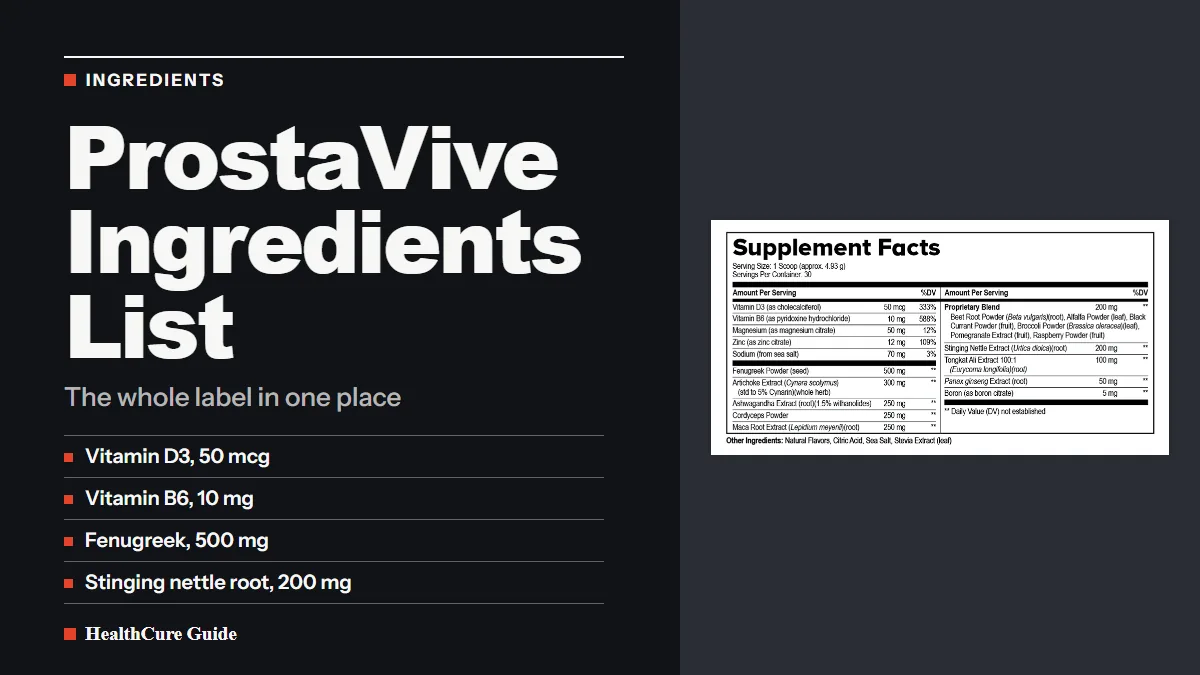
A label is only useful if you can read it, and a supplement-facts panel can look like a wall of small print. This ProstaVive ingredients list sets the panel out the way it is printed on the tub, with a plain note beside each part. We worked from the panel image the seller publishes, and we left out the sales copy, so this page is the label and nothing but the label.
If you would like the ingredients explained family by family, our companion piece on what the plants do, according to the seller covers that. For the product as a whole, the ProstaVive guide is the place to go.
ProstaVive ingredients list: the left column of the panel
The panel has two columns. The left one starts with the vitamin and mineral lines and then moves on to plants.
| Line | Form named on the label | Daily value | Amount in a scoop |
|---|---|---|---|
| Vitamin D3 | cholecalciferol | 333% | 50 mcg |
| Vitamin B6 | pyridoxine hydrochloride | 588% | 10 mg |
| Magnesium | citrate | 12% | 50 mg |
| Zinc | citrate | 109% | 12 mg |
| Sodium | sea salt | 3% | 70 mg |
| Fenugreek | seed powder | Not established | 500 mg |
| Artichoke | whole-herb extract, 5% cynarin | Not established | 300 mg |
| Ashwagandha | root extract, 1.5% withanolides | Not established | 250 mg |
| Cordyceps | powder | Not established | 250 mg |
| Maca | root extract | Not established | 250 mg |
Two details are easy to miss. First, mcg means micrograms, and a milligram equals 1,000 micrograms, so 50 mcg of vitamin D3 is a very small weight even though its daily value is high. Second, only the five lines at the top carry a percentage, which is why the plant lines show “not established” instead.
The right column, including the 200 mg blend
| Line | Form named on the label | Amount in a scoop |
|---|---|---|
| Proprietary blend of six items | see the next paragraph | 200 mg together |
| Stinging nettle | root extract | 200 mg |
| Panax ginseng | root extract | 50 mg |
| Tongkat ali | root extract, ratio 100:1 | 100 mg |
| Boron | citrate | 5 mg |
Every line in this column carries the same footnote: daily value not established.
The six items inside the blend are pomegranate extract, raspberry powder, black currant powder, beet root powder, broccoli leaf powder and alfalfa leaf powder. The label gives them one combined weight and no individual doses, and we will not guess at a split.
The other ingredients
Under the two columns, the label closes with an other-ingredients line with four entries: natural flavors, then citric acid, then sea salt and a stevia extract from the leaf. Sea salt shows up twice in a sense, since the sodium line above it comes from the same source.
On its contact page the seller goes further. Gluten, dairy, soy, wheat, barley and anything of animal origin are, it says, absent from the powder, and it knows of no allergens in it. We pass those statements on as the seller’s. Anyone with a food allergy should still read the tub in hand and ask a doctor.
What “daily value” means on this panel
A daily value, shown as a percentage, compares the amount in a serving with a reference amount for a typical day. A figure of 109% for zinc says a scoop supplies slightly more than that reference. A figure of 588% for vitamin B6 says it supplies several times the reference. Neither number is a verdict. A percentage simply tells you how a scoop stacks up against one standard, and it helps most when you add it to what other products already give you. For the plants and boron, the panel carries a footnote that no daily value has been established, so there is no percentage to compare.
A sixty-second tour of the panel
If you only have a minute, read it in this order. Start at the top left with the serving size and the count of 30 servings. Move down the left column and note the five lines with percentages. Cross to the right column and find the blend with its single 200 mg total. Finish with the other-ingredients line at the bottom. That route takes you past every number on the label, and it is the same order we used for the tables above.
Sums you can check yourself
Numbers on a label should add up, and a few of them do so neatly.
- Servings. A scoop of about 4.93 g times 30 servings gives 147.9 g, which matches the tub’s net weight of 148 g (5.29 oz).
- The plant total. The nine plant lines, counting the blend as one, add up to 2,100 mg, the figure printed as 2100MG on the front of the tub.
- How much of the scoop is plants. 2,100 mg out of about 4,930 mg is roughly 43% (2,100 / 4,930). The remaining 2,830 mg is boron, the vitamin and mineral lines and the other ingredients.
None of this is a claim about outcomes. It is a way of seeing that the label is internally consistent, which is reassuring for a daily powder.
What the panel does not print
A label is a snapshot, and some questions fall outside it.
- No split of the blend. You can see the 200 mg total but not the share of each fruit, leaf or root.
- No purpose statements. The panel lists contents, not what each item is for. The seller’s roles live on its order page, and we cover them in our ingredients guide.
- No cautions. The image we read has none printed. The seller’s site disclaimer and FAQ carry its guidance instead.
None of this is a flaw. It simply means the panel tells you what is inside, and your doctor or pharmacist is the right person for anything more personal.
Using the label next to your own supplements
If you already take a multivitamin or a single nutrient, put the labels side by side and check four lines: vitamin D3, vitamin B6, zinc and magnesium. A scoop has 50 mcg, 10 mg, 12 mg and 50 mg of those. The seller advises against taking ProstaVive with other supplements that hold similar ingredients, so a pharmacist can run the comparison in a couple of minutes if you bring both labels. Our safety guide explains the vitamin figures in more detail.
Where the powder is made, according to the seller
On the seller’s account, a US facility registered with the FDA makes the powder to GMP guidelines. That is a status the seller reports, we have not inspected the plant, and registration of a site is not an endorsement of any product. The seller adds that the powder is neither a stimulant nor habit-forming.
The routine the label describes
Stir a scoop into water or a drink once a day. A tub lasts 30 days, and six tubs at $234 last 180, about $1.30 a day ($234 / 180). Inside the US, six tubs go out with no shipping fee, while the checkout adds $9.95 to one tub or three tubs (the figure on 28 October 2026). Whichever you pick, the refund window runs 180 days from the order date, and our price page sets out the packages in full. The ProstaVive hub page has the rest.
A health note
Keep taking any medicine you have been prescribed. When pregnancy, nursing, medication or a medical condition is in the picture, the seller itself advises asking a physician first, and the label panel is a good thing to bring along.
Good to know:
- The label is the main source for what is inside, and the order page adds the seller’s own explanations.
- The blend’s individual amounts are not published.
- People respond differently, so it helps to think of a daily scoop as a habit over months.
Common questions
What is the serving size on the ProstaVive label?
A single scoop of roughly 4.93 g, taken daily. The tub holds 30 of them, which makes 30 days.
How many lines does the ProstaVive supplement facts panel have?
Fifteen: five vitamin and mineral lines, nine plant lines (counting the six-plant blend as one) and boron.
Which lines show a percent daily value?
Vitamin D3 (333%), vitamin B6 (588%), magnesium (12%), zinc (109%) and sodium (3%). The plants and boron are marked as having no established daily value.
What are the other ingredients on the label?
A short line of four items: sea salt, natural flavors (no flavor is named), citric acid and a stevia extract made from the leaf.
Is ProstaVive free from gluten and dairy?
That is the seller's statement: it lists gluten, dairy, soy, wheat, barley and animal products as absent and says it knows of no allergens. We cannot test it ourselves.
Where can I see the real label?
On the seller's order page, which our buttons open. The panel is also shown on the tub, and we built this page from the image the seller publishes.