Protoflow Ingredients: Every Label Line and Its Printed Amount
Fourteen lines, fourteen printed amounts and no blend to decode. This is a plain walk through the Protoflow Supplement Facts panel, with the capsule contents spelled out as well.
- Written by
- HealthCure Guide Editorial Team
- Reviewed by
- HealthCure Guide Editorial Team
- Updated
- Reading time
- 8 min read
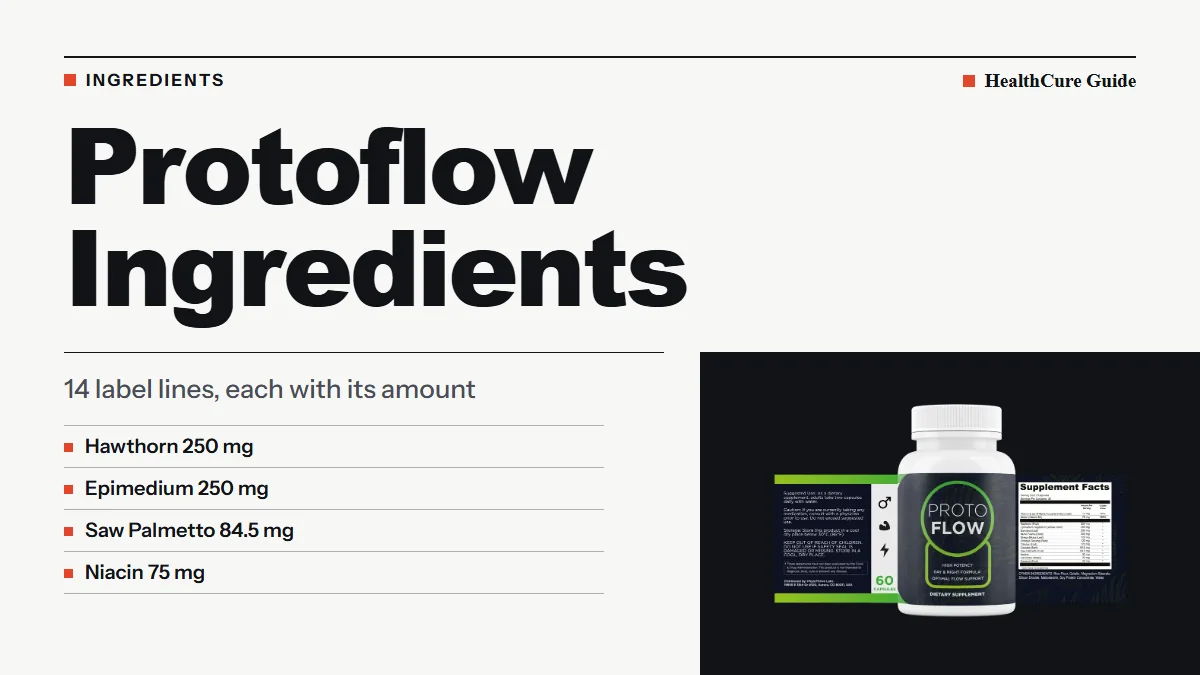
Labels ought to settle questions, and this one largely does. Each ingredient is named, given a milligram figure and left at that. We studied the label image on 11 November 2026 and rebuilt it below so it is easy to scan, which lets you compare every line with the bottle in your hand.
Protoflow is a capsule supplement for adult men, sold as a daily prostate-support formula. In the seller’s words, normal bladder, prostate and reproductive-system function is what it aims to support. Anything we say about a line below is that general description or a plain fact from the label, and none of it promises a result.
Protoflow Ingredients: The Full Label
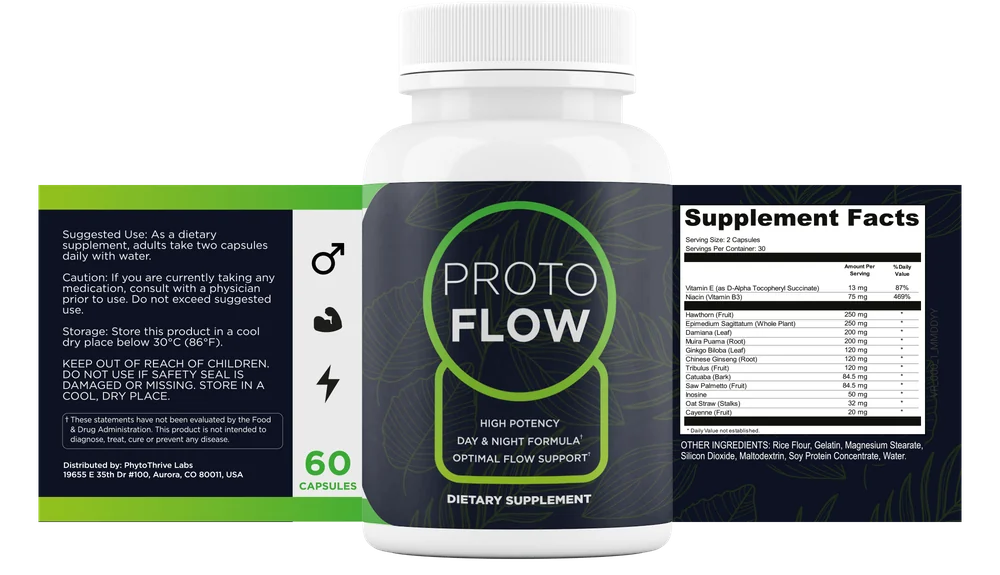
Each figure covers a serving of two capsules, and a container holds 30 servings. We sorted the lines from the lightest to the heaviest so the scale of the formula is obvious at a glance.
| Amount | Line on the label | Plant part or type | Daily Value |
|---|---|---|---|
| 13 mg | Vitamin E (as D-Alpha Tocopheryl Succinate) | Vitamin | 87% |
| 20 mg | Cayenne | Fruit | None set |
| 32 mg | Oat Straw | Stalks | None set |
| 50 mg | Inosine | Compound | None set |
| 75 mg | Niacin (Vitamin B3) | Vitamin | 469% |
| 84.5 mg | Catuaba | Bark | None set |
| 84.5 mg | Saw Palmetto | Fruit | None set |
| 120 mg | Ginkgo Biloba | Leaf | None set |
| 120 mg | Chinese Ginseng | Root | None set |
| 120 mg | Tribulus | Fruit | None set |
| 200 mg | Damiana | Leaf | None set |
| 200 mg | Muira Puama | Root | None set |
| 250 mg | Hawthorn | Fruit | None set |
| 250 mg | Epimedium Sagittatum | Whole plant | None set |
What the Label Does Not Hide
Plenty of supplements tuck their herbs into a proprietary blend and print one combined weight. Nothing is tucked away here. Hawthorn and Epimedium Sagittatum lead the herbs at 250 mg each, and Cayenne trails at 20 mg. Any two lines can be compared at once, and you can see which weighs more.
That openness is the main reason we rate the label highly. It cannot say how the capsules will suit your body, and no list could, yet it hands you the facts for a pointed question to a doctor or pharmacist.
The Lines by Plant Part
Grouping by part of the plant shows how varied the panel is.
- Fruits: Hawthorn at 250 mg, Tribulus at 120 mg, Saw Palmetto at 84.5 mg and Cayenne at 20 mg.
- Roots: Muira Puama at 200 mg and Chinese Ginseng at 120 mg.
- Leaves: Damiana at 200 mg and Ginkgo Biloba at 120 mg.
- Whole plant: Epimedium Sagittatum at 250 mg.
- Bark and stalks: Catuaba at 84.5 mg and Oat Straw at 32 mg.
- Compound and vitamins: Inosine at 50 mg, Niacin at 75 mg and Vitamin E at 13 mg.
The seller gives no separate job to each line, and we will not invent one. The formula is offered as a whole, with normal bladder, prostate and reproductive-system function as its stated aim.
Reading the Panel as a Shopper
A label is most useful when you know what to look for. Start with the serving line, which says two capsules, not one. Then check that every ingredient has its own number: on this panel, all 14 do. Next, find the Daily Value column, which here is filled in only for the two vitamins. Finally, read the other ingredients beneath, since that is where a capsule shell and any additives or carriers show up.
Do the same with any bottle you consider, including this one, and the comparison takes five minutes. Our reviews guide shows how the full picture, label, price and refund, fits together, and the Protoflow guide gathers all of it on one page.
Making Sense of the Milligrams
Because a serving is two capsules, each capsule carries about half of every printed figure. Hawthorn’s 250 mg works out to roughly 125 mg a capsule, Damiana’s 200 mg to roughly 100 mg, and Cayenne’s 20 mg to roughly 10 mg. The figures on the label are the ones to quote, since they are what the seller prints, but the halving helps when you picture what one capsule holds.
It also helps to think in tiers. Two lines sit at 250 mg, two at 200 mg, three at 120 mg and two at 84.5 mg, with the remaining herbs and compounds below that and the vitamins at the bottom of the scale. Such a spread tells you nothing about outcomes, but it does show that no single line dominates the panel.
The Two Vitamins and Their Daily Values
Just two lines show a Daily Value percentage, and both are vitamins. Niacin (Vitamin B3) is printed at 75 mg and 469%. Vitamin E, supplied as D-Alpha Tocopheryl Succinate, is printed at 13 mg and 87%. No Daily Value has been set for the herbs.
Four hundred sixty-nine percent is a big number, so it deserves a mention. Niacin at this size can cause flushing in some people, a warm, tingling redness in the skin. That remark is ours, not the seller’s.
What Else Is in the Capsule
Under the panel sits the remaining list: rice flour, gelatin, magnesium stearate, silicon dioxide, maltodextrin, soy protein concentrate and water. To say it plainly, gelatin forms the shell and soy protein is part of the contents, so anyone who avoids gelatin or soy for an allergy, a diet or a conviction should look elsewhere. For everyone else, it is simply a list to read once.
Page Versus Label
On its web page the seller names eight ingredients and gives no amounts. The label image runs to 14 lines, each with one. Where the two disagree we follow the label, since it is the information printed on the product. Ginkgo Biloba, Tribulus, Inosine, Oat Straw, Vitamin E and Niacin are the six lines that the page leaves out.
How to Take It
The directions for adults call for two capsules a day, swallowed with water, and name no hour, so choose a moment you will remember. At 60 capsules a bottle, one bottle lasts 30 days, three last 90 and six last 180. The label adds three housekeeping notes: keep it away from children, store it somewhere cool and dry below 86F, and leave it unused if the safety seal is damaged or missing.
A Safety Note on the Ingredients
The bottle’s caution says anyone currently on medication should talk to a physician before using it, and should stay within the suggested use. We add our own advice. Carry on with your prescriptions. Raise Protoflow with a doctor or pharmacist first if you use blood thinners or medicine for blood pressure, the heart or diabetes, because the panel lists ginkgo, ginseng, hawthorn, saw palmetto, cayenne and 75 mg of niacin. It is made for adult men; women and anyone under 18 should not take it. See a doctor about night-time bathroom trips, a weak stream, or pain or blood in the urine, and keep up your prostate checks, which no supplement replaces. Our side effects guide covers these points in more detail.
Price and Packages
The six-bottle order is $49 a bottle, $294 in total and about $1.63 a day, and brings free US delivery with four bonus eBooks. Three bottles are $59 each, $177 in all, with the same delivery and eBooks. Two bottles are $79 each, $158 in all, with a shipping fee and no eBooks. Our price breakdown has the arithmetic, and a 60-day money-back guarantee covers each package: unopened items, your own postage, shipping fees deducted. The ingredients page of our guide shows the same panel in compact form.
Common questions
What are the Protoflow ingredients?
Per two capsules, the label lists Vitamin E 13 mg, Niacin 75 mg, Hawthorn 250 mg, Epimedium Sagittatum 250 mg, Damiana 200 mg, Muira Puama 200 mg, Ginkgo Biloba 120 mg, Chinese Ginseng 120 mg, Tribulus 120 mg, Catuaba 84.5 mg, Saw Palmetto 84.5 mg, Inosine 50 mg, Oat Straw 32 mg and Cayenne 20 mg.
Does the label print an amount for every ingredient?
Yes. All 14 lines carry their own amount, and there is no proprietary blend.
What else is in the capsule?
The other ingredients are rice flour, gelatin, magnesium stearate, silicon dioxide, maltodextrin, soy protein concentrate and water.
How many capsules do I take?
The label says adults take two capsules daily with water. A bottle holds 60, so it lasts 30 days.
Are there Daily Values?
Two lines have them: Niacin at 75 mg is 469% of the Daily Value and Vitamin E at 13 mg is 87%. A Daily Value is not established for the herbs.
Should I check with a doctor about the ingredients?
Yes. Keep taking prescribed medicines and ask a doctor or pharmacist first if you use blood thinners or medicine for blood pressure, the heart or diabetes, or have a soy or gelatin allergy.