The Last Wish Pineal Gland: Facts vs the Video's Claims
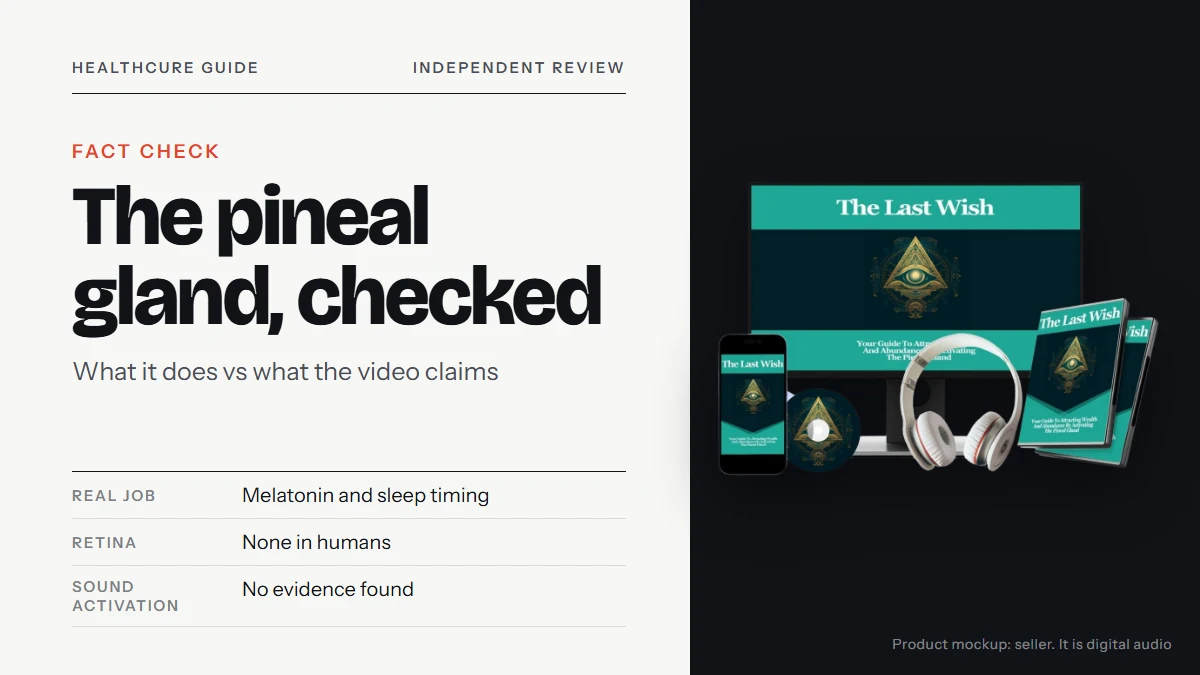
The sales video builds its pitch on the pineal gland. We lay out what that small gland really does, which of the video's statements are wrong or unproven, and what that means for a buyer.
- Written by
- HealthCure Guide Editorial Team
- Reviewed by
- HealthCure Guide Editorial Team
- Updated
- Reading time
- 9 min read
This guide contains affiliate links. If you buy through them we earn a commission at no extra cost to you. It does not change the verdict. Disclosure.
The last wish pineal gland claims are the engine of the whole sales pitch, so they are worth checking one at a time. This page sets each statement from the video beside what is known about the gland. It does not judge anyone’s faith. It only checks statements about the body. Readers after the wider verdict on the offer can open our complete review; the manifestation idea built on this gland is handled in a companion piece.
Our position: independent, no purchase made, and no tie to the seller. Everything below comes from the seller’s pages, video and Terms as saved on 2026-10-09. Links to the offer are affiliate links, and a purchase through one can pay us a commission.
What the pineal gland does
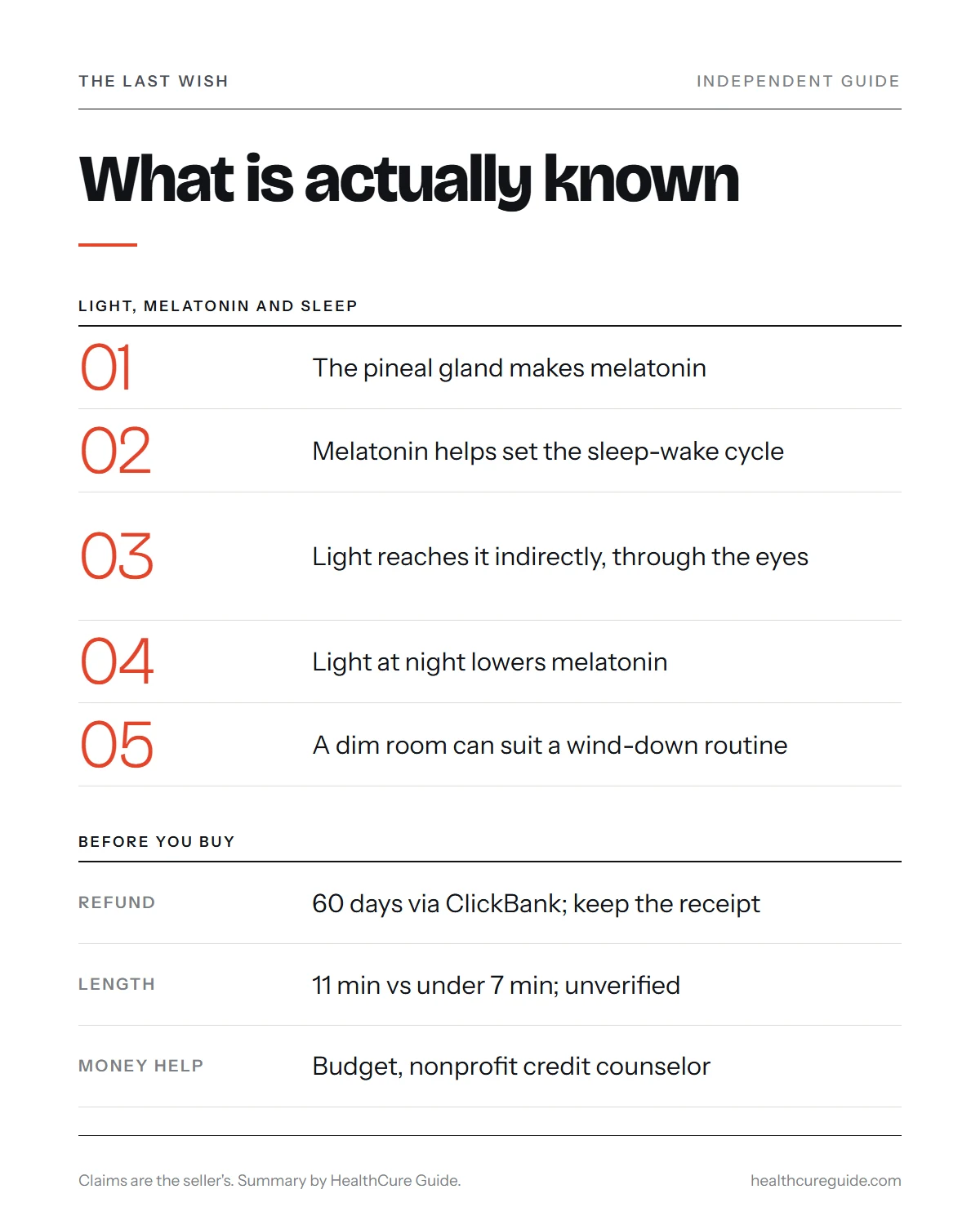
This gland is tiny, sits deep in the brain, and produces melatonin. The hormone climbs in the evening dark and drops with light, and the gland helps keep your daily sleep and waking rhythm on schedule. That is its solid, well-understood job.
Two simple consequences follow. Light at night lowers melatonin. And a dark, quiet room can support a bedtime routine. We can fairly say the second point is a sensible habit. It is not evidence for the product’s bigger promises.
The Last Wish pineal gland claims, one by one
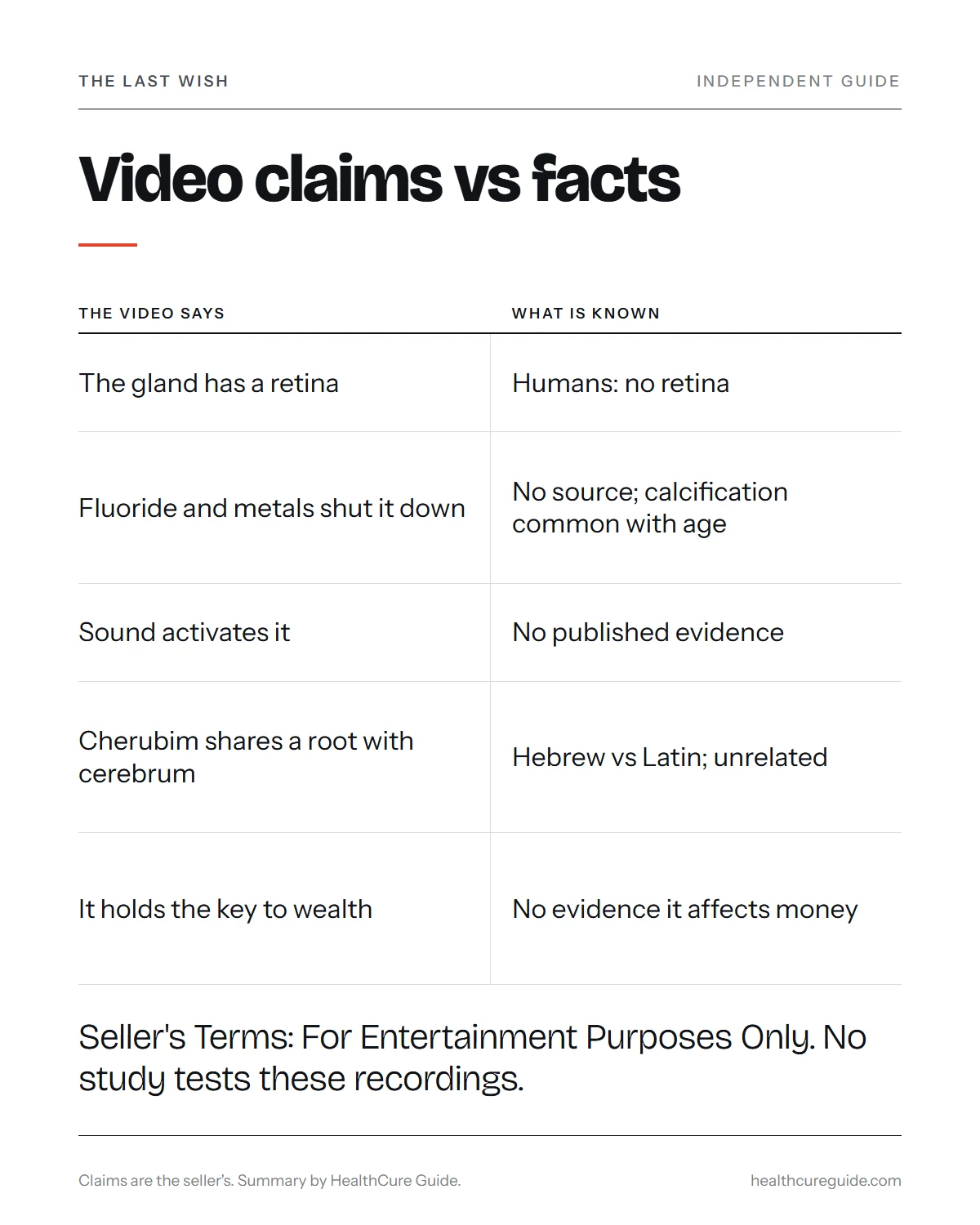
The sales video gives the gland a starring role. The table lists the statements, roughly where they appear, and what we can say about each.
| What the video says | Where | What is known |
|---|---|---|
| The gland is where you “meet God” and holds the key to wealth | Throughout | A matter of belief for faith; there is no evidence it affects money |
| “Cherubim” shares a root with “cerebrum” | 10:36 to 11:04 | Different languages and roots |
| Fluoride, heavy metals, time indoors and pesticides make it calcify and “shut down,” on purpose | 13:38 to 14:04 | Calcification is common with age; the claim has no source on the page |
| Calcite crystals are “extremely sensitive to sound,” and certain frequencies activate the gland | 14:04 to 14:37 | No published evidence |
| The gland “has a retina in it” and shuts down in light | 15:25 to 15:50 | The human pineal gland has no retina |
Each of these deserves a closer look.
No retina in the human pineal gland
The video claims the gland contains a retina and therefore switches off in light, so you must listen in the dark. For people, that is not accurate. Humans have no retina in this gland at all. Whatever light does to it travels through the eyes first, which explains why a lit room at night drops melatonin.
So the seller’s instruction, to sit in a dark room, rests on a wrong explanation. The habit itself is harmless and may help you wind down. Treat it as a relaxation routine and nothing more.
Calcification and the decalcification plan
Calcium deposits in the pineal gland are common as people get older, and they show up on scans. The video goes much further. The narrator blames fluoride in water, heavy metals in grooming products, indoor living and pesticides, says they harden the gland until it “shuts down,” and describes this as “a deliberate effort.” He offers no source for any of it.
There is no good evidence that “decalcifying” the gland through diet changes anything, and none that it affects money or luck. The Last Wish bundles a free gift named The Pineal Gland Decalcification Plan, pitched as a how-to for clearing the gland faster. We could not read it, so we do not judge the individual steps. We do say the idea behind it is unsupported. If you have a health concern about your brain, a doctor is the right person to ask.
Can sound activate the gland?
The video adds that tiny calcite crystals inside the gland react strongly to sound, and that particular frequencies turn it on. No published work we found shows sound making these deposits vibrate, or “activating” the gland in any measurable way.
The wider research on audio is mixed. Pooling earlier trials, a 2019 meta-analysis of binaural beats saw a medium effect overall on some outcomes. A 2023 review was less flattering: in most entrainment studies, brainwaves did not actually shift. Neither piece of research is about the pineal gland, and no study has tested The Last Wish recordings. Something can feel relaxing without activating any organ.
Cherubim, cerebrum and the scripture reference
The narrator, who calls himself Danny Kelly, cites Exodus 25, which mentions two cherubim of gold, and says the word shares a root with “cerebrum.” The Terms say names in the marketing may be pen names and some scenarios dramatized, so we cannot confirm who he is. We can check the words.
“Cherub” is Hebrew. “Cerebrum” is Latin, meaning brain. They are different words from different languages and do not share a root. The link is the seller’s wordplay.
People read scripture in many ways, and that is for each reader and community to decide. Our only point is that the word match is not a fact and cannot support a claim about the brain.
Descartes, the pine cone and a famous painting
The video also leans on three cultural touchstones: Descartes and his “seat of the soul” phrase, the Vatican’s big pine cone statue, and Michelangelo’s painting of Adam’s creation. These are references from history and art. A link between art, philosophy or symbolism and a gland does not show that the gland causes wealth.
Similarly, the idea that the gland releases a “spirit molecule” (DMT) in meaningful amounts in humans is speculative. We would not treat it as established.
Why the dark room still makes sense
There is a gentle irony in this pitch. The advice to listen in a dark, quiet room is supported by a real, ordinary fact: light at night lowers melatonin, and many people sleep and unwind better in dim conditions. So the instruction is sound even though the stated reason is wrong.
If you like the idea of a nightly ritual, you could get the same calming effect from slow breathing, a short walk, soft music or a few pages of a book, with the lights low and the phone put away. Those habits cost nothing and make no promises. We mention this not to talk anyone out of the product, only to keep the benefit in proportion. The benefit is a wind-down, and a wind-down does not need a gland to be “activated.”
Money, luck and the gland
The sales page promises effortless wealth. It says the gland is the hidden part of the mind that holds the key to abundance. Nothing in the known biology supports this, and no evidence connects the gland to income or luck.
The same goes for the narrator’s anecdotes: a $3,617 commission day, a tax refund of $10,137 and a $2,000 scratch-off ticket. These are unverified seller stories. Nobody should expect them, and we do not offer them as evidence.
One banner on the sales page credits Harvard and the University of Michigan with research behind the product. It names no study, no author and no link, and a search on our side turned up no research linked to this product.
Research backs two plainer techniques. One is rehearsing the concrete steps toward a goal. The other is mental contrasting: hold the goal in mind, then the obstacles, then settle on an “if this happens, I will do that” plan. Both help people follow through, whereas dreaming only of the result has gone with less effort in some studies.
A quick test for any gland claim
You can apply three questions to this pitch, or to any health-flavored sales story.
- Is a source named? A real claim points to a study, an author or a link. The fluoride and sound statements point to none.
- Does it match basic anatomy? The retina statement fails here, since people have no retina in the pineal gland.
- Can the result be measured? Melatonin and sleep timing can be studied. “Activation” and “abundance” have no agreed measure at all.
A pitch that fails all three is better treated as a story than as science, which fits the seller’s own Terms, where the content is offered for entertainment. There is nothing wrong with enjoying a story. The trouble starts when a story is used to justify spending money you need.
If you still want to try the recordings
A short, quiet listening routine at night may feel pleasant, and we are glad to say so. Keep your expectations modest and a few practical points in mind.
- The video says 11 minutes each night. The sales page says under 7 minutes. We could not verify the number or length of the recordings.
- The refund is 60 days under ClickBank’s checkout and the seller’s Terms. A badge on the sales pages shouts 365 days but nothing in the text backs it, while the video page footer sends readers to another company’s terms (abundant-life.co) that allow 90 days, but only on conditions. Use ClickBank’s route and keep the receipt.
- The countdown timer, the Today Only label and the line about the video disappearing any minute are sales tactics.
- Buyers may be added to email lists, including third-party offers.
- Use a comfortable volume, never listen while driving, and ask your doctor first if you have epilepsy, seizures, hearing problems or a medical condition, or if you are pregnant, nursing or taking medication.
- If money is tight, put a budget and a nonprofit credit counselor ahead of any audio.
Our verdict on the pineal gland pitch
The gland is real and interesting, and its true job is sleep timing. The pitch around it mixes a few accurate ideas with several that are wrong or unsupported. A dark room and a calm evening are fine. An activated gland that delivers wealth is not something the evidence can back.
We give no number score. In words: enjoy the idea as entertainment if you like, but do not spend money you need on it.
Common questions
What does the pineal gland actually do, compared with The Last Wish claims?
It is a small gland in the brain that makes melatonin and helps set the sleep-wake cycle. Darkness lets melatonin rise at night, and light lowers it. That is the established job. Claims that it is a gateway to wealth, luck or spiritual senses are not part of the medical picture, and no evidence links the gland to money.
Does the human pineal gland have a retina?
No. The Last Wish video says the gland has a retina and shuts down in light, but that is not accurate for humans. Light reaches the gland only indirectly, through the eyes, which is why light at night lowers melatonin. A dark room can help a sleep routine, yet it does not involve a retina in the gland.
Can sound or music activate the pineal gland?
We found no published evidence that sound activates it, or that sound makes calcium deposits in it vibrate. Research on audio such as binaural beats is mixed: a 2019 meta-analysis found a medium overall effect on some outcomes, while a 2023 review found most studies did not show the brainwave change. No study has tested The Last Wish recordings.
Is pineal gland calcification a problem?
Calcification of the pineal gland is common with age and shows up on scans. The video presents it as a deliberate shutdown of the gland, which it does not support with a source. We cannot give medical advice here. If you have health worries or symptoms, speak with your doctor rather than relying on a product's claims.
Can you decalcify the pineal gland with a plan or diet?
There is no good evidence that diet changes decalcify the gland or change how it works. The Last Wish lists a Pineal Gland Decalcification Plan as a free gift, described as steps to speed up decalcification. We could not read it, so we cannot judge its steps, but the underlying claim lacks support.
Are the words cherubim and cerebrum related?
No. The video says they share a root, but cherubim comes from Hebrew and cerebrum is Latin, so the link is wordplay and not etymology. Readers who value the Book of Exodus passage the video cites can still do so; the point is only that the two words do not have a common origin.
Does the pineal gland affect money or luck?
There is no evidence that it does. The gland's known role involves melatonin and sleep timing. The Last Wish sells a link between the gland and wealth, and tells income stories that are unverified seller stories, not results. Research on reaching goals points to planning and picturing the steps, not to any organ in the brain.
Is it true that you must listen in the dark for the gland to work?
The seller says to listen in a dark room because the gland shuts down in light. The reasoning is wrong, but the habit has a modest, ordinary logic: light at night lowers melatonin, so a dim, quiet room suits a wind-down routine. That benefit is about relaxing and sleep, not about activating a gland.