TitanFlow Ingredients: What Is in Each Capsule and Why
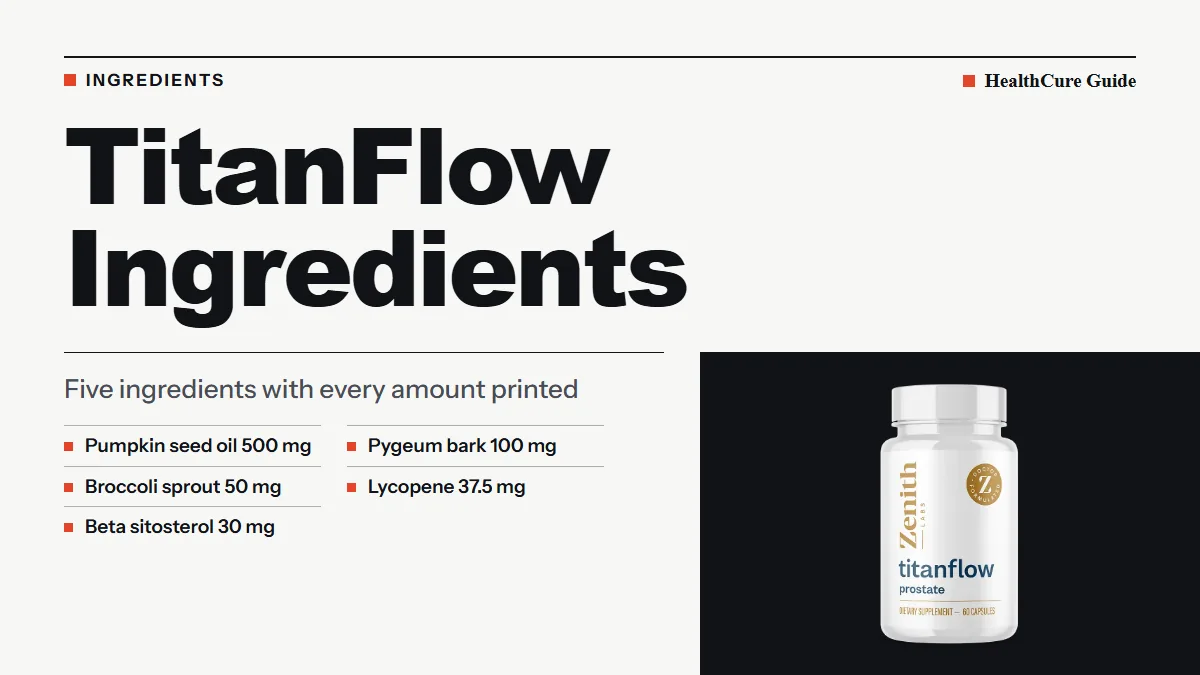
Five actives, each with a printed amount. We go through the TitanFlow label one ingredient at a time and explain the role the seller gives each one.
- Written by
- HealthCure Guide Editorial Team
- Reviewed by
- HealthCure Guide Editorial Team
- Updated
- Reading time
- 8 min read
Before you swallow anything each morning, you should know what it is. That is a fair rule for any supplement, and TitanFlow makes it easy to follow, because its label puts a dose next to every active. There is no blend with a mystery total and no list of names without numbers.
This guide walks through the TitanFlow ingredients in the order of how much work the seller says each one does. We describe every role as the seller’s own and we do not stretch it. Nothing here is a medical claim, and a capsule is no replacement for a doctor.
The thinking behind the formula
The seller’s starting point is that urinary flow is about more than prostate size. Its sales page leans on the strength of the urethra walls as well, and it presents the formula as built around that idea. We relay this as the seller’s view. In practice it produced a set of ingredients chosen for traditional use around urinary comfort, flow and antioxidant support.
The seller also mentions university research on pumpkin seed oil. Treat that as background on a single ingredient. It is not evidence about TitanFlow itself, and nobody should read it as proof that the product works. A short overview of the product sits on the TitanFlow hub page.
Pumpkin seed oil: 500 mg
The biggest dose by weight, and the one the seller leads with. The label names the plant Cucurbita pepo. In the seller’s telling, the oil is a traditional ally for urinary and prostate comfort and for emptying the bladder fully. At 500 mg it makes up the bulk of the active material in two capsules, so it is the backbone of the formula.
Beta sitosterol complex: 30 mg
Beta sitosterol is a plant compound, and here it is listed as a complex. The seller says it teams up with the oil to support emptying and flow. That partnership is central to the product’s logic, which explains why the two appear side by side. The dose is small beside the oil, as you would expect from a supporting player.
Pygeum africanum bark extract: 100 mg
Pygeum is listed as a 4:1 bark extract, a ratio indicating a concentrate made from a larger amount of plant. The seller calls it a traditional herbal helper for urinary health and flow. At 100 mg it is the second-largest active in the capsule.
Lycopene: 37.5 mg
Lycopene is taken from tomato skin and listed at a 5% grade. The seller describes it as antioxidant backing for the urinary tract. It is the red pigment most people know from ripe tomatoes, and its job in the formula is a gentle one.
Broccoli sprout extract: 50 mg
Another 4:1 extract, this time from sprouts, at 50 mg per serving. The seller lists it for its antioxidants. Alongside lycopene it rounds out the formula with plant-based antioxidant support next to the traditional ingredients.
The TitanFlow ingredients at a glance
| Ingredient | Role named by the seller | Per two capsules |
|---|---|---|
| Broccoli sprout extract (4:1) | Antioxidants | 50 mg |
| Lycopene 5% (tomato skin) | Antioxidant backing | 37.5 mg |
| Pygeum africanum bark extract (4:1) | Urinary health and flow | 100 mg |
| Beta sitosterol complex | Works with the oil on emptying and flow | 30 mg |
| Pumpkin seed oil (Cucurbita pepo) | Urinary comfort and complete emptying | 500 mg |
Rice flour, silicon dioxide and vegetable-grade magnesium stearate fill out the capsule, which is wrapped in gelatin. That gelatin makes TitanFlow a poor match for vegetarians. A bottle holds 60 capsules, or 30 servings.
What the label leaves out
Look at what is absent. There are no promises of numbers, no percentage gains and no timeline on the label. The seller recommends three or six bottles and explains that the research on the ingredients covered roughly 90 days, but that is a reason to give the routine time, not a forecast. Responses differ from man to man, and that is the whole point of the six-month refund window. If you want to see how people approach opinions online, our piece on TitanFlow customer reviews explains how to read them with care.
Made where, and tested how
According to the seller, the capsules are produced at a US plant the FDA inspects, with independent testing. We relay that as the seller’s statement. It speaks to where and how the product is made, and it is not an endorsement of the product itself.
Who should speak to a doctor first
Everyone, ideally, and especially these readers.
- Men whose medicine list includes something for the prostate, blood pressure or blood thinning.
- Anyone with a medical condition, which the label also says should prompt a physician check.
- Anyone under 18, since TitanFlow is not meant for them.
Your prescribed medicines stay in your routine. A new or worsening urinary symptom calls for a doctor’s examination, because the possible causes are many, and a supplement cannot fill that role. Our guide to TitanFlow side effects covers safety in more depth. Never exceed the recommended amount of two capsules in a day.
How to read any Supplement Facts panel
The TitanFlow label is a good place to practise a skill that works on every bottle in the cupboard. Start with the serving size, because every figure below it is per serving, and here a serving is two capsules. Check the number of servings in the container, which tells you how long it lasts. Then read the amounts. A real dose looks like 500 mg, not a vague phrase. Next, look at the form of each ingredient, such as the 4:1 extract ratio on the bark and the sprout, which tells you how it was prepared. Finally, read the other-ingredients line for fillers and the shell material. On that last point, TitanFlow tells you plainly that its capsule is gelatin.
Doing this takes two minutes and tells you far more than any promise on the front of a package. It is also the best way to prepare for the conversation with your doctor that we recommend before you start.
How it is taken and what it costs
One serving a day is two capsules, ideally alongside your first meal. The six-pack costs $234, which is $39 a bottle and roughly $1.30 a day, with no US postage fee and two bonus books. A single bottle is $69 plus $9.95 delivery, and three bottles are $177 plus $9.95. Everything is laid out on our TitanFlow price page, and the TitanFlow product overview gives the short version.
The refund promise rounds it off. The seller describes the Empty Bottle guarantee as lasting 180 days from your purchase, with Zenith Labs giving back the full price paid even when the bottles have been used up.
Quick answers about the ingredients
Is there a hidden blend? No. Each of the five actives has its own dose.
Does the label list a stimulant? None that we can see. Still, ask your doctor if you are unsure.
Can it go with other supplements? Ask your doctor first, and take the label along.
How the ingredients fit the buying decision
Knowing what is inside should make the purchase easier, not harder. Five actives, each with its dose, in a capsule you take once a day, from a company that names itself and offers six months of refund cover: that is a clear set of facts to base a decision on. If the formula matches what you hoped to find, order the six-pack, take it as the label directs, and let the guarantee give you the time to judge.
Common questions
What are the TitanFlow ingredients?
Per two-capsule serving: pumpkin seed oil 500 mg, Pygeum africanum bark extract 100 mg, broccoli sprout extract 50 mg, lycopene 37.5 mg and beta sitosterol complex 30 mg.
What else is in the capsule?
Rice flour, silicon dioxide, magnesium stearate (vegetable grade) and a gelatin capsule shell.
Is TitanFlow suitable for vegetarians?
No. The capsule shell is gelatin, so it is not suitable for vegetarians.
Why does the formula use pumpkin seed oil?
The seller names it as the lead ingredient, with traditional use for urinary comfort and complete emptying, and refers to university research on it. The seller does not claim that research proves TitanFlow works.
How many capsules make a serving?
Two capsules once a day, ideally with your first meal. A 60-capsule bottle holds 30 servings.
Should I check with a doctor about the ingredients?
Yes. Keep taking prescribed medicines and ask your doctor first, especially if you use prostate, blood pressure or blood-thinning medicine.