Who Created the Last Wish Manifestation? What We Know
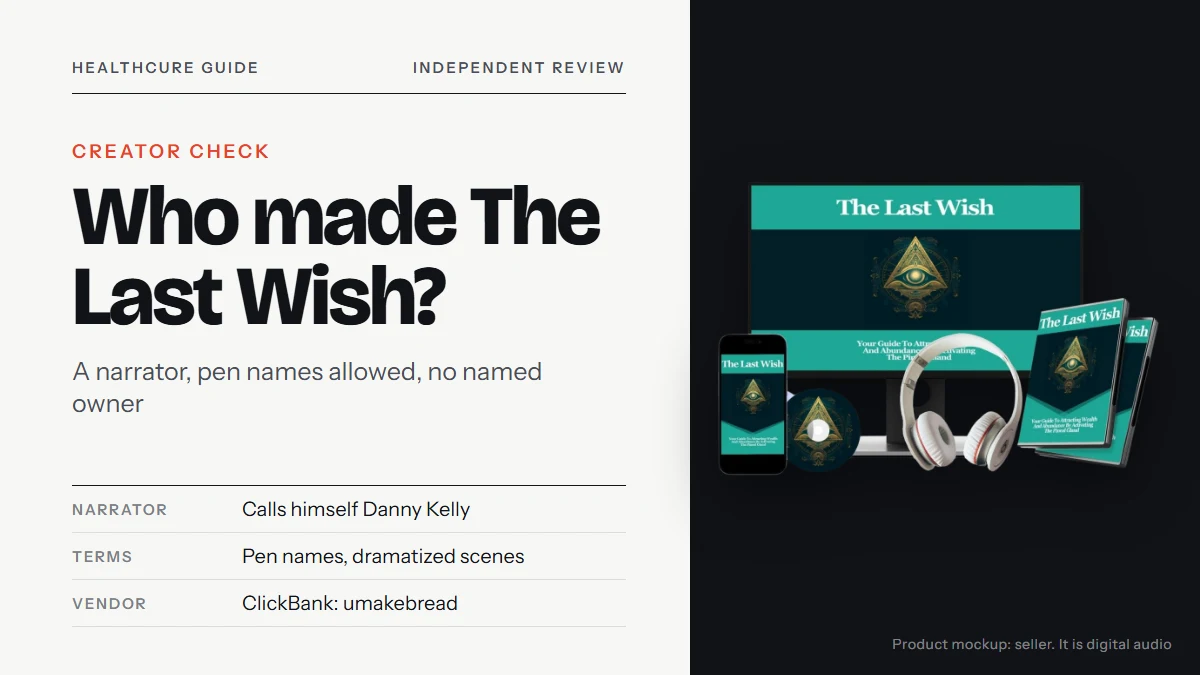
A man who calls himself Danny Kelly narrates the sales video and says his time is near. The seller's Terms say names can be pen names and scenarios dramatized. Here is what can be checked and what cannot.
- Written by
- HealthCure Guide Editorial Team
- Reviewed by
- HealthCure Guide Editorial Team
- Updated
- Reading time
- 9 min read
This guide contains affiliate links. If you buy through them we earn a commission at no extra cost to you. It does not change the verdict. Disclosure.
People who ask who created the last wish manifestation are usually trying to decide how much weight to give a very personal sales story. This page collects what the saved pages say about the narrator, the origin story and the business traces behind the sale, and marks each item as checkable or not. We keep the overall verdict elsewhere, in our longer review, and a separate piece on reading online feedback covers the praise you may run into.
We are an independent site, we are not the seller, and we did not buy the product. We worked from four saved items, all captured on 2026-10-09: the order page, a copy of the video page, the Terms and the ClickBank checkout. If you use a link below, we may earn a commission, at the same price to you.
Who created the last wish manifestation: the short answer
No page we saved names a founder, an author or a company as the maker. What the pages offer is a narrator. In the video he introduces himself at about 04:39 as Danny Kelly, and the photo caption on the video page uses the same name. Near the end, at 25:33, he says “Dan Kelly.” The man is the face of the pitch, but a face is not the same as a documented creator.
That leaves two separate questions. Who is speaking? And who runs the business that takes your payment? The first has a name that cannot be checked. The second has a ClickBank vendor ID and a few email and web addresses, which we cover below.
The narrator and the name he uses
The man who calls himself Danny Kelly makes a personal case. In his own words, “my time is near,” and he describes the present as “the end of my days.” Elsewhere he claims the recordings were reworked with sound engineers.
We could not verify that this person exists, how old he is, or whether anything about his health is true. We are not suggesting he is invented. We are saying that a reader has no way to test it, and that the pitch asks for an emotional response that no document backs up.
What the Terms say about names and stories
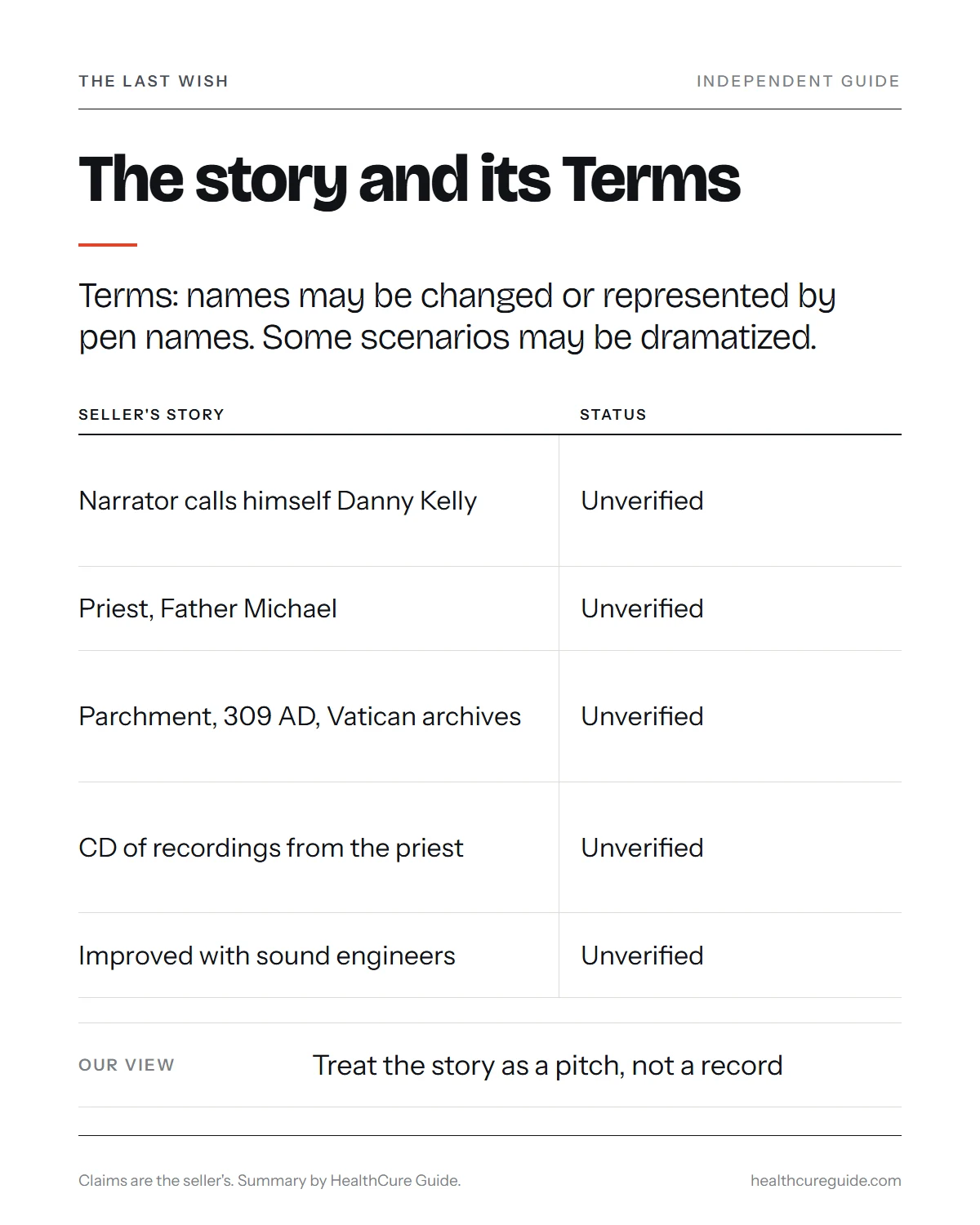
The seller’s Terms page contains the most useful sentence for this question. In one short passage it says that names and details in the marketing “may be changed” or shown under pen names, and that “some scenarios may be dramatized.” The stated reason is privacy and entertainment.
The same page says testimonials “represent exceptional results and may not reflect typical experiences,” that images or videos may be dramatizations, and that the seller does not verify the accuracy of testimonials. The footer of the order page adds that testimonials are “forwarded to us by users.”
Put plainly, the seller has told you in its own paperwork that the person on screen may be using a pen name and that scenes may be staged. It is fair to read the narrator, the priest and the events in his story through that lens. Whether the name Danny Kelly is a pen name, we cannot say; the Terms simply leave that door open.
The origin story, told as the seller tells it
The video says that about twenty years ago a priest named Father Michael, head of St. Anthony’s church, told the narrator about a parchment. As the narrator tells it, the parchment came from a prayer book dating back to 309 AD and was kept in the Vatican’s Secret Archives. It showed a diagram of the brain with the Hebrew word for God at its center. The priest later gave him a CD of recordings, which he says he then improved. He also says that people allowed into the archive “must be over 75 years old.”
We could not find anything that confirms the priest, the church, the parchment or the CD. That makes the whole account unverified, and we do not present it as something that happened. One fact from outside the video: the archive changed its name in 2019, to the Vatican Apostolic Archive, and admits qualified researchers. We are not claiming to have disproved the story either. Without a document, there is nothing to prove or disprove.
A note on faith. Many readers hold sincere religious beliefs, and a story that involves a priest, a church and scripture can feel personal. Faith is not what we are checking here. We are checking whether a sales claim can be verified, and this one cannot.
| Part of the story | What the seller’s video says | Can it be checked? |
|---|---|---|
| The priest | Father Michael, head of St. Anthony’s church | No church location or record given |
| The parchment | From a prayer book, dated 309 AD, held in the Vatican’s Secret Archives | No document or photo shown |
| The CD | Handed over by the priest, later improved with sound engineers | No copy, label or engineer named |
| The narrator’s health | Time is near, end of his days | Nothing to check |
The company traces we can see
Even without a named owner, the pages leave a trail of small facts. None of them is a name, but together they show how the sale is organized.
| Trace | Where we found it | What it tells you |
|---|---|---|
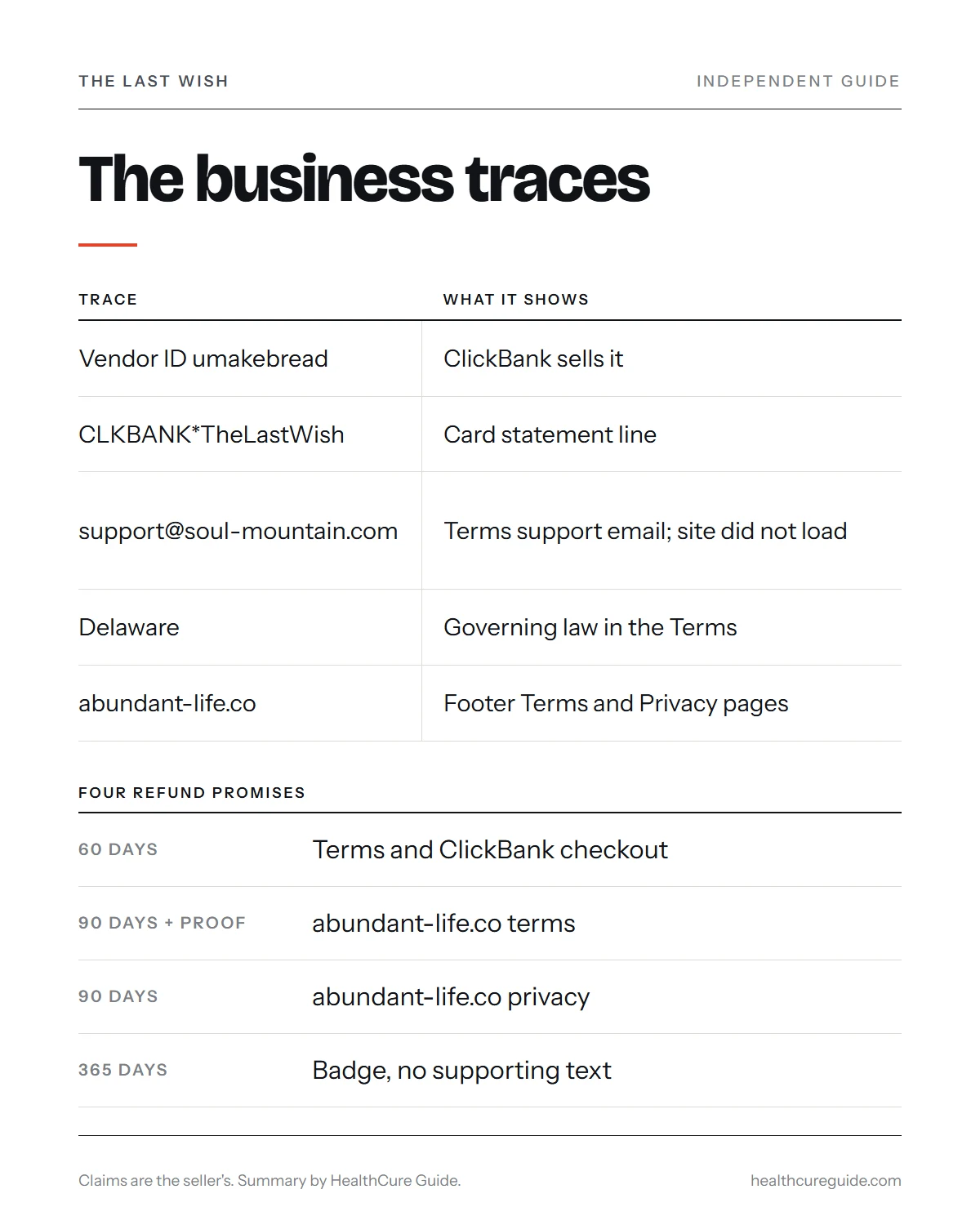
| ClickBank vendor ID umakebread | The checkout address umakebread.pay.clickbank.net | The sale is processed by ClickBank, which is the retailer |
| Card statement CLKBANK*TheLastWish | ClickBank checkout | What the charge looks like on your bank statement |
| [email protected] | The seller’s Terms | The listed product support address; the website soul-mountain.com did not load on 2026-10-09 |
| Delaware | The Terms | The stated governing law |
| Age 18 and over | The Terms | The stated target audience |
| abundant-life.co | The video page footer links | A second domain that hosts the footer Terms and Privacy pages |
Our saved copy of the Terms gives no company name and no postal address. We cannot tell you who owns the business, and we will not guess.
Why the abundant-life.co pages matter
The video page footer has links labeled “Terms And Conditions” and “Privacy Policy.” They do not go to messageofmanifestation.org. They go to abundant-life.co, and they redirect to addresses that contain the words “ex-back-thank-you-page.” The terms page there covers The Last Wish and two other products, The Abundance Brain Accelerator and The Abundance Sequence.
That page sets strict refund conditions: proof of at least thirty consecutive days of use, documented proof such as receipts and photographs, a request within 90 days, and a company decision that the text calls “final and binding.” The privacy page on that domain instead offers a full refund for any purchase made in the last 90 days, requested through [email protected].
So a shopper meets four refund promises: 60 days (in the Terms and at ClickBank’s checkout), 90 days with conditions, 90 days with none, and a 365-day seal that nothing in the site’s text backs up. ClickBank, as retailer, processes refunds under its own 60-day policy. Keep your receipt and use the ClickBank route.
What a pen name does and does not tell you
A pen name is not proof of wrongdoing. Writers, marketers and entertainers use them often, and this seller has stated openly that it may. What a pen name does remove is your ability to look up the speaker’s work history, track record or reputation.
That matters because a good deal of the video’s pull comes from the person telling it. When the speaker cannot be checked, the sensible move is to hold the claims to the evidence, and the evidence is thin.
- A line on the order page credits “research from Harvard and University of Michigan.” That line names no study at all, with no author and no link, and we found nothing tied to this product.
- The narrator’s money stories, $3,617 in a day, a $10,137 IRS refund and a $2,000 scratch-off, are unverified seller stories. Nobody can promise you money, and a buyer should not read them as typical.
- The Terms frame the content as entertainment, under the heading “For Entertainment Purposes Only.”
- No published study tests these recordings. The video says to listen for 11 minutes a night, and the page talks about under 7 minutes; we could not verify how many recordings there are or how long they run.
Sales pressure that can cloud the question
A countdown timer, a “Today Only” price and a headline that says the video could be taken down at any moment appear on the video page. He adds that, in his words, the powers that be would rather he stayed quiet. These are sales tactics. They push readers to decide before they have asked the questions on this page.
One more practical point: according to the Terms, a purchase can put you on the seller’s email lists, whose mailings may promote third-party offers on spirituality, prayer, astrology and related topics. Each email has an unsubscribe link.
Questions worth asking before you pay
You cannot interview the narrator, but you can still ask sensible questions of the seller and of yourself.
- Does the story need to be true for me to want this? If the answer is yes, the lack of proof is a problem.
- Am I comfortable that the person speaking may be using a pen name?
- Can I accept that I do not know who owns the business, and that my contact points are a ClickBank order line and one support email?
- Is the money truly spare? When bills are piling up, a written budget or a call to a nonprofit credit or debt counselor is the better first step.
- Do I know the refund route? Use ClickBank, within 60 days, with the receipt.
If you write to the product support address, keep the reply. A written answer about the company or the refund terms is worth having on file.
Our take on the question of who is behind it
The honest answer to “who created the last wish manifestation” is that the pages show a storyteller and a payment processor, and nothing in between. Here the narrator calls himself Danny Kelly, while the seller’s Terms leave room for pen names and staged scenes, and the priest and Vatican account has no support beyond the video itself. The business traces are thin but real: a ClickBank vendor, a support address and a second domain for the footer pages.
None of that settles whether the audio is worth $37.44. It does mean you should buy, if you buy at all, for the audio and the refund window, and never because you believe the story. We have no number score; in words, the creator question stays open.
Common questions
Is Danny Kelly a real person?
We cannot say. The narrator of the sales video calls himself Danny Kelly, and the photo caption on the video page uses the same name, but nothing on the pages we saved lets a reader check who he is. The seller's Terms also say names in its marketing may be pen names, so the name itself proves nothing either way.
Is the priest and Vatican parchment story true?
Nobody can confirm it from what is published. The video tells of a priest called Father Michael who spoke of a parchment from 309 AD in the Vatican's archives. No document, photo, date or source is shown. The Terms add that some scenarios may be dramatized, so we treat the whole account as an unverified story.
What do the Terms say about the names and stories in the marketing?
Two lines matter. Names and details in marketing materials may be changed or represented by pen names to protect privacy, and some scenarios may be dramatized for entertainment purposes. Read together, they mean a reader cannot assume that the narrator, the priest or the events in the video are literal. That is the seller's own wording.
Which company sells The Last Wish?
The checkout runs on ClickBank, which acts as the retailer, under the vendor ID umakebread. The Terms page we saved does not name a company or a postal address, and says Delaware law governs. Your card statement should show CLKBANK*TheLastWish. Beyond those items, we could not trace a named owner.
Where do I send questions about the product?
The Terms list [email protected] as the product support address, though the soul-mountain.com website itself did not load when we tried on 2026-10-09. For billing, orders and refunds, ClickBank order support is the better route: call 1-800-390-6035 or go to clkbank.com, and have your receipt ready.
Why does the video page link to abundant-life.co?
The footer links for Terms And Conditions and Privacy Policy on the video page lead to a different domain, abundant-life.co. Those pages mention The Last Wish and its two upsells but set refund rules that differ from the seller's own Terms. We cannot explain the link, so we advise readers to use ClickBank's 60-day route and keep the receipt.
Does a pen name mean the product is a scam?
Not by itself. Pen names are common in publishing and marketing, and this seller says openly that it may use them. The practical effect is that you cannot check the narrator's background. Judge the offer by its price, its refund route and the evidence for its claims, and not by the storyteller.