Arctic Blast Ingredients: The Full Label, Actives and Inactives
What the Drug Facts box says in plain words: the two labelled actives with their percentages, the full inactive list, the seller's wording about DMSO and the cautions worth reading first.
- Written by
- HealthCure Guide Editorial Team
- Reviewed by
- HealthCure Guide Editorial Team
- Updated
- Reading time
- 7 min read
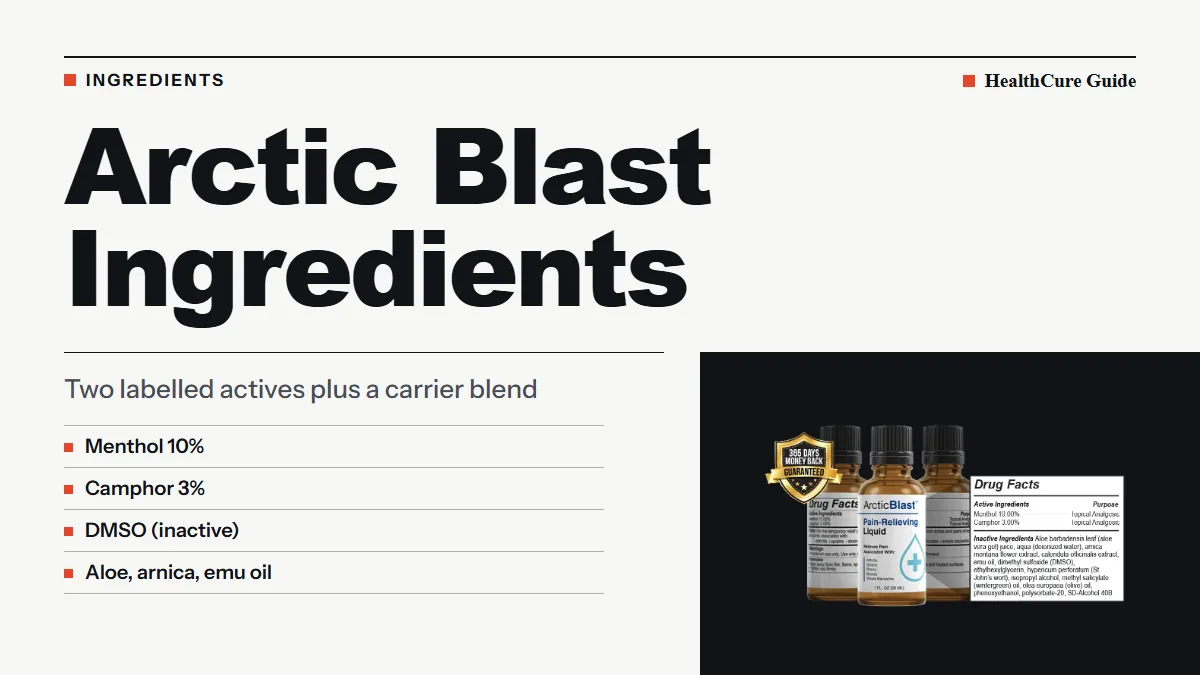
A liquid you rub into your skin deserves the same scrutiny as anything else you put on your body, so this guide begins with the printed box rather than the sales copy. The box is short. It gives two actives with their percentages, then a long list of everything else with no quantities. We read the label and the seller’s pages, then set out what each part says, where the seller’s wording goes further than the box and which cautions belong with each entry. For the wider product picture, the Arctic Blast hub is the place to begin.
Arctic Blast ingredients: the two labelled actives
Menthol is printed at 10.00% and camphor at 3.00%. Both are marked as topical analgesics, a label term for a substance used on the skin to ease minor aches and pains. The printed purpose is the temporary relief of minor aches and pains of muscles and joints. Those two entries are the only actives the box names, so they are the figures to compare when you weigh the liquid against any other topical product.
Together they give the liquid a cooling menthol-and-camphor feel when it goes on. That description is ours, based on the labelled ingredients, and it is not a promise about how your skin will respond.
The fourteen inactive entries, as printed
The inactive list appears in this order on the box, with no amount beside any item:
- Aloe barbadensis leaf (aloe vera gel) juice
- Aqua (deionized water)
- Arnica montana flower extract
- Calendula officinalis extract
- Emu oil
- Dimethyl sulfoxide (DMSO)
- Ethylhexylglycerin
- Hypericum perforatum (St. John’s wort)
- Isopropyl alcohol
- Methyl salicylate (wintergreen) oil
- Olea europaea (olive) oil
- Phenoxyethanol
- Polysorbate-20
- SD-Alcohol 40B
Because no quantities are given, the list tells you what is present without telling you how much of each. That gap is worth raising with support before you buy, rather than assuming a proportion for any single entry.
Where the seller’s wording and the box differ
Read in the seller’s sales letter, the formula is described as DMSO plus menthol and camphor, with aloe vera gel, arnica montana flower extract, emu oil and wintergreen oil named as contents. The same letter says the product supports the body’s natural pain relief response. Those words are the seller’s, and we attribute them as such. The pain relief phrase does not appear on the box, so for composition the box is the better guide.
DMSO is where the two sources part company. The seller calls it the carrier the formula is built around. On the box it sits in the inactive group, next to the other entries, with no amount attached. Read the box as the authority on composition, and regard the seller’s description as a statement about design rather than a list of active parts.
Notes on specific named entries
Some entries need no interpretation beyond what is printed. Menthol and camphor are the two actives. The aloe, arnica, calendula and oil entries are flower extracts and plant oils that the box names without any amount. The seller’s letter mentions several of them by name, but it gives no quantities either, so we add no role for any of them beyond the label’s own description.
The entries that need a closer look are the wintergreen and St. John’s wort lines, and the alcohol lines. They are covered in the next section, because each one changes who should ask a professional before the first use.
Reading the box from top to bottom
The box opens with the active ingredients, each with its percentage and its purpose. It then runs through the inactive ingredients in the order given above, and it ends with the volume, 1 FL. OZ (30 ML). Only two figures on the whole box are percentages, so the reading is quick. Everything else is a name, and the real work lies in matching those names against your own history and against whoever you consult.
Cautions tied to particular entries
- Wintergreen oil and St. John’s wort. Both are on the box. Anyone allergic to aspirin or salicylates, anyone on blood thinners and anyone with sensitive skin should ask a doctor or pharmacist before the first application.
- Alcohols. Isopropyl alcohol and SD-Alcohol 40B are the reason for the flammable notice. Keep the bottle clear of fire and heat, and tighten the cap after each use.
- DMSO. In our general note, DMSO can carry other substances through the skin. Apply the liquid to clean skin, and keep it apart from other creams on the same area.
- Eyes and broken skin. Keep the liquid out of the eyes, away from wounds and off damaged skin. Do not bandage the area.
Adults aged 18 and over are the intended users, and the seller advises applying the liquid to the affected area no more than three to four times a day. A patch test on a small area before wider use is our standing advice for any topical with a list this long.
Checking the list against your own history
Use the list as a checklist against your own history. Write each name down exactly as the box prints it rather than as you remember it, because a pharmacist will want the printed spelling. Think about any past reaction to a plant extract, an oil, an alcohol or a salicylate. Think about any blood thinner you use and how sensitive your skin tends to be. If any of those points applies, bring the box to a pharmacist, together with the list of medicines you already use. Stay on any prescribed medicine while you check, and keep your regular appointments.
The box also tells you what to keep away from the bottle: children, flame and direct heat. Store it at ordinary room temperature and keep the cap closed between uses.
The same method works for anyone helping you choose. Start with the box, mark the entries you already know to be a concern, and bring that marked copy to a pharmacist. A pharmacist can answer much more quickly from a marked list than from memory.
What the box leaves for you to ask
The box settles two things: which entries are active, and which percentages apply to them. It does not settle how much of each inactive entry the formula contains, and it does not say how the seller measures the liquid’s strength beyond the two actives. Those are fair questions for support. Write them down, send them before you order, and keep the answer with your order records. If support replies with figures, file them beside the box photo, so that the answer and the printed list stay together. A seller that answers in writing gives you a firmer footing than any summary, including this one.
Keeping the box with your order
Photograph the Drug Facts box on the bottle, and keep that photo beside your confirmation email, not in a folder of unrelated screenshots, so the panel and the purchase stay together. If you ever need to ask a question about the formula, the photo lets you quote the exact wording and the exact percentages. It also helps a pharmacist work from the same text you are reading, which saves time at an appointment.
Our reading of the box
The box speaks plainly about its two actives and lists its inactive entries in full. The open point is quantity, and that is the question to put to support before you commit. The box is enough to decide whether the formula suits you, and the 365-day guarantee gives you a long window to confirm that decision in ordinary use. The drops review sets out our full assessment, and the side effects guide turns the cautions into everyday steps.
Common questions
What are the active ingredients in Arctic Blast?
Menthol at 10.00% and camphor at 3.00%. Each is marked with the purpose Topical Analgesic on the Drug Facts box.
Does the label give amounts for the other ingredients?
No. None of the 14 inactive ingredients has an amount printed, DMSO included.
Is DMSO in Arctic Blast?
Yes. The label lists dimethyl sulfoxide among the inactive ingredients, and the seller describes it as the carrier for the formula.
Does the formula include wintergreen or St. John's wort?
Yes. Methyl salicylate (wintergreen) oil and Hypericum perforatum (St. John's wort) are both on the list. Anyone allergic to aspirin or salicylates, on blood thinners or with sensitive skin should ask a doctor or pharmacist first.
Why does the bottle carry a flammable warning?
Several listed items are alcohols, including isopropyl alcohol and SD-Alcohol 40B. Keep the bottle away from fire, flame and heated surfaces, and close the cap firmly after each use.
Who should check the label before using it?
Anyone who is pregnant or breastfeeding, anyone allergic to an ingredient and anyone with a medical condition. Bring the label to your doctor or pharmacist.