Brain Song Audio Review: Twelve Minutes, Headphones and a $39 Price
Judging a sound file is different from judging a gadget. We look at length, delivery, devices and the listening setup that suits it best.
- Written by
- HealthCure Guide Editorial Team
- Reviewed by
- HealthCure Guide Editorial Team
- Updated
- Reading time
- 7 min read
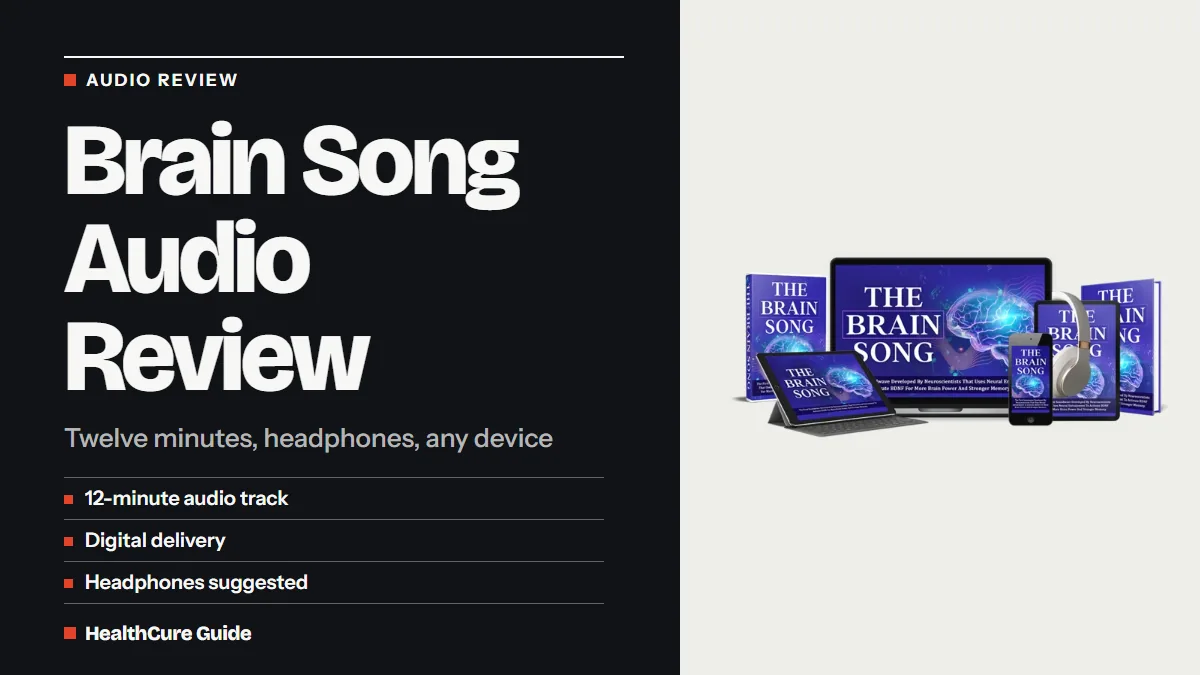
Most reviews of wellness products talk about boxes, labels and parcels. A Brain Song audio review starts somewhere else: with a pair of headphones, a quiet spot and a clock that runs for twelve minutes. You are not buying an object. You are buying a listening experience, so the useful questions are about sound, setup and habit.
Here is how we would judge it as an audio product, using only what the seller states.
Brain Song audio review: the format in plain terms
The product is one audio track. It lasts twelve minutes. The seller says it uses “advanced sound patterns” to guide the brain toward gamma frequencies, and it describes the sound as relaxing and neuroscience-inspired.
There is no series of lessons to follow, no instructor to keep pace with and no screen to watch. That makes it closer to a piece of music you play than to a course you study. For many people, that is the appeal: nothing to read and nothing to remember except the time you press play.
One honest caveat for an audio review: the seller’s page is a short text page, with no video and no sample, so the sound itself is something you will meet only after buying. That is a fair reason to value the refund window.
Delivery and devices
After you pay, the audio is delivered digitally. The seller’s terms point to download or streaming access, which means you will not wait for anything to arrive in the mail. The product pictures on the page, a laptop, a tablet and a phone with headphones, carry a note that images are for visualization only, so think of them as ideas of where you might listen, not as items you receive.
Practically, any device you already own that plays audio is a candidate. A phone is the most natural choice because it travels with you. A laptop works well at a desk. Pick the device that makes it easiest to start, because friction is what ends most daily habits.
The headphone question
The art on the order page pairs a phone with headphones, and the sound is aimed at a gentle, focused kind of listening. That is why we suggest headphones. They help in three ways:
- They block out kitchen noise, traffic and household chatter.
- They keep the sound consistent from one session to the next.
- They let you keep the volume modest, since a closed space needs less loudness.
Whatever pair you choose, set the level at something comfortable. Louder is not better, and it is wise never to listen while driving or operating machinery. If you use a hearing device or have a seizure history, check with your doctor first.
What twelve minutes does to your schedule
An audio product lives or dies by the calendar. Twelve minutes is long enough to feel like a real pause and short enough to survive a busy day. Compare that with a forty-minute session you keep postponing.
Three slots tend to work well:
- Before the day starts, as a quiet bridge between waking and work.
- Mid-afternoon, when attention usually dips.
- In the evening, as a way to close the screen and let the day settle.
Choose one and keep it. If you want help tying the slot to something you already do, the habit-building tips in our daily routine walkthrough are a good next read.
How to judge the sound yourself
Because we cannot hand you a recording to audition, here is a short list of things to notice in your first few sessions.
- Comfort. Does the sound feel pleasant at a low-to-moderate volume, or do you keep turning it down?
- Ease of starting. Can you press play without effort, or does it feel like a chore?
- Staying with it. Does twelve minutes pass easily, or do you find yourself checking the clock?
- How you feel afterward. A quick note about your mood and concentration builds a useful record.
None of these require special knowledge, and none depend on the science. They tell you whether the audio fits you as a listener, and that is what an audio review should help you decide.
Two more habits help. First, use the same headphones for the whole test, so a change in gear does not get mistaken for a change in the audio. Second, try different times of day before settling. A track that feels flat at lunch can feel very different in a quiet evening room, and you want to find your best slot, not just your first one.
What the science line means for listeners
The seller ties the audio to gamma brainwaves and to BDNF, which its page links with learning and focus. For background reading, one paper explains why researchers study BDNF, and a meta-analysis gathers work on binaural beats. Neither examines this track, and the seller’s terms file the audio under entertainment, adding that entrainment is not an exact science. For a listener, the takeaway is modest: this is a calm, structured sound session, and you decide how it feels.
What the purchase includes is listed on the hub’s what’s included page, and the main product overview links every guide we wrote.
Who an audio like this suits
Some listeners are natural fits. If you already put on headphones for podcasts, music or white noise, adding twelve more minutes of sound costs you nothing in setup. If you commute by train or bus, a seat and earbuds can be enough, although a calm space at home is what the seller has in mind.
People who dislike apps will notice something else: there is no account to create and no dashboard to check. You press play, you finish, you move on. That simplicity is also the product’s main limitation. It cannot track your progress or send you reminders, so the discipline stays with you, and a phone alarm is the easy fix.
Price and protection
You pay $39 once. Nothing in the terms suggests a subscription. Stretched across the 90-day guarantee window, it is about $0.43 a day, and across a year it works out near $3.25 a month.
To use the guarantee, write to the seller’s support desk quoting your order number and a short reason, headed “Refund Request”, or go to ClickBank order support instead. Playback questions get a deeper look in our piece on the audio file and playback.
Our rating as an audio product
Judged as an audio product, The Brain Song scores 9.0/10 from us. The idea is simple, the length respects your time, delivery is immediate and the price is small. What we cannot judge for you is the sound, which is why the refund matters.
If you like short, headphone-friendly routines, the offer is easy to say yes to. If you prefer to preview before you pay, the 90 days work as your preview.
Good to know:
- The audio is delivered digitally; the product pictures are illustrations.
- The seller calls it entertainment in its terms, and your experience may differ from someone else’s.
- A doctor can advise you if a hearing device or a health condition applies.
Common questions
How long is the audio?
It runs twelve minutes. The seller recommends listening once per day.
What do I need to play it?
Any device that plays audio will do. The seller's artwork shows a phone with headphones, and also a laptop and tablet.
Do I have to listen with headphones?
The seller's imagery points that way, and headphones keep outside noise down during the twelve minutes. Whatever you use, keep the volume comfortable.
Is anything physical sent to me?
No. The product is delivered digitally, and the seller notes that its pictures are for visualization only.
Can I share the track with a partner or friend?
The terms of sale give you a personal, single-user copy, and they rule out sharing, reselling or uploading it.
What if I do not like the sound?
You have 90 days from the day you buy to ask for the $39 back. Contact the seller's support team directly, or ask the retailer, ClickBank, to help.