Does VisiFlora Really Work? What to Expect and How to Test It
No supplement suits everyone the same way. Here is a straight look at the design of VisiFlora, what ingredient research does and does not show, and an easy way to judge for yourself.
- Written by
- HealthCure Guide Editorial Team
- Reviewed by
- HealthCure Guide Editorial Team
- Updated
- Reading time
- 9 min read
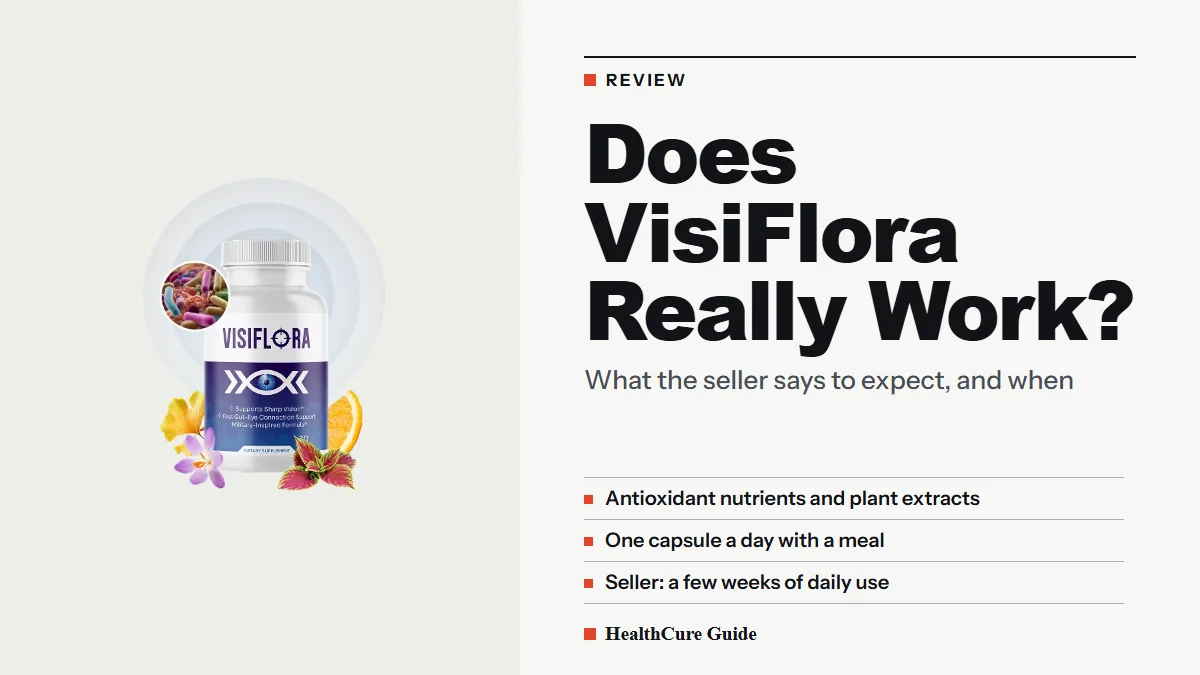
Does VisiFlora really work? It is the question behind almost every search about this capsule, and it deserves a straight reply. The reply has three parts: what the formula is designed to do, what the available research says about its ingredients, and how you can run a fair test that costs you very little if the answer turns out to be no.
VisiFlora is a once-daily dietary supplement positioned around everyday eye comfort, especially through screen time and reading. That is a modest and sensible goal, and we judge it as one.
Does VisiFlora really work? What “work” can honestly mean
A supplement is not a medicine. It cannot be sold with a promise to change a medical condition, and VisiFlora does not make one. What it can do, in the seller’s description, is supply nutrients that support eye health and visual comfort. So “does it work” is best read as “will I notice my eyes feeling more comfortable day to day while I use it?”
That is a personal outcome, and it depends on your routine, your diet and how much time your eyes spend on screens. The honest answer is that some people notice a difference and some do not. A fair test lets you find out which group you are in.
How the formula is designed to work
Think of the capsule as three ideas wrapped together.
Idea one: antioxidant nutrients. The label lists vitamin C and vitamin E, each at 100% of the Daily Value, along with vitamin A from beta carotene at 50%. The blend adds lycopene, astaxanthin and alpha lipoic acid, which the seller describes as antioxidants.
Idea two: carotenoids and plant extracts. Lutein and zeaxanthin are carotenoids found in the eye, and the blend includes both. Alongside them sit botanicals such as bilberry, saffron, ginkgo and eyebright, the last of which the seller calls a traditional botanical.
Idea three: the seller’s gut-eye story. The seller says the formula draws on modern research into the connection between nutrient absorption and eye health, and it builds the product’s identity around that link.
All of it fits into one capsule, taken with a meal and water, which is the seller’s instruction.
What the research says about the ingredients
Let us be careful here. The papers below study ingredients and topics. None of them is a trial of VisiFlora, and none shows that this capsule does anything specific for you. They simply show what scientists have looked at.
- Lycopene. A 2024 review in the Journal of Nutrition and Metabolism looks at lycopene as an antioxidant with several roles.
- Beta carotene. A 2005 lab study followed the way beta carotene becomes vitamin A in cultured retinal pigment cells.
- Eyebright. A 2014 laboratory study in the Balkan Medical Journal tried an eyebright extract on human corneal cells.
- Lutein and zeaxanthin. A 2020 review in Antioxidants covers these two carotenoids, together with beta carotene, in eye health.
- The gut-eye link. A 2022 review in Ophthalmic Research surveys what is known about gut microbes and the eye.
The reading list sits below the article. If you enjoy digging, start there, and bring anything interesting to your doctor.
What the seller says to expect
The seller’s FAQ says that many individuals notice daily eye comfort, focus and visual clarity getting better once they have stayed consistent for a few weeks. We stay with the comfort part of that sentence, and we repeat the seller’s own caution that results vary. No overnight change is promised, and none of us should expect one.
What antioxidants and carotenoids actually are
Two words keep appearing around this capsule, so a plain definition helps. Antioxidants are nutrients that the body uses to manage everyday oxidative stress, the normal chemical wear that comes with living and breathing. Vitamins C and E are familiar examples. Carotenoids are colorful plant pigments, such as the beta carotene in carrots, and some of them, lutein and zeaxanthin among them, are found in the eye itself. A formula built around these families is trying to supply nutrients the eye uses, which is a reasonable thing to want from a daily supplement and a far cry from a medical claim.
A fair way to test it
The best answer to “does it really work” is your own experience, gathered carefully. The guarantee gives you 60 days after delivery, which is ample time for a tidy test.
- Write a baseline. Before the first capsule, jot down how your eyes feel once a long spell at the computer is behind you.
- Keep it steady. Take one capsule with the same meal each day, so you are testing the capsule and not your timing.
- Add the habits. Open the three free e-books early. One is about eye exercises and daily habits, one is a meal plan built on 21 easy recipes and one gathers short tips for tired eyes. Those habits are part of the program, and they cost nothing extra.
- Log, lightly. One line every few days is enough.
- Decide in advance. Choose a review date comfortably ahead of day 60, and decide then whether to continue or send everything back.
What a reasonable result looks like
A realistic aim is modest: eyes that feel a little less tired when a screen-heavy day is over, or an evening routine that feels easier. If you reach that, VisiFlora has earned its place. If you do not, you have risked little more than the postage, because the refund covers the order price with shipping fees left out, and the guarantee applies to every package.
Who tends to get the most from a routine like this
A capsule makes the most sense as one part of a plan, never as a shortcut. The fairest test comes from taking it consistently, keeping screen habits sensible and allowing enough time. It also helps to know in advance what you hope for. If your goal is to feel a little more comfortable through long workdays, a routine like VisiFlora’s matches that goal. If your goal is something medical, a capsule is the wrong tool, and your doctor is the right person to talk to.
How to read your own notes
When review day arrives, resist the urge to judge on a single good or bad afternoon. Look for a pattern across your short notes instead. Were most of your late-afternoon entries a little brighter than your baseline, a little flatter or about the same? Whatever the pattern shows, you now have something concrete to base the decision on, and that is far better than a vague impression formed in a hurry.
Habits that work alongside a capsule
Nobody should expect a capsule to do all the work. Regular breaks from screens, a comfortable working distance, good lighting and regular eye exams matter as much as any supplement. The seller’s e-books lean the same way, which is encouraging. See the capsule as one piece of a routine and the guides as the rest.
Our verdict
VisiFlora does not claim to be a miracle, and we would be wary of any product that did. It claims to be a tidy daily formula for eye comfort, with a label you can read, an offer that is easy to understand and a refund window that starts at delivery. For most readers, six bottles at $49 each covers 180 days, ships free in the US and gives the test a comfortable runway. Our VisiFlora ingredients guide goes deeper into the label, and the money-back guarantee article explains the exit. The ingredients page and the VisiFlora hub keep the facts together.
Good to know:
- Research on ingredients is not research on VisiFlora itself.
- Outcomes differ between people, and a supplement is not a substitute for medicine.
- Talk to your doctor first if you take medication, have a condition or plan surgery.
Common questions
How long before VisiFlora might make a difference?
The seller's FAQ speaks of a few weeks of consistent use before many people notice more comfort. Some notice little, which is exactly why a 60-day guarantee exists.
Has VisiFlora itself been tested in a trial?
We found no trial of VisiFlora. The research we cite concerns ingredients and topics, and it does not show what this capsule does.
Does it replace an eye exam?
No. A supplement is not an exam, a prescription or advice from an eye-care professional, and none of those should be skipped.
What is the seller's idea behind the formula?
It frames the capsule around nutrient absorption and a gut-eye connection, and it adds carotenoids, plant extracts and antioxidant vitamins to support eye comfort.
What if I notice nothing?
Then use the guarantee. You have 60 days after delivery to send everything back and receive the price of the order, shipping fees excluded.
Is it safe with my medication?
That is a question for your doctor or pharmacist. The blend includes ginkgo, coleus forskohlii, quercetin and grape seed extract, which matters for blood thinners and some other medicines.
Sources
- Lycopene as an antioxidant with several health roles: a review (J Nutr Metab, 2024)
- Beta-carotene to vitamin A in cultured retinal pigment cells, a lab study (Invest Ophthalmol Vis Sci, 2005)
- Eyebright extract and human corneal cells, tested in vitro (Balkan Med J, 2014)
- Lutein, zeaxanthin and beta-carotene in eye health: a mechanistic review (Antioxidants, 2020)
- The gut-eye link: a review (Ophthalmic Res, 2022)