VisiFlora Ingredients: A Guided Tour from Vitamin A to Saffron
A walk through what is in each capsule, grouped the way you would sort a kitchen shelf. We give the label amounts where they exist, the seller's own role for each ingredient and a few research pointers.
- Written by
- HealthCure Guide Editorial Team
- Reviewed by
- HealthCure Guide Editorial Team
- Updated
- Reading time
- 9 min read
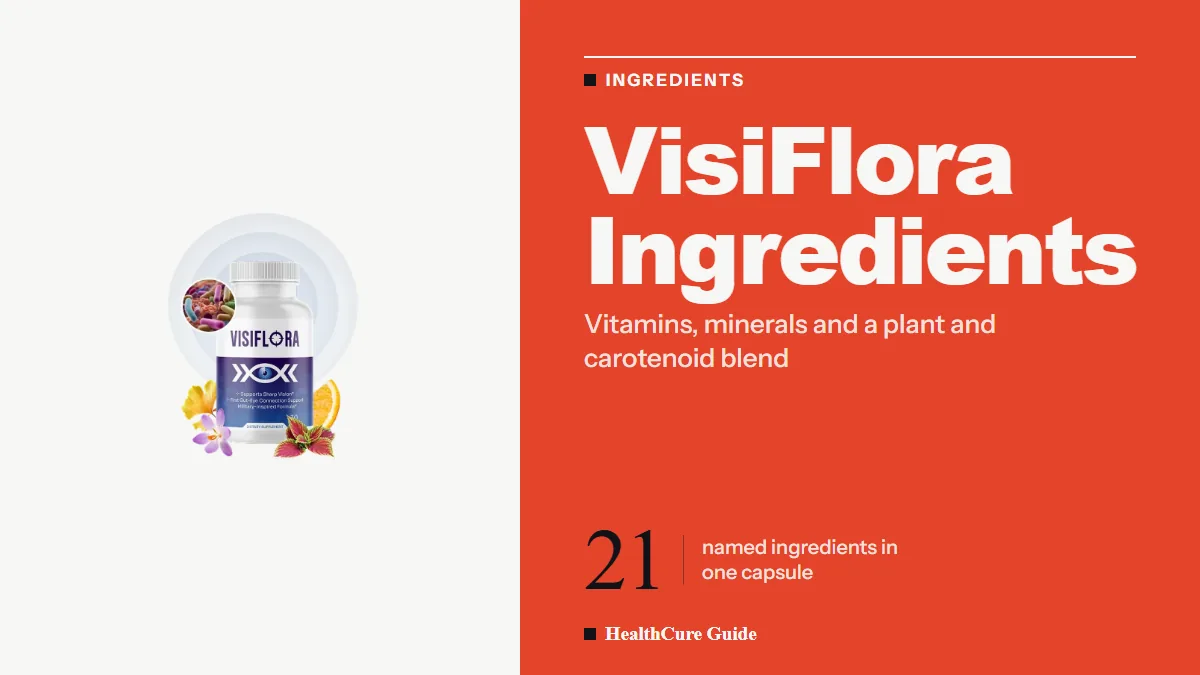
Open a kitchen cupboard and the shelves tell a story: oils on one, spices on another, tea somewhere near the kettle. A supplement label is easier to read when you sort it the same way. That is the plan for the VisiFlora ingredients below. We group them, give you the amount wherever the label prints one and add the seller’s own short note on what each is there for.
Everything on this page comes from the label and from the seller’s descriptions, and we say which is which. For the product overview, start with our VisiFlora guide.
VisiFlora ingredients: the shape of the label
Think of the capsule as two layers. The first is a short list of vitamins and minerals, each with an amount per capsule. The second is a single blend of 14 ingredients, shown only as a combined 351 mg. Seven plus fourteen makes 21 named ingredients, and the shell and fillers add four more lines on top.
Because the blend is a total and not a list of doses, we never state an amount for any single item inside it. When you see a figure next to an ingredient below, it belongs to the first layer.
The vitamin and mineral layer
Seven nutrients come first, each printed with a dose and a share of the daily value.
- Vitamin A arrives as beta carotene, at 450 mcg RAE, which is 50% of the daily value. The seller links it to eye wellness and cellular health.
- Vitamin C is ascorbic acid, 90 mg, or 100% of the daily value. The seller lists it among the antioxidants.
- Vitamin E is DL-alpha tocopheryl acetate, 15 mg, also 100%, and also described as antioxidant support.
- Zinc comes as zinc oxide at 11 mg, 100%. The seller connects it to normal enzyme activity in the eye.
- Selenium is selenium AAC at 20 mcg, 36%, which the seller calls an essential mineral.
- Copper is copper gluconate at 0.9 mg, 100%, another essential mineral in the seller’s words.
- Chromium is chromium picolinate at 15 mcg, 43%, tied by the seller to healthy metabolic function.
The carotenoid family
Four members of the blend belong to the carotenoid family.
Lutein, from marigold, and zeaxanthin are the pair the seller places at the center of its story. It describes them as carotenoids found in the eye. Astaxanthin is introduced as a potent carotenoid antioxidant, tied by the seller to eye health. Lycopene is described simply as an antioxidant.
Vitamin A deserves a second mention here, because its beta carotene source is also a carotenoid. That puts a fifth member of the family into the label, just outside the blend.
Plants with a long reputation
Four botanicals sit in the blend, and each comes with a short seller’s note.
- Bilberry fruit extract is described as rich in anthocyanins.
- Saffron stigma extract is called a carefully studied botanical extract.
- Eyebright aerial parts is presented as a traditional botanical used to promote comfort around the eyes.
- Ginkgo leaf appears with coleus forskohlii root. The seller says the two support healthy circulation and the delivery of nutrients to the eyes.
The flavonoid trio
Grape seed extract, rutin and quercetin are bioflavonoids, a family of plant compounds. The seller says they support cellular integrity and the small vessels around the eyes. Rutin and quercetin on this label come from Sophora japonica.
Two quiet helpers
Taurine is described as supporting cellular hydration. Alpha lipoic acid is listed as an antioxidant. Neither makes much noise in the seller’s story, but together with the others they bring the blend to its 14 names.
How to read a label like this one
A few habits make any supplement panel less intimidating. Start with the serving size, which here is one capsule, and the servings per container, which is 30. Next, read the amounts with their percentages, because a percent of the daily value tells you how large the dose is next to a typical day’s need. Then look for any line marked as a blend, since that is where one total stands in for several ingredients. Finally, read the other-ingredients line and the caution at the bottom.
Run VisiFlora through that routine and the panel is tidy. The seven nutrients carry amounts and percentages, the blend carries a single weight and a daily value that is not established, and the caution asks you to stay within the recommended dose. The routine is a capsule each day alongside food and some water, so there is nothing to measure and nothing to mix, and no dose to calculate.
What the capsule itself is made of
The shell is hypromellose, a vegetable material. Rice flour, magnesium stearate and silicon dioxide make up the rest of the other-ingredients line. The seller calls the product non-GMO and says its ingredients pass through a certified facility held to strict quality standards. Both are the seller’s statements, and we have not verified them.
The research, by topic
None of the work below tested VisiFlora, and we do not suggest otherwise. It is background on single ingredients and on the wider subject.
- A 2024 review weighs lycopene in its role as an antioxidant.
- A 2005 paper asks how human retinal pigment cells convert beta-carotene to vitamin A.
- A 2014 lab experiment exposes human corneal cells to eyebright extract.
- A 2020 review surveys beta-carotene, lutein and zeaxanthin as they relate to eye health.
- A 2022 review looks at the gut-eye link, the notion behind the seller story.
The links sit at the foot of the page. What they offer is context. Whether the capsule suits you is something your own experience will show over weeks of steady use, which is also how the seller frames it.
Putting the groups together
Seen side by side, the groups fall into a clear pattern. The vitamins and minerals form the measured base. The carotenoids and the flavonoid trio supply the antioxidant theme that the seller returns to again and again. The botanicals bring the traditional note, and ginkgo with coleus carries the circulation idea. Taurine and alpha lipoic acid fill the remaining places.
The seller sums the whole design up as a formula for everyday eye comfort and nutrient absorption. That is a modest, tidy promise, and it is easy to hold the label up against it. If the story suits the way you like to take care of yourself, the guarantee gives you 60 days from delivery to see how the routine fits.
Who should look twice
A short list of ingredients and nutrients deserves a conversation with your doctor.
- Ginkgo, coleus forskohlii, quercetin and grape seed extract are the plant items to mention if you use blood thinners, blood-pressure medicine or diabetes medicine, or if surgery is coming up.
- Four of the seven nutrients (vitamin A, zinc, copper, selenium) are also common in other products, so tally what you already swallow each day.
- Under 18, pregnant or nursing: the label says not to use it.
Our safety post goes through each of these calmly, and the label has a general reminder to stay within the recommended dose. If you simply want every line as a single table, see the full ingredients list or the ingredient page.
Our view of the label
We like that this capsule prints amounts for its seven nutrients and names every blend ingredient, even though the blend total is the only figure it gives. Together with a one-time payment and a guarantee that runs 60 days from delivery, it is a label worth reading before you decide. Results vary, and the seller describes a few weeks of consistent use.
Good to know:
- Ingredient notes are the seller’s descriptions, not our findings.
- Research cited here concerns single ingredients, not this capsule.
- Show the label to your doctor if you take regular medicine.
Common questions
What are the main VisiFlora ingredients?
Seven measured nutrients (chromium, copper, selenium, zinc and vitamins A, C and E) plus a mix of 14 that includes astaxanthin, lutein, zeaxanthin, bilberry, saffron, ginkgo and eyebright.
How many ingredients does the label name?
Twenty-one, because 7 nutrients plus 14 blend ingredients makes 21. Four more items on the label, such as the capsule shell, are listed as other ingredients.
Does the label give a dose for each plant?
No. The blend is printed as one total of 351 mg per capsule, so we quote no amount for any single ingredient inside it.
Where does the seller say lutein and zeaxanthin fit in?
The seller describes them as carotenoids found in the eye, and they sit at the center of its story about everyday eye comfort.
Is the research about VisiFlora itself?
No. The papers we mention look at single ingredients or at the wider topic, and none of them tested this capsule.
Should I check the ingredients with a doctor?
Yes, particularly when a blood thinner or a medicine for blood pressure or diabetes is in your routine, when an operation is planned, or when you already use vitamin A, zinc, copper or selenium products. Take the label with you.
Sources
- Lycopene reviewed as an antioxidant, 2024, Journal of Nutrition and Metabolism
- Retinal pigment cells and the conversion of beta-carotene, 2005, Investigative Ophthalmology and Visual Science
- Eyebright extract tried on human corneal cells in the lab, 2014, Balkan Medical Journal
- Beta-carotene, lutein and zeaxanthin and eye health, a 2020 review in Antioxidants
- A 2022 Ophthalmic Research review on how the gut and the eye are connected