Energy Revolution System Complaints: Questions Buyers Raise
The questions careful readers raise before paying for this $39 PDF, each one answered from the seller's own pages, with the seller's disclaimer and the safety rules that come first.
- Written by
- HealthCure Guide Editorial Team
- Reviewed by
- HealthCure Guide Editorial Team
- Updated
- Reading time
- 7 min read
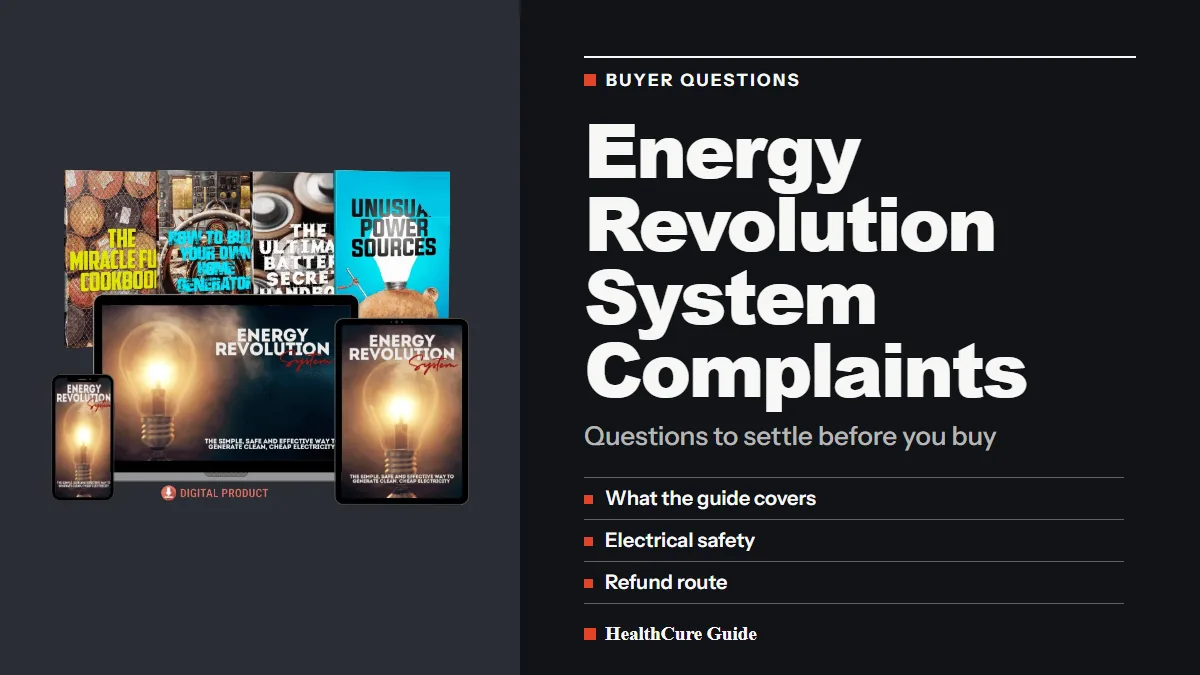
Ahead of purchase, a lot of people ask what could go wrong with a home power PDF. That is a fair thing to wonder about, and the most useful reply is a measured one. This page takes the questions that tend to surface around Energy Revolution System and explains how the vendor deals with each. We have not invented any complaints. Every point below rests on the vendor’s own pages, the retailer’s setup or the safety rules that apply to any home power work.
The product is a digital PDF sold for one payment of $39, with a 60-day refund promise attached. The sections that follow tackle the common concerns one by one, so you can form your own view of each. For the full product context, begin with the Energy Revolution System hub.
Energy Revolution System complaints: the video-led sales page
A frequent starting point is the design of the sales page, which is built around a video. The vendor does use a video-first layout, with a short block of text alongside. We did not watch the video, so we cannot describe anything it covers beyond what the written text states.
That matters because the written text is thin. It does not itemize the chapters, the parts or the cost of any build. If a video-first page leaves you uncertain, the sensible move is to send a direct question to the vendor through its contact page before ordering, and to read the refund terms in full.
The guide does not list its contents
This is the concern we think deserves the most attention. The vendor describes the PDF as a guide that explains how a small home power device is built. It also names a beginner section and a list of materials. What it does not do is spell out the steps, the parts in detail or what it costs to put a build together.
A reader who needs the complete contents in hand before paying is entitled to that position, and for that reader the guide may simply be the wrong purchase. Someone who is content with a written primer, and who accepts that the sales page omits detail, may find the offer a better fit.
Local rules, permits and what may be illegal
Readers often ask whether a home power project is allowed where they live. The vendor’s disclaimer speaks to this head-on. It says some home alterations may be illegal in your town, city, state, province or country, and it makes the buyer responsible for checking with the local authority.
We agree with that advice. Permits, utility requirements and building codes differ from place to place, and no sales page can answer for your property. If your plan touches a utility connection, ask whether a separate approval is needed before any work begins. Before buying parts or beginning any work, contact your permit office and ask what applies. Write the answers down, because they carry more weight than anything printed on a sales page.
Electrical safety and fuel
Electrical and generator work brings fire and shock risks, and safety is the question that matters most for a project of this kind. Anything linked to house wiring belongs with a licensed electrician, who can inspect the work and manage the permits and inspections your area requires.
Fuel adds its own dangers. Never run fuel-burning equipment indoors, and keep fuel and batteries out of living spaces. The bonus titles the vendor lists cover fuel, alternators, batteries and unusual power sources, so the same caution applies to them.
Upgrades at checkout
Another common question is whether checkout adds charges you did not choose. The vendor says extra upgrades or products selected during checkout appear as separate transactions. That is a detail to keep an eye on, though it is not a reason for alarm.
Read every line of the order before you approve it. Checkout is a place to slow down rather than hurry through. If an item appears that you did not select, stop and review the order before you finish. The vendor gives the statement name as CLKBANK*EnerRevolution, so a charge carrying a different name deserves a closer look. Keep the confirmation message as your record.
Refund steps and timing
Refund questions come up often, so here is the route as the vendor lays it out. A 60-day refund promise applies. To request a refund, write to the vendor at the address shown on its contact page, quoting your full name, your order number and the subject line Refund Request.
Requests are processed within 48 hours, according to the vendor, and the bank then returns the money over three to five business days. Buyers are asked to avoid a bank dispute while a request is open. After a refund clears, the file is no longer available to you. If the vendor does not answer, ClickBank order support, reachable through clkbank.com, is the second route. Keep a copy of every message you send and every reply you receive. A short, dated record makes a refund request easier to follow up, whether you deal with the vendor or with ClickBank.
Our money-back guarantee post lays these steps out as a checklist, and it is worth reading before you order.
The vendor’s disclaimer
The disclaimer is the most direct statement of what the vendor concedes. It says the story and presentation are created strictly for promotional purposes only. It describes the product as an experiment that was not technically assessed, and it states that the product has not been produced at any scale.
The disclaimer page also says the author name is a pen name and that some customer-style stories on the sales page are re-enacted by actors. We report those statements as the vendor’s own words. They are a reason to treat the sales page as marketing, and to rely on the guide’s content once you have it rather than on the pitch.
How to use this list before you order
Treat this list as a set of checks rather than a verdict. Start by reading the vendor’s refund page and contact page in full. Then open the order page only through our button, and read every line before you approve the order. Next, check the local codes and permits that apply to your property, and write the answers down. If a project would touch house wiring or fuel, arrange a review by a qualified professional before any work starts.
Most of these checks take less than an hour, and they leave you with a clearer picture than any sales video. Finally, settle whether a written primer is the right kind of purchase for you. If you want the full contents and cost in writing before paying, the sales page will not supply them, and you will need to weigh that gap yourself. If you are comfortable with a short guide and the rules that come with it, the questions above become easier to handle once you hold the answers.
What the complaints tell you
Taken together, these questions describe a product that is straightforward to buy and to return within its terms, but thin on detail before purchase. The refund process is written out, and the price is a single payment. The gaps are the sales page’s silence on contents, parts and cost, and the disclaimer’s admission that the product was not technically assessed. The product hub gathers the rest of the published details in one place.
For a reader who enjoys written primers and will follow local rules, the offer can be a modest, low-cost read. For anyone who needs the full plan before paying, it will not meet that need. Our what is Energy Revolution System post describes the product as the vendor presents it, and our review gives our overall reading.
Safety comes first
Whatever you conclude about the guide, the safety rules come first. Read them before any project starts, check local codes and permits, and ask a qualified electrician to review anything connected to house wiring. Keep fuel-burning gear out of living spaces entirely, and treat fuel and batteries with real caution.
The guide does not replace those checks. The vendor says the product was not technically assessed, so responsibility for any build sits with you, your local authority and the people you hire. The safety guide for this product sets out the same rules in more detail.
Common questions
Are there Energy Revolution System complaints we can point to?
We have not invented any. The questions below are the ones a careful reader tends to raise when reading the seller's pages, and each one is answered from those pages.
Why is the sales page mostly video?
The seller builds the sales page around a video. We did not watch it, so we describe only the written text, which is short.
What does the guide leave out?
The sales page does not list the contents, the parts or the cost of a build. We have not built anything from the file.
What happens if local rules forbid a project?
The seller says some home alterations may be illegal where you live. Check with your local authority before any project starts.
Are checkout upgrades charged separately?
The seller says any extra upgrades appear as separate transactions, so read every line of the order before you approve it.
How do I ask for a refund?
Email the seller at the address on its contact page with your full name, your order number and the subject Refund Request.