FemiCore Ratings: What Each Number Means and Misses
Three kinds of number get attached to FemiCore: the seller's own rating graphic, scores on marketplace listings, and editorial scores from review sites like ours. Each one measures something different, and only some of them can be checked.
- Written by
- HealthCure Guide Editorial Team
- Reviewed by
- HealthCure Guide Editorial Team
- Updated
- Reading time
- 9 min read
This guide contains affiliate links. If you buy through them we earn a commission at no extra cost to you. It does not change the verdict. Disclosure.
FemiCore ratings come from three very different places, and they are easy to confuse. A number on the seller’s page, a number on a marketplace listing and a number on a review site look alike at a glance. They are not measuring the same thing, they are not set by the same people, and only some of them can be checked by you. This page takes each kind in turn, then gives you a short test you can apply to any supplement score you come across.
HealthCure Guide is independent. We are not the seller of FemiCore and we do not process orders. Each button here is an affiliate link. A sale that starts from one of them can earn this site a commission, while the checkout total you see stays identical. Our score was set from published facts and does not move with sales.
Three kinds of number, three different sources
Before reading any score, it helps to know which family it belongs to. Here is how the numbers attached to FemiCore break down.
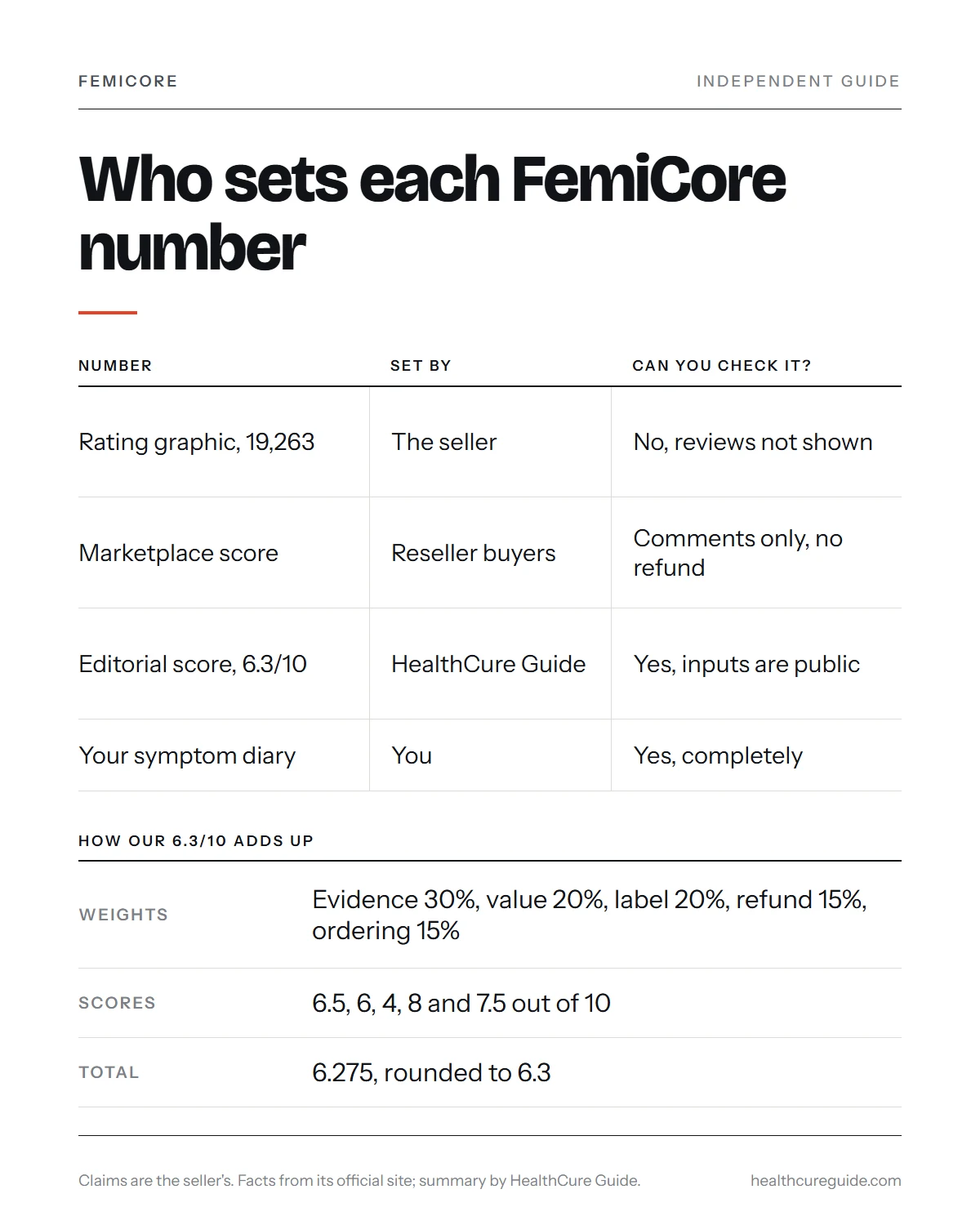
| Source | Who sets the number | What it summarizes | Can you check it? |
|---|---|---|---|
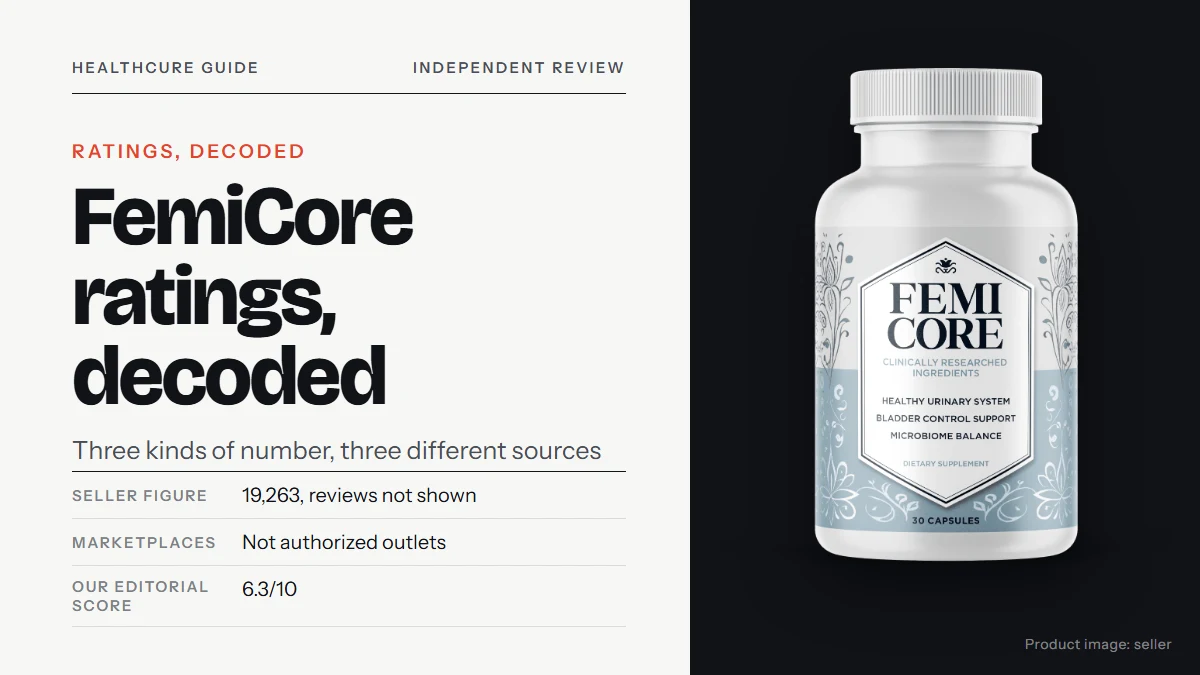
| Seller’s rating graphic | The seller | Reviews it says it holds (19,263) | No, the reviews are not shown |
| Marketplace listing | Buyers of that listing | A reseller’s stock, not an authorized outlet | Partly: comments yes, bottles no |
| Editorial score (ours, 6.3/10) | A review site | Label, price, terms, ingredient research | Yes, every input is public |
| Your own diary | You | Your symptoms before and after | Yes, completely |
The last row is the odd one out, and it is the one we return to at the end. Every other number is a summary made by somebody else, for their own reasons, from data you mostly cannot see.
The rating graphic on the seller’s page
When we checked the official site on October 9, 2026, the home page and the order page showed no individual testimonials at all: no names, no quotes, no photos of buyers. What they did show was a rating image with a line saying customers rate the product highly, based on 19,263 reviews.
That figure raises questions the page does not answer:
- Where were the reviews collected? A survey of buyers, an email follow-up, a third-party platform? Nothing on the page says.
- Over what period? A count built over many years means something different from one built last month.
- How many were low? A graphic shows an overall impression. It does not show the spread.
- Can you read any of them? No. There is no list, no filter, no link to a review platform.
The same site carries a disclaimer that its testimonials “may not reflect the typical purchaser’s experience”. The page also claims that “96% of customers order 6 bottles”, which is equally the seller’s own statement. None of this makes the figure false. It makes it unverifiable, and an unverifiable number belongs in the marketing column, not the evidence column.
Why marketplace scores for this product mislead
You may see FemiCore listings with their own scores on large shopping platforms. The seller states that Amazon, Walmart and eBay are not authorized outlets for FemiCore, and warns that listings there may be fakes or old stock. That changes what the score is about.
A marketplace score is the opinion of people who bought from one listing. It can be shaped by how fast the parcel came, whether the box was dented and whether the price felt like a bargain. It cannot tell you whether the bottles came from the official supply chain, how long they sat in a warehouse, or how a product with live bacteria was kept along the way.
There is also a practical cost. The 60-day refund on the official store does not cover bottles bought from a reseller, so a buyer who trusts a marketplace score gives up the one protection that makes a trial low risk. Our guide to FemiCore on Amazon explains how to check a listing before you buy anything from it.
How our 6.3/10 editorial score is built
Our number is a weighted average of five categories, each scored out of 10 against written criteria: ingredients and evidence (30% of the total, scored 6.5), value for money (20%, scored 6), label transparency (20%, scored 4), guarantee and refund terms (15%, scored 8) and ease of ordering (15%, scored 7.5). Multiplying each score by its weight and adding the results gives 6.275, which rounds to 6.3. The full breakdown, with the reasoning for each category, is in our scorecard post.
What the score is not matters as much. It is not a customer rating, it is not a prediction of how the capsule will work for you, and it does not include any review we collected, because we collected none.
A five-question test for FemiCore ratings
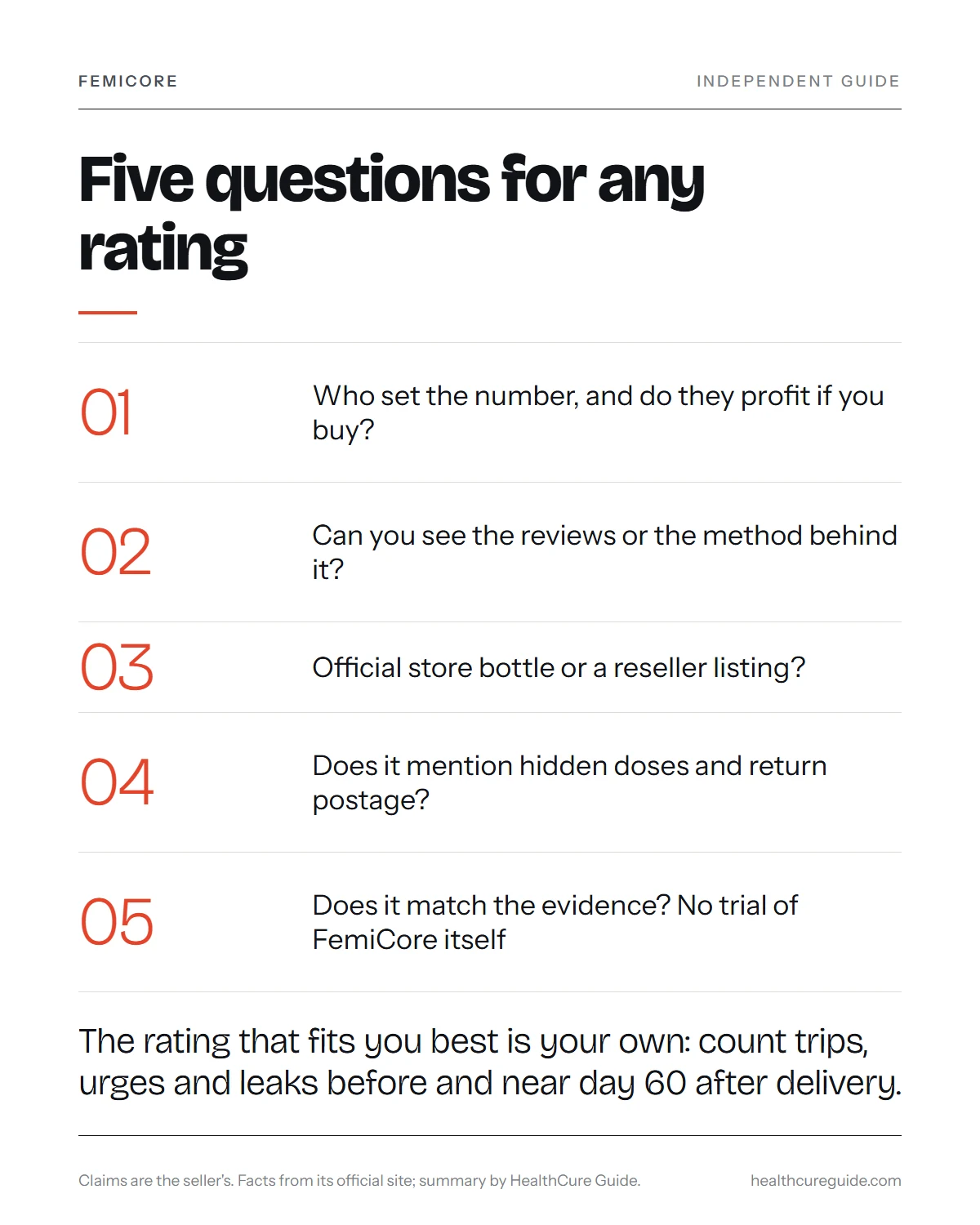
Run any score you find through these five questions. It takes a minute and filters out most of the noise.
- Who set the number, and do they profit if you buy? The seller does. Resellers do. Affiliate sites do, ours included. Profit does not make a score wrong, but it means you should look for the method.
- Can you see what sits behind it? A figure with readable reviews or a published method is worth more than a figure on its own.
- Which bottle does it describe? A score for the official store and a score for a marketplace listing are about different stock and different refund terms.
- What does it leave out? A high score that never mentions the hidden doses, the return postage or the need to send every bottle back has skipped the parts that cost buyers money.
- Does it match the evidence? There is no trial of the finished FemiCore formula. A rating that implies proven results is claiming more than the research shows.
Reading any supplement rating
The same habits work for any capsule or powder you are weighing up, not only this one.
| What the number shows | What to ask next |
|---|---|
| A high average | How many ratings, and how spread out are they? |
| A large review count | Can you read them, and who gathered them? |
| A score out of 5 or out of 10 | Is it a crowd score or one writer’s judgement? |
| A recent date | Have the price, label or terms changed since? |
| Praise for speed or packaging | Is any of it about the effect itself? |
Timing matters with this kind of product. The seller suggests giving FemiCore at least 3 months before you decide, so a rating written after one week describes the first week, not the result. People who stop early tend not to post at all, and people who changed other habits at the same time may credit the capsule for the change.
There is also a difference between scores that rate the product and scores that rate the purchase. A smooth checkout and a clear refund page are real strengths, and our own score gives them weight. They tell you the buying risk is manageable, which is not the same as telling you the capsule will help.
When a number should change your plans
Ratings are weak evidence about effect, but they can still be useful signals in a narrower way. Three situations are worth acting on.
A pattern you can verify. If many comments describe the same buying problem, such as a refund request that went unanswered, compare it with the written terms. Under the official policy you have 60 days from delivery to send an email headed “Refund Request”, and returns go to an address in Tallmadge, Ohio. A complaint that ignores those steps tells you what to do differently. A complaint that followed them is a warning worth taking seriously.
A change in an editorial score. Our 6.3 would move if the inputs moved: printed doses would lift the label category, a published trial of the finished capsule would lift the evidence category, and a shorter refund window or new shipping charges would pull the total down. If you see a site revise its number, look for the reason it gives.
A price that does not match. A listing or a rating page that quotes bottles below $49, or single bottles, is describing something other than the official packages. That alone is reason to stop and buy elsewhere or not at all.
What no rating can measure for you
Every public number about FemiCore is an average of other people, or a desk judgement about a label. Neither knows your situation. Some things only you, and your doctor or pharmacist, can weigh:
- Your medicines. Berberine may drop blood sugar, may drop blood pressure, and slows the liver enzymes CYP3A4 and CYP2D6, which raises levels of many drugs. Cranberry has warfarin case reports. Bearberry has a lithium interaction.
- Pregnancy and breastfeeding. Berberine is considered unsafe in both, and bearberry should be avoided. The official site itself tells pregnant or nursing women, and anyone on medication or with a medical condition, to check with a physician first.
- Your symptoms. Blood in the urine, fever or chills, flank pain, burning, or bladder control that suddenly gets worse call for a doctor, not a supplement.
If none of those apply, the most useful rating is one you keep yourself. Note your daytime trips, night trips, urgent moments and any leaks for a few days before the first capsule. Repeat the same notes in the weeks before your refund deadline, which falls 60 days after delivery. If the numbers have not moved, the written refund terms let you send every bottle back, empty or full, with the packing slip, at your own postage cost.
Where the ratings leave us
Put the three public numbers side by side and a pattern appears. The seller’s figure is large but cannot be inspected. Marketplace scores can be inspected but describe stock outside the official supply chain. Our 6.3/10 can be inspected and is built from public facts, yet it is still one site’s judgement and cannot predict your result.
That is why we treat ratings as a starting point. If a score makes you curious, read what sits behind it: the FemiCore catalog page lists the label, packages and terms in one place, and our 2026 review records what we re-checked this year. Then decide whether a dated, refundable trial fits you.
This page is general information, not medical advice. Speak to your doctor or pharmacist before starting any supplement if you take medicines or have a health condition.
Common questions
Where does the 19,263 figure on the FemiCore page come from?
It comes from the seller. The FemiCore sales page shows a rating image with the line that customers rate it highly based on 19,263 reviews, but the reviews themselves are not displayed anywhere on the page. Nobody outside the company can see how they were collected, over what period, or how many were low. Read it as a marketing figure, not as measured evidence.
Can I trust a FemiCore score on a marketplace listing?
Only as a description of that listing. The seller says FemiCore is not an authorized Amazon, Walmart or eBay product, so a score there belongs to a third-party reseller and may cover fakes or old stock. Bottles bought that way also fall outside the 60-day refund. The comments can tell you about delivery and packaging, not about the official product.
What does a 6.3 out of 10 mean for FemiCore?
It is our editorial score, not a customer score. It sits in the middle of the scale: the buying terms and refund policy score well, the evidence is moderate, and label transparency scores low because no dose is printed for any of the nine ingredients. In plain terms, a reasonable experiment for the right person, not a proven product and not one to avoid outright.
Why doesn't HealthCure Guide publish a user score for FemiCore?
Because we have no verified user data to build one from. We did not collect customer reviews, run a survey or take the capsules ourselves, and inventing a crowd score would mislead you. Our number is limited to what anyone can check: the label, the prices, the refund terms, the ordering process and published research on the ingredients.
Is a high average score proof that a supplement works?
No. A high average can reflect who chose to rate, when they rated and what they were rating, such as fast shipping. People who quit early rarely post, and the seller advises about 3 months of use before judging FemiCore, so early ratings say little. Controlled trials answer whether something works, and there is no trial of the finished FemiCore formula.
Which number should matter most when judging FemiCore?
Your own before-and-after count. A few days of noting daytime trips, night trips, urgent moments and leaks before you start, then the same notes near the end of the refund window, tells you more about your result than any public figure. Combine that with the refund date, counted from delivery, and you have a decision you can actually defend.