FemiCore Reviews and Ratings: Our Scores and Method
Star ratings tell you little when the seller controls the page. So we built our own scorecard from things anyone can check, showed the arithmetic, and set out how to judge the customer feedback you find elsewhere.
- Written by
- HealthCure Guide Editorial Team
- Reviewed by
- HealthCure Guide Editorial Team
- Updated
- Reading time
- 9 min read
This guide contains affiliate links. If you buy through them we earn a commission at no extra cost to you. It does not change the verdict. Disclosure.
Most FemiCore reviews and ratings you find online fall into one of two groups: five-star widgets on pages that sell the product, and one-line dismissals that never look at the label. Neither tells you how the number was reached. This page does the opposite. We explain the scoring method first, apply it category by category, and then show you how to find customer feedback that is worth reading, and how to read it.
A note on what this is not. It is not a report of personal use, and it does not contain customer quotes. Links to the store are affiliate links, so we may earn a commission if you buy; the scores were set before any link was added and do not depend on it.
How we score FemiCore reviews and ratings
A useful rating has to be repeatable. If another reader took the same inputs and the same rules, they should land close to the same number. So every category below is scored out of 10 against written criteria, using only information that is publicly available: the ingredient list, the published prices and package terms, the refund conditions, the ordering process and peer-reviewed research on the ingredients.
| Category | Weight | What we look at |
|---|---|---|
| Ingredients and evidence | 30% | Is there a plausible rationale, and how strong is human research on each ingredient? |
| Value for money | 20% | Cost per day across packages, what you can and cannot compare |
| Label transparency | 20% | Doses, strain detail, how claims and figures are presented |
| Guarantee and refund terms | 15% | Length, what is covered, what you must do, what it costs you |
| Ease of ordering | 15% | Where it is sold, checkout, billing type, shipping times and costs |
Ingredients carry the most weight because they decide whether the product can do anything at all. Guarantee and ordering carry the least because they lower your risk rather than add benefit.
What each score means
- 9 to 10: best in class, nothing material missing.
- 7 to 8: good, with minor gaps you can live with.
- 5 to 6: acceptable, with clear trade-offs.
- 3 to 4: a significant weakness a buyer should weigh.
- 1 to 2: a serious problem.
What we leave out matters too. We do not score “customer satisfaction”, because we have no verified data for it, and we do not score how a product feels to take, because that would require use we have not done.
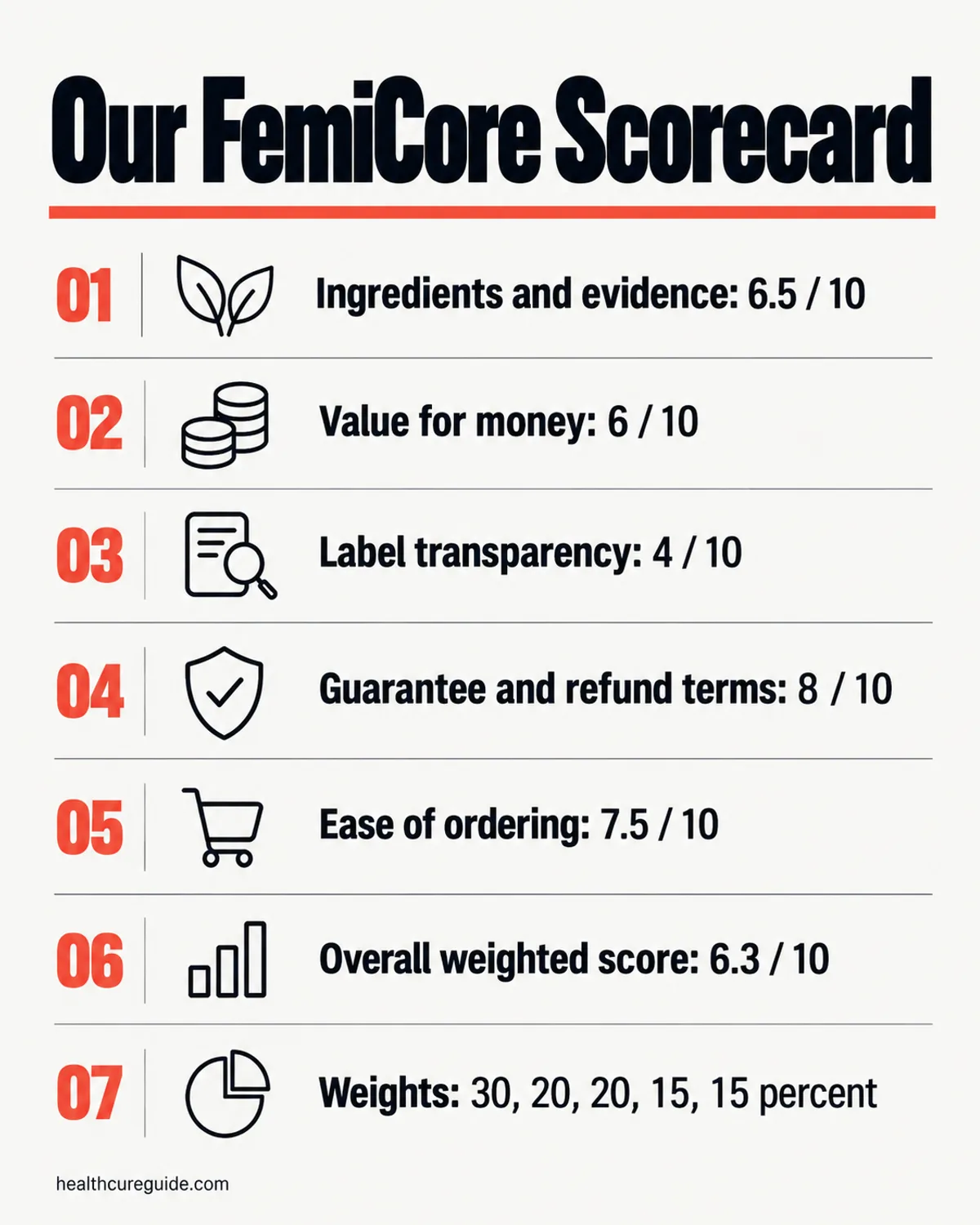
The FemiCore scorecard
| Category | Score | Weighted | One-line reason |
|---|---|---|---|
| Ingredients and evidence | 6.5 / 10 | 1.95 | Real rationale, two well-studied ingredients, no product trial |
| Value for money | 6 / 10 | 1.20 | $1.63 to $2.80 a day, doses unknown |
| Label transparency | 4 / 10 | 0.80 | Proprietary blend, no amounts per ingredient |
| Guarantee and refund terms | 8 / 10 | 1.20 | 60 days, opened bottles accepted |
| Ease of ordering | 7.5 / 10 | 1.13 | One official store, one-time payment |
| Overall | 6.3 / 10 | Reasonable to try, hard to judge on paper |
The weighted column adds up to 6.275, which we round to 6.3.
Category by category
Ingredients and evidence: 6.5
The rationale is sound. Sequencing work from 2012 showed the adult female bladder is not sterile (Wolfe and colleagues), a 2014 study linked urgency incontinence with less Lactobacillus in bladder bacteria (Pearce and colleagues), and a 2018 paper showed the bladder and vaginal microbiota are connected (Thomas-White and colleagues). Two ingredients have meaningful human trial data for urinary health: cranberry, which a 2023 Cochrane review found reduces repeat urinary tract infections in susceptible groups, and L. crispatus, which cut UTI recurrence from 27% to 15% in a 2011 trial, though that trial used a vaginal suppository rather than a capsule.
The rest is thinner. Berberine’s case rests largely on mechanism, such as its effects on gut bacteria (Habtemariam, 2020). Bearberry is a traditional urinary herb that NCCIH describes as suited to short-term use. Mimosa Pudica has the least human evidence of the nine. And there is no published trial of FemiCore as a finished product. That keeps the score in the middle. For a fuller walk through the evidence, see does FemiCore really work.
Value for money: 6
Per day, FemiCore costs about $2.80 on the 2-bottle package including $9.99 shipping, $2.30 on the 3-bottle package and about $1.63 on the 6-bottle package. The bigger packages are clearly better value per capsule, and the 6-bottle order adds three digital guides that the vendor lists at $793 combined.
Two things hold the score down. The $179 “regular price” is a reference figure, so the advertised savings of $200, $330 and $780 are measured against a price few people pay. And because the doses are hidden, there is no way to say whether you are paying for a meaningful amount of the ingredients that have research behind them.
Label transparency: 4
This is the weakest category. The nine ingredients are named, but they sit in a proprietary blend, so the amount of each one is not disclosed. The probiotics are listed by species, with no strain designations and no count of live bacteria. Those details matter: the cranberry and L. crispatus findings come from specific products at known doses, and a reader cannot check FemiCore against them.
The marketing does not help. The review count is the vendor’s own number, and the reference price frames the discounts. On the positive side, the manufacturer states its manufacturing claims (manufactured in the USA with imported ingredients, GMP-certified, FDA-registered facility, non-GMO, no stimulants), and the refund terms are written down. Facility registration is not product approval, and no supplement is FDA-approved.
Guarantee and refund terms: 8
The guarantee runs for 60 days from delivery and covers opened bottles, which many supplement refunds do not. You contact support, return all bottles with the packing slip, and the purchase price goes back to your original payment method. Points come off for the friction: return shipping is at your own cost, every bottle has to go back, and 60 days is shorter than the 8 to 12 weeks the manufacturer suggests for judging results.
Ease of ordering: 7.5
There is one place to buy: the official website, with BuyGoods handling checkout and order support. Orders are one-time payments, not subscriptions, and US delivery takes 5 to 7 business days, free on 3 and 6 bottles. Points come off because the smallest order is two bottles, and because orders to Canada, the UK, Ireland, Australia and New Zealand pay $15.95 and wait 10 to 15 business days. A single sales channel is also a mixed blessing: it protects the guarantee but means you cannot pick it up locally.
What the sales page ratings do and do not tell you
The official page cites about 19,263 reviews. We do not repeat it as a measure of quality, for three reasons. The figure comes from the vendor and cannot be audited. We do not know how reviews were gathered, whether all of them are shown, or how negatives are handled. And a large count says nothing about whether the product worked for people with symptoms like yours.
Marketplace star ratings are not a shortcut either. FemiCore is not sold on Amazon, Walmart or eBay by its maker, so any rating on those sites belongs to a reseller listing. It can reflect delivery speed or packaging as much as the capsules, and the bottles behind it sit outside the 60-day guarantee. Our guide to FemiCore scam warning signs covers those sellers in more detail.
Where to find genuine customer feedback
Real feedback exists, but you have to look past pages that earn from the sale, including affiliate pages like this one. Places worth checking:
- Health forums and community threads. Look for posts where the writer answers follow-up questions and describes their situation in some detail.
- Independent review sites that publish criticism. A site that lists real downsides, and says how it makes money, is more credible than one that does not.
- Video reviews from people who show the bottle and label. Treat these with the same scepticism: check the description for affiliate links and see whether the creator mentions anything negative.
- Consumer complaint platforms. These skew negative by design, which makes them a useful counterweight. Read them for patterns about delivery or refunds rather than for single angry posts.
- The written terms. For questions about refunds and shipping, the official terms and BuyGoods order support are more reliable than anyone’s memory of them.
How to read a FemiCore review without being misled
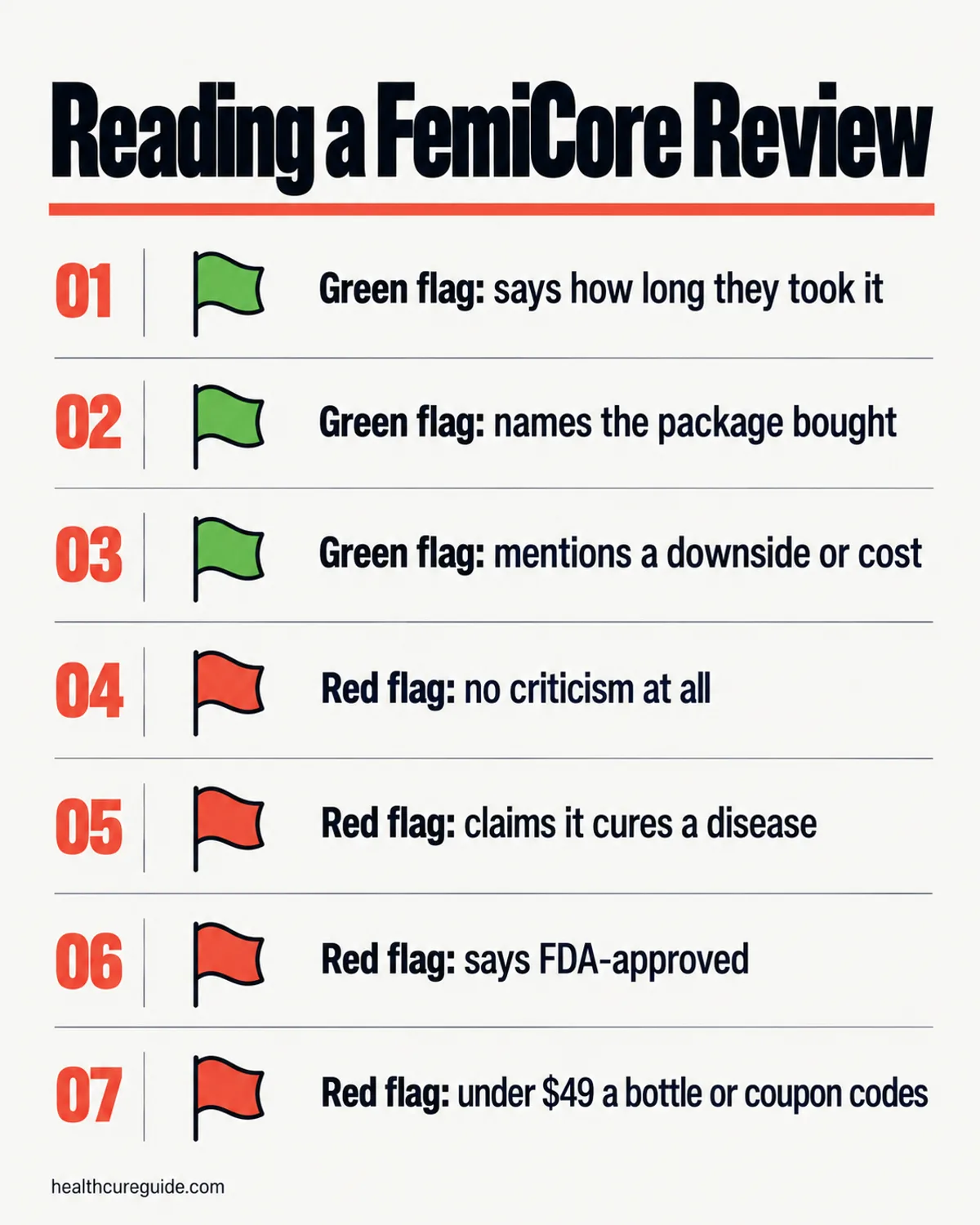
Signs a review is worth your time
- It says how long the person took it and which package they bought.
- It describes symptoms in concrete terms, such as night-time trips or urgency, rather than “it changed my life”.
- It mentions at least one downside, cost or doubt.
- It talks about timing honestly. Probiotic-based products are slow, and the seller itself advises using it for at least 3 months before deciding.
- If the person asked for a refund, it says how the process went.
Signs a review is an advert
- No criticism at all, plus a buy button every few lines.
- Claims that FemiCore cures infections, overactive bladder or any disease.
- Statements that the product is FDA-approved. No supplement is.
- Prices below $49 a bottle, coupon codes or single-bottle trials, which point to an unofficial seller.
- The same wording on several sites, or reviewer photos that look like stock images.
Even genuine reviews have limits. People who notice a change are more likely to post, people who quit early rarely do, and many women change other habits at the same time. One person’s result is not a prediction of yours.
What the FemiCore rating means for you
A 6.3 is not a recommendation to buy and not a warning to avoid. It describes a product with a believable idea, a fair refund policy and a label that asks you to take a lot on trust. Whether that is a good bet depends on your situation.
It suits an adult woman with mild to moderate urgency or occasional leaks, no interacting medication and no red-flag symptoms, who is comfortable running a structured 60-day trial with a simple symptom diary. It is a poorer fit if dose transparency matters to you, if you are pregnant or breastfeeding, have kidney disease, or take diabetes, blood pressure or blood-thinning medication. Talk to a clinician first in those cases, and straight away if you have blood in your urine, fever or new, painful symptoms.
The best review of FemiCore for your purposes is the one you write yourself in that diary. For the long-form evidence, pricing and verdict, read our complete FemiCore reviews guide.
Common questions
What is FemiCore's overall rating?
On our weighted five-category method, FemiCore scores 6.3 out of 10. It does best on its refund guarantee (8/10) and ease of ordering (7.5/10), sits in the middle on ingredients and evidence (6.5/10) and value (6/10), and scores lowest on label transparency (4/10) because the amount of each ingredient is not disclosed.
How is the FemiCore rating calculated?
Each of five categories gets a score out of 10 against written criteria, then a weight: ingredients and evidence 30%, value 20%, transparency 20%, guarantee 15%, ease of ordering 15%. The weighted scores are added together. Every input is something a reader can check: the label, the published prices and terms, and peer-reviewed research on the ingredients.
Did you test FemiCore yourselves?
No. Our rating is a desk assessment of documented information, not a report of personal use. We do not collect or publish customer star ratings, because we cannot verify them. That is a limitation, and it is why the score focuses on what can be checked: ingredients, evidence, price, label disclosure, refund terms and the buying process.
How many customer reviews does FemiCore have?
The FemiCore sales page cites about 19,263 reviews. That is the vendor's own figure, and there is no independent way to check how it was counted, over what period, or how many were negative. Treat it as marketing rather than as evidence of how well the product works.
Are FemiCore ratings on Amazon real?
FemiCore is not sold on Amazon, Walmart or eBay by its maker. Any listing on those platforms comes from a third-party reseller, so its star rating describes that listing and that seller, not the official product supply chain. Bottles bought there are also outside the 60-day money-back guarantee.
Where can I find genuine FemiCore customer feedback?
Look for independent discussion where the writer has nothing to sell: health forums, community threads and review sites that publish criticism as well as praise. The most useful accounts mention how long the person took it, which package they bought and, where relevant, how the refund went. Pages with no downsides at all are usually adverts.
Will the FemiCore rating change?
Yes, if the inputs change. A disclosed dose per ingredient would lift the transparency score, a published trial of the finished product would affect the evidence score, and price or refund-term changes would move value and guarantee. We note the date of any revision in the modified field at the top of the page.
Sources
- Wolfe AJ et al. Evidence of uncultivated bacteria in the adult female bladder. J Clin Microbiol. 2012.
- Pearce MM et al. The female urinary microbiome: a comparison of women with and without urgency urinary incontinence. mBio. 2014.
- Thomas-White K et al. Culturing of female bladder bacteria reveals an interconnected urogenital microbiota. Nat Commun. 2018.
- Stapleton AE et al. Randomized, placebo-controlled phase 2 trial of a Lactobacillus crispatus probiotic given intravaginally for prevention of recurrent urinary tract infection. Clin Infect Dis. 2011.
- Williams G et al. Cranberries for preventing urinary tract infections. Cochrane Database Syst Rev. 2023.
- Habtemariam S. Berberine pharmacology and the gut microbiota: a hidden therapeutic link. Pharmacol Res. 2020.
- National Center for Complementary and Integrative Health. Uva Ursi.