Finessa Ingredients: The Full Label, Blend by Blend, Explained
A powder is only as convincing as its label. Here is every Finessa ingredient, the amount printed beside it and the role the seller gives it, in plain words.
- Written by
- HealthCure Guide Editorial Team
- Reviewed by
- HealthCure Guide Editorial Team
- Updated
- Reading time
- 7 min read
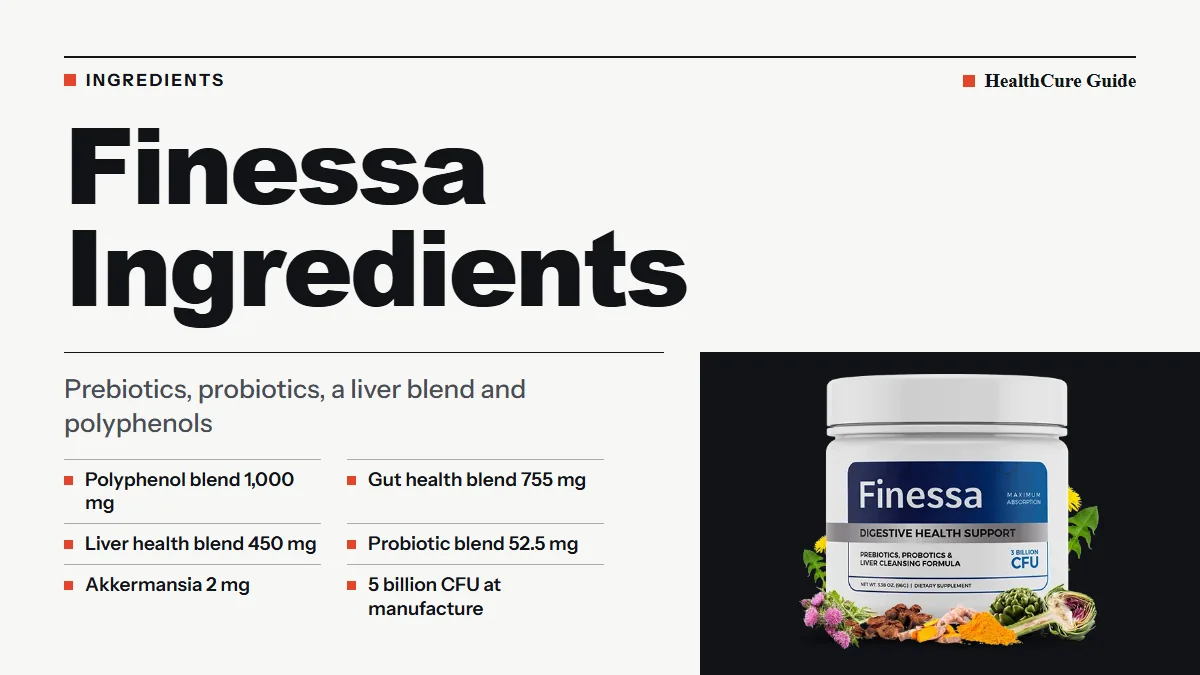
When something goes into your glass every day, you should be able to read what it is. The seller of Finessa prints a weight beside each blend, which makes the formula easy to follow, and this guide walks through it from the bacteria at one end to the berries at the other.
Finessa carries the label wording “Digestive Health Support”, followed by prebiotics, probiotics and a liver cleansing formula. A serving is a single scoop with 10 calories and 3 g of carbohydrate.
Finessa ingredients at a glance
| Blend | What it holds | Weight per scoop |
|---|---|---|
| Akkermansia muciniphila AH39 | A single strain, printed on its own line | 2 mg |
| Probiotic blend | Nine strains and 5 billion CFU, counted when made | 52.5 mg |
| Liver health blend | Artichoke, dandelion, milk thistle, silymarin, turmeric | 450 mg |
| Gut health blend | Cascara sagrada, cassia cinnamon, DGL licorice, FOS, ginger | 755 mg |
| Polyphenol blend | Nine berries, fruits and colorful roots | 1,000 mg |
Elsewhere on the panel you will find potassium (10 mg), sodium (40 mg) and selenium (1 mcg). Rounding out the jar, the label names silicon dioxide, stevia leaf extract, sea salt, citric acid, natural flavors and resistant dextrin.
The friendly bacteria
Gut balance is the theme the seller returns to most, and two lines of the label carry it. The probiotic blend groups several families. From the Lactobacillus side come L. acidophilus, L. casei, L. rhamnosus, Lactobacillus acidophilus LA85 and Lactobacillus reuteri LR08. Bifidobacterium lactis BLa80 and Bacillus coagulans BC99 follow, then Clostridium butyricum and Streptococcus thermophilus. The count printed on the label is 5 billion CFU, measured when the product is made.
Akkermansia muciniphila AH39 sits apart at 2 mg. The seller presents it as one more strain for the gut, giving the formula a second source of bacteria beyond the blend. If your immune system is weakened, raise probiotics with a doctor before you begin.
The prebiotic and the spices
Bacteria need food of their own, and that is the job of the prebiotic. FOS (fructooligosaccharides) is a fiber of that kind. In the gut health blend it shares the stage with ginger, cassia cinnamon bark, DGL licorice and cascara sagrada bark extract.
A few notes on that group. DGL stands for deglycyrrhizinated licorice, a form of the root. Cascara sagrada is an old-fashioned bark known for stimulating the bowels, which makes it the one to approach with a little care. Ginger and cinnamon will be familiar from your kitchen. The five together make up a 755 mg total.
The liver herbs
Around the seller’s “gut-liver axis” idea sits a 450 mg liver health blend of silymarin, milk thistle, turmeric root, dandelion root and artichoke extract. According to the label, the artichoke is standardized to 5% cynarin and the silymarin to 80%.
People have used these plants in traditional routines for a long time, and the seller draws on them for what it calls the link between gut and liver. We describe their role the way the seller does and go no further.
The berries and roots
By weight, the largest blend on the panel is the polyphenol blend at 1,000 mg. Its nine ingredients are acai berry, blueberry, cranberry, pomegranate, raspberry, black currant, strawberry juice, beet root and purple carrot. Polyphenols are the plant pigments that give such foods their deep colors, and that is where the blend takes its name. They also give the drink much of its fruit-and-vegetable character.
Why the formula is built this way
Put side by side, the logic is easy to follow. One scoop is meant to bring bacteria (the probiotic blend and Akkermansia), food for those bacteria (FOS), traditional gut-friendly herbs, liver herbs and colorful plant foods. The seller says the aim is easy digestion, regularity, a healthy gut balance, liver and colon health, energy and a lighter-feeling belly. A ten-second habit stands in for what could otherwise be four separate bottles.
How the pieces work together
Think of the formula as a team rather than a list. The friendly bacteria arrive in two forms: the nine-strain blend and the separate Akkermansia strain. FOS is the fiber that bacteria feed on, so the two ideas complement each other. Ginger and cinnamon are kitchen staples that people have long linked with comfortable digestion, and the liver herbs round out the seller’s picture of gut and liver working together.
The berries and roots supply the broad plant backdrop. They are the part of the label you could picture on a plate, and they are the reason the drink reads as a fruit-and-herb mix, not a pharmacy product.
What the label leaves out
A good label is notable for what it leaves off. There is no long string of unnamed extras, and the numbers per serving are modest: 10 calories, 3 g of carbohydrate and small traces of sodium, potassium and selenium. Nothing in the list asks you to take a secret on trust.
Reading the numbers fairly
Every blend shows a single total. That means we cannot say how much dandelion or cranberry sits in a scoop, and we will not guess. What you can say is that each line of the formula has a weight, which makes the label easier to compare than one that hides them. The list above covers the whole panel.
Questions people ask about the label
Is there a lot of sugar? The panel shows 3 g of total carbohydrate and 10 calories per serving, and the sweetener it names is stevia leaf extract.
Why is there salt? Sea salt appears among the other ingredients, and the panel shows 40 mg of sodium per scoop. If you watch your sodium, show the panel to your doctor.
Why so many strains? The seller’s idea is variety: nine named strains in one blend, with Akkermansia alongside.
Do I need to take it with food? The directions are simple: a scoop stirred into water or a drink you like each morning.
Is that the full list? The Supplement Facts panel plus the other-ingredients line make up everything we have described.
Who should read the label twice
Cascara sagrada deserves the most attention. Follow the directions on the jar and keep a glass of water handy. Carry on with every medicine your doctor prescribed, and speak to them before you begin if you are pregnant or nursing, live with a bowel condition, or take medicines such as blood thinners, diuretics or heart medicines. Your physician comes first, and the seller says as much. Our post on Finessa side effects covers this ground calmly and in detail.
What it costs
Each bottle is a 30-day supply. A single bottle is $59. Three bottles are $147, or $49 each, with three bonus guides. For six bottles you pay $234, or $39 each, with no shipping charge inside the US and the same three guides, which comes to roughly $1.30 per day. Our Finessa price post shows the sums, and the ingredients page in our catalog keeps the label on hand as a reference.
Our view
For the right reader, and for a wider look at the product in our Finessa overview, this is a thoughtful label. It is readable, it gives a weight on every line and it does not lean on a single “miracle” ingredient. If a simple morning drink for digestion appeals to you, Finessa is easy to try, with a satisfaction-or-your-money-back promise that lasts six months. Our full review puts the label, the offer and the guarantee together.
Good to know:
- Each blend shows one total, not a per-ingredient amount.
- A routine takes weeks to judge, and your own result may differ from anyone else’s.
- If any medicine is part of your day, check with your doctor before you start.
Common questions
What are the Finessa ingredients?
Four labeled blends and one strain: a 1,000 mg polyphenol blend, a 755 mg gut health blend, a 450 mg liver health blend, a 52.5 mg probiotic blend and 2 mg of Akkermansia muciniphila AH39.
How many probiotics are in Finessa?
The label lists nine strains in the probiotic blend, with 5 billion CFU, counted at the time it is made, and a tenth strain, Akkermansia, printed separately.
Does Finessa contain a prebiotic?
Yes. Fructooligosaccharides (FOS) in the gut health blend are a prebiotic fiber, the kind of ingredient the seller says feeds friendly bacteria.
What are the other ingredients?
Resistant dextrin, natural flavors, citric acid, sea salt, stevia leaf extract and silicon dioxide.
Are the amounts of each herb listed?
Each blend shows one total, not a figure per ingredient, so we do not guess how much of any single item a scoop holds.
Should I check with a doctor before using it?
Yes. Keep taking prescribed medicines and ask your doctor first, above all when you are pregnant or nursing, live with a bowel condition, have a weakened immune system, or take blood thinners, diuretics or heart medicines.