Gluco6 Ingredients: What Is in Each Capsule and Why It Is There
A friendly tour of the Gluco6 label. We sort the ingredients into four groups, repeat what the seller says each one is for and point to the research the seller cites about its central fiber.
- Written by
- HealthCure Guide Editorial Team
- Reviewed by
- HealthCure Guide Editorial Team
- Updated
- Reading time
- 9 min read
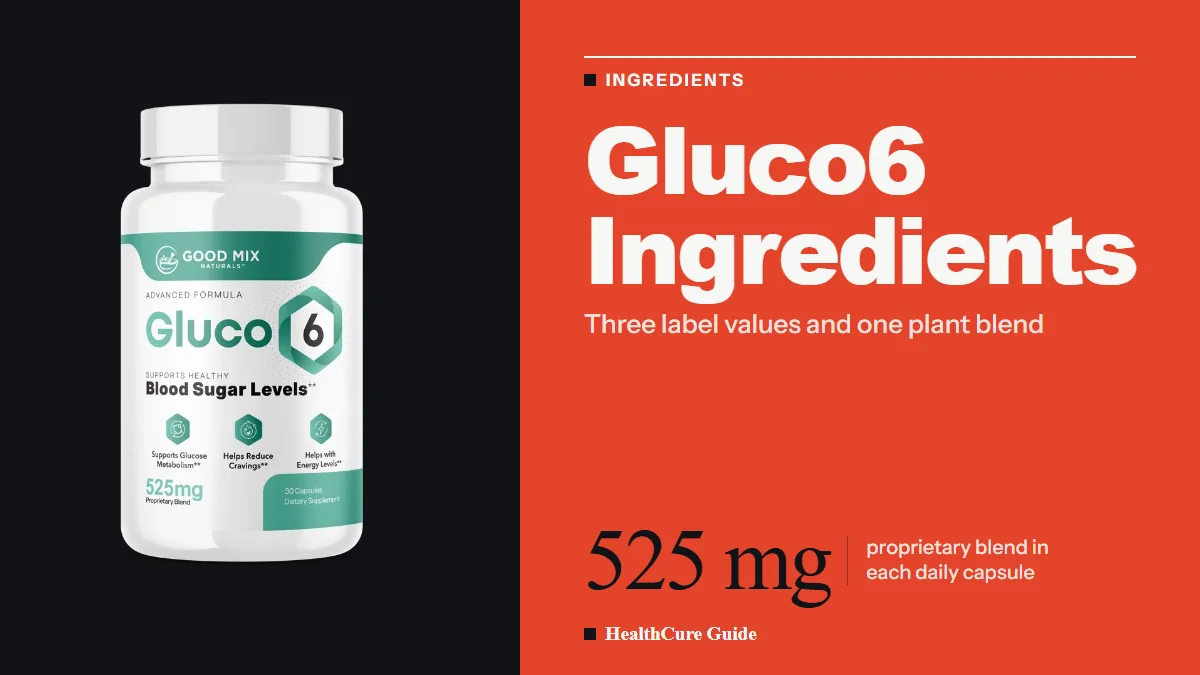
Some labels make you squint. The Gluco6 label is easier than most, since it names every item in the blend and prints an amount for three nutrients. That makes it a good candidate for a plain-English tour, and that is what you will find below. We group the ingredients, say what the seller thinks each one does, and flag the few places where a conversation with a professional is sensible.
New to the capsule? The Gluco6 hub page has the overview, the price table and the refund steps.
Gluco6 ingredients in four groups
| Group | What is in it | What the label prints |
|---|---|---|
| The fiber | Sukre (L-arabinose) | Part of the 525 mg blend |
| The tea family | Green tea leaf, theacrine, theobromine | Part of the 525 mg blend |
| Three plant extras | Eleuthero root, cassia cinnamon bark, gymnema leaf | Part of the 525 mg blend |
| Measured nutrients | Vitamin D3, vitamin B1, chromium | 50 mcg, 100 mg and 1 mg |
Each capsule counts as a serving, and every bottle carries 30 servings. The blend totals 525 mg, and the label does not split that figure among the plants. We do not guess at any split.
The fiber at the center: Sukre
Sukre is a prebiotic plant fiber, and chemically it is L-arabinose. The seller describes it as a healthy sugar and puts it at the heart of the formula. Its explanation, put simply, centers on how the body handles the sugar that arrives with meals. We keep that to one sentence because it is the seller’s story and not our finding.
What matters for a buyer is that the fiber is named plainly on the label. You can look it up, show it to your doctor and compare it with other products.
The tea family
Three of the blend’s items belong to the same loose family of tea-related plant compounds.
- Green tea leaf. The label says the extract is standardized to 98% polyphenols with 65% EGCG. The seller ties it to healthy weight management.
- Theacrine, which carries the brand name TeaCrine. The seller presents it as a way to draw on the strengths of Chinese tea.
- Theobromine. The seller does not describe a role for it.
All three are caffeine-type compounds from plants. If you react strongly to caffeine, they are worth a mention to your doctor or pharmacist before the first capsule. We say so plainly because the label itself lists them. A sensible test is your own history with strong tea or coffee: if a cup in the morning leaves you jittery or wakeful, mention that to a professional when you discuss the capsule, and let them decide what suits you.
Three plant extras
Eleuthero root. The order page describes no role for it, and we will not invent one.
Cassia cinnamon bark. The seller says cinnamon supports a healthy insulin response. That is its wording and not ours.
Gymnema leaf. A plant with a long history of traditional use. The seller connects it with sugar cravings.
Cinnamon and gymnema are the two names people who use medicines for blood sugar tend to raise with a pharmacist, which is why we mention them again in the safety section.
The measured nutrients
These three are the only items printed with an amount.
- Vitamin D3 (as cholecalciferol), 50 mcg. The seller names no specific role for it.
- Vitamin B1 (as thiamine mononitrate), 100 mg. Again, no role described.
- Chromium (as chromium niacinate), 1 mg. The seller’s page describes chromium as essential for stable glucose levels.
The seller’s FAQ adds a practical caution. Since chromium is already in the capsule, buyers are told to be careful about stacking other products rich in chromium. If a multivitamin is part of your day, glance at its chromium line before combining the two, and ask your pharmacist when in doubt.
The research behind the central fiber
The seller points to three papers, and we opened all three. Each is about L-arabinose, the fiber in the formula. None tested Gluco6 itself, so we handle them strictly as ingredient research and describe them by their titles.
- A 2000 paper in a Japanese nutrition journal, on L-arabinose and the blood glucose level after food that contains sucrose.
- A 2015 rat study in Food and Nutrition Research on L-arabinose given alongside a high-carbohydrate, high-fat diet.
- A 2011 article from the American Journal of Clinical Nutrition about how L-arabinose affects sucrase, an intestinal enzyme, in laboratory work and in volunteers.
Reading a title is one thing, and knowing how a finished capsule behaves in your own routine is another. Individual results differ, and the seller itself suggests giving Gluco6 three to six months of steady use before you judge it.
What the label leaves unsaid
The blend is a proprietary blend, so you cannot see how much of each plant is inside. That is normal for products labeled this way, and it simply means ingredient-by-ingredient comparisons with other brands are not possible. Outside the active items, the shell is hypromellose, a plant-derived material, and the remaining fillers and flow agents are stearic acid, magnesium stearate, silicon dioxide and microcrystalline cellulose. The seller adds that production happens in the USA, in a plant it labels FDA-registered and GMP-certified, which is its own description and not a regulator’s endorsement.
Questions people ask about the label
Is it plant-based? The seller calls the product vegetarian and plant-based, and says it contains no soy or dairy and no GMO ingredients. Its badges also mark egg, crustaceans, nuts, BPA and gluten as absent. These are the seller’s statements, and we have no separate test results to add.
Are the vitamin amounts large? They are simply what the label prints. We leave the percentage columns out because the numbers are not needed to understand the routine, and your doctor can interpret them against your own diet.
Where should I start reading? With the three measured nutrients and the single blend total, since those lines give you the facts you can compare. The plant-by-plant descriptions above are the seller’s explanation, useful for context, and they are best read alongside our Gluco6 overview.
The price of the routine
Because each bottle holds 30 capsules, a daily routine costs whatever the package costs divided by its days. Six bottles at $234 cover 180 days, about $1.30 a day ($234 / 180). Three bottles at $147 cover 90 days, about $1.63. Two bottles at $138 cover 60 days, $2.30 a day before the $9.95 US delivery fee. Free US delivery and two bonus guides come with three and six bottles. Our Gluco6 price page lists every figure, and our look at what the seller means by how it works sets the ingredient story in context.
Reading the label with your doctor
Bring the label to your appointment if any of the points above applies to you. Your prescriptions should carry on unchanged, and diabetes medicines in particular are a reason to ask your doctor before the first capsule. The caution printed on the bottle excludes under-18s, pregnant women and nursing mothers, and it also says not to go beyond the recommended dose, which is one capsule a day. For a closer look, our side effects guide covers those cautions calmly.
Good to know:
- The amounts of the blend’s individual plants are not published.
- The research the seller cites concerns the fiber, not the finished product.
- Individual experience differs, and the seller’s advice is to stay with it for months, not days.
Common questions
What is the main Gluco6 ingredient?
Sukre, the prebiotic plant fiber known chemically as L-arabinose. In the seller's words it is a healthy sugar, and the rest of the formula is arranged around it.
Which Gluco6 ingredients are listed with an amount?
Three nutrients carry amounts: 1 mg of chromium, 100 mg of vitamin B1 and 50 mcg of vitamin D3. All the plant ingredients share a single 525 mg figure.
Does Gluco6 contain caffeine-type ingredients?
Yes, in the plant sense. Theobromine, theacrine and green tea leaf are cousins of caffeine, so anyone who reacts to caffeine should ask a professional first.
Is the research the seller cites about Gluco6 itself?
No. The three papers are about L-arabinose, the fiber in the formula, so we describe them as ingredient research and nothing more.
What holds the ingredients together?
A hypromellose vegetable capsule, with microcrystalline cellulose, silicon dioxide, magnesium stearate and stearic acid listed as other ingredients.
Should I check the ingredients with my doctor?
Yes, particularly when diabetes medicines, other chromium products or a caffeine sensitivity are part of the picture. Bring the label with you.
Sources
- Japanese nutrition journal, 2000: L-arabinose and the blood glucose level after eating food that contains sucrose
- Food and Nutrition Research, 2015: a rat study of L-arabinose alongside a high-carbohydrate, high-fat diet
- American Journal of Clinical Nutrition, 2011: L-arabinose and sucrase activity in the intestine, studied in the lab and in people