Gluco6 Ingredients List: The Whole Label in One Place
No stories, just the label. Every line of the Gluco6 panel set out in tables, with a short note on what the printed amounts tell you and what they leave open.
- Written by
- HealthCure Guide Editorial Team
- Reviewed by
- HealthCure Guide Editorial Team
- Updated
- Reading time
- 6 min read
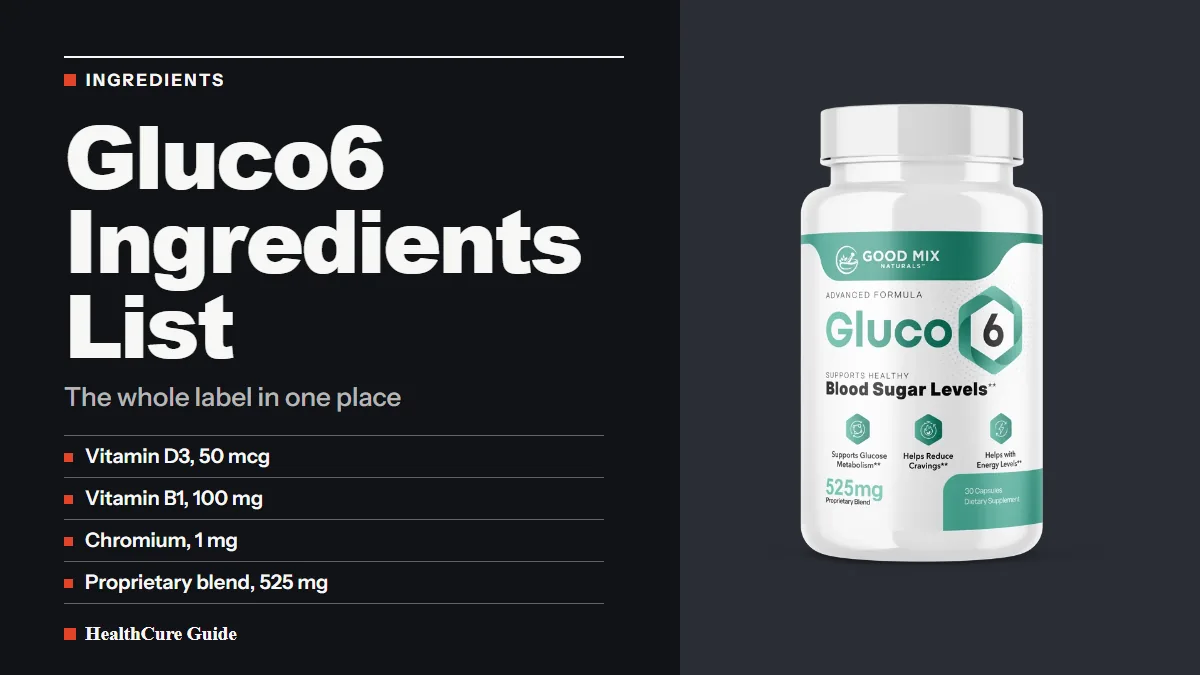
Sometimes you just want the label. No story, no sales pitch, only the lines that are printed on the bottle and a clear note on how to read them. That is what this page offers for Gluco6. Our source is the label as the seller’s page shows it, and we left the Daily Value percentages out on purpose, because the amounts themselves are what you need to compare.
If you would rather have the ingredients explained one by one, our companion piece on what is in each Gluco6 capsule does that. For the product as a whole, see the Gluco6 hub page.
Gluco6 ingredients list: the Supplement Facts panel
| Panel line | Detail |
|---|---|
| Serving size | 1 capsule |
| Servings per bottle | 30 |
| Chromium, in the form chromium niacinate | 1 mg |
| Vitamin B1, in the form thiamine mononitrate | 100 mg |
| Vitamin D3, in the form cholecalciferol | 50 mcg |
| Proprietary blend, all seven items together | 525 mg |
Two details help when you read the numbers. The units differ: vitamin D3 is printed in micrograms (mcg), while chromium and vitamin B1 are printed in milligrams (mg). A milligram equals 1,000 micrograms, so the D3 figure is the smallest of the three by weight. And the blend row is a total, not a single ingredient.
The panel marks the Daily Value for the blend as not established. That is a standard footnote for blends, and it means no percentage is printed next to the 525 mg figure.
Inside the 525 mg blend
Seven ingredients sit under the blend heading. The label prints them in its own sequence, and we sorted them alphabetically below so that each is easy to find.
| Ingredient | Label note |
|---|---|
| Cinnamon bark | Cinnamomum cassia |
| Eleuthero root | Eleutherococcus senticosus |
| Green tea leaf | Camellia sinensis, 98% polyphenols, 65% EGCG |
| Gymnema leaf | Gymnema sylvestre |
| Sukre prebiotic fiber | The plant fiber L-arabinose |
| Theacrine | Sold as TeaCrine |
| Theobromine | No note on the label |
The panel gives one combined weight for all seven. It does not say how many milligrams of each plant the capsule holds, and we will not guess at a split.
The other ingredients
Beyond the active lines, the label lists the following.
| Item | Where it appears |
|---|---|
| Hypromellose | The vegetable capsule shell |
| Stearic acid | Other ingredients line |
| Magnesium stearate | Other ingredients line |
| Silicon dioxide | Other ingredients line |
| Microcrystalline cellulose | Other ingredients line |
A small glossary for label readers
- Proprietary blend. A group of ingredients printed with one combined weight instead of separate amounts.
- Prebiotic fiber. The seller’s term for Sukre, a plant fiber. We use it as the seller does.
- EGCG. A compound in tea that the label quotes when it describes the green tea extract.
- Hypromellose. A plant-derived material that makes up the capsule shell.
- Daily Value. A reference percentage. We leave it out here, and the blend’s figure is marked not established.
What the label does not print
A label is a snapshot, and it helps to know what is outside the frame.
- No amount for any single plant in the blend. Only the combined 525 mg appears, so you cannot compare, say, the green tea in Gluco6 with the green tea in another product.
- No stated purpose for vitamin D3, vitamin B1, theobromine or eleuthero. The seller’s order page describes roles for some ingredients and none for these four.
- No list of reactions. The bottle carries a caution, which we cover below, but it is not a list of effects.
None of that is a problem in itself. It simply means the label is a guide to what is inside, and your doctor or pharmacist is the right person for anything more personal.
The directions and cautions printed on the bottle
The directions are short: one capsule, once a day. The seller’s FAQ adds the habit most people follow, a morning capsule, before you eat, with a glass of water.
The caution on the label has three parts, which we paraphrase here. First, stay within the recommended dose. Second, the product excludes under-18s and pregnant or nursing mothers. Third, people on a medication, or living with a medical condition, should consult a physician before use. Keep every prescription going, and ask your doctor before starting if diabetes medicines are on your list.
The bottle also carries storage notes. Keep it in a cool, dry place below 30 degrees Celsius (86 degrees Fahrenheit), keep it away from children, and skip any bottle whose safety seal is damaged or missing.
How the label compares with the seller’s story
In the seller’s framing, Gluco6 is a routine aimed at blood sugar levels in the normal range, alongside weight management, and Sukre is a healthy sugar at the heart of the formula. The bottle front adds three short lines of its own, reading supports glucose metabolism, then helps reduce cravings, then helps with energy levels. Those are the seller’s words, and the panel is the more neutral document, since it lists contents and not outcomes.
| Where you look | What you learn |
|---|---|
| The Supplement Facts panel | What is in a capsule and three exact amounts |
| The bottle front | The seller’s headline claims |
| The order page | The seller’s explanation of each ingredient |
| Research the seller cites | Papers about L-arabinose, not about Gluco6 |
Reading across all four gives you a fair picture. Our full ingredient page goes through the same ground with more commentary, and the Gluco6 overview puts it beside the price table.
Reading the label next to your own supplements
Many people already take a multivitamin or a single nutrient, so a quick comparison can save confusion. Lay the two labels side by side and look at three lines in particular: chromium, vitamin B1 and vitamin D3. Gluco6 prints 1 mg, 100 mg and 50 mcg for those, and the seller’s FAQ specifically asks buyers to be careful about adding other formulas that are high in chromium.
Then look at whether any other product you use also contains green tea extract or another caffeine-type ingredient. The goal is not to find a problem, only to know the full picture before you add a daily capsule. A pharmacist can run through the same comparison in a couple of minutes if you bring both labels.
Questions to take to a pharmacist
If you would like a second opinion on the label, these questions give the conversation a starting point.
- Does anything on the list clash with a medicine I use now?
- I react to caffeine. Are theobromine, theacrine and green tea leaf likely to matter for me?
- My multivitamin also has chromium. Is the combination sensible?
- Cassia cinnamon and gymnema are on the list. Do they matter alongside my diabetes medicines?
Take a photo of the label panel, or bring this page, and the conversation will be quicker.
The routine the label describes
One capsule a day makes a bottle last 30 days. Six bottles at $234 stretch over 180 days, roughly $1.30 a day ($234 / 180), and three bottles ($147 / 90 days) land near $1.63 daily. Both larger packages ship free inside the US and include two bonus guides. For a closer look at how the whole routine is priced, our look at Gluco6 pricing works through each package.
What people notice differs, and the seller’s own advice is to allow a long stretch, three to six months, before you decide.
Good to know:
- The label is the main source for what is inside; the seller’s order page adds its own explanations.
- The blend’s individual amounts are not published.
- A physician is the right person to ask when a medication or a condition is part of your day.
Common questions
What is the serving size on the Gluco6 label?
One capsule, taken once a day. A bottle holds 30 capsules, so it holds 30 servings.
How many items does the Gluco6 label list in the blend?
Seven. Gymnema leaf, cinnamon bark and eleuthero root sit beside green tea leaf, theacrine, theobromine and Sukre, and together they weigh 525 mg.
Does the Gluco6 ingredients list show an amount for each plant?
No. Only vitamin D3, vitamin B1 and chromium have their own amounts, while the plants appear under one blend total.
What are the non-active ingredients?
Hypromellose forms the vegetable capsule shell. The other-ingredients line then adds stearic acid, magnesium stearate, silicon dioxide and microcrystalline cellulose.
Where should the bottle be kept?
In a cool, dry place below 30 degrees Celsius (86 degrees Fahrenheit), out of children's reach, and not in use if the safety seal is broken or absent.
Why does the label mention a physician?
Its printed caution advises a physician's input before use whenever you take a regular medication or have a health condition.