Is FemiCore Legit? A Trust Audit of Seller and Claims
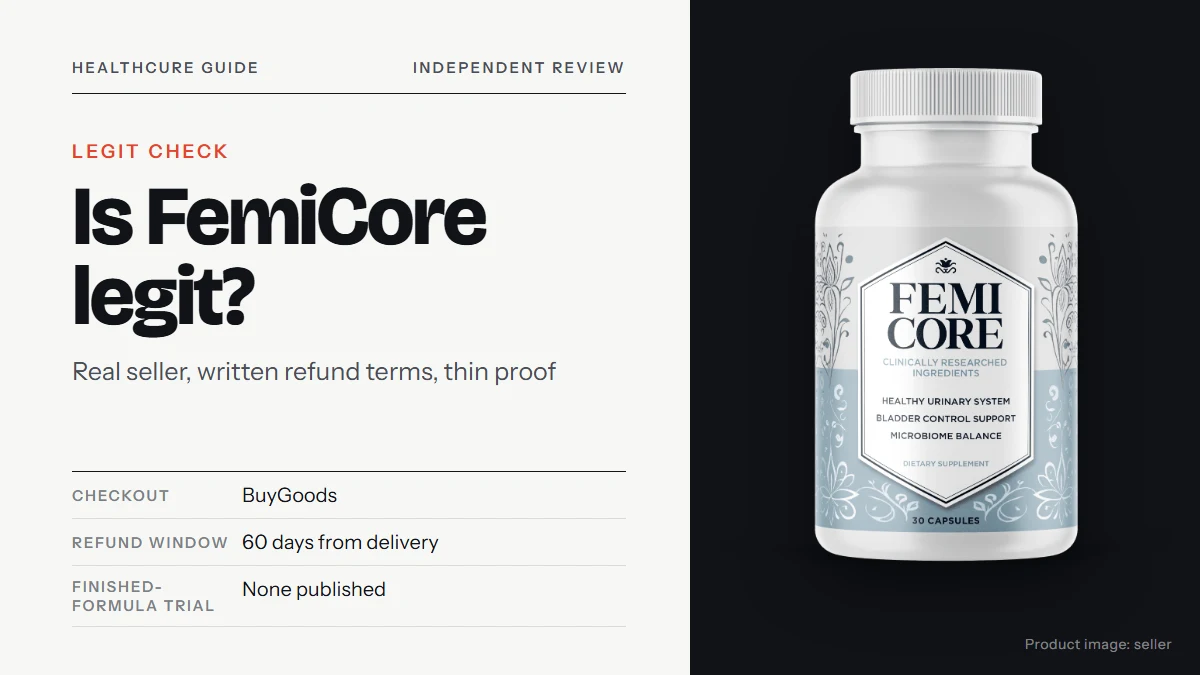
Legit can mean two things: a real business that ships and refunds, or a product that does what its label suggests. FemiCore scores well on the first and thin on the second. Here is the audit, point by point, with the strong and the weak side of each.
- Written by
- HealthCure Guide Editorial Team
- Reviewed by
- HealthCure Guide Editorial Team
- Updated
- Reading time
- 9 min read
This guide contains affiliate links. If you buy through them we earn a commission at no extra cost to you. It does not change the verdict. Disclosure.
So, is FemiCore legit? The honest answer depends on which kind of legit you mean. One kind asks whether a real business takes your money, ships a real product and gives refunds on stated terms. The other asks whether the product is as good as the sales page implies. We split those apart and ran FemiCore through eight checks, marking each one as a pass, a partial or a weak result, with the reason written beside it.
HealthCure Guide is independent. We are not the seller and we do not take orders. The order buttons here are affiliate links, and a purchase through one of them may pay us a commission. Your price stays the same, and so does every result below.
Is FemiCore legit? The eight-point trust audit
Every check below looks at something you can see for yourself before paying. The first three are about the business. The last five are about the product and how it is presented.
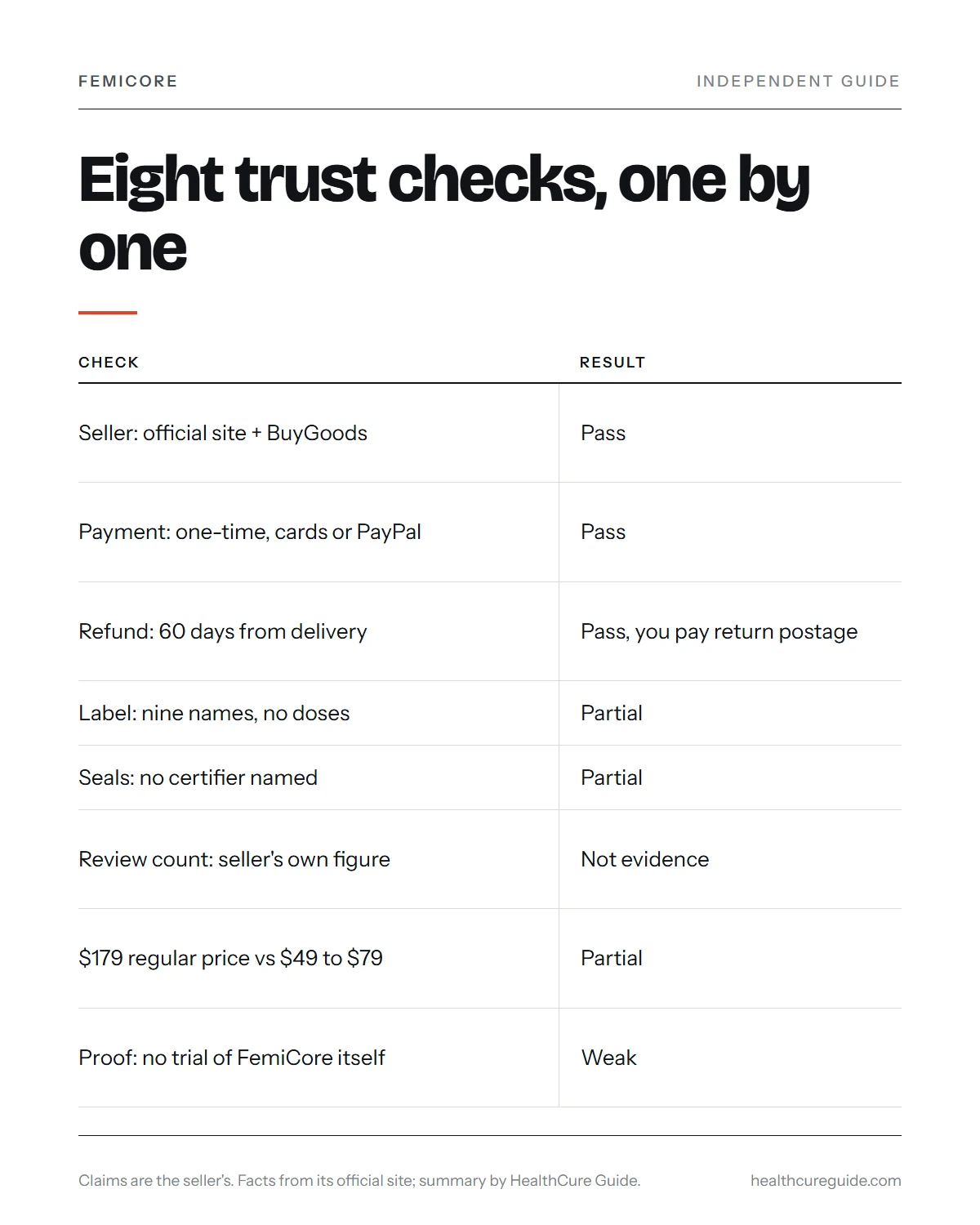
| Check | What we looked at | Result |
|---|---|---|
| 1. Seller | Official website plus a named checkout company | Pass |
| 2. Payment | Single order, mainstream cards and PayPal | Pass |
| 3. Refund terms | Written policy, 60 days from delivery | Pass, with costs |
| 4. Label transparency | Ingredient names listed, doses hidden | Partial |
| 5. Quality seals | Five seals, no certifier or maker named | Partial |
| 6. Review figures | One large count, no reviews shown | Not evidence |
| 7. Pricing | $179 “regular price” beside real prices of $49 to $79 | Partial |
| 8. Proof for the claims | Ingredient studies only, no trial of FemiCore | Weak |
The business side passes cleanly. The doubts gather on the product side. That split is common for supplements sold through a single sales page, and it is why we land on “legit purchase, limited evidence” rather than on either “scam” or “proven fix”.
Who sells FemiCore and who takes the money
The first thing a scam tends to hide is who you are paying. FemiCore does not hide it. The product is sold through its own official website, thefemicore.com, and the checkout is run by BuyGoods, a retailer that processes the payment and looks after order support. Product questions go to the vendor.
The payment options at checkout are Visa, Mastercard, Discover, American Express and PayPal. Those are mainstream methods with their own dispute processes. A seller planning to vanish usually pushes wire transfers, gift cards or crypto instead, so this is a quiet point in FemiCore’s favor.
The order is a one-time purchase. You pick 2, 3 or 6 bottles and pay once, and the official site sets up no hidden autoship. That rules out one of the most common complaints about supplements bought online: a repeat charge the buyer never knowingly agreed to.
The weak spot: the official site does not name the manufacturer. You can see who sells FemiCore and who handles the money, but not who makes the capsules. That is legal and fairly common, yet it is one less name a careful buyer can look up.
Refund terms you can read before paying
A legit seller puts its refund rules where you can read them in advance, and FemiCore does this on its help pages. The terms, in order:
- The window is 60 days from the day the parcel is delivered, not the day you ordered. Carrier tracking gives you that date.
- You email support with “Refund Request” as the subject.
- You send back every bottle from the order, used or untouched, with the packing slip inside and a note listing your name, email address and order id.
- You cover the return postage. The address on the policy page is 285 Northeast Ave, Tallmadge, OH 44278, USA.
That is a usable guarantee. It also has costs built in. The postage is yours, the packing slip matters, and a bottle you threw away is a problem because the whole order has to go back. None of that is unfair. It is simply the part that a big “60-day money-back” badge leaves out, so read it first and keep the box.
What the label shows and what it leaves out
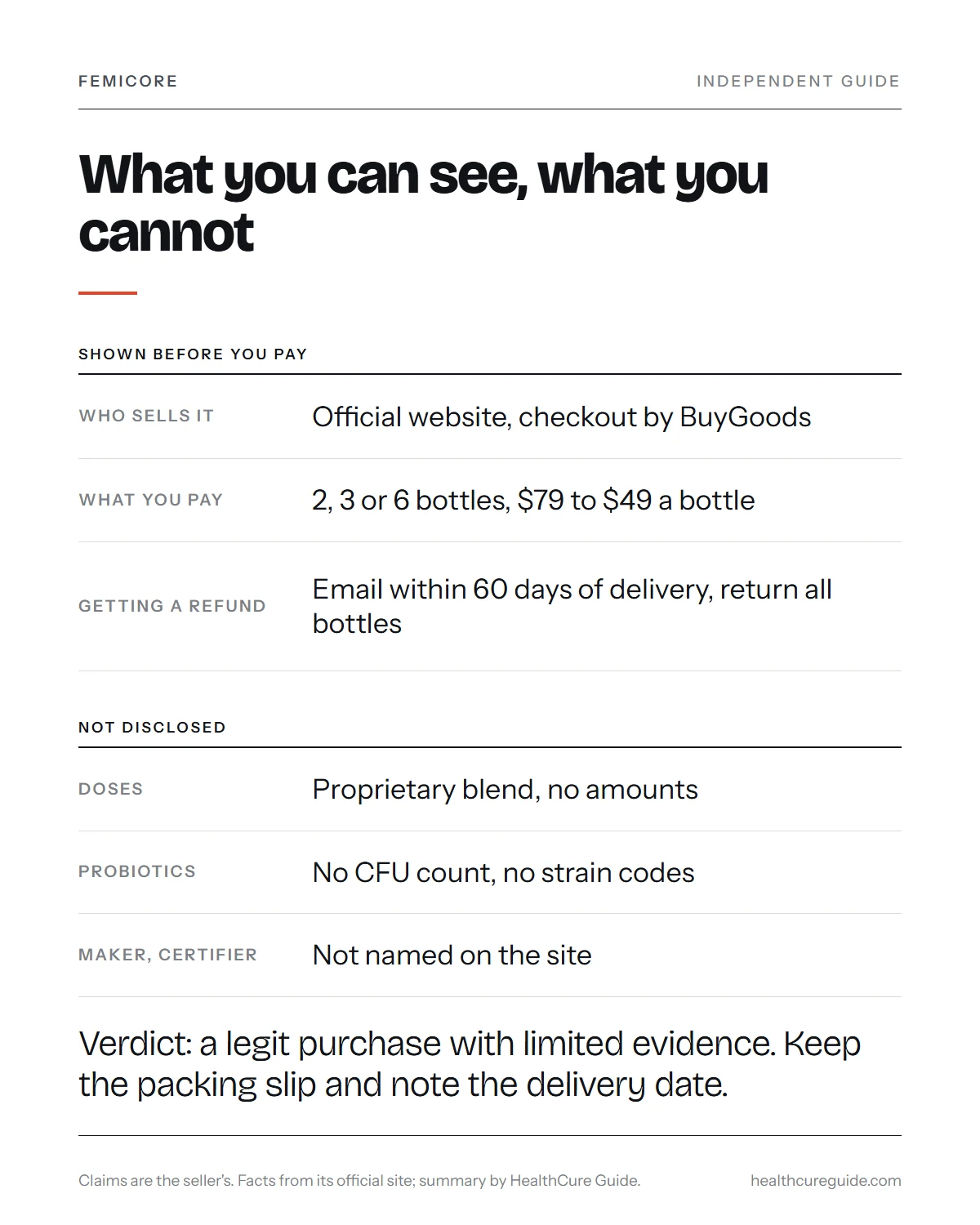
The label names nine ingredients. Four come from plants or plant compounds: Mimosa pudica, bearberry (also called uva ursi), a cranberry extract and granular berberine. Five are Lactobacillus probiotics: crispatus, acidophilus, plantarum, gasseri and casei. Every one of them sits inside a proprietary blend, so no single amount appears on the bottle.
For a legitimacy audit, the missing items say more than the list does.
| Not disclosed | Why a careful buyer would want it |
|---|---|
| Amount of each ingredient | Research results depend on how much is taken |
| CFU count | Tells you how many live bacteria a capsule holds |
| Probiotic strain codes | Probiotic effects differ from strain to strain |
| Cranberry PAC content | The cranberry research follows PAC dose |
| Bearberry arbutin content | Arbutin is the active compound, suited to short courses |
| Berberine amount | Human studies on blood sugar used about 1,000 to 1,500 mg a day |
| Certificate of analysis | An outside check that the capsule matches its label |
The bottle also carries the phrase “Clinically researched ingredients”. That describes the ingredients in general. It does not mean anyone tested FemiCore, and there is no trial of the finished formula. Proprietary blends are not a sign of fraud, since plenty of brands use them, but they make it impossible to line FemiCore up against the studies its marketing leans on.
Seals on the page, but no certifier named
The official site shows five seals: Non-GMO, Natural ingredients, GMP Certified, Made in an FDA registered facility, and Made in USA with imported ingredients. We attribute all five to the site, because it names neither the manufacturer nor whoever issued the GMP certificate. A seal you cannot trace to an auditor is a statement from the seller, not a document you can check.
The FDA seal needs a calm reading. Every dietary supplement sold in the US, FemiCore included, falls under the FDA’s supplement rules, and those rules do not include a pre-market review of each product. “FDA registered facility” is about the factory being registered. It tells you nothing either way about this particular formula, and it is not a product approval.
The seller also says the capsules contain no stimulants and are non-GMO. Those are reasonable statements for a product like this, and we have no reason to doubt them, but nobody outside the company has confirmed them in a form a buyer can see.
Whose numbers are the review figures?
The sales page shows no individual testimonials. There are no names, no quotes and no customer photos. What it does show is a rating graphic with a line saying the score is based on 19,263 reviews. Those reviews do not appear anywhere on the page, so the figure belongs to the seller and cannot be checked. The site’s own disclaimer warns that testimonials may not match what a typical buyer experiences.
Two more numbers deserve the same label. The page says 96% of customers order 6 bottles, another seller claim with nothing behind it that you can inspect. It also lists a regular price of $179 a bottle, with “save” figures of $200, $330 and $780 on the packages. No order option on the site actually charges $179. The packages work out to $79, $69 or $49 a bottle, so treat $179 as a reference figure that makes each discount look larger.
None of these numbers make FemiCore illegitimate. They are simply not evidence. If you want to know where outside feedback can be found and how to weigh it, our ratings breakdown covers that.
How strong is the evidence behind the claims?
Business honesty and product evidence are separate questions, and here the picture gets thinner. The label promises a healthy urinary system, bladder control support and microbiome balance. Those are the seller’s claims. The research behind them covers single ingredients, often in other forms and amounts.
- The bladder microbiome idea. Sequencing studies since about 2012 found that the female bladder is not sterile, and some saw fewer Lactobacillus in women with urgency incontinence. It is a plausible idea from early science. Whether an oral probiotic can shift bladder symptoms is a separate question this work does not answer.
- Cranberry. A 2023 Cochrane review found that cranberry products can reduce repeat urinary tract infections in women prone to them. That research looked at infections rather than leaks or urgency, and results track the PAC dose, a figure FemiCore leaves off its label.
- L. crispatus. A small placebo-controlled trial saw fewer repeat infections with a product used vaginally. FemiCore is taken by mouth, and it lists species rather than strains.
- Bearberry. European herbal regulators accept traditional use for mild urinary complaints in courses of about a week, not daily for months. Human evidence is limited and mixed.
- Berberine and Mimosa pudica. Human studies of berberine mostly concern blood sugar and cholesterol, not the bladder. Mimosa pudica has lab and animal reports only.
A fair description, then, is a sensible-sounding mix of ingredients with some research behind each, never tested together. The seller suggests taking it for at least 3 months before judging. That is the seller’s advice rather than a tested timeline, and it is longer than the 60-day refund window, which is worth planning around.
Scam, legit, or somewhere in between
A scam, in the useful sense, means paying for a product that never arrives, is not what was described, or comes with a refund promise nobody honors. FemiCore clears that bar on paper: there is a product, a named checkout, a single charge and a written refund route. Calling it a scam stretches the word past its meaning.
Calling it proven stretches the other way. Hidden doses, untraceable seals, an unverifiable review count and an inflated reference price are all reasons for caution, and an honest review should flag each of them.
Most of the real risk lives around the product rather than inside it: marketplace listings outside the guarantee, cloned pages with a different checkout, and coupon sites. Our scam check explains how those operate. For BuyGoods’ role, where support sits and how returns are handled, see our guide to FemiCore official channels.
Who should be careful even with a legit product
A product can be sold honestly and still be wrong for you. FemiCore’s ingredients carry real cautions, so check these before your first capsule.
- Berberine can upset the stomach and lower blood sugar, which matters if you take diabetes medicine. It slows two liver enzymes, CYP3A4 and CYP2D6, that many drugs rely on for clearance, so levels of medicines such as cyclosporine can rise. It may lower blood pressure, and it is unsafe in pregnancy and breastfeeding.
- Bearberry can cause nausea and a harmless green-brown tint to urine. It is meant for short-term use and should be avoided in pregnancy, breastfeeding, kidney disease and in children. It also interacts with lithium.
- Cranberry has case reports with warfarin, so INR checks matter. Its oxalate content is a concern if you form kidney stones.
- Probiotics often bring gas or bloating in the first week or two. Rarely, they cause infections in people with severely weakened immune systems.
The official site itself tells anyone who is pregnant, nursing, on medication or managing a health condition to check with a physician first. Certain signs need a medical visit, not a capsule: visible blood in your urine, fever or chills, an ache in your side or lower back, a burning feeling when you pass urine, bladder control that changes suddenly, or an older family member who turns confused while having urinary symptoms.
Our legitimacy verdict in plain terms
FemiCore is legit as a purchase. You can see who takes your money, what you will pay, how long you have to ask for it back and where the bottles go if you do. Those are the basics a scam fails, and FemiCore meets them.
It is not proven as a product. The formula has never been tested as a whole, the amounts are hidden, the seals name nobody, and the review count belongs to the seller. Go in with that picture. Buy only from the official store so the 60-day terms apply, write down the delivery date, and keep the packing slip. If nothing has changed after a fair trial, the refund is your safety net. For the whole product on one page, with prices, ingredients and safety side by side, see our FemiCore product page.
Common questions
Is FemiCore sold by a real company?
The selling side is easy to identify. FemiCore is sold through its own official website, and the checkout and order support are run by BuyGoods, a retailer that processes the payment. Orders are a single payment by card or PayPal, under a refund policy published on the site. What the site does not name is the manufacturer, so you can see who sells it but not who makes it.
Can I rely on the FemiCore refund policy?
The terms are specific, which is a good sign: 60 days counted from the delivery date, an email with the subject Refund Request, and every bottle sent back, empty or full, with the packing slip and a note giving your name, email and order id. You pay the return postage. We cannot speak for individual cases, so keep the box, the slip and your tracking records.
Are the quality seals on the FemiCore site real certifications?
They are claims shown on the official site: GMP Certified, Made in USA with imported ingredients, Natural ingredients, Made in an FDA registered facility and Non-GMO. Neither the manufacturer nor the body that issued the GMP certificate is named, so a buyer cannot trace them. FDA registration describes the factory, not the formula, and it is not a product approval.
Why does the FemiCore label hide the ingredient doses?
All nine ingredients sit in a proprietary blend, which lets a brand list names without amounts. It is a common practice and not a sign of fraud on its own. The cost to you is that you cannot compare FemiCore with the studies behind its ingredients, since those results depend on dose, and the CFU count and probiotic strain codes are missing too.
Should the FemiCore review count make me trust it more?
Not much. The sales page shows a rating graphic with a figure of 19,263 reviews, but the reviews themselves are not shown anywhere, so the number is the seller's own and cannot be checked. The page also carries a disclaimer that testimonials may not reflect the typical buyer's experience. Treat the count as marketing, and look at the ingredient evidence instead.
Does a legit seller mean FemiCore will work for me?
No. Whether a business is honest about payment and refunds says nothing about how well its product works. FemiCore's ingredients have some research behind them one by one, mostly for urinary infections or unrelated uses, and no trial of the finished formula exists. That is why we call it a legit purchase with limited evidence, and why the refund window matters.
What would make a FemiCore order not legit?
The order itself, when the checkout is not the official one. Warning signs include a checkout that does not name BuyGoods, single bottles or prices outside $79, $69 and $49 a bottle, a repeat billing line, or a request to pay by bank transfer, gift card or crypto. Any of these means you have likely left the official store, and its refund terms will not apply.
Sources
- Wolfe AJ et al. Evidence of uncultivated bacteria in the adult female bladder. J Clin Microbiol. 2012.
- Pearce MM et al. The female urinary microbiome: a comparison of women with and without urgency urinary incontinence. mBio. 2014.
- Williams G et al. Cranberries for preventing urinary tract infections. Cochrane Database Syst Rev. 2023.
- Stapleton AE et al. Randomized, placebo-controlled phase 2 trial of a Lactobacillus crispatus probiotic given intravaginally for prevention of recurrent urinary tract infection. Clin Infect Dis. 2011.
- National Center for Complementary and Integrative Health. Uva Ursi.