Is The Genius Song a Scam? A Legit vs Red Flag Scorecard
Paying $39 for a short audio track through ClickBank is not the same as being robbed, but this offer leans hard on pressure and borrowed authority. We score each signal, legit or not, and explain where the line falls.
- Written by
- HealthCure Guide Editorial Team
- Reviewed by
- HealthCure Guide Editorial Team
- Updated
- Reading time
- 11 min read
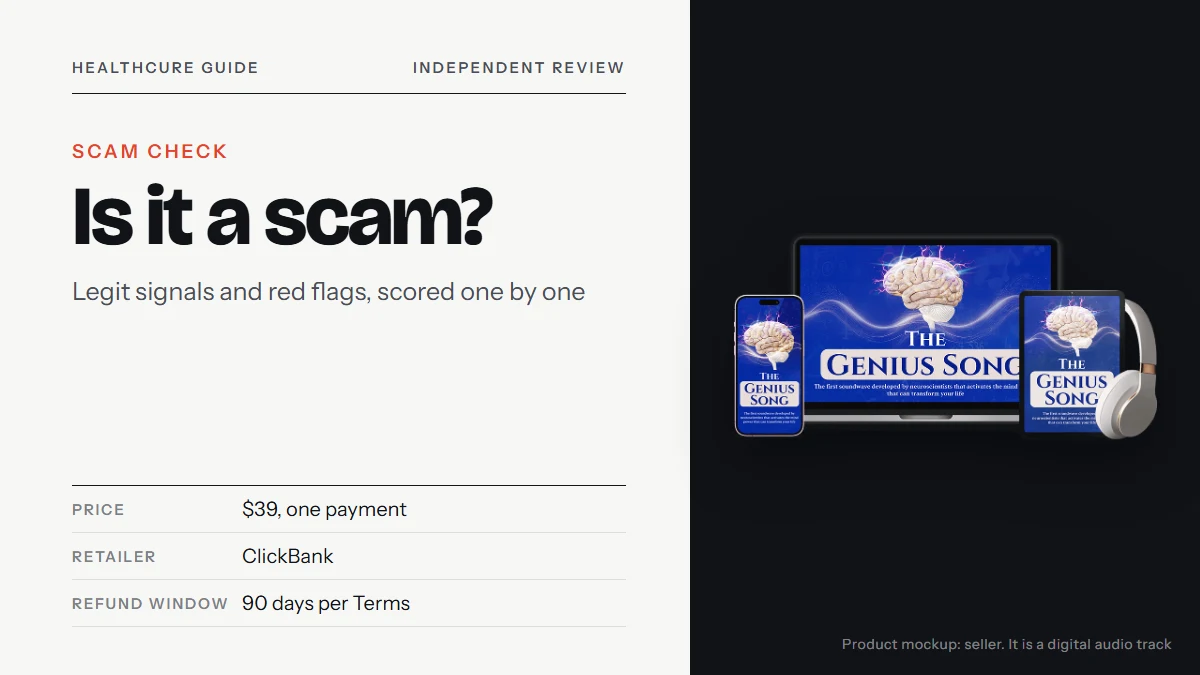
This guide contains affiliate links. If you buy through them we earn a commission at no extra cost to you. It does not change the verdict. Disclosure.
Is The Genius Song a scam? The question is fair. A sales video that promises luck, money and a sharper mind for 7 minutes of listening a day will set off alarms for most careful buyers. Rather than give a gut answer, we built a scorecard: each signal we could check gets a plain verdict of “leans legit” or “leans caution”, and the overall answer comes from the pattern, not from one item.
A quick note on our position. HealthCure Guide is an independent publication, not the seller, and we may be paid a commission if you buy through our links. We have not purchased the track. Our evidence is the seller’s own material, checked on 9 October 2026: the /video/ sales page and its video, the /text/ version, the Terms, the refund page and the ClickBank order form.
Five questions that separate a scam from a bad pitch
People use “scam” for many things, so we fixed the meaning first. An offer is a scam if you pay and get nothing, get something materially different from what was described, or find there is no working way to get your money back. Overselling, by contrast, is when the product is delivered as described but sold with claims that go far beyond it.
To tell the two apart, we asked five questions:
- Money. Who takes the payment, and can you trace the charge?
- Product. Is what you pay for described in writing?
- Exit. Is there a stated refund route that fits this product?
- People. Can you verify who is speaking and who is vouching?
- Pressure. Does the page let you decide in your own time?
The first three test whether you could be robbed. The last two test whether you could be misled.
Is The Genius Song a scam? The full scorecard
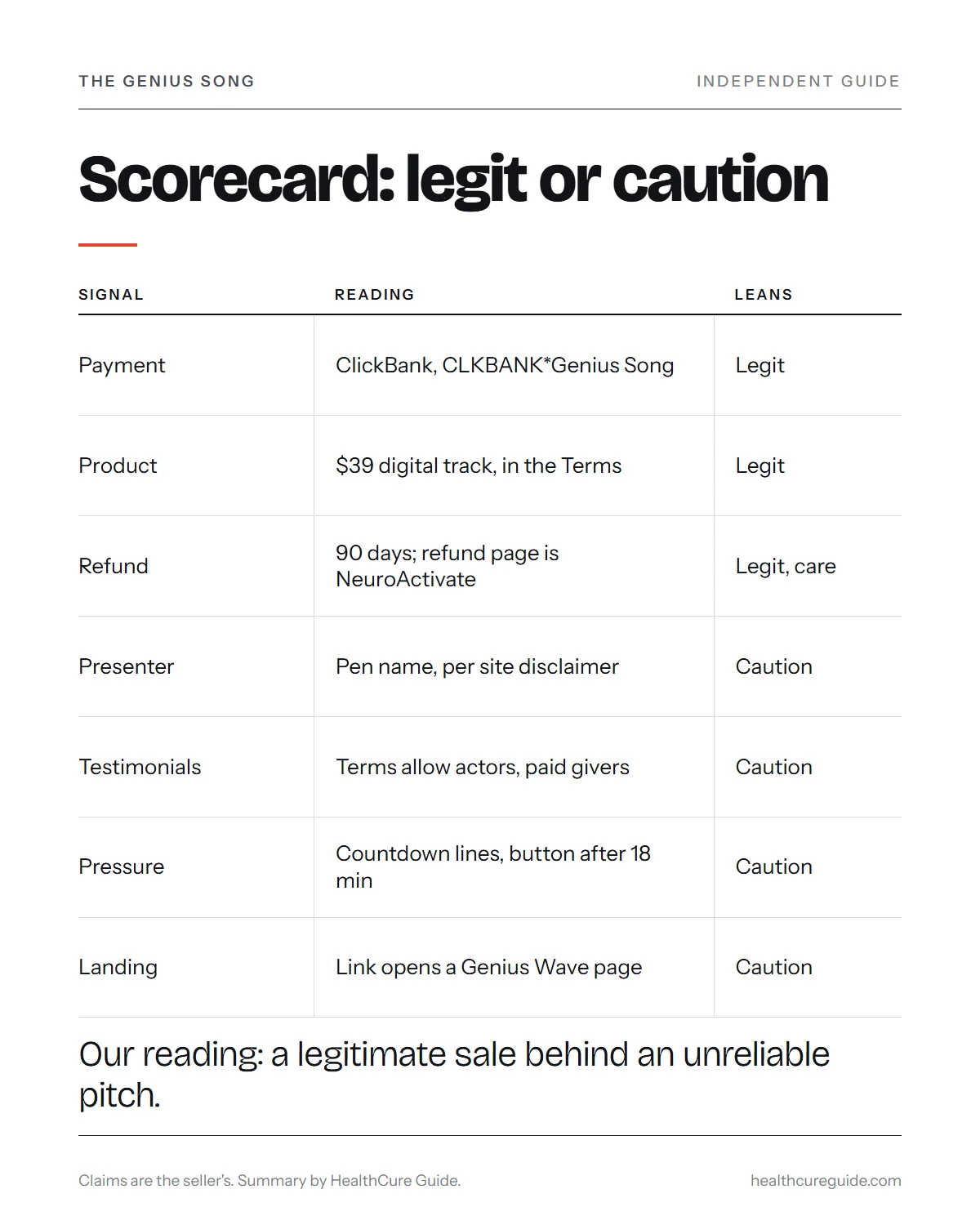
Here is every signal we checked, with the reassuring reading, the worrying one, and which way it leans overall.
| Signal | The legit reading | The worrying reading | Leans |
|---|---|---|---|
| Payment | ClickBank checkout, statement CLKBANK*Genius Song | None found | Legit |
| Product | $39 digital track, defined in the Terms | Length and content unverified by us | Legit |
| Refund | 90 days in Terms and at checkout | Site refund page is for NeuroActivate | Legit, with care |
| Presenter | Named in the video | A pen name, per the site’s disclaimer | Caution |
| Testimonials | Many stories | Terms allow actors, avatars, paid givers | Caution |
| Numbers | Big customer counts | 18,366 and 19,389, unverified | Caution |
| Pressure | One-time price, no subscription | Countdown lines, delayed buy button | Caution |
| Landing | Official domain | Link opens a page for The Genius Wave | Caution |
| Claims | Gamma is a real brain rhythm | No study of the track | Caution |
Read down the last column and the pattern is plain. The mechanics of paying and getting a refund lean legit. Almost everything about how the product is sold leans the other way.
Where it passes: money, product and exit
A traceable payment
The checkout runs on ClickBank at geniusbr.pay.clickbank.net, and the charge on your card appears as CLKBANK*Genius Song. ClickBank acts as the retailer, and its order support line, 1-800-390-6035, gives you a second party to call if the seller goes quiet. The site notes that ClickBank’s role as retailer is not an endorsement of the product, which is accurate: it handles the sale, not the claims.
A product defined on paper
The Terms of Sale state that you are paying $39 for The Genius Song, described as a copyrighted digital item for personal, single-user use. The checkout lists it as a digital product, not shippable and not recurring, so there is no hidden subscription. What you get, according to the seller, is an audio track of about 7 minutes. We could not confirm the length or content, since we did not buy it.
A refund route that fits
The Terms allow refunds on digital products for 90 days after you buy, and the ClickBank checkout states the same 90-day window. Two documents agreeing on the number is a good sign. The sales video only speaks of an “ironclad” guarantee without a figure, so lean on the paperwork.
Where it fails: how the product is sold
Credentials attached to a pen name
The man presenting the video calls himself Dr. Robert Lake. The seller’s own footer disclaimer on both sales pages admits this is a pen name, adopted with the consent of a neuroscientist it does not identify. The video and /text/ page still attach NASA training, decades of neuroscience and a New York City clinic to that pen name. There is no record to look up for someone whose name was chosen for the video.
The Terms add a further twist. A section titled “For Entertainment Purposes Only” warns buyers not to treat brain entrainment as an exact science and labels the products entertainment. Scientific authority up front, entertainment in the contract: that gap is the biggest red flag on the scorecard.
Testimonials the seller does not stand behind
The video reads out customer stories and adds anecdotes about colleagues. The Terms then say names have been changed, some marketing is dramatized, feedback may be acted by avatars or actors, some givers were paid or are friends and relatives of the founders, and the results are exceptional. Our article on the praise on the seller’s pages takes it apart piece by piece.
Pressure built into the page
The video keeps a clock running. It warns that $39 is “not guaranteed beyond today”. It claims a copy has been put aside for you that another buyer could take if you close the page, it mentions a waiting list, and it says the offer will not stay online forever. On /video/, the buy button stays hidden by code until roughly 18 minutes have played. A digital file cannot sell out, so read these as tactics, not facts.
A landing page for a different product
This is the one most buyers will notice. Our ClickBank link opens the official site’s home page, and that home page is currently given over to The Genius Wave, another audio from this seller, pitched as a 12-minute theta session and paid for on a separate checkout. The Genius Song presentation sits on the /video/ page of that same site. The two are separate products. It is not a bait and switch in itself, but it means you should check that the checkout names The Genius Song before you pay.
Paperwork borrowed from elsewhere
The policy at /TOS/refunds/ belongs to NeuroActivate, a bottled product: it wants bottles returned unopened inside 60 days to an address in Tallmadge, Ohio. The Terms also contain a shipping policy for goods sent from Ohio, which cannot apply to a download. These are leftovers from a template, and they make the site look careless.
Numbers that do not agree
The customer count is 18,366 in the video and the /text/ body but 19,389 in the /text/ headline, both the seller’s own unverified figures. The hook promises a “7-second” trick but sells a 7-minute track. And the bonus lists vary: the video says three and names four, while the /text/ page says four and lists three.
What the claims are up against
The video promises eureka moments, faster learning, luck, money, better relationships and even weight loss, all from “activating” a gamma brain wave. Some of this rests on real science, stretched a long way.
Gamma is a real brain rhythm, a fast band from about 30 to 100 Hz that studies connect with attention and memory. MIT’s Tsai lab has run 40 Hz light-and-sound experiments, mainly on mouse models of Alzheimer’s disease, with only small early trials in humans, and none of it is about luck or wealth. Binaural beat findings point in different directions: one meta-analysis from 2019 found a medium overall effect on some outcomes, yet a 2023 review reported that most entrainment studies failed to show the brainwave shift. The Genius Song track itself has never been the subject of a published study.
Even the presenter concedes the point once. Telling a story about a casino win, he admits there is “no evidence to support” a link between the win and his track.
A footer line on the site goes further, labeling the product “not intended to diagnose, treat, cure, or prevent any disease”. The stories about migraines, smoking and weight should be read with that in mind.
Verdict: a legitimate sale, an unreliable pitch
Put the scorecard together and the answer to the scam question is no, with a large caveat. You can pay through a known retailer, receive a defined digital product and ask for your money back within 90 days. Those are the things a scam does not offer.
What you should not trust is the story around it. The authority figure is a pen name, the testimonials are disowned in the Terms, the figures disagree, the pressure is manufactured and the contract calls the whole thing entertainment. If you buy, buy a short listening experiment, not a promise. For the separate problem of copies, fake deals and look-alike emails, see our Genius Song scam warnings, and for a dated record of the offer, our 2026 snapshot.
If you buy, keep your refund open
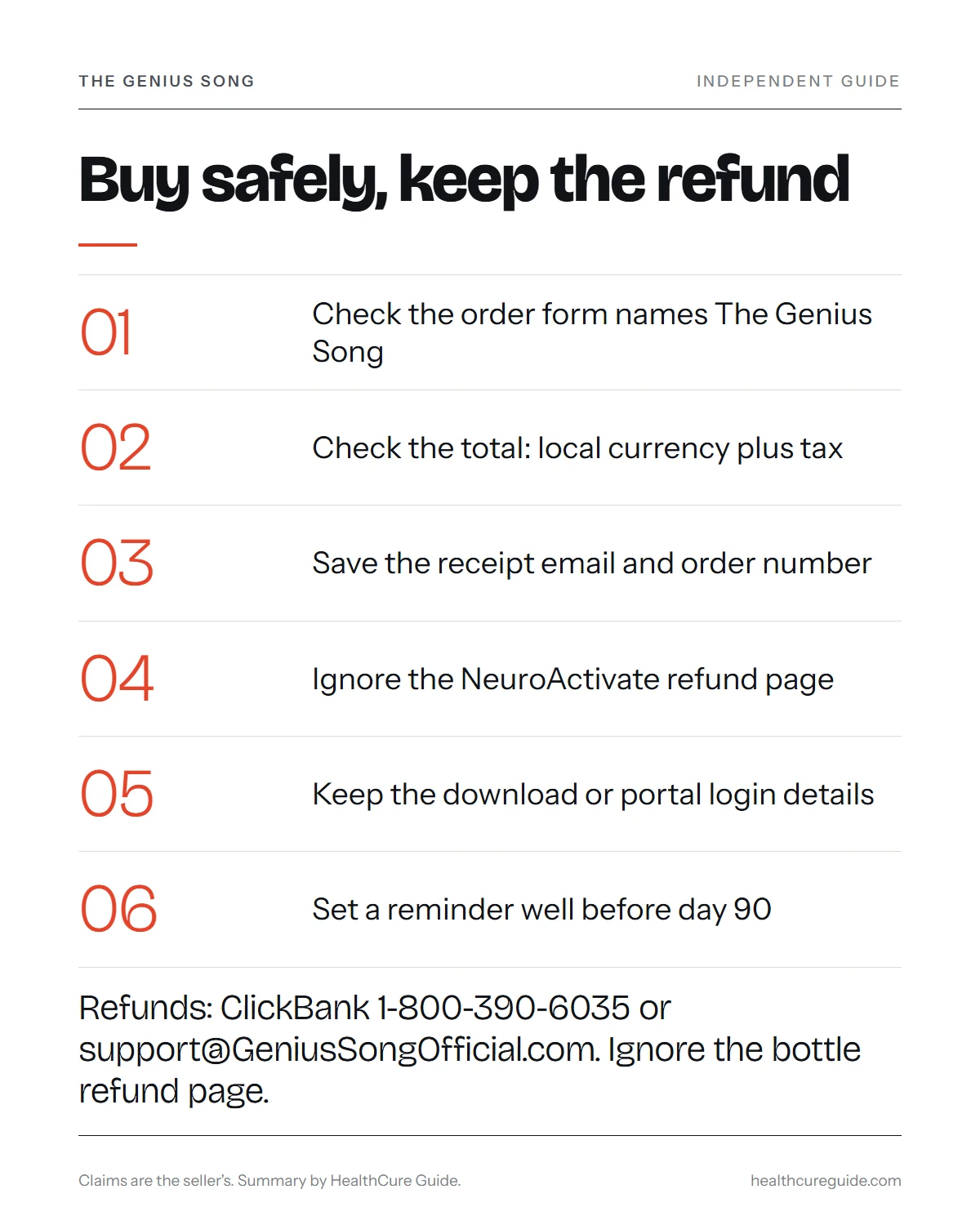
A few steps keep the money at risk small:
- Read the item name on the ClickBank order form. It should say The Genius Song.
- Check the total. ClickBank shows local currency plus tax, so it may not be exactly $39.
- Save the receipt email with the order number.
- Note that delivery is described two ways: an emailed download in the video, a Private Audio Portal login on /text/. Keep whatever access details arrive.
- Set a reminder well before day 90. If you want a refund, ring ClickBank (1-800-390-6035) or email [email protected], and skip the NeuroActivate page entirely.
Safe listening if you keep it
This is our advice, not the seller’s. Listen at a comfortable volume. Avoid it while driving or running any machinery, since you listen with your eyes closed. Epilepsy, earlier seizures or hearing difficulties are reasons to check with a doctor before trying any audio entrainment product. And do not drop a treatment you already have because of something you heard in a sales video.
This article is general information, not medical or financial advice. Read more about how we review products on our methodology page.
Common questions
Is The Genius Song legit or just marketing?
Both, in different ways. The sale is legitimate: you pay $39 on a ClickBank checkout for a digital audio track, and a 90-day refund is written into the Terms and the order form. The marketing is the weak part, with a presenter who uses a pen name, testimonials the Terms say may be acted, and claims no study of the track supports.
Does the doctor in the video make The Genius Song more trustworthy?
No. The presenter calls himself Dr. Robert Lake, and the disclaimer at the foot of the sales pages says that is a pen name. The NASA training, the decades in neuroscience and the New York clinic mentioned on the pages all belong to that pen name, so they cannot be checked. Judge the offer on its written terms instead.
Why does the buy button only appear partway through the video?
The button on the /video/ page is set to show up after 1,104 seconds, about 18 minutes into a video that runs over 39 minutes. It is a common sales technique that keeps you watching the pitch before you can see the order box. It is not a sign of fraud, but it is designed to build commitment before you compare anything.
Can the $39 Genius Song offer really sell out or be given to someone else?
The video claims a copy is reserved for you but could pass to another buyer if you leave, talks of a waiting list in case it sells out, and suggests $39 may not hold past today. A digital track does not run out of stock. Treat these lines as pressure, and give yourself time to read the Terms before paying.
Is it a red flag that the site's refund page talks about bottles?
It is a sign of a careless setup rather than a trap. The /TOS/refunds/ page is a leftover NeuroActivate policy for bottles, with 60 days and an Ohio return address. The Terms give 90 days for digital products and the ClickBank checkout repeats that, so those are the rules that fit. Request any refund through ClickBank and keep your receipt.
Has anyone proven The Genius Song does what the video says?
Not that we could find. Gamma brain waves are real and have been studied, including 40 Hz stimulation research at MIT that was mostly done in mice. Binaural beat research is mixed: one 2019 meta-analysis reported a medium overall effect on some outcomes, but a 2023 review found most entrainment studies did not show the expected brainwave change. No published study has tested this track, and the Terms describe the product as provided for entertainment.