Reviews on The Genius Song: Reading the Seller's Praise
Customer emails read aloud, stories about the presenter's colleagues, an FAQ credited to named buyers and a promise of thousands of top reviews. All of it comes from the seller, and its own Terms explain how that material is made.
- Written by
- HealthCure Guide Editorial Team
- Reviewed by
- HealthCure Guide Editorial Team
- Updated
- Reading time
- 10 min read
This guide contains affiliate links. If you buy through them we earn a commission at no extra cost to you. It does not change the verdict. Disclosure.
When people look for reviews on The Genius Song, the first and loudest voices they hear belong to the seller. The sales video spends long stretches on customer stories, the text version repeats them, and both end with an FAQ built from questions said to come from buyers.
This page is about that material. We look at each kind of praise the seller presents, how it is staged, and what the seller’s own Terms say about it. We do not name the people in those stories, because the Terms themselves say the names may be invented.
HealthCure Guide is independent of the seller. Buying through our links can earn us a commission. None of us has bought the track. Everything here comes from the seller’s /video/ page and its 39-minute video, the /text/ page, the Terms, the refund page and the ClickBank checkout, read on 9 October 2026.
Reviews on The Genius Song: where they appear
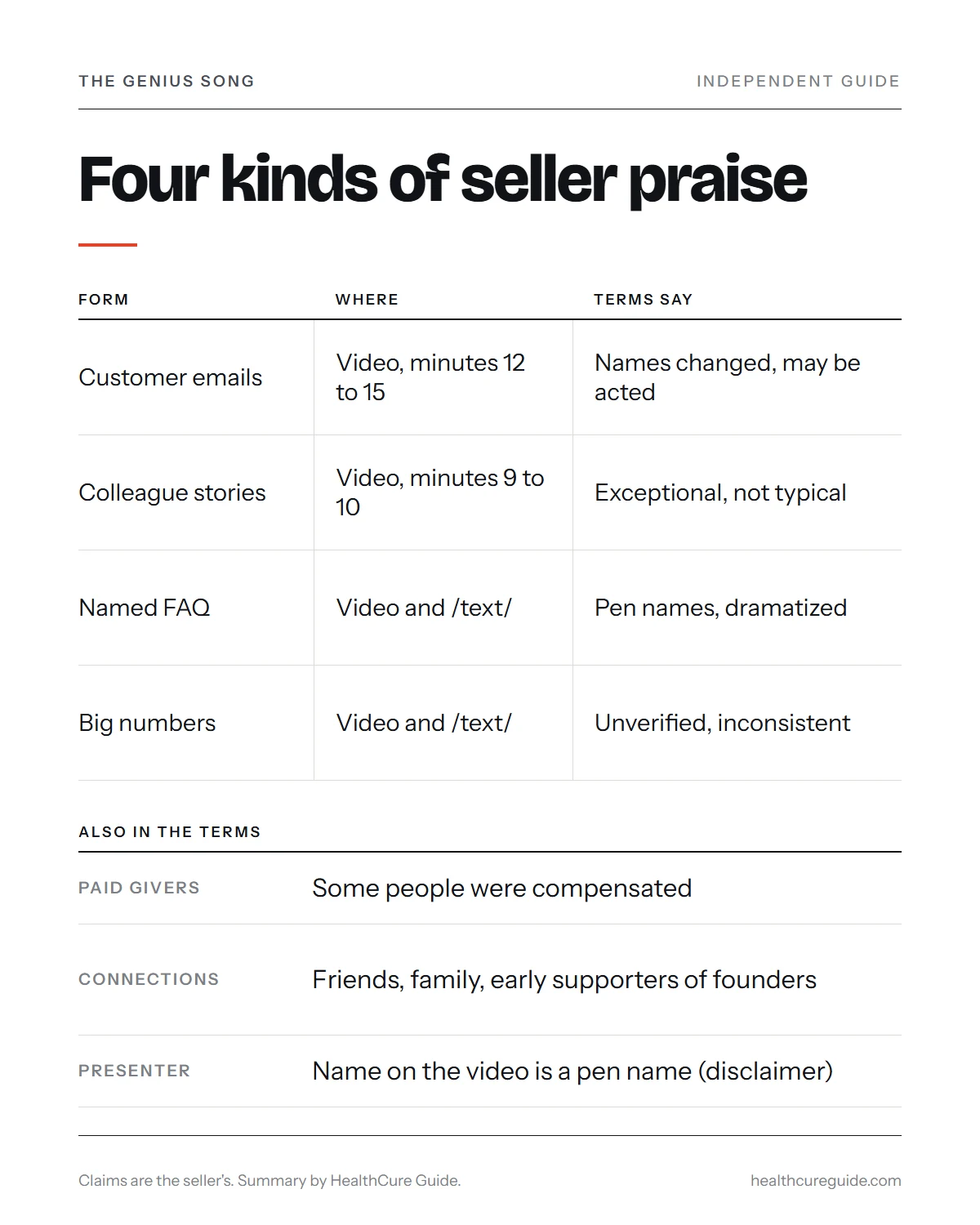
The seller’s praise turns up in four forms, spread across two pages. None of it is hosted on an outside review platform.
| Form | Where it appears | What it is meant to show | What the Terms say |
|---|---|---|---|
| Customer emails | Video, about minutes 12 to 15 | Life changes after listening | Names changed, may be acted |
| Colleague stories | Video, about minutes 9 to 10 | Results among people close to the presenter | Exceptional, not typical |
| Named FAQ | End of video and /text/ | Common doubts answered | Pen names, dramatized marketing |
| Big numbers | Video and /text/ | Popularity | Not addressed; unverified |
The table already hints at the problem. Every form of praise comes from the party selling the product, and the legal text behind the page tells you not to take it literally.
Customer emails read out in the video
About twelve minutes into the video, the presenter starts reading messages he says came from customers. One is credited to a nurse in California, another to a man who says the track helped him grow an online store until he could quit his job, a third to a woman in Manhattan who credits it with a promotion and with lifting a family “curse”.
The emails share a style. Each describes a clear before and after, each credits the track for the change, and none includes anything a reader could check, such as a full name, a photo with consent or an order date. After reading them, the presenter says he has received “hundreds of emails” like these. That figure is his own and comes with nothing to back it.
The Terms say outright that the site’s customer feedback can be performed by avatars or actors, or by what they call digital representations. So even a voice that sounds personal may not belong to a buyer.
Stories about the presenter’s colleagues
Before the emails, the video runs through a quick list of results among people the presenter says he works with: a book finally finished, a son whose grade went from C to A, an engagement after a chance meeting at Trader Joe’s, a promotion with a signing bonus. Health stories follow, including a colleague who lost 16 pounds, someone who quit smoking and migraines that went away.
These are anecdotes told second-hand by a presenter who, by the site’s own disclaimer, uses the pen name Dr. Robert Lake. If the storyteller’s name is not real, the people in his stories cannot be traced either.
The health stories need a separate warning. The site’s footer brands the product “not intended to diagnose, treat, cure, or prevent any disease”. A track that is not a treatment cannot be credited with ending migraines or a smoking habit, whatever a story says.
The FAQ written as customer questions
Both the video and the /text/ page close with questions and answers. Each question is credited to a first name and a city, mostly in the United States, with one from Frankfurt. The answers cover how to use the track, how soon it works and whether it suits everyone.
This format turns sales copy into something that reads like a conversation with other buyers. The answers carry some of the strongest claims on the page: that the track “starts working the very first time”, that plenty of buyers feel a change by day two or three, and that most people who listen daily see results inside a couple of weeks. They are claims, not findings, and no study of the track supports them.
One answer is useful, though. It explains the routine: headphones on, eyes closed, about 7 minutes a day, and missing a day is fine. That is the product in practice, without the stories.
Thousands of top reviews and the customer counts
Around the 20-minute mark, the presenter says the track has “thousands of five star reviews” from customers. The video names no store, app or review website where those ratings live, and we found none on the seller’s pages. A rating you cannot read is not a rating you can weigh.
The customer counts have a different problem: they contradict each other. The figure is 18,366 Americans in the video and in the running text of /text/, yet that page’s headline claims 19,389. Both are the seller’s own figures, unverified, and at least one of them is wrong.
The most candid moment in the whole video comes from the presenter himself. After a story about a win at a casino, he concedes there is “no evidence to support” the idea that listening produced the win. That admission fits every story on the page.
What the seller’s Terms say about these reviews
The Terms of Sale, last updated on 20 January 2026, are unusually direct about the testimonials. Here is what they allow, in plain words, and what each point means for you as a reader.
| What the Terms say | What it means for a reader |
|---|---|
| Names have been changed; pen names are used | The person may not have that name |
| Some aspects of the marketing are dramatized | Scenes and stories may be staged |
| Feedback may be acted by avatars or actors | The voice or face may not be a buyer |
| Some givers are early supporters, friends or family of the founders | There is a material connection |
| Some people were compensated | They were paid to share |
| These are exceptional results | Your result may be nothing like it |
The same document has a section headed “For Entertainment Purposes Only”, which admits entrainment is no exact science and files the products under entertainment. Testimonials promising promotions and healing sit uneasily next to that line, and the line is the one with legal weight.
How to look for feedback the seller did not write
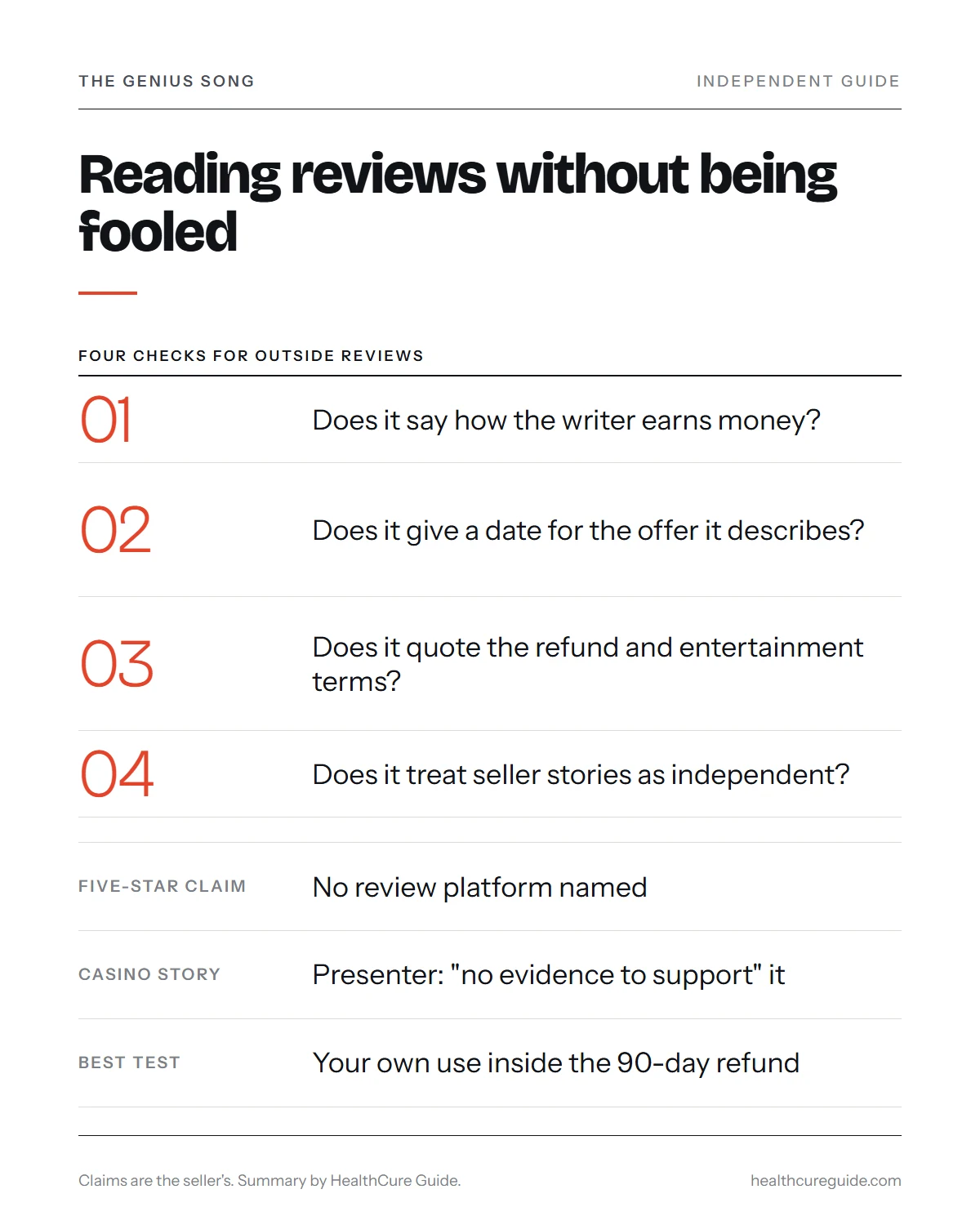
Outside the seller’s pages, you are likely to find affiliate review sites, video channels and forum threads. Affiliate sites, this one included, may earn a commission, which can colour a verdict. A few questions help sort them:
- Does the review say how the writer earns money?
- Does it give a date, so you know which version of the offer it describes?
- Does it mention the entertainment wording and the refund terms, or only the success stories?
- Does it present the seller’s testimonials as independent reviews? If so, it has not read the Terms.
For a dated look at the offer itself, see our The Genius Song reviews 2026 snapshot.
If you decide to try it anyway
Set the stories aside and the offer is simple. The Genius Song is a $39 digital track that runs about 7 minutes by the seller’s account, beneath struck-through reference prices of $200, $100 and $49. It is not an app and not a game. The video says the track is emailed for download, while the /text/ page speaks of a Private Audio Portal login, so delivery is described two ways and the file format is not stated.
Where to find it: the seller’s home page currently features its related audio, The Genius Wave, which is a different product. The pitch for The Genius Song sits on a different page of that site, /video/. Our links pass through ClickBank’s tracking and open that home page, so check that the checkout item reads The Genius Song before you pay.
The seller’s bonus lists differ from page to page. The video promises three and names four: a kids’ audio called The Genius Child, a 100-plus-year-old book about money, a Calm app creator’s guided visualization and a printable sheet of five habits. Four are promised on /text/, but only three appear there, with no Genius Child.
Refunds run for 90 days according to the Terms and the ClickBank checkout. Ignore the /TOS/refunds/ page, which is a leftover NeuroActivate bottle policy with a 60-day limit and an Ohio address. Keep the ClickBank receipt, and for a refund call ClickBank at 1-800-390-6035 or write to [email protected].
Our safety advice, separate from anything the seller says:
- Keep the volume comfortable.
- Do not listen while driving or using machinery.
- Anyone with epilepsy, a seizure history or hearing trouble should clear it with a doctor beforehand.
Our reading of the reviews
The praise on the seller’s pages is skilful and consistent, and it tells you almost nothing. Every story comes from the seller, the storyteller uses a pen name, the customer counts disagree, the five-star claim has no source, and the Terms admit the material may be acted, paid for or exceptional.
That does not make the product worthless. It means the reviews are the wrong thing to judge it by. A $39 track with a written 90-day refund can be tested directly, and your own experience is a better guide than any testimonial on the page. Our general position on product claims is set out in our disclaimer.
Related reading
Common questions
Are the testimonials in The Genius Song video from real customers?
We cannot confirm that any of them are. The seller's Terms say names have been changed, some marketing has been dramatized and customer feedback may be acted out by digital representations, avatars or actors. They also say some testimonial givers were compensated or are friends, family or early supporters of the founders. That makes the stories advertising, not independent customer reviews.
Where does the claim of thousands of five-star reviews come from?
It is a line spoken in the sales video, about 20 minutes in. The video does not say which website or store hosts those reviews, and we found no platform named anywhere on the seller's pages. Without a place to read them, the figure is the seller's own statement and cannot be checked by a buyer.
Why are the customer questions in the FAQ credited to people by name?
The FAQ in the video and on the /text/ page is written as a list of questions from buyers, each with a first name and a city. Framing sales answers as replies to customers makes them feel like conversation. Since the Terms say pen names are used and marketing is dramatized, we would not assume those people exist.
How many people does the seller say The Genius Song has helped?
The seller gives two numbers. One is 18,366 Americans, used in the video and the running text of /text/; the other, 19,389, appears in the headline of that same page. Neither comes with a source, an order report or a date. Both are the seller's own unverified figures, and the fact that they disagree is a reason to treat them as marketing copy.
Do the colleague stories in the video count as reviews?
No. They are second-hand anecdotes told by the presenter about people he says he works with, such as a finished book, a child's better grades, an engagement and a promotion. Some touch on health, like weight loss and quitting smoking. There is no way to check them, and the site states the product is not intended to treat any disease.
What is the most honest sentence in the seller's own testimonials?
After telling a story about a win at a casino, the presenter says there is no evidence to support that the track caused it. That admission applies just as well to every other story in the video. A testimonial shows that someone, real or acted, describes an outcome. It does not show that the audio produced it.
Where can I find feedback on The Genius Song that the seller did not write?
Look for sources that disclose how they earn money, give dates and quote the seller's Terms. Affiliate review sites, including this one, may earn a commission, so check whether a review mentions the refund rules and the entertainment wording or only repeats the sales story. Your own experience inside the 90-day refund window is the most reliable test.