Last Wish Reviews: The Last Wish on Affiliate Sites, Videos, Forums
Search the name and you meet a crowd of verdicts, most from people with something to gain. Here is who writes Last Wish reviews, how a commission tilts them, and what a trustworthy write-up must contain.
- Written by
- HealthCure Guide Editorial Team
- Reviewed by
- HealthCure Guide Editorial Team
- Updated
- Reading time
- 10 min read
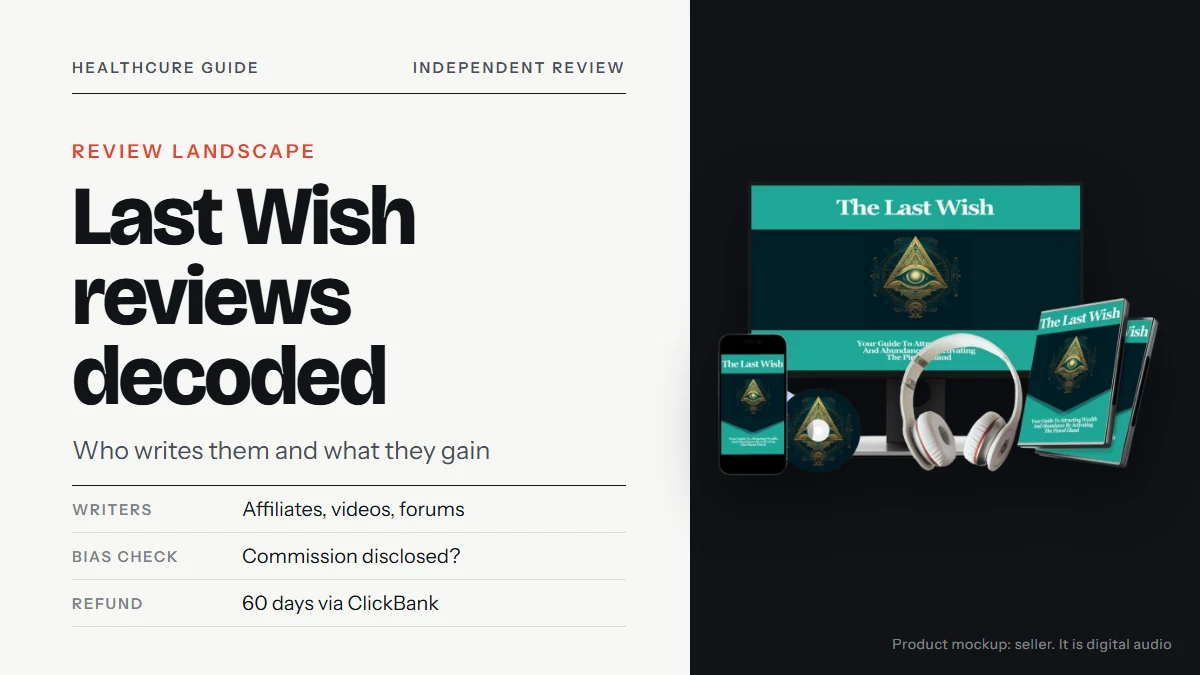
This guide contains affiliate links. If you buy through them we earn a commission at no extra cost to you. It does not change the verdict. Disclosure.
Disclosure first: we run no part of The Last Wish, we review it as outsiders, and a reader’s purchase through our buttons may pay us a commission. We have not bought it ourselves. What follows is therefore about how to read last wish reviews, our own included, and not another round of promises.
Last wish reviews online: who writes them and why
We have not audited any particular channel, thread or site, and we name none. What we can describe is the shape of the field around a product sold like this one, and the incentive each writer type usually has.
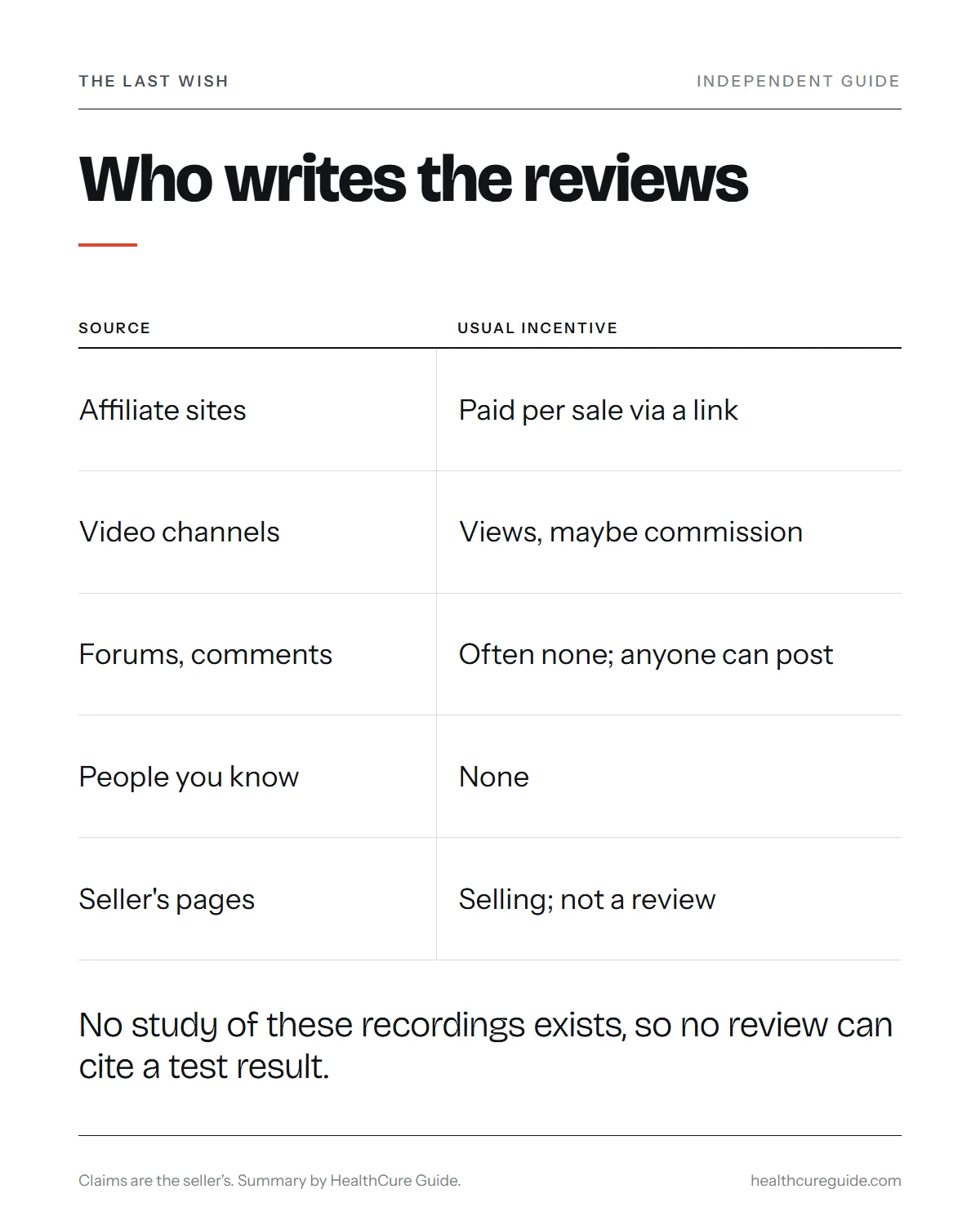
| Source | Typical incentive | What to look for |
|---|---|---|
| Affiliate review sites | Paid per sale through a tracked link | Disclosure, named downsides, refund detail |
| Video channels | Views, possibly a commission or sponsorship | Whether the presenter shows the checkout and receipts |
| Forums and comment sections | Often none, but anyone can post | Specific, checkable details |
| Friends and people you know | None | Delivery, listening experience, refund result |
| The seller’s own pages | Selling | Treat as marketing, never as a review |
Notice what is missing from that table: a neutral lab. No study of these recordings exists, so no reviewer can point to a test result. Every verdict is a judgment about a sales funnel, a price and a refund promise.
How a commission bends a verdict
An affiliate link means the writer earns when you click through and buy. That does not turn a review into a lie, but it does tilt the ground in four predictable ways.
- Softened downsides. Weak points get a gentle sentence instead of a headline.
- Borrowed claims. The seller’s pitch is repeated because it sounds persuasive, with the caveat left off.
- Urgency copied over. A countdown timer or “Today Only” line from the funnel migrates into the review as if it were news.
- Buy buttons everywhere. The page is arranged around the click, not the reader’s question.
We use the same kind of link, so we hold ourselves to the opposite practice. This page carries a few call-to-action boxes, each marked as an affiliate link. Our wording on the product itself is meant to leave you more informed, even if that means fewer sales.
What the ClickBank page does and does not tell you
Some readers treat a ClickBank checkout as proof of quality. It is not. ClickBank is the retailer, and its footer is explicit that acting as the seller of record carries no endorsement of the product and amounts to no review of it. What the checkout is good for is facts: the item name (The Last Wish, a Digital Product), the price in your currency plus tax, and the return window.
The checkout wording allows return or replacement within 60 days of purchase. The seller’s own Terms offer a 60-day refund as well. Your card statement should show CLKBANK*TheLastWish, and ClickBank order support is on 1-800-390-6035. None of that says whether the audio is any good, which is why the checkout cannot stand in for a review.
A checklist for an honest Last Wish review
Whoever wrote it, an honest review should clear most of the following.
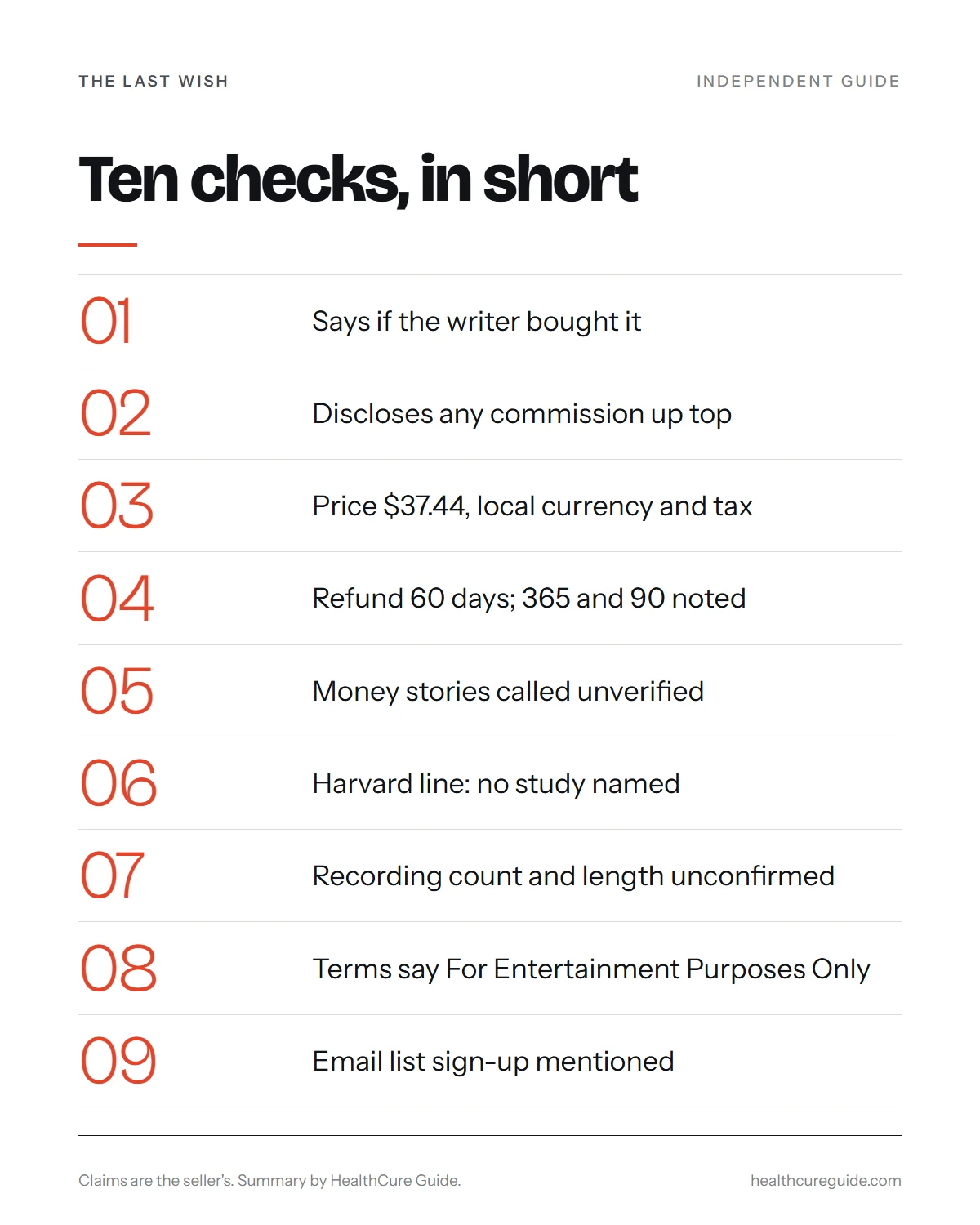
- Says whether the writer bought the product, and if not, says so near the top.
- Discloses any commission, in plain words, before the first buy link.
- Gives the price as $37.44, mentions the 37.11 “Today Only” figure on the video page, and warns that checkout converts to local currency with tax.
- States the refund as 60 days under the Terms and ClickBank, then reports the other numbers calmly: a 365-day badge that nobody backs up in writing, and a footer link to another company’s 90-day terms with conditions.
- Calls the money stories unverified, with no presentation of them as results.
- Notes that the line about Harvard and Michigan research names no study.
- Mentions that the recordings’ number and length are not confirmed, since the video says 11 minutes a night and the order page says “under 7 minutes”.
- Quotes the Terms line “For Entertainment Purposes Only” and the plain fact that manifestation outcomes are not evidence-based.
- Mentions the email list sign-up, including possible third-party offers.
- Treats faith with respect and points worried readers to real help with money.
A review that clears nine or ten is unusually thorough. One that clears three is a brochure.
Facts a trustworthy write-up must get right
Because most last wish reviews lean on the same funnel, they tend to repeat the same errors. Here are the points where we see them go wrong most easily.
The narrator. The video’s presenter, who calls himself Danny Kelly, might go by a pen name: the Terms make room for invented names and dramatized scenes. A review that treats him as a confirmed expert, or his tale of a priest and a parchment in Vatican archives as history, is repeating a story. We cannot verify either.
The money tales. A $3,617 day, an IRS refund of $10,137 and a $2,000 scratch-card prize all come from the narrator, and all are unverified seller stories. A review that quotes them as an outcome is doing the seller’s advertising.
The research line. The sales page credits Harvard and University of Michigan research, yet it names no study, so reviews that echo the line add nothing.
The pineal gland. Its known job is releasing melatonin and helping time sleep, evening light lowers melatonin, and calcium deposits grow common with age. We found nothing showing that sound activates it or that it affects money. The human pineal gland also has no retina, and “cherubim” (Hebrew) and “cerebrum” (Latin) do not share a root.
Audio evidence. If a reviewer cites binaural beats, check the framing. The literature is split: pooling studies in 2019, researchers saw a moderate average benefit for some outcomes, while a 2023 look at entrainment found that in most trials the targeted brain rhythm did not follow the sound. No study tests these recordings.
Where our own page stands
You deserve to know how this site is placed. We publish reviews of several digital products and earn commissions on some of them. For The Last Wish we use one ClickBank hop link with a tracking tag, and every button on this page uses it.
To keep ourselves honest we apply the checklist above to our own work: we state that we did not buy the product, we attribute every claim to the seller, we avoid number scores, and we avoid listing any customer outcome because we have none to verify. Our methodology page describes how we weigh sources, and you can see who edits these pages on the editorial team page.
Red flags that a write-up is really an ad
Some signs show up again and again in pages built to sell. Treat each as a reason to read more slowly.
- It treats the seller’s stories as proof, especially the money ones.
- It promises that listening will work from the first night.
- It presents the narrator as a confirmed expert or a verified person.
- It says refunds last a year, because of the badge, without checking the Terms.
- It hides or skips the price, or never mentions the checkout.
- It never mentions that the Terms frame the product as entertainment.
- It contains only buy buttons and no sentence that could lose a sale.
By contrast, a careful write-up is often a little dull. It lists what the pages say, marks what cannot be checked and leaves the decision with you. Dull is a good sign here.
Belief, evidence and money
Many readers come to a product like this from a place of sincere faith or real financial worry. Both deserve respect, and a good review keeps them apart from the sales claims. Prayer, reflection and quiet time matter to many people, and nothing here dismisses that.
On evidence, the Terms label the material entertainment, and the idea that manifestation produces outcomes rests on no proof. The planning research is the part that holds up: rehearsing the steps to a goal, and mental contrasting, which pairs the goal with the obstacle in its way and an if-then plan. Wishing alone has not been shown to produce money.
If money is the worry, tools like a monthly spending plan and a call to a nonprofit credit counselor beat any recording. Please do not spend cash you need on the hope of “abundance”.
Pressure, inboxes and what to do next
The funnel leans on pressure: a countdown on the video page, “Today Only”, and hints that the video might be pulled without warning. All of it is sales pressure and none is a fact about supply. Buyers may also be added to the seller’s mailing lists, which can carry third-party offers on spirituality and similar topics.
Our advice for reading any verdict, ours included:
- Compare at least two sources, and prefer the one that names downsides.
- Read the Terms yourself. They are short.
- If you buy, keep the ClickBank receipt, and ask for a refund inside 60 days if it is not for you.
- Remember that a review is a view, not a test.
This page is information only, not medical, legal or financial guidance; our disclaimer has the details.
Related reading
Common questions
Why do so many Last Wish write-ups sound alike?
Most are built from the same source material: the seller's order page, its video and its Terms. Writers who did not buy it can only restate what the funnel says, so the same price, gifts and claims repeat. A write-up that adds a delivery detail or a refund result from a real order stands apart.
Does an affiliate commission make a review wrong?
Not automatically. It does give the writer a financial reason to lean positive, so the useful test is whether the review still names the downsides: no study of the recordings, unverified money stories, and a refund page that conflicts with the Terms. Disclosure up front matters more than the commission itself.
How does ClickBank pay a reviewer?
ClickBank is the retailer, and sites that send buyers through a tracked hop link can earn a share of the sale. We use such a link on this page, and we can be paid when a reader buys. We state that openly, and it costs the reader nothing extra.
Can I trust a video review of The Last Wish?
Judge it by the same checklist as text. Ask whether the presenter paid, discloses a commission, shows the checkout rather than only the sales video, and avoids repeating the seller's income stories as proof. A confident voice and good lighting are not evidence.
Are forum and comment-section opinions more reliable?
They can be, but only when they give checkable details such as delivery time, what arrived and how a refund went. Anyone can post anywhere, including sellers and affiliates, so praise with no detail should count for little. Also remember one person's experience is not a result you can expect.
What is the safest way to judge The Last Wish for myself?
Read the Terms yourself, note that they call it entertainment, and rely on the 60-day return route through ClickBank. Keep the receipt email, set a reminder before day 60, and spend only money you can spare. Treat any review, ours included, as a starting point.
Do you give The Last Wish a score?
No number. We have not bought it, so a score would imply a test we did not run. We give a verdict in words on our full review page and explain our approach on the methodology page. Here the aim is simply to help you read other people's reviews.