Nitric Boost Ingredients: What Is in the Scoop, in Plain English
Eight names make up the formula. Here they are in the order the seller's story unfolds, with what the seller says each is there for, and the details the seller does not publish.
- Written by
- HealthCure Guide Editorial Team
- Reviewed by
- HealthCure Guide Editorial Team
- Updated
- Reading time
- 8 min read
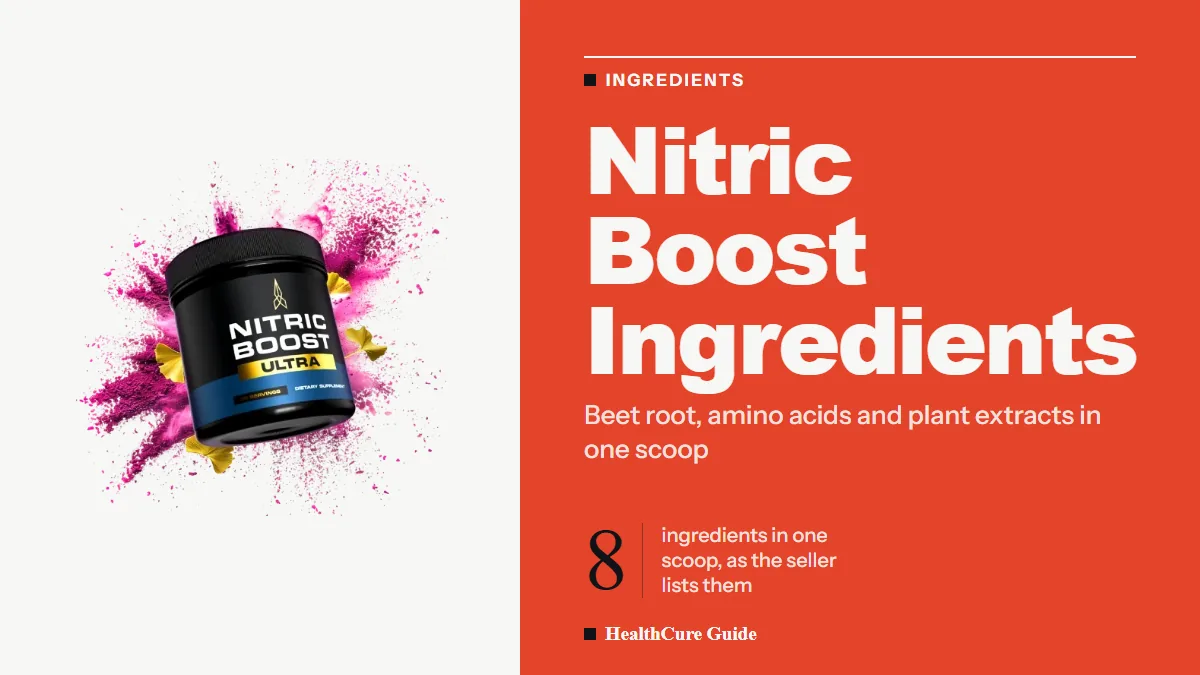
Anything you stir into a glass every morning deserves a read of its ingredient list. With Nitric Boost the list is short enough to take in at a glance, and it follows a simple storyline: a vegetable, three amino acids, a vitamin and three plants. This guide takes them in that order and says what the seller claims for each.
The formula comes as a powder in jars of 30 servings, one scoop each, and the jar is printed with Nitric Boost Ultra. According to the seller it is built to support healthy circulation, everyday energy, stamina and confidence. Our overview of Nitric Boost gives the wider picture, and this page stays on the list itself.
Nitric Boost ingredients: how the seller tells the story
The seller’s idea is built around nitric oxide, a gas that it says helps blood vessels relax and widen. In its telling, the formula supplies raw material for the body to make that gas, plus a few extras for energy and circulation. We repeat the idea as the seller’s story and not as something we have tested, and we leave the science of it to the people who write it.
The vegetable: beet root powder
Beet root comes first in the seller’s account. Beets are rich in natural nitrates, and the seller says the body converts nitrates into nitric oxide. It adds that endurance runners like beet root, a nod to the way many athletes already know the vegetable.
If you have ever seen beet juice at a juice bar or in a gym bag, you will recognize the idea. In Nitric Boost it arrives as a powder alongside the other seven.
The amino acids
Amino acids are the small building blocks that proteins are made from, and three of them appear on the list.
- L-arginine. The seller describes it as the starting material the body draws on to make nitric oxide.
- L-citrulline DL-malate. This is citrulline paired with malate. The seller says it works alongside L-arginine, and that the malate half supports energy.
- D-aspartic acid. The seller lists it as an amino acid. We leave the description there, because the seller gives it no role that we repeat.
Many people who train already know the first two names from sports nutrition shelves, which is part of the product’s appeal.
The vitamin: niacin
Niacin is vitamin B3. The seller’s line is that niacin supports healthy, flexible blood vessels. It is the only vitamin on the list, and doctors and pharmacists know it well, which is a good reason to show them the whole list if you take regular medicine.
The three plants
The last three names come from plants.
- Epimedium is a traditional herb. That is all the seller tells us that we pass on.
- Ginkgo biloba appears as a powder. The seller describes it as antioxidant support aimed at your blood vessels, and the name is familiar from supplement shelves.
- Dong quai is described by the seller as a traditional tonic for circulation, which fits the healthy blood flow theme.
Taken together, the plants round out a formula the seller aims at circulation and everyday energy.
How the eight fit together
Read top to bottom, the list makes a tidy sequence. A vegetable supplies nitrates. Amino acids supply the starting materials. A vitamin is there for the vessels, and three plants add circulation and antioxidant themes. Whether you find that story persuasive is a personal call, and the seller itself frames the results as varying from one person to another. What we can say is that the list is easy to read and every name on it is a familiar one, which makes it simple to discuss with a pharmacist.
What the seller does not publish
Honest reading means noticing the gaps. These details are missing, and we have not filled them in.
- Amounts. Not one of the eight has a published figure. The seller’s FAQ calls the powder a proprietary blend.
- A label image. We found no supplement-facts panel anywhere on the seller’s pages.
- Scoop weight. How much powder one scoop holds is not stated.
- Flavor and other ingredients. There is no sweetener, flavor or other-ingredients line.
Should one of these gaps matter to you, put the question to the seller before ordering. The email address is [email protected], and a phone line answers on weekdays at 1 (814) 885 4823.
Questions people ask about the list
Why does the order of the list matter? The seller calls the powder a proprietary blend, so we do not read the order as a ranking by amount. We describe the names in the sequence of the seller’s story, not by weight.
Are the ingredients familiar? Mostly, yes. Beet root, niacin, ginkgo and the two best-known amino acids all turn up on ordinary supplement shelves, and that familiarity is one reason the list is easy to talk through with a pharmacist.
Is anything here a surprise? For some readers, epimedium and dong quai will be the least familiar names. The seller calls both traditional herbs, and we say no more than that.
Where can I see the full overview? Our Nitric Boost review hub gathers the ingredients, price, bonus guides and refund steps on a single page.
What the seller says about quality
In its FAQ, the seller describes the powder as vegetarian, dairy-free, soy-free and non-GMO, adds that it passes third-party inspections and says it is made in the USA at a GMP-certified facility. These are claims from the seller, and we have not checked the facility ourselves.
How the seller suggests using it
The directions are plain: a scoop a day, mixed into a glass of water, a smoothie or tea. The seller proposes staying with the routine for 3 to 6 months. A jar covers 30 days, so six jars cover 180. The Nitric Boost Blueprint, a bonus guide in the larger orders, adds ideas on timing, food pairings and smoothie recipes.
Who should show this list to a doctor
Take the eight names to a doctor or pharmacist if you use a blood thinner, a nitrate prescribed for chest pain or a blood-pressure prescription, if heart or circulation trouble is part of your life, if you are pregnant or nursing or if surgery is planned. Several of the ingredients are familiar to those professionals, who can tell you quickly whether the powder suits your situation. The seller gives the same general advice for any supplement, and it adds one firm rule: nobody should stop a medicine without a doctor’s agreement. Our side-effects guide lists questions to take along, and the ingredient list post sets the names out in a table.
The price, briefly
A single jar costs $69, plus $9.99 for shipping inside the US. Three jars cost $177 ($59 a jar) and six jars cost $294 ($49 a jar), both shipping free in the US and bringing two bonus guides. Every package is backed by a 60-day money-back promise measured from your purchase, and empty jars qualify. Our price page lays the figures out in a table.
Our take on the list
Judged on clarity, the list does what a short list should: it tells you what is in the scoop, and in the seller’s words why. Judged on detail, it leaves out amounts and a label, which is worth knowing before you order. For a reader who likes a simple daily routine and a clear refund path, the eight names are an easy place to start.
Good to know:
- The ingredient roles are the seller’s descriptions.
- Results vary from one person to another.
- It is a dietary supplement and not a medicine.
Common questions
Which ingredients does Nitric Boost list?
Eight: a vegetable powder (beet root), vitamin B3 (niacin), three plants (epimedium, ginkgo biloba and dong quai) and three amino acids (L-citrulline DL-malate, L-arginine and D-aspartic acid).
What amounts of each does a scoop hold?
The seller does not say. Its FAQ calls the powder a proprietary blend, and no supplement-facts panel is shown, so we will not guess at amounts.
Which ingredient does the seller lead with?
Beet root. The seller's story starts with its natural nitrates, which it says the body turns into nitric oxide.
Is epimedium a vitamin or a herb?
A herb. The seller lists epimedium as a traditional herb and offers nothing further that we would repeat.
Should my doctor or pharmacist see the list?
Yes, especially if you use a blood thinner or any prescription aimed at blood pressure or chest pain, or if you have a heart or circulation condition. Bring all eight names.
Does the seller name a flavor or sweetener?
No. There is no other-ingredients line, so flavor, sweetener and scoop weight are all unstated.