Nitric Boost Side Effects: A Calm, Practical Safety Guide
A relaxed look at using Nitric Boost sensibly. What the seller advises, which readers should speak with a doctor or pharmacist, how to start and what to do if something feels off.
- Written by
- HealthCure Guide Editorial Team
- Reviewed by
- HealthCure Guide Editorial Team
- Updated
- Reading time
- 8 min read
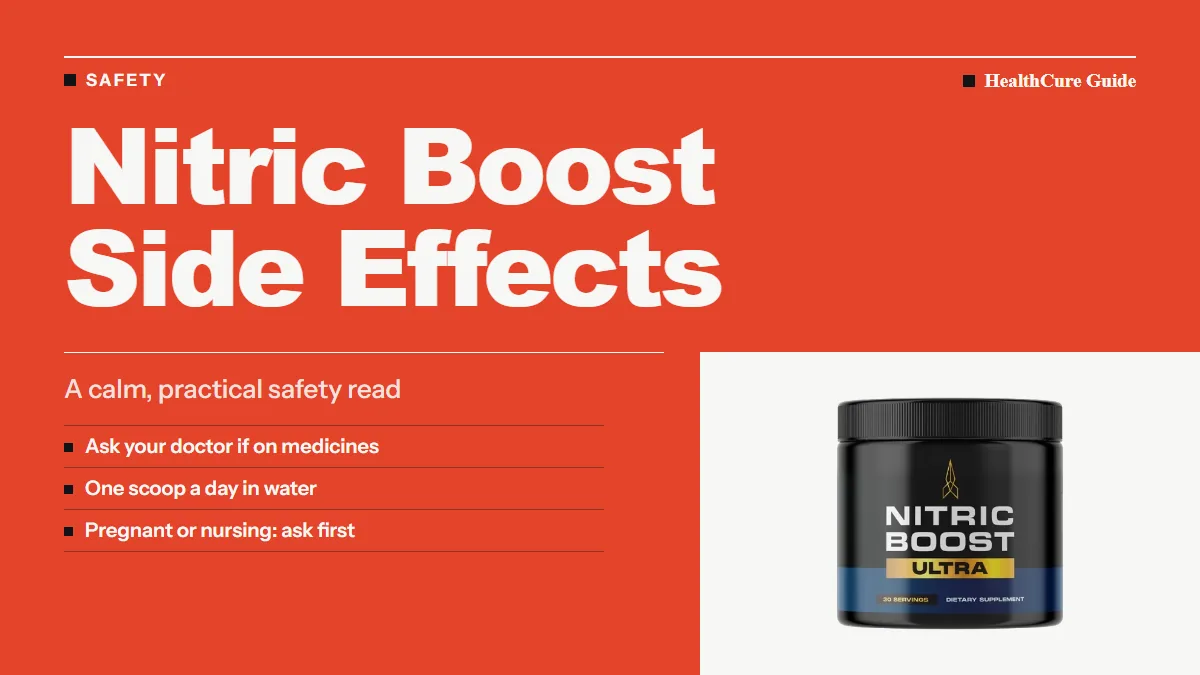
Starting something new each morning raises a fair question: is it right for me? This guide on Nitric Boost side effects helps you answer it. It will not promise that nobody ever feels unwell, because no supplement can say that, and it will not alarm you either. What it offers is a calm plan, built from the seller’s own advice and from sensible common ground with your doctor.
What you would be taking is a powder, a daily scoop stirred into a drink, packed 30 servings to a jar, with Nitric Boost Ultra printed on the label. The seller aims the formula at healthy circulation, energy, stamina and confidence. Our Nitric Boost overview covers all of that, and this page sticks to the safety side.
Nitric Boost side effects: what the seller says
Two pieces of advice appear on the seller’s pages. In the FAQ, it says a doctor should be consulted before any new supplement, and that no one should quit a medication unless their doctor has agreed. In the site footer, it names four groups who should check with a physician first: readers who are pregnant, who are nursing, who take medication or who have a medical condition. Elsewhere, the seller badges the powder as non-habit forming.
That is the seller’s guidance, and it is sensible. The pages we read do not describe particular reactions, so we cannot list any, and we will not invent them.
Before the first scoop: a three-minute check
Taking a few minutes now is the best way to feel relaxed later. Ask yourself three things.
- Do I take any regular medicine? If so, bring the name of the powder and its eight ingredients to your doctor or pharmacist.
- Is there a health condition I manage? Heart or circulation matters are the ones we would flag most.
- Is anything planned? A procedure or an operation is a good reason to mention every supplement you use.
If all three answers are no, you may still like to mention it at your next check-up, as a matter of habit.
The medicines worth a question
This short list comes from reading the ingredient names and not from any marketing claim, and it is not a statement that a problem will occur. The seller’s story rests on beet root and on the amino acids L-arginine and L-citrulline, all tied to the body’s nitric oxide pathway. Niacin, ginkgo and dong quai are names pharmacists also tend to look at when they check a medicine list for someone who takes a blood thinner.
| If this describes you | A sensible move |
|---|---|
| You use a blood-pressure medicine | Raise it with your doctor or pharmacist before the first jar is opened |
| A nitrate has been prescribed for your chest pain | Get a pharmacist’s view first |
| You use a blood thinner | Hand your pharmacist the ingredient list |
| Your heart or circulation needs care | Ask the doctor who knows your history |
| You are expecting or nursing | The seller wants a physician’s word before you use it |
| An operation is booked | Tell the surgical team about every supplement |
Nothing in the table suggests you stop a prescription. Keep taking everything you have been told to take.
The first weeks: a gentle start
After the checks, begin the way the seller describes, with a single daily scoop that goes into water, a blender or a mug of tea. We would add three small habits of our own.
- Pick one moment a day. A fixed time makes it easy to notice how you feel.
- Keep a short note. A line a day on how your energy and general comfort seem is enough.
- Change one thing at a time. If you start a new supplement or medicine in the same week, you will not know which is responsible for what.
The seller suggests staying with the routine for 3 to 6 months, so think of the first weeks as the start of a habit and not a verdict.
If something feels off
If you notice anything that worries you, do not push on. Stop taking the powder for the moment and speak to a doctor or pharmacist, and mention what you have been taking. If you ever feel seriously unwell, seek medical help as you would for any other cause. Your 60-day refund window is still open in the background, so there is no pressure to keep going while you wait for advice.
Questions to take to your appointment
A short list makes a short visit. Print or save these before you go:
- Here is my medicine list. Does a powder built on beet root and amino acids fit alongside it?
- Do any of the eight names, such as niacin, ginkgo or dong quai, matter for my situation?
- My heart or circulation needs care. Would a powder taken every day make sense in my case?
- Surgery is planned for me. Whom should I tell, and should anything be paused beforehand?
- Is there anything I should watch for in the first weeks?
Our ingredient guide lists all eight names with the seller’s description of each, which you can hand over as it is.
Keeping the routine simple
Part of staying comfortable is not adding complications. The seller’s routine has one moving part, a scoop a day, so resist the urge to double it or to pile other new products on top in the first weeks. The seller publishes no dose we can quote, so we would not suggest any change from its directions. If you wonder whether a second scoop would be better, the answer is to ask your doctor and not to experiment. Likewise, if a powder is going into a smoothie, keep the other ingredients familiar to you.
Many people find that tying the scoop to something they already do, such as the morning kettle, makes the habit stick. A habit that sticks is easier to review honestly after a few weeks, because you will know exactly what you have been taking and when. The same note-keeping helps if you ever contact the seller’s support, since you can describe your routine in one sentence. The Nitric Boost hub has a short how-to-use section as well.
Using the guarantee as a safety net
A sensible buyer likes a way out. The seller’s money-back guarantee lasts 60 days, and ClickBank counts those days from your purchase. The seller words it as no questions asked, and jars you have already emptied still count. Getting started takes one message to the seller’s support address or a weekday call, and the seller’s refunds page also carries a form. After that, you post the jars to Adem Naturals (Tallmadge, Ohio), and the postage is on you. If you prefer, you can decline the parcel at the door. Because no refund time is published, put that question to support early on. Each step is spelled out in our refund guide.
Which package suits a careful start
If you want to be cautious, there is nothing wrong with a single jar for the first month. It costs $69, with $9.99 added for US shipping, which makes $78.99. If you are comfortable with the plan, three jars at $177 or six jars at $294 give you 90 or 180 days, free US shipping and two bonus guides. Whichever you pick, the same 60-day promise applies.
A quiet reminder
This page is general information, not a medical opinion, and the product is sold as a dietary supplement. People respond to supplements in different ways. If you want help deciding, your doctor or pharmacist is the right person to ask, and our safety page offers a few questions to bring along.
Good to know:
- Seller guidance is general and does not replace a doctor’s advice.
- Keep taking prescribed medicines unless a doctor tells you otherwise.
- Experiences vary from person to person.
Common questions
Does Nitric Boost have side effects?
Any supplement can disagree with someone. The seller pages we read give general doctor advice and no list of reactions, so we would not promise that nothing will ever feel off. Pause and ask a health professional if it does.
Who should speak to a doctor before starting?
The seller's footer names pregnancy, nursing, medication and medical conditions. We would add heart or circulation conditions and anyone with an operation planned.
Which medicines are worth asking about?
Blood-pressure medicines, nitrates taken for chest pain and blood thinners. Ask your doctor or pharmacist before the first scoop.
Should I stop a medicine to try it?
No. The seller says never to stop a medication without speaking to your doctor, and we agree completely.
Is it habit forming?
The seller lists it as non-habit forming. Still, if something feels wrong, pause and speak with a health professional.
Can I return it if it does not agree with me?
Within 60 days of your purchase you can ask for a refund. Empty jars qualify, and the return postage is yours.