Smart Water Box Review: What the Seller Shows and What It Leaves Out
A buyer-focused look at a DIY water-from-air guide: the seller's story, the open questions about format and contents, the disclaimer and the refund path.
- Written by
- HealthCure Guide Editorial Team
- Reviewed by
- HealthCure Guide Editorial Team
- Updated
- Reading time
- 8 min read
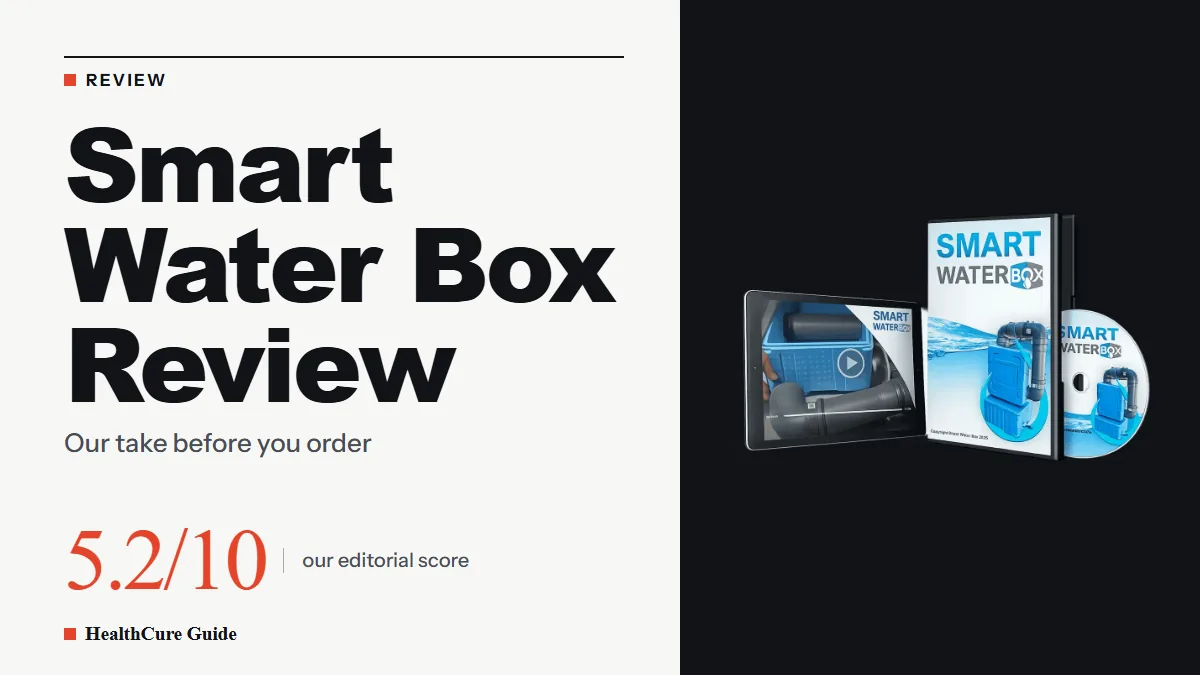
Curiosity about water drawn from ordinary air is what usually brings people to this Smart Water Box review. The idea sounds practical: a small home build that gathers moisture from the room and turns it into a usable source. The seller shows a guide that walks through that build, so our job here is to set out what the seller shows, what it holds back and how a careful buyer can check the rest before ordering. We read the publisher’s open pages in November 2026. We have not opened the guide itself, so nothing below describes its pages, its parts or its steps in detail.
What the Seller Describes
The seller frames the product as a guide rather than a ready-made machine. According to the seller, it explains how to build a small box that collects water from humid air, and the sales copy talks about bringing water into the home without much fuss. The seller also says the material is laid out as a step-by-step sequence. We pass those claims on as the seller’s stated words and make no promise about any of them.
The useful first question is what you actually receive once you pay. That is where the open pages become thin, and it is why a review of this product has to spend as much time on gaps as on promises.
What the Main Page Leaves Out
The front page is built around a video and a run of bold headlines, with buttons that lead to the order screen. Three things are missing from it: a price, a list of contents and a plain statement of format. The seller leaves unsaid whether the material is a file or a physical item. That gap changes what you will hold on the first day and how a refund would be handled.
The what’s included page on our site walks through those gaps one at a time, and it is worth reading alongside this review.
How the Build Is Framed
A guide of this kind usually asks the reader to think in stages: understand the goal, gather the materials the guide names, assemble the parts in order and then check the result with care. The seller’s marketing follows a similar outline, though we cannot confirm the stages from the open pages. Once you have access, look for three things: a parts list, a set of steps and a section on safety. If any of the three is missing, that tells you something about the rest of the package.
Think of the guide as a plan to study before any tools come out. A reader who skips the planning stage often finds the build harder to weigh afterwards, because nothing was written down to compare against.
Who the Guide Might Suit
Hobbyists are the natural audience. Someone who enjoys small builds, works well from a written sequence and finds water-from-air ideas interesting will probably read the material with the most patience. The seller’s framing fits that reading, because it treats the guide as a plan to work through rather than a product to switch on.
A reader who wants a finished appliance, a reliable drinking source or a quick fix for a dry spell will find a poor match. No home build of this kind replaces a regulated water source, and the seller does not claim that it does. Treat the project as a learning exercise with a clear list of checks, and you will get more from it.
Reading the Offer Against Your Goals
Ask yourself what you want from the project before you read anything else. If the answer is curiosity, a weekend exercise or a way to learn how air-based collection works in principle, the guide’s stated goal lines up with your aim. If the answer is a dependable supply for daily use, the offer is the wrong tool, and no amount of careful reading will change that.
A mismatch between goal and promise is the easiest way to be let down by any project like this, so write your goal down first and compare it with the seller’s wording line by line. Keep the timeline realistic too. A study project moves slowly by design, because every step needs checking against local rules and against your own skills.
Water, Power and Local Rules
Start with the water. Any water such a device collects should be treated or tested before drinking, and nothing on the publisher’s pages changes that rule. Output also depends on humidity and temperature, so a box that performs well on a humid morning may disappoint on a dry afternoon. Plan around that variation instead of around a single good day.
Any build with powered parts brings its own duties. Keep electrical safety at the front of every step, leave wiring and mains connections to a trained professional, and stop if a step feels beyond your skill. The rules where you live matter as much as the instructions in the guide.
The Seller’s Disclaimer
The seller labels the device an experiment, and the footer of its main page says it was not technically assessed and has not been produced at any scale. Read that line slowly. It tells you the project is not an independently assessed product, and a fair buyer should weigh it before anything else on the page.
The same pages describe the story and presentation as made for promotional purposes only. The author name printed on the pages is a pen name, so it should not be read as a credential. The seller also warns that some home alterations may be against the law where you live and asks you to check with your local authority. We repeat that advice because a fair review has to carry it.
Our Score and the Reasons Behind It
We grade guides on clarity, openness and fit. Smart Water Box receives 5.2 out of 10 from our editorial team, which is our own score and not a tally of customer feedback. It reflects thin open-page material, the missing details on format and contents, the experiment disclaimer and a refund process that runs by email.
The score does not measure how much water a build would make, because we have not built anything and make no claim on that point. Our product hub lists every page we wrote on this product, if you want the wider picture.
The Guarantee and the Refund Route
The seller provides a 60-day refund promise and names a support address for refund requests. The route is to write to the seller, ask for a full refund and quote your order details. The seller reports the money can take a few business days to come back, somewhere in the range of three to five.
Keep the confirmation email from your order, since it is the document that ties your purchase to the refund. Reach the seller through the address on its contact page rather than through a link you found somewhere else. For the step-by-step version, see our refund post.
What We Would Check First
Before you click through, settle four points. Read the order screen for the price and the payment terms, because the front page shows neither. Look for the format, so you know whether a file or a parcel is coming. Compare the refund terms with the guarantee described on the publisher’s pages. Then confirm that the page you are on belongs to the seller and not to a copy.
Each of these takes a few minutes. Together they remove most of the guesswork, and they leave the sales story where it belongs, in the background. For the price question specifically, our price post explains what to look for on the order screen.
Our Verdict
For a curious hobbyist who likes to study a plan before committing, Smart Water Box is worth a careful look. The guide is presented as a step-by-step build, the seller mentions three bonuses without naming them on the front page, and the refund path is written down. Its weak points are the ones the seller leaves open: no price on the front page, no stated format, no contents list and a disclaimer that calls the device an experiment.
Read the order screen in full, keep your confirmation email and treat any water as unverified until a professional adviser has looked at it. If you also want the legal angle, our legit check goes through the seller’s support and refund pages in order. The full set of pages on this product is gathered on our product hub. If the plan sounds right for you, the order screen is the place to start.
Smart Water Box Review: Common Questions
What is Smart Water Box?
The seller shows it as a guide to building a small box that collects water from humid air. The front page does not state the format or the contents, so the order screen is where to check both.
How much does Smart Water Box cost?
The front page shows no figure. The amount is listed on the official order page, together with the payment terms, and both are worth reading there before you commit.
Is there a money-back guarantee?
The seller outlines a 60-day refund promise and asks buyers to request the refund by email, through the address on its contact page.
Has the device been technically assessed?
According to the seller, no. It calls the device an experiment that was not technically assessed, and we repeat that wording as the seller's stated.
Can I drink the water the device makes?
Water from a home device needs proper treatment before anyone drinks it. Output shifts with the weather, so no page can promise a steady result.
Who wrote the guide?
The author name on the publisher's pages is a pen name, so it should not be read as a professional credential.
Common questions
What is Smart Water Box?
The seller shows it as a guide to building a small box that collects water from humid air. The front page does not state the format or the contents, so the order screen is where to check both.
How much does Smart Water Box cost?
The front page shows no figure. The amount is listed on the official order page, together with the payment terms, and both are worth reading there before you commit.
Is there a money-back guarantee?
The seller outlines a 60-day refund promise and asks buyers to request the refund by email, through the address on its contact page.
Has the device been technically assessed?
According to the seller, no. It calls the device an experiment that was not technically assessed, and we repeat that wording as the seller's stated.
Can I drink the water the device makes?
Water from a home device needs proper treatment before anyone drinks it. Output shifts with the weather, so no page can promise a steady result.
Who wrote the guide?
The author name on the publisher's pages is a pen name, so it should not be read as a professional credential.