Is Smart Water Box Legit? A Checklist Before You Order
A reassuring but careful walk through the signs that a DIY water-from-air guide is genuinely sold, supported and refundable, and where those signs stop.
- Written by
- HealthCure Guide Editorial Team
- Reviewed by
- HealthCure Guide Editorial Team
- Updated
- Reading time
- 7 min read
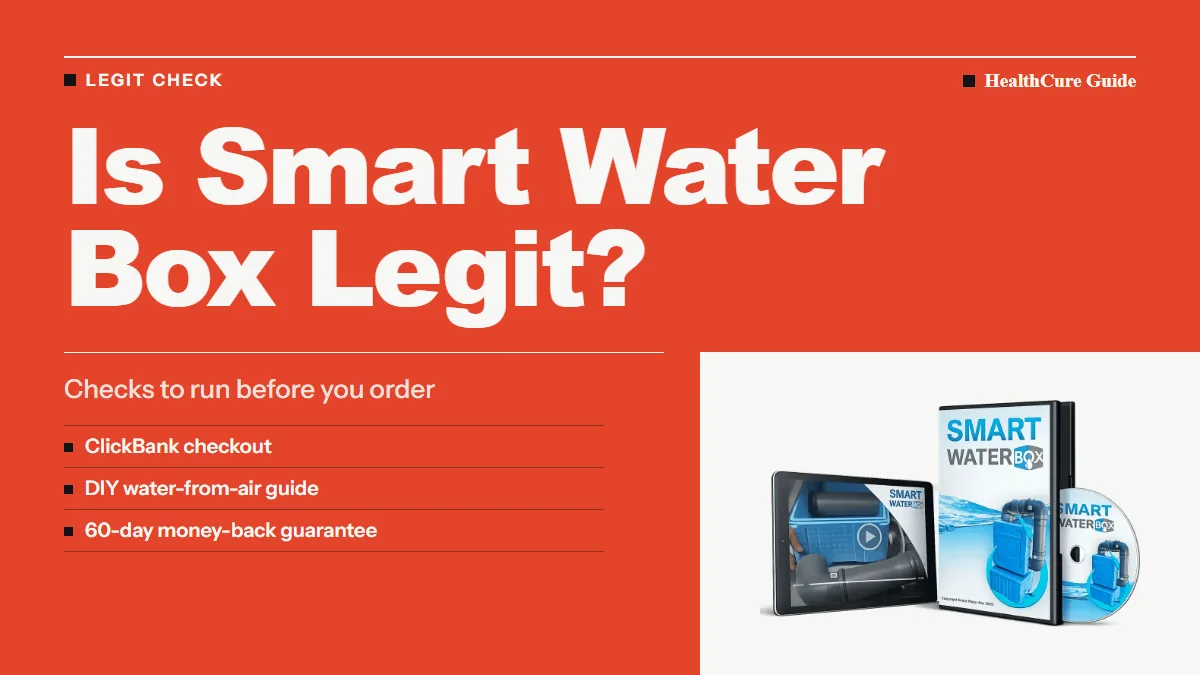
Is Smart Water Box legit? That is the question most careful readers ask before they spend a single minute on the publisher’s pages, and it deserves a straight answer. Our short reply is that the sale runs through a known retailer, a support address is listed and a refund promise is written down. Those are reassuring signs. They do not tell you what the guide contains, which is the part only the order screen and the material itself can settle.
Is Smart Water Box Legit? Our Checklist
We went through the publicly visible pieces in the same order a cautious buyer would. Each item below is a plain check you can repeat in a few minutes. None of them requires trust in our word, which is the point of a checklist.
- The sale runs through a named retailer.
- The seller lists a support address for questions and refunds.
- A refund promise appears on the publisher’s pages and is described in plain terms.
- The seller’s stated disclaimers are visible, and they are not hidden in a footer you have to hunt for.
- The format and the contents are not stated on the front page, so they must be checked at checkout.
Items one to four are signs of a conventional, traceable sale. Item five is the open question, and it is where a careful buyer spends the most time.
The Sales Route and the Retailer
The publisher’s pages say that ClickBank handles the purchase. ClickBank is a marketplace that processes digital product orders, and that arrangement means the order itself runs through a system with its own support desk. The sales story is the seller’s, but the transaction is handled by a third party that keeps order records.
That does not make every detail of the offer verified. It does mean you have a second route if the seller does not answer, and a record that sits outside the seller’s stated pages. Keep the confirmation email, because it is the first document you will need. Our product hub gathers the other pages we wrote on the offer, so you can check each claim against the rest.
Why Legitimacy Is Not the Whole Question
A sale that checks out is a good starting point, but it answers only one question. Legitimacy tells you that a seller is reachable, that a retailer handles the payment and that a refund route is written down. It does not tell you whether the guide suits your skills, whether its steps fit your local rules or whether the water it describes is worth the effort. Those questions belong to the material and to your own planning.
Keep the two questions apart in your head. A legitimate sale can still produce a project that is hard to finish, slow to show results or simply not what you wanted. The reverse is also true: a project you like can still be sold through a route you do not trust, and that is a reason to pause, not to order. Our checklist answers the first question quickly, so the second one gets the attention it deserves.
The Support Address and What It Covers
The seller lists the address [email protected] for questions and refund requests. Write in complete sentences, include the name you used at checkout and keep a copy of every message. Email gives you a timestamped trail, which is more useful than a phone call you cannot prove.
Use that address for product questions and refund requests only. For order-level problems such as a missing confirmation, ClickBank order support is the better first stop, reachable through its own site.
Reading the Refund Promise
The seller outlines a 60-day refund promise. The practical route is to write to support, say you want a full refund and quote your order details. The seller reports refunds take a few business days to appear, which fits the usual pattern for card and bank reversals.
Read the wording twice. A refund promise is only as useful as the steps you take to claim it, so note the date of your purchase, keep your confirmation email and make the request in writing. Our refund policy post lays out each step in order.
Lookalike Pages and Copies
Copies of popular guides are common. A lookalike page may use a domain that is close to the real one, show a different figure or promise a file for nothing. None of those traits alone proves a page is fake, but together they justify slowing down. The genuine route is the seller’s stated domain, reached by typing the address yourself or following a button from a page you trust.
Our official website post and the official website page describe the genuine route in more detail. If a page asks for payment details without showing the order screen first, close it and start again.
The Seller’s Own Disclaimer
The seller labels the device an experiment, and it says the device was not technically assessed. That wording matters for a legitimacy check, because it means the seller is not presenting the device as an independently checked product. We pass the line on in the seller’s stated words.
The seller also says the presentation is for promotional purposes only. Read it as a marketing page, not as a technical report. Some home alterations may be against the law where you live, so check with your local authority before you change anything. The name printed as author is a pen name, which means it should not be read as a credential. Our review places the same disclaimer beside the rest of the offer.
Safety Before Any Build
A legitimate sale does not make every build sound by default. Water made by any home device should be treated or tested before drinking, and output depends on humidity and temperature, so a box that gathers water on one day may produce little on another. Electrical safety matters the moment a build includes fans, pumps or cooling parts, and mains work belongs with a trained professional.
Keep those points separate from the sales route. A sale can be genuine and the build can still need careful handling, and buyers who understand both are the ones who avoid trouble.
How to Keep Your Records
Good records make any later question easier to settle. Keep the confirmation email in a folder you can find again, and keep a copy of the order screen as it looked on the day you bought. If the page shows a figure, write that figure down with the date. Note the name of the retailer, the support address and any reference number the checkout gave you.
When you write to the seller, keep the thread together and avoid splitting the conversation across several messages. A dated log in a plain text file is enough. Records like these do not prove anything on their own, but they turn a vague worry into a question you can put in writing and follow up.
Where a Legit Check Stops
Our checklist has limits, and we want to state them. We have not opened the guide, so we cannot confirm its parts, its steps or its results. We have not measured any water, and we make no claim about what a build would yield. The publisher’s pages do not list the format or the contents, so those two answers must come from the order screen.
Given those limits, the honest verdict is that the sale looks conventional, the support route is written down and the refund promise is stated. That is a sound starting point, not a guarantee of the outcome you want. If you want the wider picture, our product hub gathers the rest of our pages in one place.
A Quick Self-Check Before You Click
Before you follow any button, run through four questions. Did you reach the page by typing the address or by a button you trust? Does the domain match exactly? Does the page show the product name and a refund route before it asks for anything personal? Can you find the support address without searching for it? If you can answer yes to all four, the sales route is in order, and the open questions about format and contents are the only ones left to settle.
If any answer is no, stop and start again from the official address. Nothing is lost by doing so, and the order screen will still be there when you return.
Questions and Short Answers
Is Smart Water Box a real product?
It is offered as a guide, sold through ClickBank, which the publisher's pages name as the company handling the sale. A real sales route does not prove the guide's contents, so read the order screen closely.
Does the seller offer a refund?
Yes. The seller outlines a 60-day refund promise and asks buyers to write to its support address and request a full refund.
Where should I send a refund claim?
Use the support address on the seller's contact page and keep a copy of what you send. ClickBank order support is a second route for order-level questions.
Why do the disclaimers matter?
The seller reports the device is an experiment that was not technically assessed and that its presentation is for promotional purposes. Those lines show how the project is framed, so read them before paying.
How can I avoid a copy of the page?
Type the seller's address yourself or follow a button from a trusted page, then check that the domain matches exactly.
Is the author a recognised expert?
No. The author name is a pen name, so it should not be read as a professional qualification in water or electrical work.
Common questions
Is Smart Water Box a real product?
It is offered as a guide, sold through ClickBank, which the publisher's pages name as the company handling the sale. A real sales route does not prove the guide's contents, so read the order screen closely.
Does the seller offer a refund?
Yes. The seller outlines a 60-day refund promise and asks buyers to write to its support address and request a full refund.
Where should I send a refund claim?
Use the support address on the seller's contact page and keep a copy of what you send. ClickBank order support is a second route for order-level questions.
Why do the disclaimers matter?
The seller reports the device is an experiment that was not technically assessed and that its presentation is for promotional purposes. Those lines show how the project is framed, so read them before paying.
How can I avoid a copy of the page?
Type the seller's address yourself or follow a button from a trusted page, then check that the domain matches exactly.
Is the author a recognised expert?
No. The author name is a pen name, so it should not be read as a professional qualification in water or electrical work.