Teds Woodworking review: what the library holds for $67
What arrives after you pay, who the library suits, which building rules still apply, and why we rate it 7.4 out of 10 on our own editorial scale.
- Written by
- HealthCure Guide Editorial Team
- Reviewed by
- HealthCure Guide Editorial Team
- Updated
- Reading time
- 8 min read
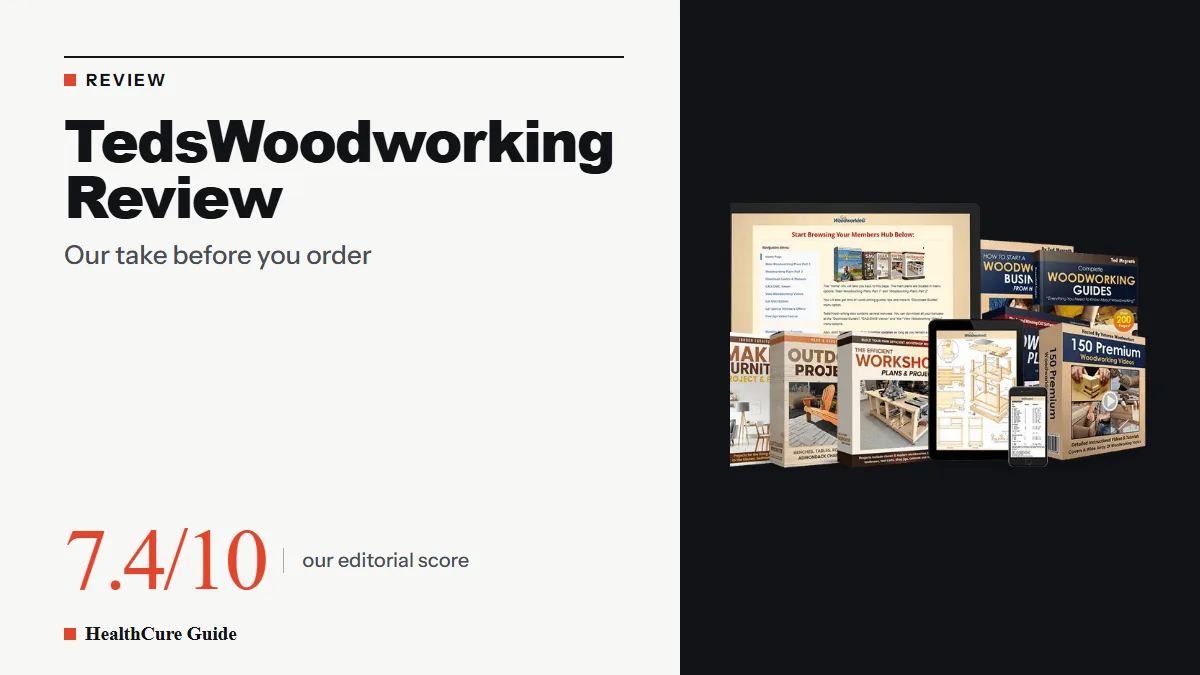
If you have ever stood in a lumber aisle holding a rough sketch and no cut list, this Teds Woodworking review is for you. Teds Woodworking is a digital plan library, a collection of woodworking drawings you receive as downloadable files, and the whole offer is organised around one question every project starts from: what to build next, and how to build it properly. This review walks through what arrives after payment, who the library suits, which building rules still apply, what the single payment covers and where we land on the rating. Every sub-page hangs off the hub page, so jump ahead there if you like.
Teds Woodworking review at a glance
| Item | What the seller says |
|---|---|
| File types | PDF and DWG, as a digital download |
| Library size | About 16,000 plans, by the seller’s count |
| Each plan | Build steps written out, a cut list, a list of materials and drawings of the assembly taken apart |
| Difficulty | Beginner, intermediate, advanced |
| Included extras | Complete Woodworking Guides, 150 Premium Videos, and a DWG/CAD viewer |
| Price | $67, one payment |
| Refund cover | Sixty days, as the seller words it |
Every row comes from the seller’s pages. We have not tallied the plans ourselves, so the library size stays the seller’s figure, and we credit it each time it appears.
What you open after you pay
After checkout you log into the members area and look through the library by keyword or by category. The seller describes about one hundred categories, with headings including buildings and shelters, workshop and tools, storage, furniture, and outdoor and garden. Every plan is tagged with a difficulty level, which lets a newcomer pass over the expert designs with no searching.
Searching is forgiving. Type a word such as shelf, planter or workbench and the results list every plan that mentions it. Filtering by difficulty narrows the list further, so a weekend project does not get buried under advanced drawings. The seller’s own category headings are a good second route when you know the type of piece but not its name.
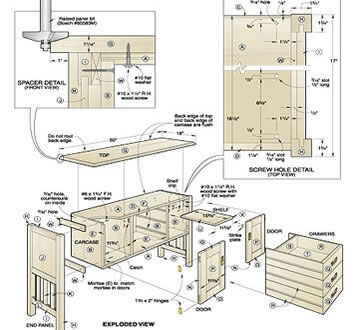
A single plan is where the library earns its keep. Take a bookshelf as the example. The cut list states how many boards to buy and the length of each piece. The materials list names the hardware and the finish. The exploded view shows how the parts slide together, which teaches more than a flat front view ever could.
According to the seller, fresh plans are added each month. Inside the members area, a custom request form lets you ask for a design the catalog lacks, and the seller states those requests carry no added fee. One limit matters here: single plans cannot be purchased separately. Every buyer receives the whole library, so the setup pays off mainly for people who mean to start a number of projects.
Who the library suits
We think the library fits three kinds of reader well:
- The home workshop owner who already keeps a saw, drill, clamps and sanding gear on hand and wants a queue of projects ready to go.
- The beginner builder who hopes to start with a shelf, a bench or a planter, backed by a clear cut list before any wood is cut.
- The planner who enjoys comparing many designs side by side before picking one.
Buyers who want finished furniture delivered to the door will be disappointed here. These drawings are instructions for your own build, not the furniture itself.
Consider a realistic first few months. Someone who owns a drill and a set of clamps might start with a small shelf, move on to a planter, then take on a bench with drawers. Every step adds a technique that the following plan takes for granted. The library makes that ladder easy to follow, because every plan lists its difficulty and its tools in the same place.
Tools, skill and building rules
This is the practical part, and it deserves a careful read. The seller’s own wording says a typical plan leans on a table saw, plus a drill, some clamps and a sander. It also describes most designs as beginner-level, with the others intermediate and a handful at expert level. Check the tool list at the head of every plan before you buy timber.
There are three safety points. On the building side, the seller says its designs are not drawn to satisfy any building code, so take a shed, a deck or any other build to your local building office first. Next, read each tool’s handbook and put on eye and ear protection. Finally, a beginner rating speaks only to how hard a drawing is to follow, not to how risky the work is, so it is no safety promise. Software matters too: PDFs open in a free reader, while DWG files need the bonus viewer supplied with the order.
A practical way to start is with a plan that uses tools you already own. Read the cut list first and count the boards or sheets you need. Then compare that with the materials list. If the numbers fit your garage and your budget, you have a project. If they do not, look for a smaller design in the same category before you spend anything at the lumber yard.
A sample first project
Here is how a first project might run, offered as a sketch of the process rather than a claim about any particular plan. You pick a bookshelf from the storage category and filter for beginner difficulty. You check the tool list, where clamps, a drill and a sander are named, and you find you already own all three. You print the cut list, mark the boards at the lumber yard and cut them at home. The exploded view settles the order of assembly. Each step follows from the drawing, so the plan does the thinking while you do the building.
What the one payment covers
The seller lists $67 as one payment with lifetime entry to the library of plans (seller’s terms). We checked that figure on 24 November 2026. Tax or currency conversion may shift the amount at checkout, so compare the final figure with what the order page shows before you confirm.
A simple way to weigh the figure is to count the plans you would realistically build in the next year. If the answer is one or two, a standalone book of designs could be the better buy. If the answer is five or more, the arithmetic usually favours a library. Either way, add the lumber, hardware and finish to the total, because those costs sit outside the $67.
The trio of bonuses covers the Complete Woodworking Guides, which the seller describes as over 200 pages, plus 150 Premium Videos and the DWG/CAD Plan Viewer. Our bonuses page takes each of them apart in turn. If you want the numbers laid out, the price breakdown is the place.
Refund cover runs for sixty days, as the seller words it. To claim it, write to the seller through its support page and include your order details. The seller states that money comes back within 48 hours. Hold on to your confirmation email, since it proves the purchase. The charge itself runs through ClickBank, whose order support is reachable at clkbank.com.
Our editorial score: 7.4 out of 10
This rating is ours. It does not come from buyers, and it is not a number the seller supplied. We gave the library credit for its breadth, for the cut and materials sheets the seller says arrive with each plan, for the single price and for the sixty days of refund cover. We took a little off for the library size, which we cannot count, and for the build-related claims that appear only in the seller’s own words. Local codes and safe handling of power tools still rest with you, and no score changes that.
Good to know
- The library is digital: plans and bonuses arrive in your members area.
- Plans are drawn without any particular building code in mind, so check local rules before you build anything structural.
- Keep your confirmation email for the sixty-day refund cover.
Our verdict
For a hobbyist who wants a single searchable home for projects, complete with cut lists, materials lists and printable PDF and DWG files, Teds Woodworking is a reasonable pick, priced at $67 as one charge. It suits the home shop owner and the first-time builder best. If you need finished furniture or only one design, look somewhere else. Keep reading through the hub page, which links every sub-page. Before you commit, our legit check explains how to confirm you are on the real order page, and the what’s included page sets out the contents in order.
Your next build is already drawn up somewhere. The library is simply a faster way to find it, with the cut list and the materials sheet already in hand before you reach the lumber yard.
Common questions
Is Teds Woodworking worth $67?
That depends on how many projects you plan to start. The seller lists $67 as a single charge for the library, and the sixty-day refund cover applies to a genuine order. If you only want one design, a standalone book of designs could suit you better.
Which file formats do the plans use?
PDF and DWG. The PDF files open in a free reader, and the CAD files open in the bonus DWG viewer, per the seller.
What skill level are the plans written for?
Per the seller, the designs skew beginner-friendly, with intermediate ones alongside and only a few at expert level. The library can be sorted by difficulty.
Is a printed copy included?
Checkout also lets you pick a DVD or USB copy. The digital library is the core product, and the disc or stick is an add-on.
Do the plans meet building codes?
No. Per the seller, the designs are not drawn to any building code, so ask your local building office before you begin a shed or other structure.
How do I ask for a refund?
Reach out via the seller's help page, quoting your order details, and hold onto the confirmation email. The seller states that payments return within 48 hours.