The Brain Song Scam Worries: How to Order the Real Audio Safely
The product is genuine. The trouble, if any, lives in look-alike pages and unofficial copies. Here is how to steer around them and order with a 90-day refund behind you.
- Written by
- HealthCure Guide Editorial Team
- Reviewed by
- HealthCure Guide Editorial Team
- Updated
- Reading time
- 7 min read
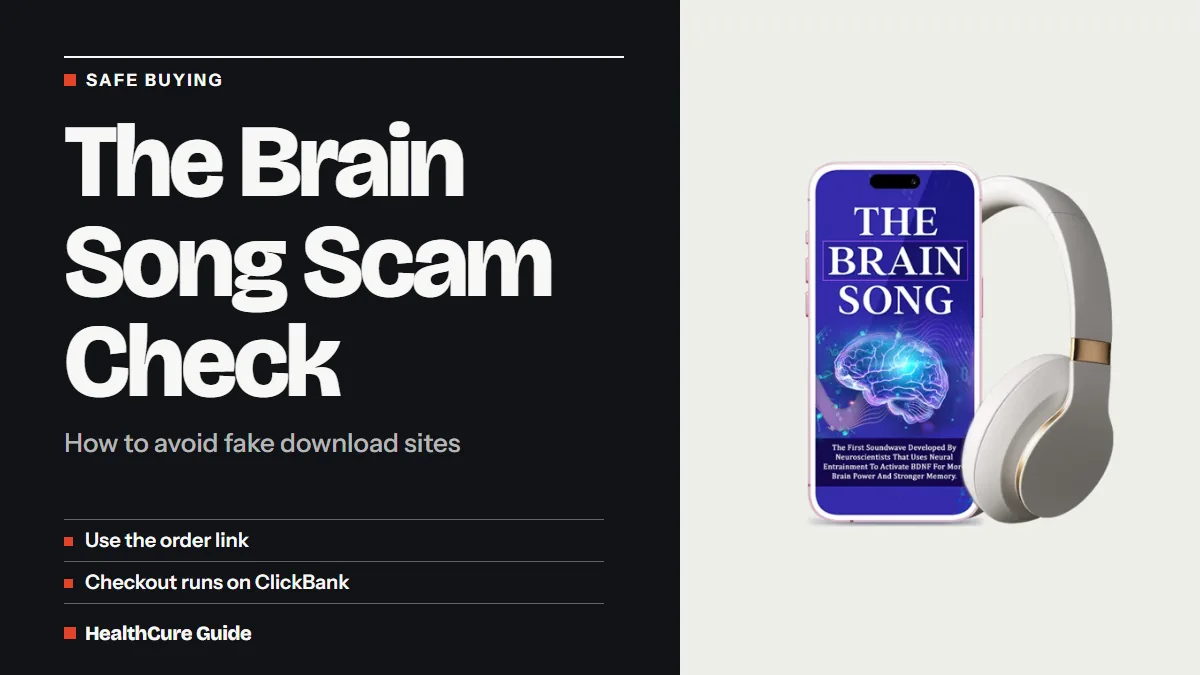
The word “scam” appears next to almost every popular digital product, and it rarely means what people fear. More often it reflects a quiet worry: if I cannot hold it, how do I know it is the real thing? Anyone searching for The Brain Song scam is asking a smart question about safety.
We looked at the seller’s order page and terms. The offer behind them is straightforward. What follows shows where trouble could come from, and how to sidestep it completely.
The Brain Song scam question: where the worry comes from
A twelve-minute audio is a small file. That is good for convenience and a little awkward for security, because small files are easy to copy. Whenever a digital product gets attention, three things tend to follow:
- Pages that promise the track for free.
- Sites that claim a secret discount code or a special reduced rate.
- Uploads on video, music or file-sharing pages that borrow the name.
None of these is the seller’s offer. They are side effects of popularity, and they exist around nearly every download you could name. The product on the seller’s page is a separate thing, with a published price, a named retailer and a written guarantee.
What the genuine purchase looks like
It helps to know the real thing so the fakes stand out.
| Detail | The genuine offer |
|---|---|
| What you buy | One twelve-minute audio, delivered digitally |
| Price | $39, a single payment |
| Checkout | A ClickBank payment page |
| Support | A seller email, a weekday phone line and ClickBank order support |
| Guarantee | 90 days from purchase |
| After buying | You join the seller’s mailing list and can unsubscribe |
If a page differs from this table in a big way, such as a different price, a free offer or a form that has nothing to do with ClickBank, you are not looking at the seller’s order flow.
Why copies cost you more than they save
A free or cut-price copy looks like a bargain. In practice it trades away the things that make a $39 purchase low risk.
No refund. The 90-day promise applies to purchases through the seller. Nobody owes you money back for a file picked up elsewhere.
No support. If the track will not play or you cannot find it, there is no team to ask.
No certainty about the file. You cannot know what you are opening. A genuine audio file is just sound, but a copy from an unknown source could be anything, and that is a poor thing to gamble on for the price of a takeaway meal.
No fairness to the seller. Under the terms of sale your purchase is a single listener’s copy, and sharing, reselling or uploading it is ruled out. Pirated copies break those rules.
At about $0.43 a day across the refund window, the real purchase is already inexpensive, so the saving from a copy is tiny compared with what you give up.
A note on “too good to be true”
Most of us carry an instinct for deals that look wrong, and it serves well here. The seller’s price is already low: one payment of $39, which is about $0.75 a week if you keep listening for a year. A page that claims to cut that further, or to give the track away, is asking you to believe something unusual about a cheap product.
Ask yourself what the page gains from the offer. A free download that wants your card number “to verify your account” gains your card number. A discount code that routes you to an unfamiliar form gains a payment you cannot reverse easily. The genuine route has nothing to prove, because the price is public and the refund is written down.
How to protect yourself in five steps
Think of this as a short habit, not a chore.
- Start from a link you trust. The button on this page leads to the seller’s order flow. Bookmarking the page you ordered from saves you from searching again later.
- Read the address and the amount. The checkout should be on a ClickBank payment page and show $39 for one audio.
- Be cautious with “free” and “secret code”. The order page mentions neither. Pages that do are selling something else.
- Save your confirmation. Your order number is the key to support and to the refund.
- Know the seller’s email domain. Messages about your purchase come from BrainSongOfficial.com. Mail from a different domain asking for payment details deserves a pause.
For a longer look at what separates a genuine order page from a lookalike, our guide to finding the right place to order walks through it.
Is the product itself worth the trust?
Safety is half the story. The other half is whether the audio suits you, and here we are careful. The seller says the track aims to back up focus, learning and mental wellness through gamma-frequency sound patterns, and it links the idea to BDNF, a protein tied to learning in its description. Those are the seller’s statements. General research on BDNF exists, including a paper on what BDNF is and why it is studied, but no study has tested this track, and the seller’s own terms call the sound entertainment.
That honesty is reassuring in its own way. The seller does not promise a medical result. It offers a daily listening ritual and a refund if you do not enjoy it. If you want the legitimacy checks in more detail, see our six-point check.
If you already paid on the wrong site
It happens, and it is fixable. Take a breath and do these in order:
- Contact your card provider and explain that you paid a site that is not the seller’s order page.
- Watch your statement for unfamiliar charges over the next weeks.
- Place a fresh order on the genuine page so you have a proper copy and the 90-day cover.
You will not be the first person to take this route, and acting quickly is what matters.
Our verdict
On the question of whether The Brain Song is a scam, our answer is calm and clear: the product is real, the retailer is established and the guarantee is written down. The thing to avoid is not the audio but the unofficial versions that circle it. We give the offer 9.0/10 as our editorial score.
If a twelve-minute daily pause appeals to you, ordering through the seller’s page is a low-risk move. More background lives on the product hub, and a condensed list of the same checks sits on the hub’s ordering sub-page.
Good to know:
- The audio arrives online; no parcel is involved.
- Entertainment is how the seller’s terms classify the track, and no two listeners report quite the same thing.
- Talk to your doctor beforehand if you have a health condition or use a hearing aid.
Common questions
Is The Brain Song a scam?
The product itself is a real twelve-minute digital audio sold through ClickBank for $39 and covered by a 90-day refund. The risks come from unofficial copies and look-alike pages, which you can avoid by ordering from the seller's own page.
How do I recognize a fake download page?
It usually offers the track for nothing, pushes an unusual discount or asks for card details on a page that does not use the ClickBank checkout.
Do I get a refund if I buy from a copycat?
No. The 90-day guarantee belongs to purchases made through the seller's order flow. A copy from elsewhere comes with no refund rights.
Where does the real checkout live?
On a ClickBank payment address that you reach from the seller's order page.
Why would anyone copy a $39 audio?
Digital files are easy to duplicate, and a recognizable name draws search traffic. That is a general online risk, not a flaw in the product.
What should I do if I already paid on a strange site?
Contact your card provider about the charge, and then place your order on the seller's genuine page.