The Genius Song by Dr. Lake: A Pen Name, Not a Profile
The sales video leans hard on its presenter's authority. The small print on the same pages says the name is invented. Here is what that means for the NASA, clinic and research claims built around him.
- Written by
- HealthCure Guide Editorial Team
- Reviewed by
- HealthCure Guide Editorial Team
- Updated
- Reading time
- 9 min read
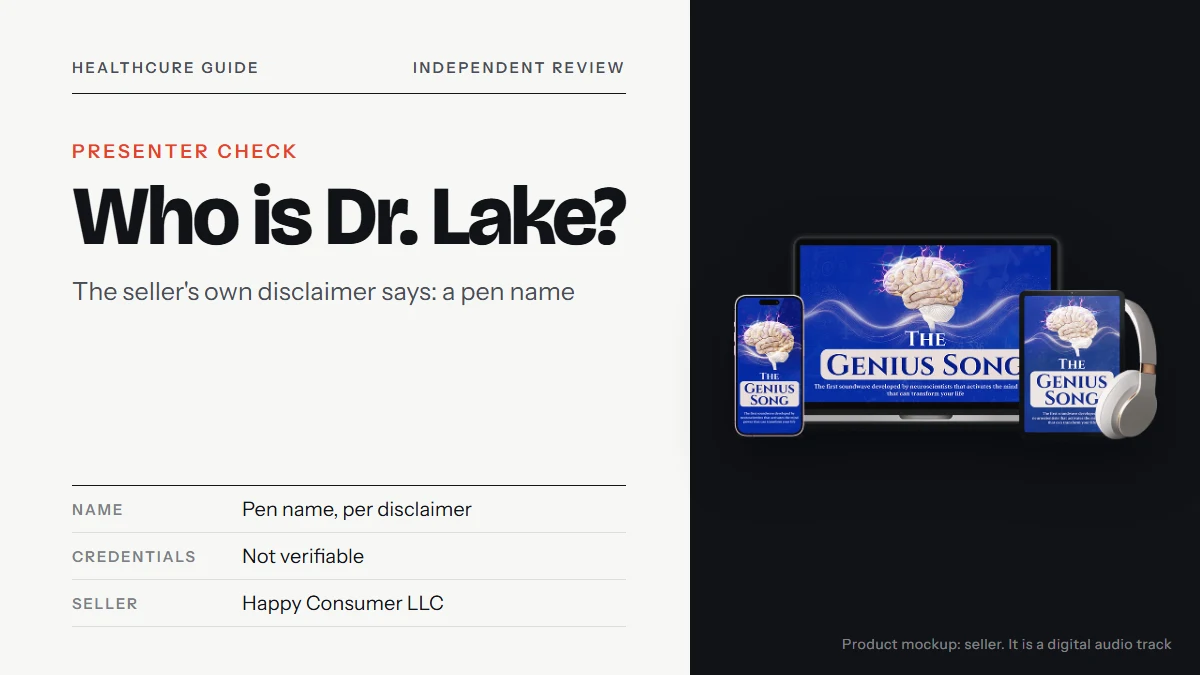
Searches for the Genius Song by Dr. Lake usually come from people who watched the video and want to know who is talking to them. The honest answer is short: by the seller’s own account, the name is a pen name. This page sets out exactly what the disclaimer says, what the pitch claims about the man behind the pen name, and how the scientific stories in the presentation hold up.
HealthCure Guide is an independent site and is not the seller. We did not buy the track. The pages, the 39-minute sales video and the Terms were reviewed on 2026-10-09.
The Genius Song by Dr. Lake: what the pen name disclaimer says
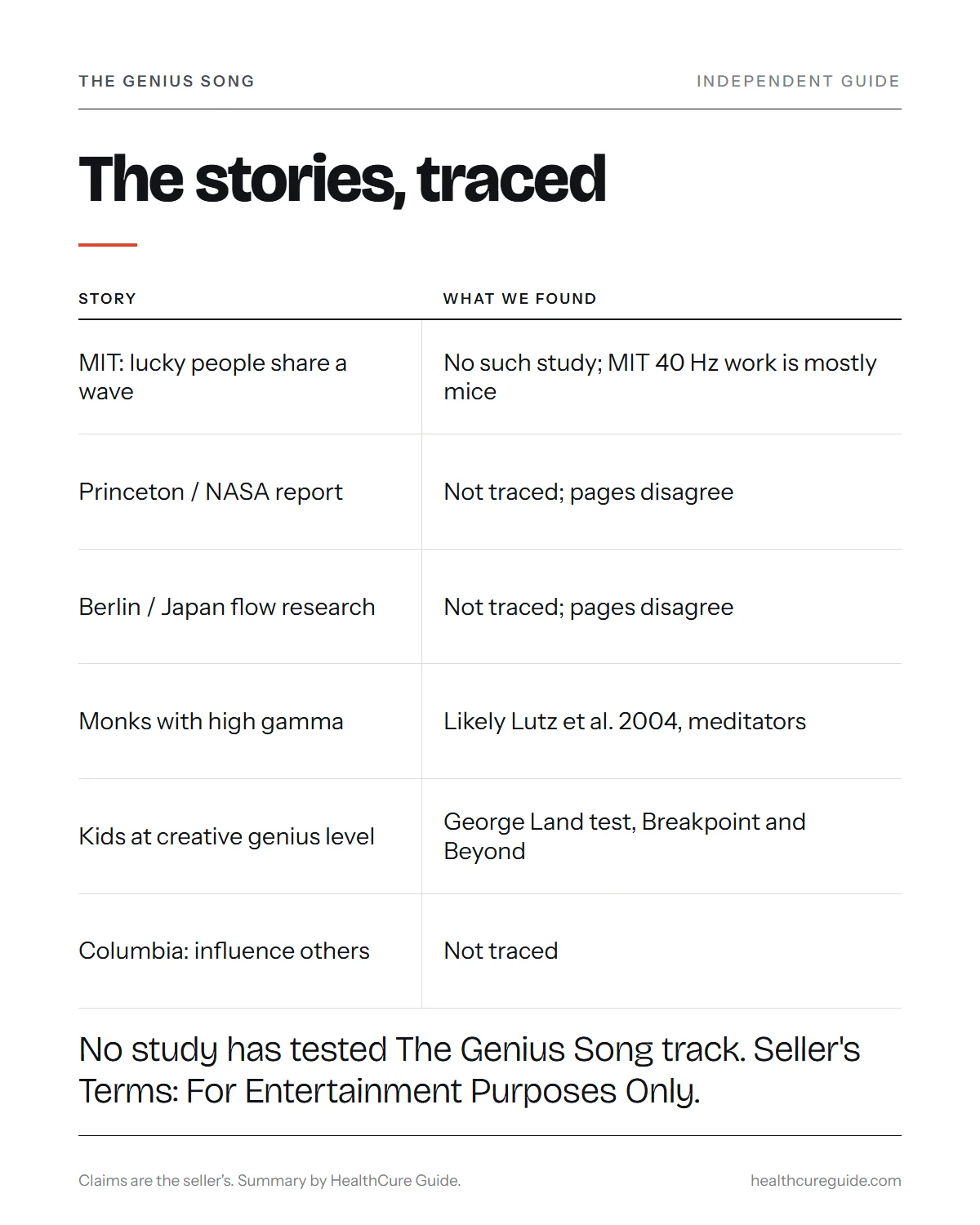
The footer on the seller’s /video/ page, repeated on the /text/ page, contains one sentence that changes how the whole presentation should be read. In it, the seller labels “Robert Lake” a pen name. The same line says that this neuroscientist, described only as “our leading” one, gave consent for it.
Three things follow from that sentence, and from the pen name it describes.
- The name is not a real person’s name. The seller says so itself.
- The real person is not identified. “Our leading neuroscientist” has no name, no institution and no publication list attached.
- Nothing about the presenter can be verified. Credentials, employers and research belong to a real identity, and that identity is withheld.
None of this is hidden in a separate legal page. It sits at the foot of the same pages that carry the video. It is simply easy to miss after a long presentation.
What the pitch says about the man behind the pen name
The video and the text page build an expert profile around the pen name. Here is each claim, where it appears, and whether it can be checked.
| Claim | Where it appears | Can it be checked? |
|---|---|---|
| Introduces himself as “doctor Robert Lake” (a pen name) | Video, about 1:43 | No: the disclaimer says the name is a pen name |
| “Top NASA Scientist” | Headline | No NASA role, project or date given |
| “NASA-Trained Neuroscientist” | /text/ page | No training record or institution named |
| Runs a “New York City clinic” | Video, about 17:59 | No clinic name or address anywhere |
| “Thirty four years as a neuroscientist” | Video, about 24:14 | No employer, papers or licence named |
We are not saying any single claim is false. We are saying that, with the real identity withheld, none of them can be confirmed, and a buyer should give them no weight.
Why a pen name changes how you read the video
Most of the persuasion in a long sales video rests on trust in the speaker. A named neuroscientist with a clinic and decades of work sounds like a reason to believe the science that follows. Once you know the name is invented, that support disappears, and each claim has to stand on its own evidence.
The pen name is also not the only stand-in on the page. The seller’s Terms say testimonial names “have been changed”, that the company uses pen names, that some marketing is dramatized, and that customer feedback may be performed by avatars or actors. The founders’ own circle (friends, family members, early backers) may be among those praising the track, some speakers were paid for it, and the outcomes described are, in the Terms’ word, exceptional. So both the expert and the customers you see may be presentations rather than independent voices.
The research stories, one at a time
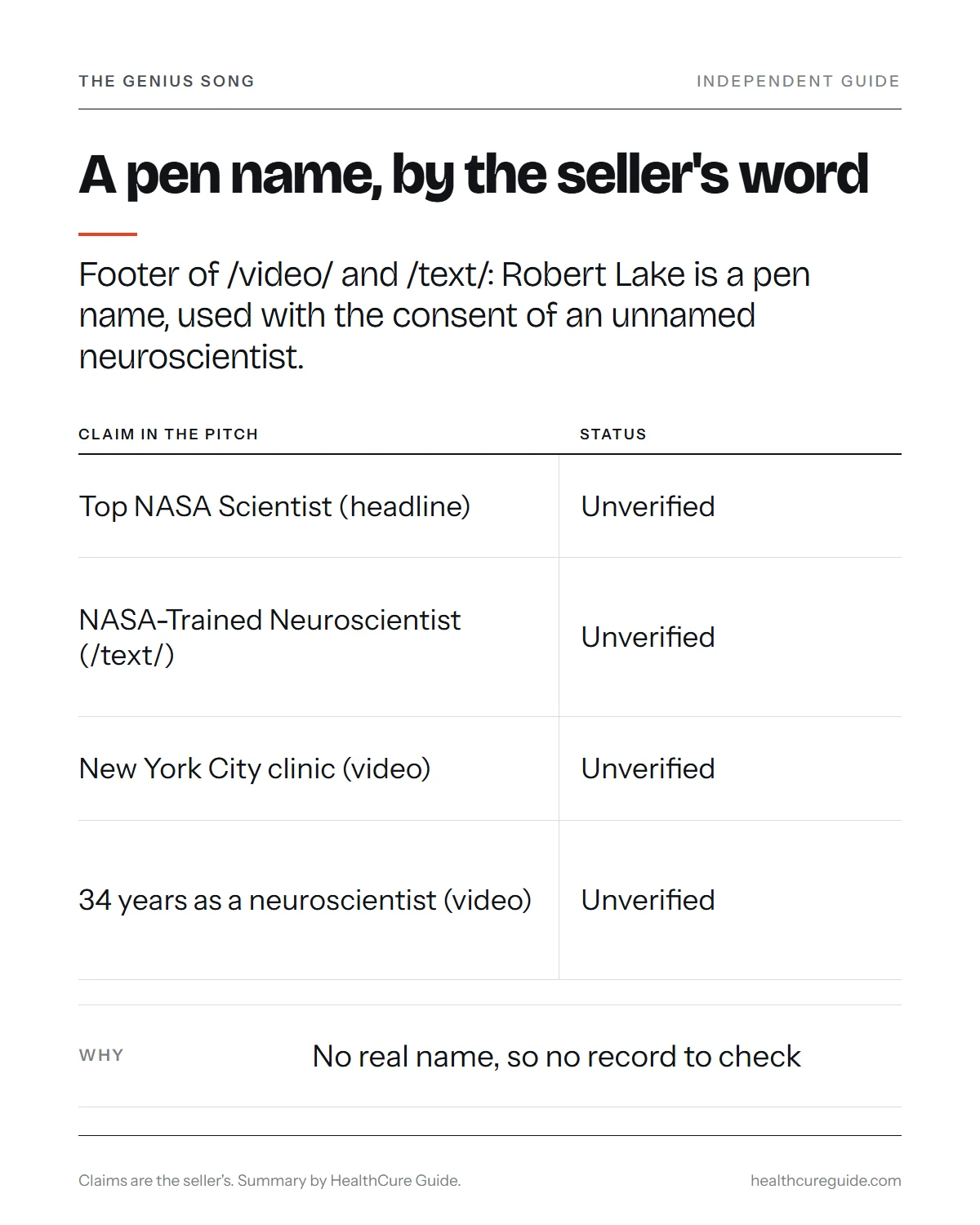
The presentation is built around a series of discovery stories. We checked what we could. Every story below is the seller’s statement.
| Story in the video | What we found |
|---|---|
| MIT found that “all lucky, wealthy, successful people” share one brain wave | No such study found. MIT’s 40 Hz research mainly involves Alzheimer’s mice and a handful of small human pilots |
| Claimed 2026 “discovery”, backed by Princeton and a paper said to date from 27 December 2025 | Not traced. The /text/ page tells the story with NASA in place of Princeton |
| A British double-blind study in which children knew who was calling | Not traced |
| Einstein Center Berlin linking flow states to gamma | Not traced. The /text/ page credits “colleagues in Japan” instead |
| Monks with unusual gamma activity | Likely a simplified version of Lutz and colleagues (2004, PNAS), who recorded strong gamma in long-term meditators |
| Children score at “creative genius” level, adults rarely do | Traces to George Land’s creativity test, described in Breakpoint and Beyond (1992); no peer-reviewed NASA paper found |
| Edison’s gamma device; billionaires rising at 4 AM for gamma; a Columbia finding that gamma “could influence another person” | Not traced |
Two patterns stand out. First, the video and the text page do not tell the same story: the institution changes from Princeton to NASA, and Berlin becomes Japan. Second, where a real study sits underneath a story, it is far narrower than the claim built on it.
What gamma research does show
The brain wave at the center of the pitch does exist. Gamma activity sits at the fast end of the spectrum, somewhere around 30 to 100 Hz, and scientists associate it with how the brain handles attention and memory. The most cited recent gamma work comes from the Tsai lab at MIT, which has exposed mostly mice, and a few people in small early trials, to 40 Hz flicker and tones as an Alzheimer’s research tool. It is about brain disease, not about intelligence, fortune or wealth.
Wider evidence on sound-based entrainment, binaural beats included, points in two directions. Pooling earlier trials, a 2019 meta-analysis saw a moderate overall benefit for some measures of thinking, anxiety and pain. Yet a 2023 systematic review counted more studies against actual brainwave entrainment than for it. No study has tested The Genius Song track.
The presenter’s own caveats
Even inside the pitch, the speaker using the pen name concedes some limits. After a story about winning at a casino, he says there is “of course, no evidence” that the track caused it. That is the most accurate sentence in the presentation about the size of the evidence.
At other moments the claims run the other way. The video says the track “starts working the very first time you listen”, that plenty of buyers feel a change after just two or three days, and that results generally follow within about two weeks of daily use. It ties the track to promotions, money, relationships, school grades, weight loss and quitting smoking. These are the seller’s claims; we found nothing that shows them.
The seller’s paperwork is more cautious than its pitch. A heading in the Terms reads “For Entertainment Purposes Only”, and beneath it the seller admits its own method is “not an exact science”. The site’s FDA line also makes clear it is not a treatment for any disease. Oddly, the same Terms also say the entrainment claims are “substantiated by established scientific research”, so the document contradicts itself.
Who is actually behind The Genius Song
If the presenter is a pen name, the accountable party is the company. According to the Terms, that is Happy Consumer LLC, a Puerto Rico business. The agreement falls under local Puerto Rican law, and its last revision is dated 20 January 2026. Sales run through ClickBank under the vendor ID geniusbr, and your card statement would read CLKBANK*Genius Song. Product support is at [email protected].
The same publisher sells another audio, The Genius Switch, under a separate ClickBank vendor ID. Both sites list the contact address [email protected].
Does any of this matter if you just want the audio?
It depends on why you are buying. If you want to try a short daily audio as a personal experiment, the identity of the speaker matters less than the purchase terms. Those terms are clear: $39 plus local tax, sold through ClickBank, and a refund on digital products requested within 90 days under both the Terms and ClickBank’s checkout.
Some practical points before you pay:
- Where it is sold. Our link opens the seller’s front page, which when we checked was advertising a different audio from the same company, The Genius Wave. The Genius Song presentation, pen-name disclaimer included, is on the /video/ page of that site, with a written version at /text/. Make sure the ClickBank item line names The Genius Song.
- The refund route. Ignore the site’s /TOS/refunds/ page. Its text concerns returning NeuroActivate bottles to Ohio within 60 days, which has nothing to do with a digital track. Phone ClickBank on 1-800-390-6035 (or go to clkbank.com) and hold on to the receipt.
- The customer numbers. One page claims 18,366 helped, another headline 19,389. Neither total is independent; both are unverified seller figures that contradict each other.
- Listening safety, our advice. Set the volume low enough to be pleasant, keep it away from driving and machinery, and if epilepsy, earlier seizures or hearing difficulties are part of your history, ask your doctor before trying it.
Our take on the presenter
The seller has told you, in its own footer, that “Dr. Robert Lake” is a pen name. Take it at its word. That means treating the NASA, clinic and 34-year claims as part of a script, not as a résumé, and judging the research stories by what they actually trace to, which is far less than the video promises.
If you still want to try the track, do it for the right reasons: curiosity about a seven-minute listening habit, a fixed price, and a written refund window. Not because a named expert vouched for it, since the seller has confirmed that the expert’s name is a pen name.
Related reading
Common questions
Is Dr. Robert Lake a real scientist?
We cannot say, and neither can anyone reading the sales pages. The disclaimer in the footer of the /video/ and /text/ pages states that Robert Lake is a pen name, used with the consent of a neuroscientist the seller does not name. Without a real name there is no way to look up qualifications, publications or a professional licence.
Did the Genius Song presenter work at NASA?
The /text/ page calls him a NASA-trained neuroscientist and its headline says top NASA scientist, but no NASA role, project or date is given, and the name used is a pen name by the seller's own admission. We found nothing that confirms a NASA connection. Treat it as a marketing claim.
Does the presenter really run a clinic in New York City?
He says so in the video, at about the 18-minute mark, and he also mentions 34 years as a neuroscientist. No clinic name or address appears on the sales pages, the Terms or the checkout. Since the presenter's name is a pen name, there is no way to match the claim to any clinic record.
Who actually sells The Genius Song?
The Terms name Happy Consumer LLC, a company based in Puerto Rico, with Terms governed by Puerto Rico law. The product is sold through ClickBank under the vendor ID geniusbr. The same publisher is behind The Genius Switch, another audio product, which is sold under a different ClickBank vendor ID.
Is the MIT study about lucky, wealthy people real?
We found no published study showing that all lucky, wealthy or successful people share one brain wave. MIT researchers have studied 40 Hz light and sound stimulation, mostly in mice bred to model Alzheimer's disease, with small early human trials. That work is about brain disease, not about luck, money or IQ.
Are the people in the Genius Song testimonials using real names?
Not necessarily. The seller's Terms say names have been changed and pen names are used, that parts of the marketing are dramatized, that feedback may be acted out by avatars or actors, and that some testimonial givers were compensated or are connected to the founders. They also say the results shown are not typical.
Can I contact the presenter with questions about the track?
The sales pages offer a product support address, [email protected], which is the seller's general contact. We found no personal contact for the presenter, which fits a pen name. Billing and refund questions go to ClickBank instead, by phone at 1-800-390-6035 or through clkbank.com.