The Genius Song Gamma Waves: What the Research Shows
The sales video calls gamma the super brain wave and says a 7-minute track can switch it back on. We set the pitch next to what gamma research has actually looked at, in plain words and without promises.
- Written by
- HealthCure Guide Editorial Team
- Reviewed by
- HealthCure Guide Editorial Team
- Updated
- Reading time
- 10 min read
This guide contains affiliate links. If you buy through them we earn a commission at no extra cost to you. It does not change the verdict. Disclosure.
People who search for the genius song gamma waves usually want one thing: to know whether the science in the sales video holds up. This page answers that in neutral terms. We explain what gamma is, what the main lines of gamma research have tested, what the seller says, and where the two stop matching. We did not buy the track and we report no results of our own. Readers new to the product can start with our plain explainer; for the full verdict, read our editorial review.
Product details here were checked on 2026-10-09 against four seller sources: the sales video, its text page, the Terms and the ClickBank checkout. The research summary is our own and kept deliberately short.
Gamma waves in plain terms
Your brain cells work partly through electrical activity. When many cells fire in step, the activity forms rhythms that an EEG can pick up from sensors on the scalp. Researchers sort those rhythms into bands by speed.
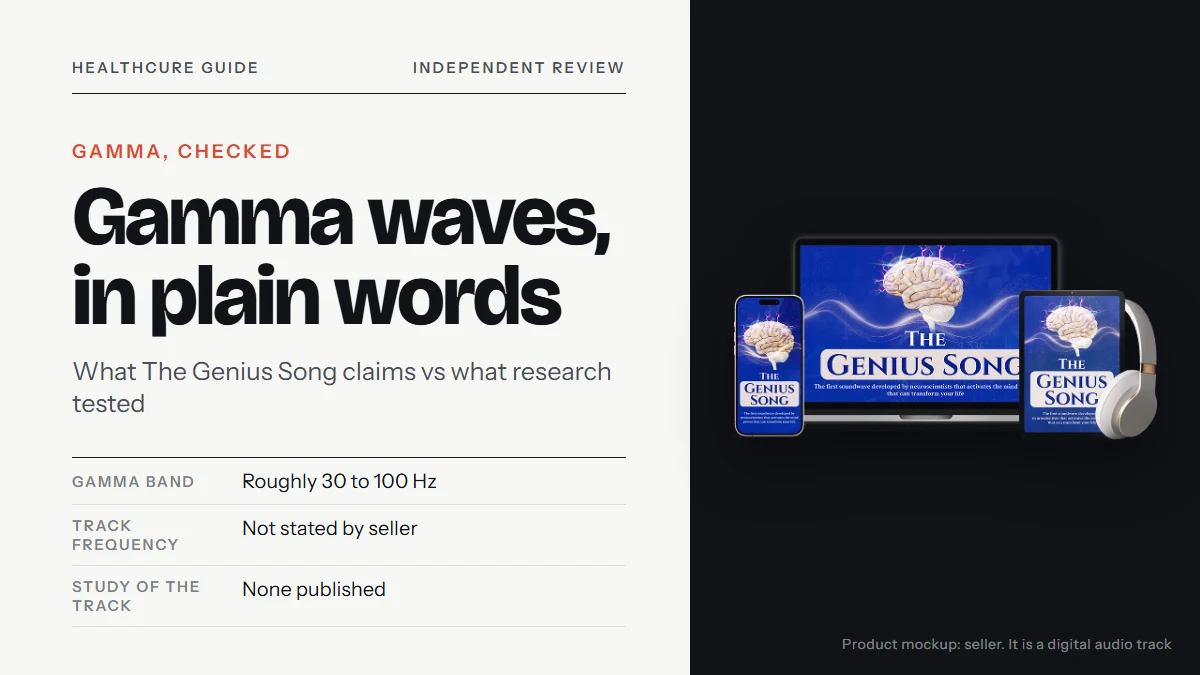
Gamma is the fastest band in common use, roughly 30 to 100 cycles per second (Hz). In research it is linked to attention and memory processing, the moment-to-moment work of holding information and pulling it together. Theta is a slower band, and it matters here only because the seller’s other audio product, The Genius Wave, is pitched as theta.
Three things are worth keeping in mind:
- Gamma is normal. Everyone’s brain produces it. It is not a hidden power that switches on or off.
- A rhythm is a measurement, not a goal. Finding more gamma during a task does not mean that adding gamma would improve the task.
- “Linked to” is not “causes”. Most findings are associations seen in the lab.
The Genius Song gamma waves claim, in the seller’s words
The sales video, about 39 minutes long, builds its whole pitch on gamma. Here are its main statements next to what we could check.
| What the video says | What we found |
|---|---|
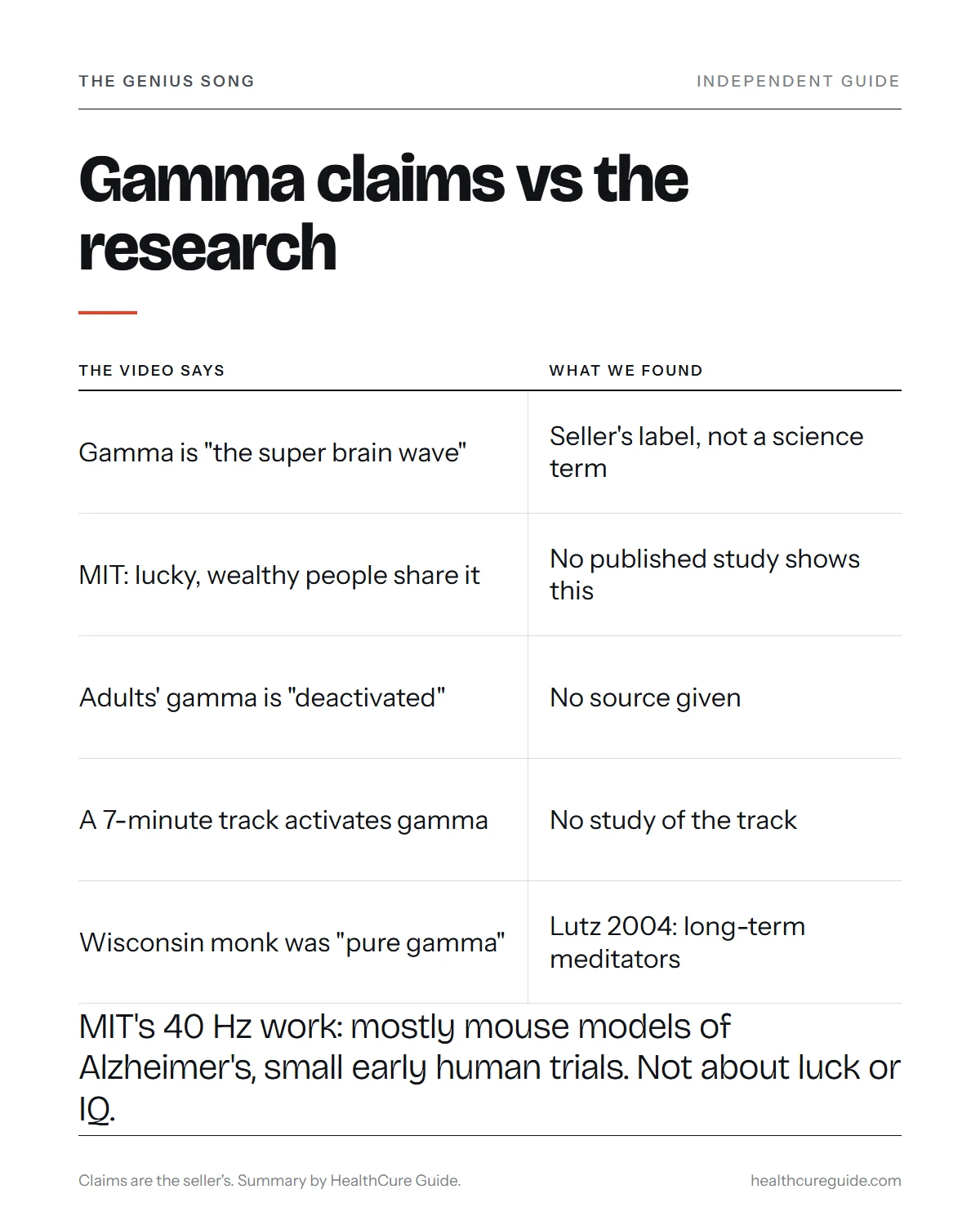
| Gamma is “the super brain wave” | The seller’s label, not a scientific term |
| Adults’ gamma is “dormant” or “deactivated” by modern life | No source given; we found none |
| MIT supposedly showed that “lucky, wealthy, successful” people all share one wave | We found no study saying so |
| A “brand new discovery in 2026” | Not identified; no paper named |
| Brain entrainment can “activate gamma by connecting several regions of your brain” | No study of the track itself |
| Columbia University research shows gamma “could influence another person” | Unverified seller statement |
| Einstein Center Berlin linked flow to gamma | Unverified seller statement |
According to the video, a normal entrainment session lasts an hour, and the team compressed that hour into a 7-minute sound wave. How that compression works is never explained. The hook also promises a “seven second” brain trick, but what is sold is a 7-minute track, and the video never shows a separate 7-second trick.
No frequency on the page
This is the detail that matters most for a gamma question. We searched the video captions and the text page for any frequency in hertz and found none. The seller does not say the track runs at 40 Hz, does not say it uses binaural beats, and does not describe the sound at all beyond “sound wave” and “brain entrainment”. Oddly, the sales page’s 14 references lean on theta research, general entrainment papers and popular creativity pieces (Inc.com, Medium, a TED talk), and the very same list sits on the seller’s Genius Wave page.
What the 40 Hz research actually tested
When people hear “gamma” and “MIT” together, they are usually thinking of the work from the Tsai lab. Here is that work in one paragraph.
Researchers there have exposed mice bred to model Alzheimer’s disease to light and sound flickering at 40 Hz, and have begun small early trials in humans. The questions were about brain processes involved in that disease. The stimulation followed set lab protocols. The work is still at an early stage in people.
What it does not cover
- It was not about IQ, creativity, luck, money, relationships or weight.
- It did not test any commercial download, including this one.
- It did not show that healthy adults are short of gamma and need more.
- Early human trials are small, and small trials can point in a direction without settling anything.
So the honest link between MIT and The Genius Song is thin. Both involve the word gamma. One is a research program in disease models; the other is a $39 audio track whose frequency the seller does not state.
Meditators, monks and a simplified story
The video mentions researchers in Wisconsin who studied a monk and found his brain was “pure gamma wave”. That is most likely a simplified version of a real study.
In 2004, Lutz and colleagues at the University of Wisconsin published a paper in PNAS that recorded high-amplitude gamma activity in long-term meditators. The key words are long-term. These were people with years of practice, measured in a lab during meditation.
What the study supports:
- experienced meditators can show strong gamma activity while they meditate
What it does not support:
- that gamma explains happiness, luck or success
- that a recording can produce the same pattern in someone without that practice
- that a short daily track can stand in for years of training
The video itself lists meditation as one of four ways to raise gamma, then sets it aside as “very hard and time consuming” before offering the track as the easy option. That is a sales move, not a research finding.
Brain entrainment and what the reviews say
“Brain entrainment” means using a rhythmic stimulus, often sound, to nudge brain activity toward a rhythm. Binaural beats are the best-known version.
Taken together, the research on binaural beats points in more than one direction. A 2019 meta-analysis in the journal Psychological Research pooled the available studies and reported a medium overall effect on some outcomes, such as measures of cognition, anxiety and pain. A 2023 systematic review asked something narrower: do the beats really pull brainwaves toward the intended rhythm? In the majority of studies it examined, that shift did not appear. The Genius Song itself was outside both papers, and we know of no published test of it.
So the picture is mixed: some pooled effects on how people perform or feel, and weak support for the idea of steering the brain into a chosen rhythm, which is the very thing the video promises for gamma. Either way, it is a long way from the outcomes the video lists.
What no one has shown
The video attributes a long list of results to raising gamma with the track. All of them are unproven seller claims. Here they are, grouped, with what we could find.
| Claimed outcome | Evidence we found |
|---|---|
| Eureka moments and problems solved “with little to no effort” | None for this track |
| Faster learning and better memory | Mixed research on beats in general; none for this track |
| Luck, synchronicities, money, promotions | None |
| Weight loss, quitting smoking | None; it is not a treatment |
| Migraines and joint pains going away | None; it is not a treatment |
| Results “the very first time you listen” | None |
A related favorite of this genre, that 98% of young children test at “creative genius level”, comes from George Land’s creativity test and his 1992 book Breakpoint and Beyond. A peer-reviewed NASA paper with those numbers is something we could not find.
Even the video concedes the point once. After a story about casino winnings, the presenter admits there is “no evidence to support” that the track was the cause. It is the most accurate line in the whole presentation.
Who is making the gamma claims
The science in the video comes from a presenter billed as Dr. Robert Lake, which the footer disclaimer on the seller’s pages identifies as a pen name. According to that footer note, the seller’s lead neuroscientist agreed to the use of this pen name. The text page describes him as NASA-trained, while the video adds a clinic in New York City plus a career of more than three decades. Because the name is a pen name, none of that can be checked, and we do not treat it as fact.
The Terms add their own framing. A section headed “For Entertainment Purposes Only” warns that brain entrainment “is not an exact science”, then states the products are “provided for entertainment purposes only”. Yet the same Terms also insist that what they say about entrainment, focus and mental energy rests on “established scientific research”. Both lines sit in one document; a reader can weigh them.
Stories and numbers
The video features customer stories and colleague anecdotes. According to the Terms, the seller changes names, uses pen names and dramatizes parts of its marketing; feedback may be performed by avatars or actors; some featured people were paid or know the founders; and the stories are exceptional results, not typical ones. We do not treat them as independent reviews. The seller’s customer counts are its own and do not match: 18,366 in the video and the text page body, 19,389 in the text page headline. Neither is verified.
If you still want to try a gamma track
Some readers will want to try it anyway, as a calm 7-minute habit. That is a reasonable personal choice if you go in with the right expectations. A few practical points first.
Where the link goes
Our link lands on the official site’s home page, which at the moment advertises The Genius Wave, a separate audio from this seller. If you want the Song’s own presentation, it is on the /video/ page of that same domain. Do not mix the two up: per the seller’s own pages, the Wave runs 12 minutes and targets theta, while the Song runs about 7 minutes and targets gamma. Make sure the checkout names The Genius Song before you pay.
Price and refund
The order box shows $39, with $200, $100 and $49 as reference prices. ClickBank handles checkout and may show local currency and tax. The Terms give a 90-day refund window for digital products, and the ClickBank checkout states 90 days as well. The site’s separate refund page, /TOS/refunds/, is a leftover policy written for NeuroActivate bottles; for an audio track, ask ClickBank for the refund and keep your receipt. The track arrives digitally; the seller describes both an emailed download and an online audio portal, and it does not state the file format.
Listen safely
This is our advice, not the seller’s:
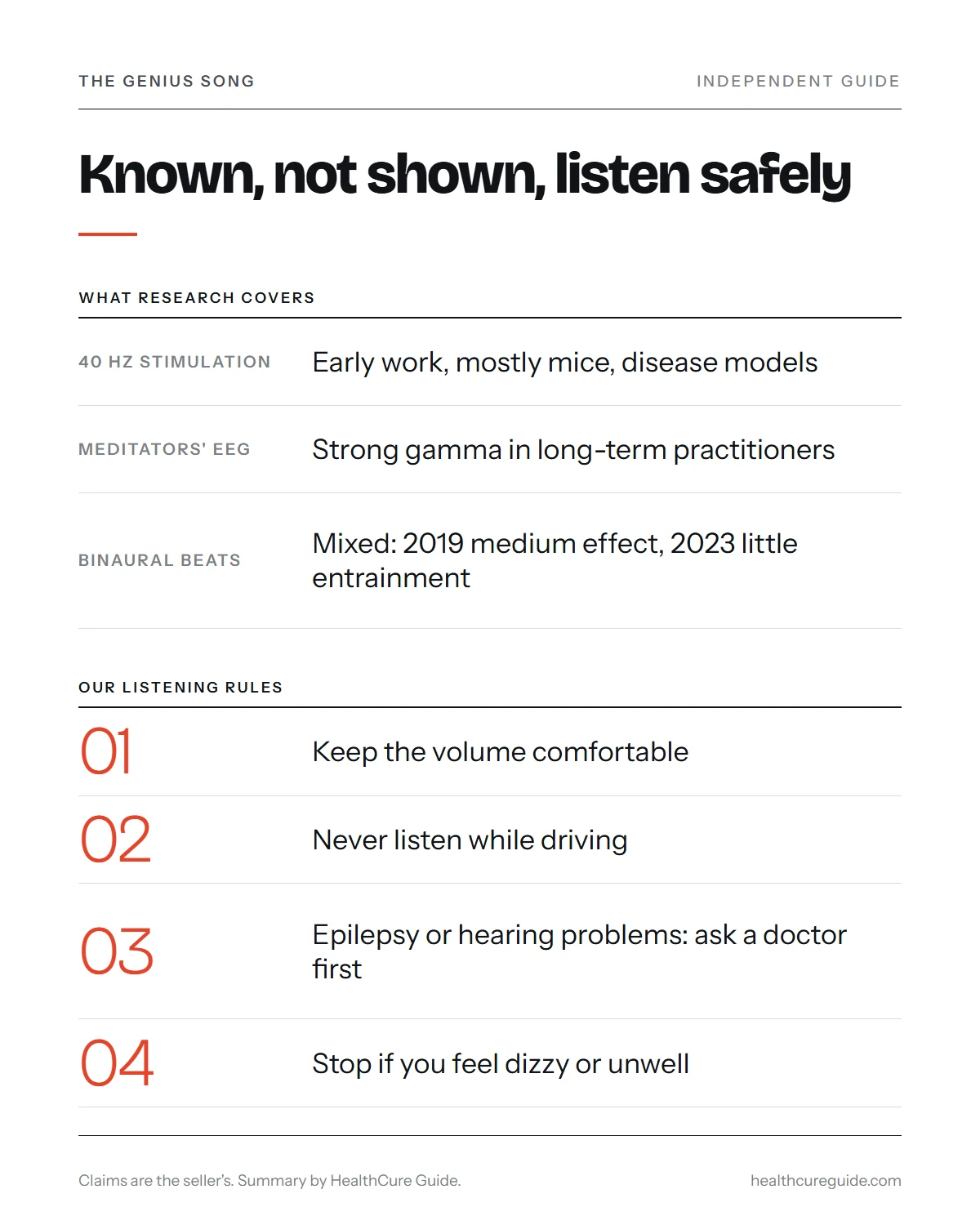
- Keep the volume comfortable, low enough to hear someone speak to you.
- Never listen while driving or operating machinery.
- Talk to a doctor before the first session if you have had seizures or epilepsy, or have trouble with your hearing.
- Stop if you feel dizzy, get a headache or feel unwell.
Our take on the gamma science
Gamma waves are a real and active research topic. The 40 Hz work is interesting, but it is early, it is mostly in mice, and it is about disease models, not about success. The meditator studies describe trained practitioners, not listeners of a short recording. Binaural beat research is mixed, with a medium pooled effect on some outcomes in one 2019 analysis and little sign of real brainwave entrainment in a 2023 review.
The Genius Song borrows the vocabulary of that research without stating what its own track contains. The seller’s Terms call the product entertainment, and the site says it is not intended to diagnose, treat, cure, or prevent any disease. If you buy it, buy a 7-minute listening ritual with a 90-day refund window, not a gamma upgrade.
This guide is for information only and is not medical advice. Our methodology explains how we review products.
Common questions
What frequency does The Genius Song track use?
The seller does not say. Neither the sales video nor the text version of the sales page names a frequency in hertz, and the seller does not say whether the track uses binaural beats or another kind of entrainment. We did not buy or analyse the track, so we cannot tell you what is in the file.
Is gamma the same as the 40 Hz sound people talk about?
Not exactly. Gamma is a range of fast brain rhythms, roughly 30 to 100 Hz. 40 Hz is one frequency inside that range, and it is the one MIT researchers used in their light and sound stimulation work, mostly in mice. A product that mentions gamma is not automatically using 40 Hz, or any tested protocol.
Did MIT find that successful people share one brain wave?
We found no published study showing that all lucky, wealthy or successful people share one brain wave, which is what the video opens with. The MIT gamma work we know of tested 40 Hz light and sound stimulation, mainly in mouse models of Alzheimer's disease, with small early human trials. It was not about luck, money or IQ.
Can a gamma audio track help with Alzheimer's or memory loss?
No product track has been shown to do that, and The Genius Song is not a treatment. The site itself says it is not intended to diagnose, treat, cure, or prevent any disease. The 40 Hz research is still early and was run under lab protocols. Anyone worried about memory should talk to a doctor.
Do meditators really have more gamma activity?
A 2004 study by Lutz and colleagues at the University of Wisconsin, published in PNAS, recorded high-amplitude gamma activity in long-term meditators. It describes experienced practitioners in a lab. It does not show that a short recording can produce the same brain activity in someone who has never meditated.
Why does the seller's reference list mention theta if the song is about gamma?
We cannot say why. The 14-item reference list on the sales page cites theta and general entrainment studies plus creativity articles, and it is the same list the seller uses for its other audio, The Genius Wave. The video itself is about gamma. We report the mismatch as a fact and leave the reasons to the seller.
Is a gamma wave track safe to listen to?
For most people ordinary audio is low risk, but we suggest a few rules for any entrainment product: keep the volume comfortable, never listen while driving or operating machinery, and ask a doctor first if you have a history of epilepsy or seizures, or a hearing problem. Stop if you feel dizzy or unwell.