The Genius Song Review: Our Full Editorial Verdict
A short daily audio track, a long sales video, a pen-name presenter and a 90-day refund. We read every page the seller publishes, its Terms and the ClickBank checkout, and weighed the claims against published research.
- Written by
- HealthCure Guide Editorial Team
- Reviewed by
- HealthCure Guide Editorial Team
- Updated
- Reading time
- 10 min read
This guide contains affiliate links. If you buy through them we earn a commission at no extra cost to you. It does not change the verdict. Disclosure.
This is The Genius Song review we would want to read before spending money: what the purchase contains, how the seller persuades people to make it, which claims hold up, what the refund really covers, and who should pass. If you mainly want to know how to judge the testimonials, our separate guide to The Genius Song reviews focuses on that.
HealthCure Guide is independent and is not the seller; links on this page can pay us a commission. We have not bought the track. Our sources are the official site’s sales pages, the 39-minute sales video and its captions, the Terms of Sale and the ClickBank checkout, checked on 2026-10-09.
The Genius Song review at a glance
| Question | Short answer |
|---|---|
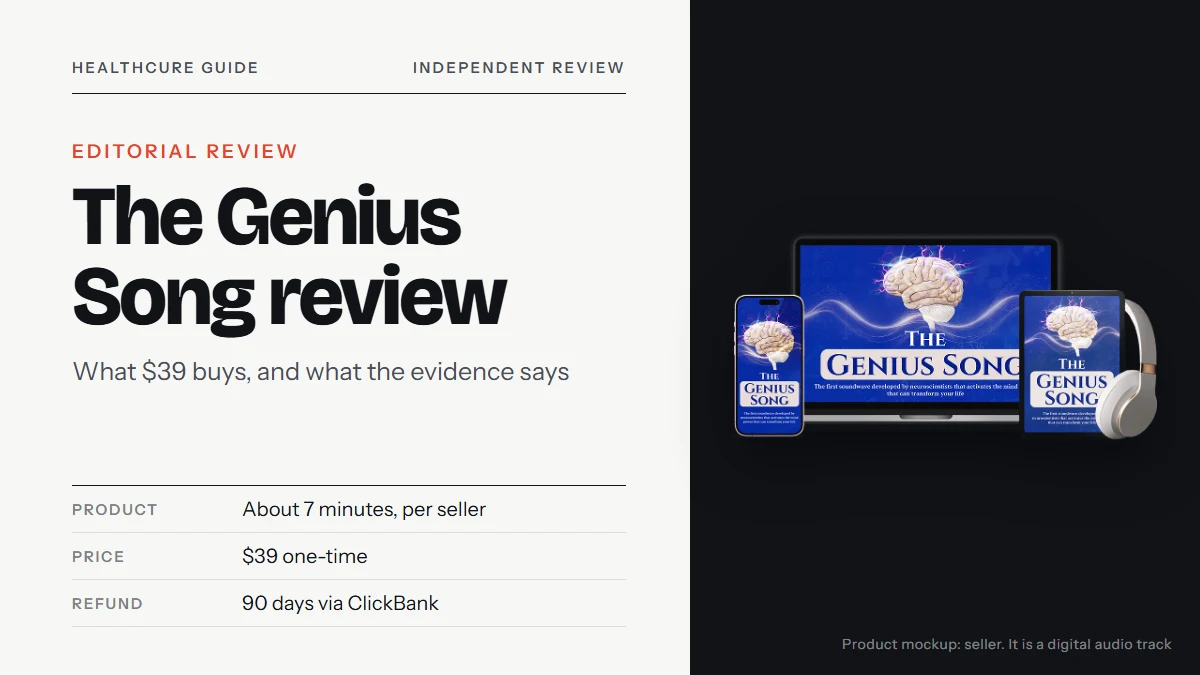
| What is it? | One short audio file, pitched as a “sound wave” |
| Length | About 7 minutes, per the seller (we could not time it) |
| How to use it | Headphones on, eyes closed, once a day |
| Price | $39 one-time; local currency and tax outside the US |
| Retailer | ClickBank; statement shows CLKBANK*Genius Song |
| Refund | 90 days, per the Terms and the checkout |
| Seller | Happy Consumer LLC, Puerto Rico |
| Evidence | No published study of this track |
What you get for $39
The core product is one audio track. In the video, the presenter says his team turned an hour of brain entrainment into a sound wave of about seven minutes and called it The Genius Song. You are told to put on headphones, close your eyes and listen once a day, and that skipping a day is fine.
Delivery is where the seller’s pages disagree. In the video, the track lands in your inbox minutes after payment, ready to save on a phone or computer. The written sales page tells another story: a “Private Audio Portal”, a login sent to you, and streaming on whatever device you like. Its FAQ, though, drifts back to downloading. From outside, there is no way to tell if you get a file, a portal login or the pair. No file format is named anywhere on the seller’s pages.
The bonuses also vary by page. In the video the count is “three free bonuses”, yet four get described: The Genius Child (an audio meant for kids’ focus), a free copy of a money classic more than 100 years old, a visualization session from a creator known on Calm, and a one-page sheet of five daily habits. The text page puts the gifts at “$197.00” and says four, then shows only the book, something it names “Genius Visualization” and a printable titled “Create Your Ideal Future”. No children’s audio appears there.
It is not an app, a game or a streaming release. By the presenter’s account, his own website is the one place to get it; audio posted under similar names on YouTube or Spotify, he says, is a different thing.
How it is sold
The sales video runs 39 minutes. Its presenter uses the pen name Dr. Robert Lake; the site’s own disclaimer, in the footer of the sales pages, says so and describes him as a neuroscientist who consented to the name. The video and text page attach a NASA connection, a New York City clinic and 34 years of neuroscience to that pen name. We cannot verify credentials attached to a name the seller says is not real.
The pitch follows a familiar pattern:
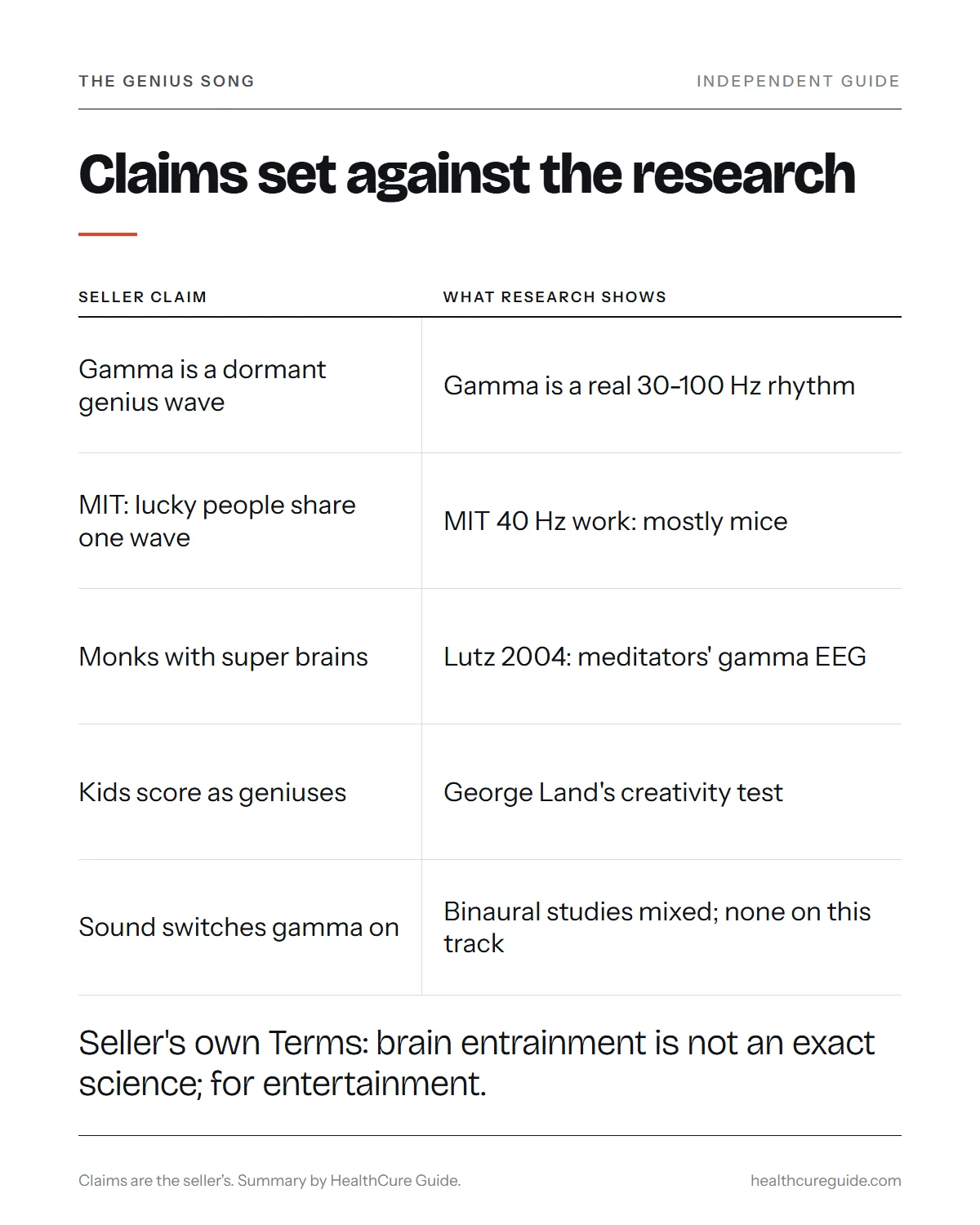
- A hook. A “seven-second brain trick” tied to Nikola Tesla, and a claim that MIT found all lucky, wealthy and successful people share one brain wave.
- A villain. Modern life has supposedly left the adult gamma wave dormant.
- The fix. A short sound wave that is said to switch gamma back on.
- Proof by story. Customer and colleague anecdotes covering money, promotions, grades, relationships and health.
- Urgency. The $39 price is “not guaranteed beyond today”, a held order could be handed to another shopper if you leave, and there is talk of a waiting list.
On the /video/ page, the order button stays hidden until roughly the 18-minute mark of the video. None of the urgency lines are facts about stock; a digital file does not run out.
The claims, set against the evidence
The video piles up research claims. It cites an MIT finding about successful people, bills the gamma idea as a “brand new discovery in 2026” too, then points to Princeton and to a paper it dates to 27 December 2025. It adds a British double-blind study about children, an institute in Berlin linking flow to gamma, and Columbia University work on gamma influencing other people. The text page tells a similar story with NASA in place of Princeton. We could not match these descriptions to published work, and they are the seller’s statements.
What published research does show is more modest:
- Gamma is real. Gamma waves are fast brain rhythms, roughly 30 to 100 Hz, associated in studies with attention and memory processing.
- The MIT 40 Hz work. Tsai’s lab flickered light and played 40 Hz tones, chiefly to mice bred to model Alzheimer’s, and has run a few small first trials in people. Luck, IQ and income are not part of it.
- Meditators. A 2004 study by Lutz and colleagues recorded unusually strong gamma activity in long-term meditators. The video’s story about monks seems to be a simplified version.
- Sound-based entrainment. The binaural beat literature is split. Pooling binaural studies, a 2019 Psychological Research meta-analysis put the overall effect in the medium range for some measures of thinking, anxiety and pain, while a 2023 systematic review found that most entrainment studies it examined failed to show the expected brainwave change. Nobody has studied this track.
- Creative genius figures. The “98% of children” numbers trace to George Land’s creativity test and the 1992 book Breakpoint and Beyond, not to a peer-reviewed NASA paper.
There are also oddities on the site itself. The browser tab of the /video/ page reads “The Gamma Song”. The footer says copyright 2023 while the video calls the discovery new in 2026. Its 14 references lean on theta research, broad entrainment papers and a few creativity pieces, and the same 14 sit on the seller’s Genius Wave page, although this pitch is all about gamma.
Price, refund and the leftover refund page
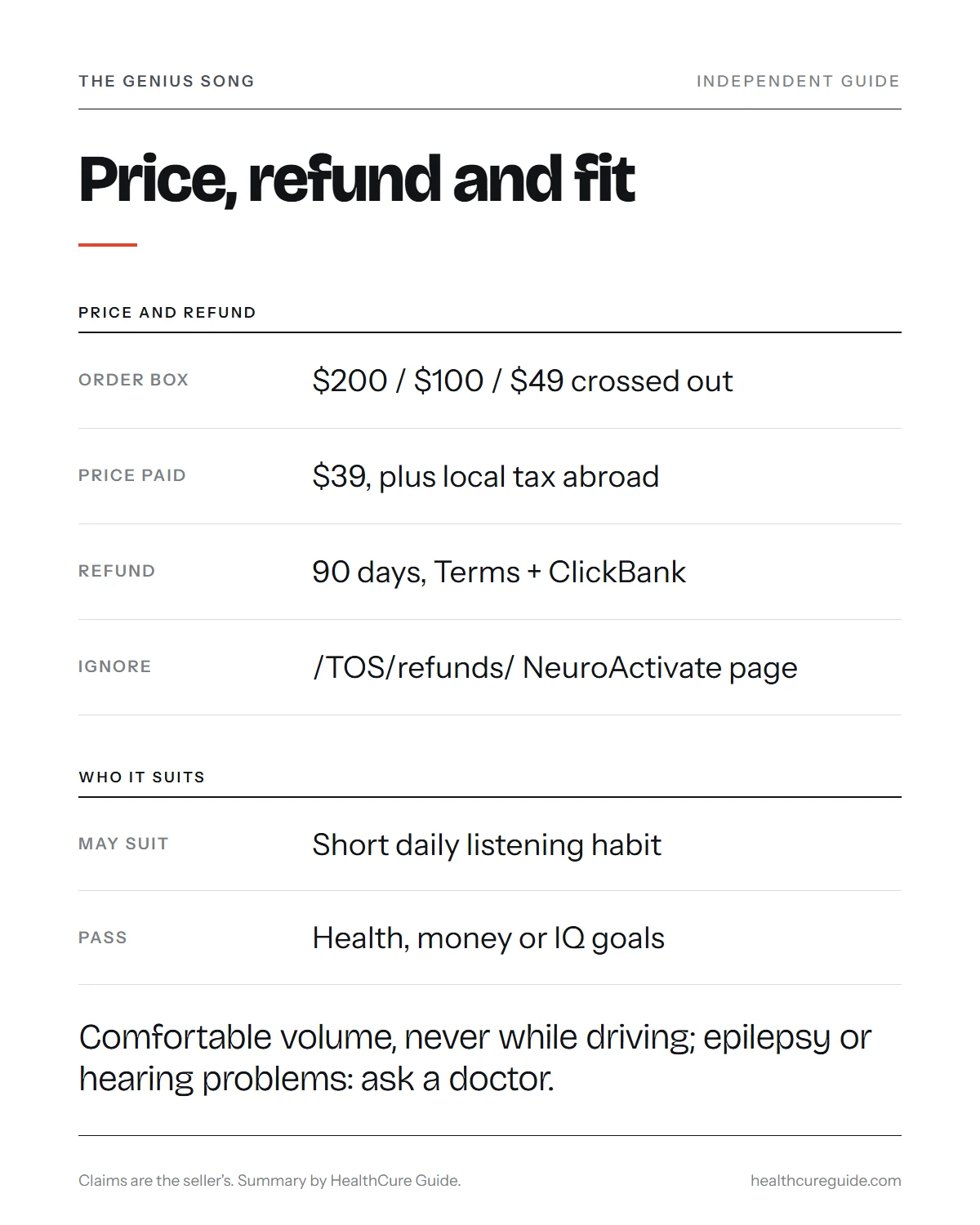
The order box shows “Regular Price” figures of $200, $100 and $49 crossed out, then “Today Just For $39”. The video first mentions $49 and then drops to a “special” $39. The Terms of Sale state you are paying $39. Shoppers outside the US see their own currency plus their own tax; our check from India came to roughly ₹4,965 all in.
The refund side is the product’s strongest point, with one caveat:
- Under the Terms, a refund on a digital product can be requested up to 90 days after you first bought it.
- The ClickBank checkout allows a return or replacement within 90 days.
- The video calls it an “ironclad” guarantee without naming a number of days.
The caveat: click the site’s /TOS/refunds/ page and you land on rules for a bottled product called NeuroActivate, a 60-day window for sealed bottles mailed back to Tallmadge, Ohio. An audio track has no bottle to return. Use ClickBank’s route, keep the receipt email with your order number, and call ClickBank order support on 1-800-390-6035 if needed. The Terms also contain a shipping policy that cannot apply to a download.
Expect marketing mail afterwards. Ordering signs you up to lists from HappyConsumerPublishing.com, and those messages may pitch other sellers’ products on the law of attraction, numerology, astrology and similar themes. An unsubscribe link sits in each one.
Where the official link takes you
The official site is geniussongoriginal.com. Our links send you to its home page, and at the moment that home page sells a sister product from the same seller: The Genius Wave, a 12-minute theta audio, also $39. For The Genius Song you need the site’s /video/ page (or /text/ for a written version). Do not treat the two as one product; before paying, make sure the checkout line names “The Genius Song”.
Fine print worth knowing
Two lines in the Terms deserve a careful read. One section is titled “For Entertainment Purposes Only” and calls brain entrainment “not an exact science”. Another asserts that research substantiates every claim it makes on entrainment, focus and mental energy. The two lines share one document, last updated 20 January 2026.
The testimonials come with their own warning. The Terms say names are changed, scenes may be dramatized or acted by avatars, some people featured have personal or financial ties to the founders, and the stories describe exceptional results. Even the customer tally shifts. The video says 18,366 people, the top of the text page says 19,389, and neither has any outside check, so we treat both as unverified seller figures.
A boilerplate FDA-style footer also appears with the words “not intended to diagnose, treat, cure, or prevent any disease”.
Who it suits and who should pass
It may suit you if
- You like short guided or ambient listening sessions and want a seven-minute daily habit.
- You treat $39 as a small experiment and will put the 90-day refund deadline in your calendar.
- You can set the sales stories aside and judge the track on how it feels.
Better to pass if
- A health worry is behind your search, from migraines to pain, smoking or weight. That is a job for a doctor.
- You are counting on more money, luck or a higher IQ.
- You need proof before you buy. None exists for this track.
If you do try it, our own safety advice: keep the volume low enough to be comfortable, save it for when you are not driving or running machinery, and check with a doctor beforehand if seizures, epilepsy or hearing loss are part of your history.
Our verdict in words
The transaction is easy to describe: a brief track at $39 (more abroad once tax is added), sold by ClickBank, refundable for 90 days. The selling is where our confidence drops. A pen-name presenter, unverifiable research stories, testimonials the Terms say may be acted, two customer counts and a refund page for a different product all point to a heavy marketing operation rather than a careful one.
None of that proves the track is unpleasant or useless to listen to. It does mean the promised results are claims, not findings. If a brief daily listening ritual interests you, it is a modest, refundable test. If you want something that has been shown to work, this is not it. Our methodology explains how we reach verdicts like this.
Nothing in this review is medical advice.
Common questions
What exactly do you receive when you pay for The Genius Song?
The seller describes one short audio track, which it says runs about 7 minutes, delivered digitally with nothing shipped. The video says it arrives by email within minutes, while the text sales page talks about a Private Audio Portal with login details. Up to four digital bonuses are listed, but the list differs between those two pages.
Is the 7-second trick the same thing as the 7-minute track?
The video's opening talks about a seven-second brain trick and a seven-second morning ritual, but the product it sells is a track of about seven minutes. The video never shows a separate seven-second technique. We read the seven-second line as a hook rather than a description of what you get.
Does the research the video mentions support The Genius Song?
Not directly. Gamma rhythms are real and are studied in attention and memory research, and MIT's 40 Hz work has mostly involved mice with small early human trials. None of it concerns luck, money or IQ, and no published study has tested this particular track. The seller's MIT and Princeton stories are unverified claims.
Why does the buy button not appear right away on the sales video page?
The button on the /video/ page is set to appear only after about 18 minutes of the video have played. It is a common sales-page technique that keeps viewers watching the pitch. You do not have to watch the whole video to check the price, the Terms or the refund rules.
Is the $39 price really a discount from $200?
The order box shows $200, $100 and $49 crossed out above a $39 price, and the video calls $39 a special price only available through it. We have no evidence the track ever sold at $200. Treat the higher figures as the seller's own reference prices and $39 as the actual price.
Who sells The Genius Song?
The Terms name Happy Consumer LLC, based in Puerto Rico, with Puerto Rico law governing the sale. ClickBank processes the order under the vendor ID geniusbr. Happy Consumer also publishes The Genius Switch, another audio product, and buyers must be 18 or older.
Who is The Genius Song a poor fit for?
Anyone hoping for a fix for a health problem, a way to make money or a guaranteed change in memory or focus. The seller's own Terms frame it as entertainment. It also suits nobody who dislikes headphone audio or who would forget to request a refund within 90 days.