The Genius Song Reviews: Testimonials vs Real Feedback
Almost every opinion you can find about this audio track traces back to the seller's own sales video. We separated the marketing stories from anything a buyer could actually check, and read the fine print that explains how those stories were made.
- Written by
- HealthCure Guide Editorial Team
- Reviewed by
- HealthCure Guide Editorial Team
- Updated
- Reading time
- 9 min read
This guide contains affiliate links. If you buy through them we earn a commission at no extra cost to you. It does not change the verdict. Disclosure.
People who search for the genius song reviews usually want one thing: to hear from someone who paid $39 and listened. That is hard to find, because most of what exists online is either the seller’s marketing or pages that repeat it. This guide sorts the material into what came from the seller, what the seller’s fine print admits about it, and what anyone can verify before paying.
This site is independent of the seller. If you order through one of our links, a commission may come our way. We never purchased the track ourselves. Everything below comes from the official sales pages, the sales video, the Terms of Sale and the ClickBank checkout page, all read on 2026-10-09.
Where The Genius Song reviews come from today
There are three kinds of material that show up when you look for opinions on this product, and they are not equal.
| Source | Who produced it | How much weight to give it |
|---|---|---|
| Stories in the sales video | The seller | Very little; the Terms describe how they were made |
| Customer counts and “five-star” claims | The seller | None until an outside source is shown |
| Write-ups on review sites | Third parties, often paid per sale | Check whether they add anything the seller did not say |
| A buyer’s own account with details | A real customer | The most useful, and the rarest |
The first two rows dominate. They are not reviews in the usual sense, because the person telling the story is also the person selling the product. The third row includes sites like ours. We explain our own incentive above, and you should expect the same honesty from any page you read. If you want our assessment of the track and offer rather than the testimonials, read our companion page, The Genius Song review.
The testimonials inside the sales video
The sales video runs about 39 minutes. Customer stories appear throughout it, and they cover a very wide range of outcomes. According to the seller, listeners describe sudden ideas and eureka moments, faster learning, better memory, lucky coincidences, promotions, money, closer relationships and children doing better at school.
The presenter also tells stories about his colleagues: a book finished, a son’s grade rising from a C to an A, an engagement after a chance meeting in a grocery store, and a promotion with a signing bonus. Health outcomes appear too, including weight loss, quitting smoking, migraines fading and joint pain easing.
Three named customers get longer segments, and the FAQ section on the text version of the sales page attributes its questions to people with first names and home cities. We are not repeating those names here. The reason is in the next section.
The presenter does say one candid thing. Recounting how one listener won money gambling, he concedes there is “no evidence to support” a link to the song. Apply that same caution to every other anecdote in the pitch.
What the Terms say about those stories
The Terms of Sale, last updated 20 January 2026, contain a passage on testimonials that changes how you should read the video. In plain terms, the seller says:
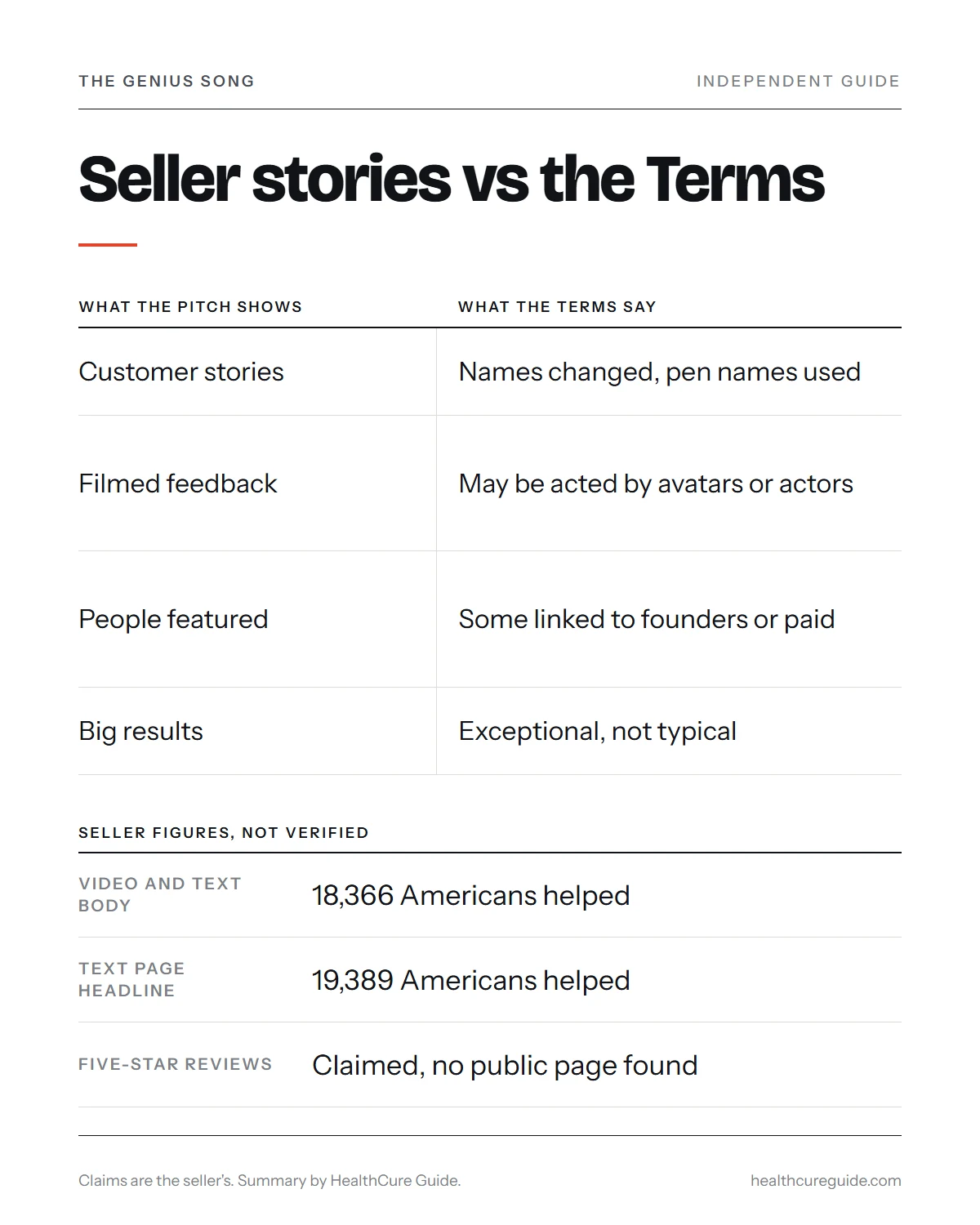
- Names “have been changed”, and it uses pen names.
- Some aspects of the marketing “have been dramatized”.
- Feedback from users may be performed by actors, avatars or other digital stand-ins.
- Some of the people telling stories may be close to the company: the Terms mention early backers plus friends and relatives of its founders, a material connection.
- Some people were compensated for sharing their experiences.
- The testimonials are exceptional results and may not reflect what a typical customer experiences.
Each of those points is the seller’s own admission, sitting in a document that most buyers never open. Taken together, they mean the video’s stories cannot be treated as evidence of what happens to an ordinary listener.
The same Terms include a section headed “For Entertainment Purposes Only”. There, brain entrainment is called “not an exact science”, and the products are labelled entertainment. Yet a few paragraphs away, that very document insists everything it says on entrainment, focus and mental energy rests on solid science. The seller wrote both lines. We put them next to each other so you can see the tension for yourself.
Two customer counts that do not agree
The video says the track has helped 18,366 everyday Americans, and the body of the text sales page uses the same number. Scroll back up to the headline of that very page and the figure becomes 19,389 Americans.
The gap is small, but it matters for a simple reason: a number that changes between two pages from the same seller is not a measured count. Neither figure links to sales data, a public review platform or any outside check. We treat both as the seller’s own unverified marketing figures.
Elsewhere in the pitch you hear of “thousands of five-star reviews” and “hundreds of emails”. We looked for a public page that hosts those ratings and found none. A rating nobody can read is not a rating.
What we verified and what we could not
Here is our ledger. “Verified” means we saw it on the seller’s pages, Terms or checkout. It does not mean we confirmed the result of listening.
| Statement | Our finding |
|---|---|
| It is a short digital audio track | Verified on the sales pages; the seller says about 7 minutes |
| Price shown is $39 | Verified; checkout adds local currency and tax outside the US |
| Sold through ClickBank | Verified; checkout runs on geniusbr.pay.clickbank.net |
| 90-day refund | Verified in the Terms and on the ClickBank checkout |
| Presenter’s identity and credentials | Not verified; the site calls the name a pen name |
| 18,366 or 19,389 people helped | Seller figures, inconsistent, not verified |
| “Thousands of five-star reviews” | Seller claim, no public source found |
| Effects on memory, luck, money or health | Seller claims; no study of this track exists |
On the presenter: the site’s disclaimer at the foot of its sales pages says the presenter uses the pen name Dr. Robert Lake, with the consent of what it calls its leading neuroscientist. Around that pen name the headline builds a “Top NASA Scientist”, and the video adds a clinic in New York City and a 34-year career. Credentials hung on a pen name have no person behind them that anyone could look up, so we do not repeat those titles as fact.
Independent feedback: what to look for
Genuine buyer feedback, if you find it, tends to look different from marketing. Use these signs.
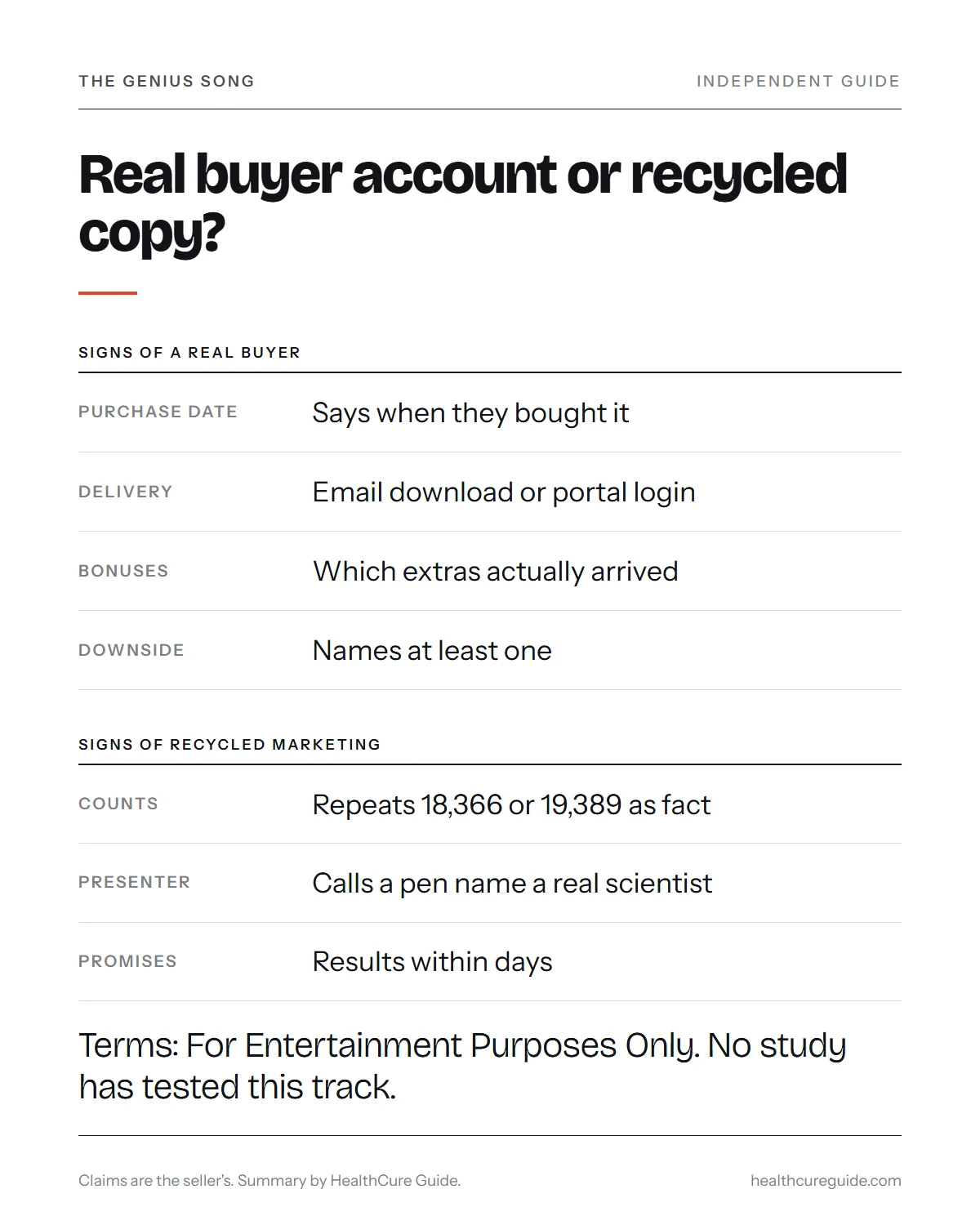
Signs of a real buyer account
- The writer says roughly when they bought and how long they listened.
- They explain how the track reached them. The seller’s own pages tell two delivery stories, an email in the video and a “Private Audio Portal” login on the text page, and only a buyer can say which one really happens.
- They say which bonuses turned up. This matters because the seller’s pages differ on them: the video counts “three free bonuses” yet goes on to describe four extras (an audio for children, an old book about money, a guided visualization, a habits printout), and the text page counts four but shows only three, leaving out the children’s audio.
- They mention a downside, even a small one, and whether they asked for a refund.
Signs of recycled marketing
- It quotes 18,366 or 19,389 without saying where the number comes from.
- It calls the presenter a NASA scientist or a real neuroscientist.
- It promises results in days.
- It treats the video’s customers as independent reviewers.
Where to buy, and how a refund works
The seller says it only offers the track through its own website, at geniussongoriginal.com. One thing surprises people: our links open the official site’s home page, and right now that page promotes the seller’s related audio, The Genius Wave, which is a different 12-minute track. To see the Genius Song pitch itself you go to the /video/ address on that domain. Each product has its own ClickBank item, so read the item name before you pay.
The checkout lists “The Genius Song (90-Day 100% Money Back Guarantee)” as a one-time digital product, not a subscription. Your card statement should read CLKBANK*Genius Song.
The refund terms have one trap. The site’s /TOS/refunds/ page describes a 60-day policy for unopened bottles of a product called NeuroActivate, with an Ohio return address. It does not fit a digital track and looks like a leftover template. The Terms of Sale (“Digital Products … 90 days”) and ClickBank’s own 90-day line are the ones that apply. Keep your ClickBank receipt, and if you want your money back, contact ClickBank order support at 1-800-390-6035. Product questions go to [email protected].
Buying also adds you to the seller’s email list, which may send third-party offers. Every email carries an unsubscribe link.
Listening safety and what no review can promise
Do not mistake any of this for medicine. The seller’s own footer concedes: “not intended to diagnose, treat, cure, or prevent any disease”. Migraines, pain, smoking and weight belong with a doctor, not a headphone session.
On the science, gamma waves are real brain rhythms linked in research to attention and memory, and lab work on 40 Hz sound and light has been done mostly in mice, with small early human trials. Binaural beat findings pull in two directions. When researchers pooled studies in 2019, the combined effect came out medium-sized for some outcomes; in 2023, a review of entrainment trials counted more studies against the predicted brainwave shift than for it. Not one of these papers tested The Genius Song.
Our own advice for any audio program of this kind:
- Turn the volume down to where it feels easy, not loud.
- Keep it for moments at rest, never while driving or near machinery.
- Epilepsy, past seizures or hearing trouble? Talk to a doctor before the first session.
Our reading of the reviews
Strip away the seller’s stories and figures and very little review evidence remains. That is not proof the track is useless. It means the material that looks like reviews was produced by the seller, under Terms that allow acting, pen names, compensation and atypical results, and the headline customer count does not even match across two pages.
What can be confirmed fits in one line: one brief track, a $39 sticker price before local tax, a ClickBank checkout and a refund window of 90 days. If a short daily listening habit appeals to you, that window is your real review process. If you need independent proof first, it does not exist yet. Our methodology explains how we assess products like this one.
We wrote this to help you judge a purchase; it is not medical advice.
Common questions
Are the customer stories in The Genius Song video independent reviews?
No. They are part of the seller's advert. Its Terms say names have been changed, pen names are used, some marketing is dramatized, feedback may be acted out by avatars or actors, some people featured are early supporters, friends or family of the founders, and some were compensated. Read them as sales copy, not as buyer reviews.
Why does The Genius Song customer total change from page to page?
It depends on which page you read. The sales video and the body of the text page say 18,366 Americans, while the headline of the same text page says 19,389. Both figures are the seller's own, neither links to an outside source, and we could not verify either of them.
Does the seller really have thousands of five-star reviews?
The presenter says so in the video, along with a mention of hundreds of emails. We found no public review page, platform or rating that the claim points to. Until one is shown, treat it as a line from the sales pitch rather than evidence of what buyers think.
Who is the doctor presenting The Genius Song?
The presenter uses the pen name Dr. Robert Lake, and the site says so itself in the disclaimer at the bottom of its sales pages. The video and text page attach titles such as NASA-trained neuroscientist to that pen name. We could not verify any of those credentials, so we do not treat them as fact.
What would a trustworthy review of The Genius Song include?
A reviewer who actually bought it should say roughly when, describe how the track was delivered and how long it runs, list which bonuses arrived, mention at least one downside and say whether a refund was requested. A review that repeats the seller's customer counts or calls the presenter a real scientist is recycling the pitch.
What if I buy The Genius Song and do not like it?
The Terms allow a refund on digital products requested within 90 days of purchase, and the ClickBank checkout states the same 90 days. Ask through ClickBank's order support at 1-800-390-6035 with the order number from your receipt. Ignore the site's separate refund page, which describes a bottle product called NeuroActivate.
Can a review tell me whether The Genius Song will work for me?
No review can. No published study has tested this track, and the seller's own Terms present it for entertainment purposes only. Personal accounts, even honest ones, describe one listener. If you are curious, the 90-day refund window is a fairer test than anyone else's opinion.