Western Astrology vs Eastern Astrology: Eastern Astrology Language Reading
Some people live by their moon sign. Others grow up arguing about whose zodiac animal is luckier. This guide looks at which system people choose, why, and how to try both without committing to either.
- Written by
- HealthCure Guide Editorial Team
- Reviewed by
- HealthCure Guide Editorial Team
- Updated
- Reading time
- 9 min read
This guide contains affiliate links. If you buy through them we earn a commission at no extra cost to you. It does not change the verdict. Disclosure.
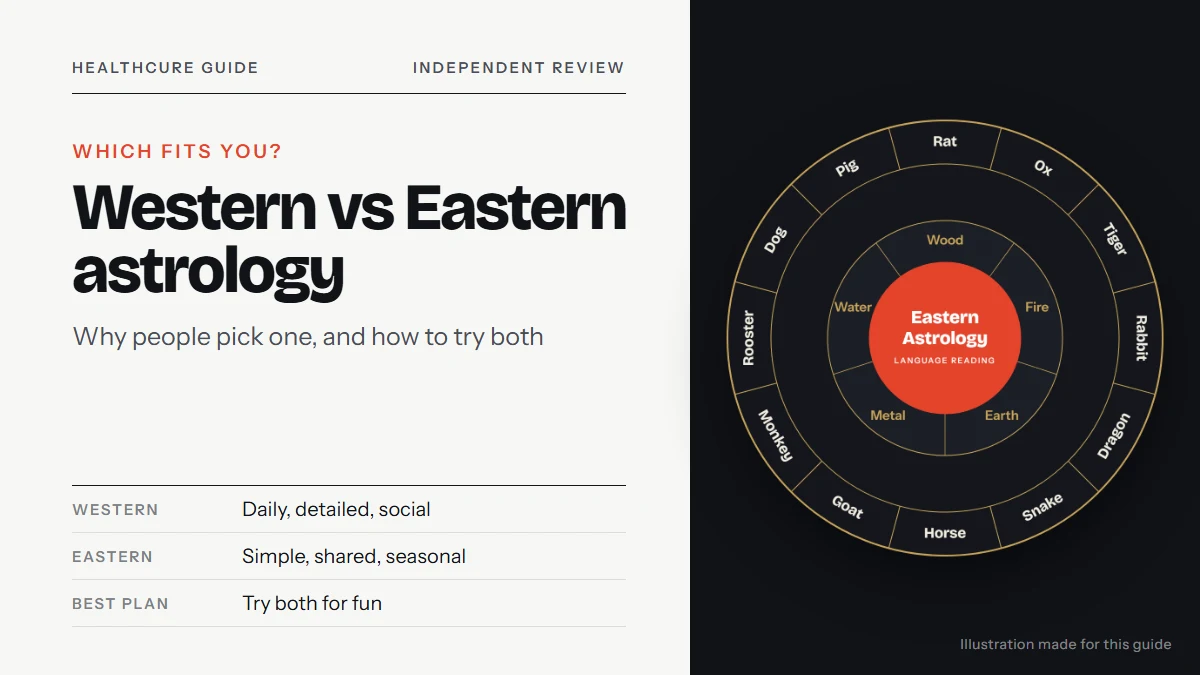
You are standing in front of two doors. Behind one is a chart of sun, moon and planets. Behind the other is a wheel of twelve animals and five elements. Western astrology vs eastern astrology is less a debate about which is correct and more a question of which one you will actually enjoy using. For the Eastern side, the Eastern Astrology Language Reading is a simple way to get a personal chart.
This guide skips the technical comparison and looks at the human side: what each one feels like, why people pick one, and a low-effort way to try both. If you are curious about the Eastern side, the free quiz linked below takes about a minute.
Why people reach for Western astrology
Ask a fan of Western astrology what they love and the answers sound similar.
- A rich shared language. Sun, moon and rising signs give you three different handles to describe yourself, and strangers often swap them within minutes of meeting.
- A daily habit. Horoscopes arrive in apps and feeds, so checking in takes seconds.
- Social fun. Asking “what’s your sign?” is an instant icebreaker, and sign jokes are everywhere.
- Depth when you want it. A full natal chart with houses and aspects gives hobbyists plenty to study.
Western astrology suits people who like detail, who enjoy a regular ritual, or who want a vocabulary for mood and personality.
Why people reach for Eastern astrology
The pull of Eastern astrology is a little different.
- One clear answer. Your birth year gives you an animal and an element, so you can start in a minute.
- It feels shared. Families often talk about who is the Rooster and who is the Ox, and the whole household shares the year’s animal each Lunar New Year.
- Rhythm and customs. The yearly cycle brings traditions, such as wearing red in your own animal’s year, that many people enjoy.
- A bigger frame. Elements, yin and yang, and the four pillars offer a layered picture when you want one.
Eastern astrology suits people who like a simple entry point, family storytelling, or a calmer pace than daily horoscopes.
What each one feels like to use
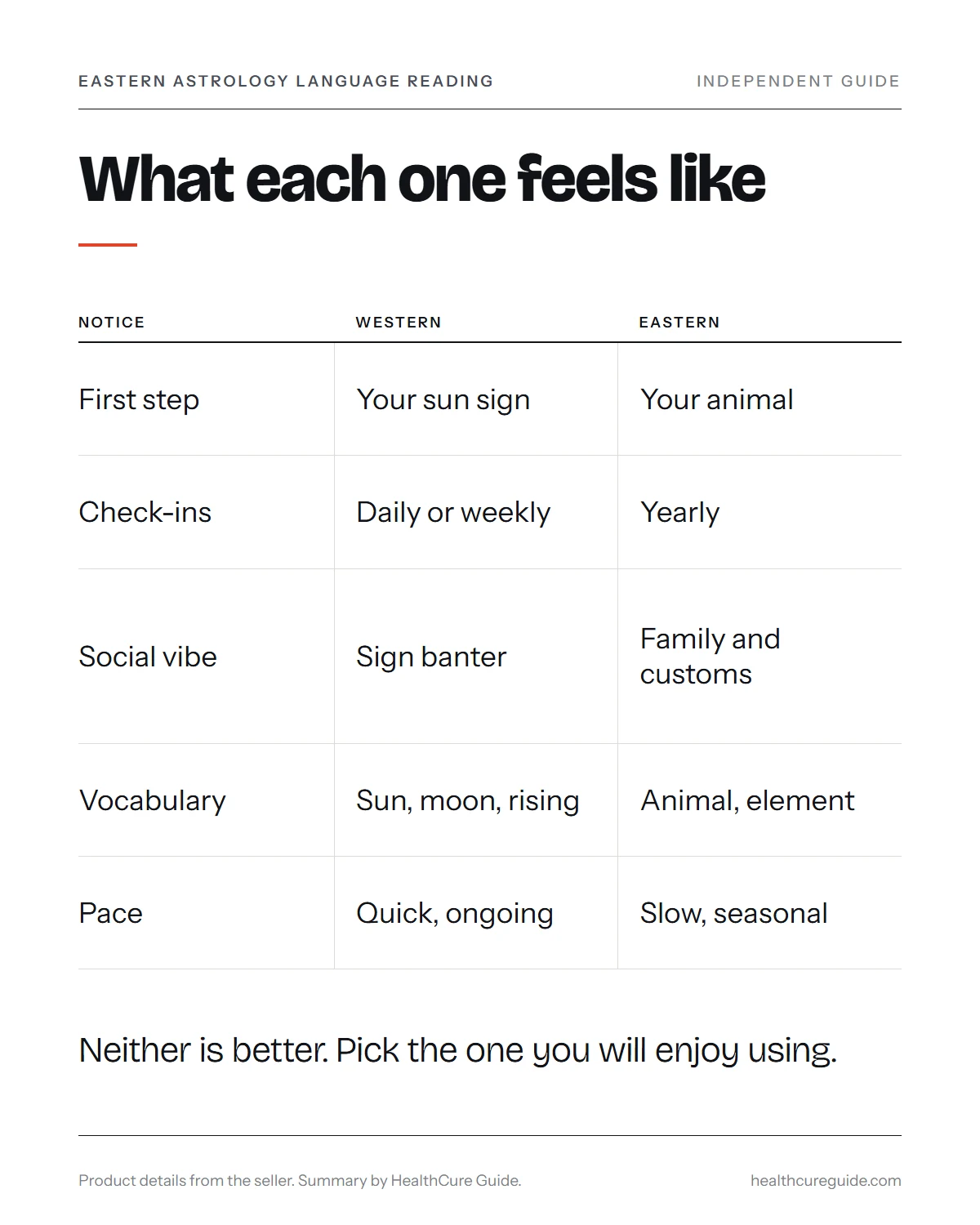
Here is the experience side by side.
| What you notice | Western astrology | Eastern astrology |
|---|---|---|
| First step | Look up your sun sign | Look up your animal by birth year |
| How often you check | Daily or weekly horoscopes are common | Yearly forecasts are common |
| Social vibe | Sign banter and compatibility memes | Family traits and festive customs |
| Vocabulary | Sun, moon, rising, houses, aspects | Animal, element, yin and yang, pillars |
| Pace | Quick and ongoing | Slow and seasonal |
| Best moment to use it | Whenever you want a mood check | When a new year begins or you plan ahead |
A Monday morning with each
Imagine two ordinary mornings.
On the Western morning you open an app and read a short paragraph about your sign. It nudges you to be patient with a colleague or to watch your spending. You smile, forward it to a friend with the same sign, and carry on. The whole thing takes about two minutes, and it fits neatly into a routine.
On the Eastern morning there is no daily paragraph. Instead you remember that this year belongs to a certain animal, and you wonder how it sits with yours. Maybe you and a cousin compare notes over tea, or you plan a small family dinner for the new year. It is less of a habit and more of an occasional event.
Neither morning is better. One is a steady companion, the other is a seasonal tradition, and many people enjoy having both.
If you like this, try that
Use this as a loose guide, not a rule.
| If you tend to… | You might enjoy |
|---|---|
| Check in with your horoscope every morning | Western astrology |
| Like a single, memorable label | Eastern astrology |
| Enjoy collecting details and learning terms | Western astrology, with a natal chart |
| Care about family and tradition | Eastern astrology |
| Like planning around the new year | Eastern astrology |
| Want a quick chat topic at a party | Either one |
Most people are a mix. The point is that you do not have to choose a team.
Western astrology vs eastern astrology: who prefers which
There is no survey behind this, just patterns people often describe. Those who grew up with the Chinese zodiac tend to carry their animal as part of their identity, and many Western astrology fans arrived through apps or friends. A beginner who wants a fast, friendly start often picks the animal sign. A hobbyist who wants a steady stream of material often picks the sun, moon and rising signs.
Both groups say much the same thing: they enjoy it because it gives them a way to talk about themselves and the people they care about.
Reasons people stay with one system
Sticking to a single tradition is perfectly reasonable.
- Familiarity. If your family has always used the Chinese zodiac, the animal sign may already feel like part of who you are.
- Depth over breadth. A person who loves learning houses, aspects and transits may prefer to go deep on the Western chart.
- Simplicity. One system is easier to keep track of than two.
- Fit with your calendar. Daily readers like Western horoscopes. Annual planners like yearly animal forecasts.
You do not owe either tradition any loyalty. Choose what you actually look forward to.
Five questions to help you decide
If you like to choose deliberately, these questions help.
- How often do I want to check in? Daily and weekly people lean Western. Yearly people lean Eastern.
- Do I know my birth time? Without it, Western charts lose their rising sign and houses, while the Eastern basics still work from your birth year.
- Do I want a label or a vocabulary? An animal is a compact label. A natal chart is a whole vocabulary.
- Who will I share it with? Friends who love sign banter make Western astrology lively. Relatives who love tradition make Eastern astrology lively.
- Do I want a document to keep? A personalized chart you can read slowly appeals to people who like to reread and underline.
There are no wrong answers. If your replies split down the middle, that is your cue to try both.
Using either one kindly
A last note on manners. Whichever system you choose, astrology is at its best when it opens conversations and at its worst when it boxes people in.
- Ask friends what their sign means to them instead of telling them.
- Avoid judging a colleague or a date by an animal or a sun sign.
- Remember that a description fits many people, so treat it as a prompt rather than a verdict.
- Keep the mood playful. If a description does not fit, shrug and move on.
Used this way, both traditions are pleasant companions for reflection, and neither one asks you to take it too seriously.
Try both in one weekend
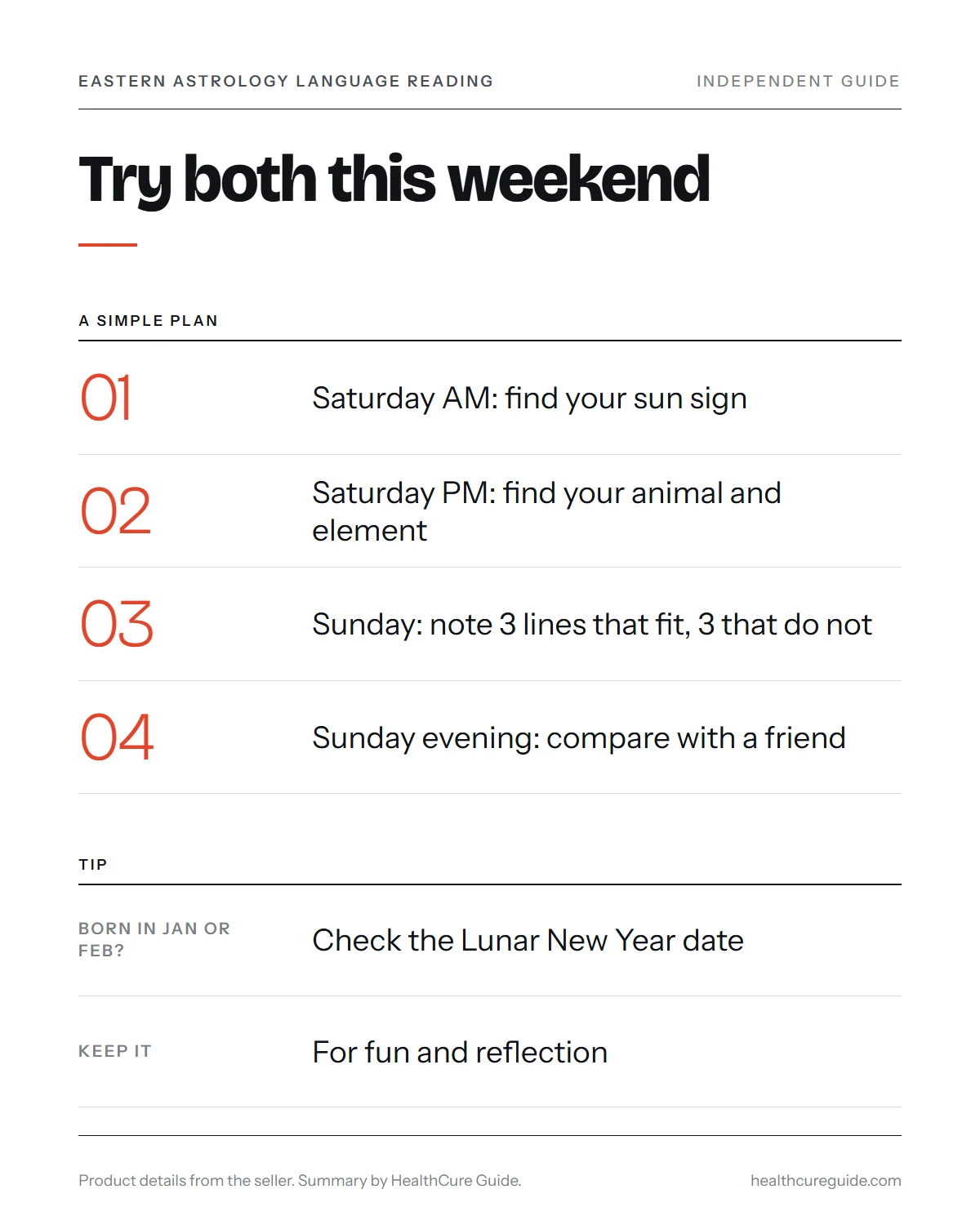
You can test both traditions without spending anything.
- Saturday morning. Find your sun sign and, if you know your birth time, your rising sign from any free chart tool.
- Saturday afternoon. Find your Chinese zodiac animal by birth year, and compare your birthday with that year’s Lunar New Year if it falls in the first weeks of the calendar.
- Sunday. Write down three lines from each that felt true and three that did not.
- Sunday evening. Share your results with a friend and compare.
Whatever you keep, keep it for fun. Writing down what you want from the coming year can be useful whichever chart you used to start the conversation.
Why many people add an Eastern chart
People who start with a sun sign often say the Eastern side feels like a fresh angle. A personalized chart goes beyond the headline animal and looks at the element and pillars too. It also gives you something to keep, which a daily horoscope never does: a single document you can read in an evening, underline, and come back to when a new year starts.
The seller presents the Eastern Astrology Language Reading as a personalized chart of 50+ pages made from your birth date. Per the seller, you receive your animal, your element and your BaZi pillars, plus sections on themes like money, romance and lucky days. You start with the free quiz and then see two options, and a separate post on the reading itself goes through them step by step.
| Package | Price | In plain terms |
|---|---|---|
| Essential Reading | $19 | The whole chart, emailed in about 48-72 hours, with optional add-ons you can accept or skip |
| VIP Reading | $47, against a $97 regular price shown by the seller | Essential plus three bonus items, faster 12-hour delivery and priority support |
The bonus items are an energy clearing kit, a soulmate compatibility map and a morning audio. The seller prices them at $67, $47 and $33 respectively, so VIP is pitched as a bundle.
A big comfort for first-time buyers is the 60-day money-back guarantee. You can try the chart at your own pace and still ask for a refund inside that window. Payment goes through ClickBank.
Who will enjoy the Eastern reading most
It tends to appeal to people who:
- already enjoy horoscopes and want a new angle
- like the idea of one personalized document to read at their own pace
- are curious about elements and the four pillars
- value a clear refund period before they commit
If you would rather stay with a sun-sign routine, that is a perfectly good choice too.
Good to know
- According to the seller, its readings come from software and astrological calculations, and they are offered for entertainment and personal reflection. Our broader stance is on the disclaimer page.
- The quiz asks for your first name, email and date of birth, and its email box is selected by default.
- Astrology is a cultural tradition, so keep medical, legal and money decisions separate from it.
Related reading
Common questions
Is Western or Eastern astrology better for beginners?
Neither is better, they just start differently. Western astrology begins with a sun sign you probably already know, then invites you to add moon and rising signs. Eastern astrology begins with a single animal by birth year, which many beginners find simpler. Pick whichever matches how you like to learn.
Why do some people prefer the Chinese zodiac to a horoscope?
Many like that it feels shared. Whole families talk about animals, and the yearly cycle brings an easy reason to chat each Lunar New Year. It also gives a clear single answer, an animal and an element, without needing your birth time or place for the basics.
Do I have to believe in astrology to enjoy either one?
No. Many people treat both as cultural traditions and prompts for reflection, a bit like a personality quiz with a long history. You can enjoy the symbolism and the conversation without treating any chart as a rulebook. Entertainment and personal reflection are what most readers are really after.
Can I follow both systems at the same time?
Yes, and plenty of people do. They are separate traditions with different logic, so you read them side by side instead of merging them. For example, you might enjoy your sun sign for daily moods and your animal and element for the bigger picture of the year.
What do I need to try Eastern astrology for the first time?
Just your birth date. Check it against the Lunar New Year date for that year, since January and early February birthdays may belong to the previous animal. From there you get your animal and element, and a personalized chart can add pillars and themes.
Which is more popular, Western or Eastern astrology?
It depends on where you live. Western horoscopes are everywhere in apps and magazines in many countries, while the Chinese zodiac is deeply woven into daily culture across East Asia and in many communities around the world. We do not have reliable figures, so we will not guess at a ranking.
Is there a no-cost way to start with the Eastern side?
Yes, the seller's quiz costs nothing to take. Expect nine questions, about a minute, and requests for your first name, email and birth date. A brief reading comes first and the paid offer follows. Look at the email consent checkbox before continuing, because it comes selected.
What if I change my mind after buying the Eastern Astrology Language Reading?
Reach out within 60 days of the purchase. Both the seller's Terms and the ClickBank checkout describe a 60-day money-back window, so you can ask for a refund through ClickBank or the seller's support team. Any local tax or currency conversion shows up at checkout.