What Is The Genius Song? A Plain-English Explainer
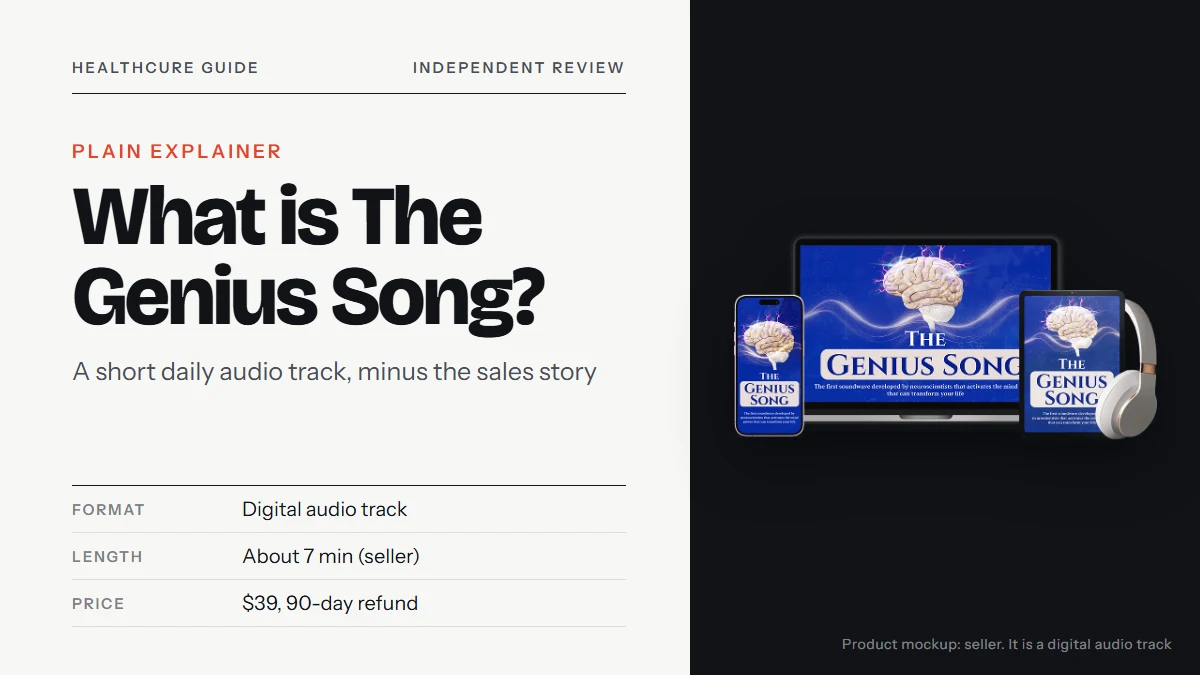
Strip away the sales video and The Genius Song is a short digital audio track with a big story attached. Here is what the product is, how the seller describes it, and the things it is often mistaken for.
- Written by
- HealthCure Guide Editorial Team
- Reviewed by
- HealthCure Guide Editorial Team
- Updated
- Reading time
- 9 min read
This guide contains affiliate links. If you buy through them we earn a commission at no extra cost to you. It does not change the verdict. Disclosure.
If you are asking what is the genius song, the honest answer is shorter than the 39-minute video that sells it. It is a piece of audio you download or stream, wrapped in a story about brain waves, famous inventors and lucky people. This explainer separates the product from the story so you can decide whether it is something you want at all.
HealthCure Guide is independent of the seller. If you buy through our links, we may be paid a commission. We did not buy the track ourselves, so anything about the file comes from the seller’s pages.
What is The Genius Song, in plain words
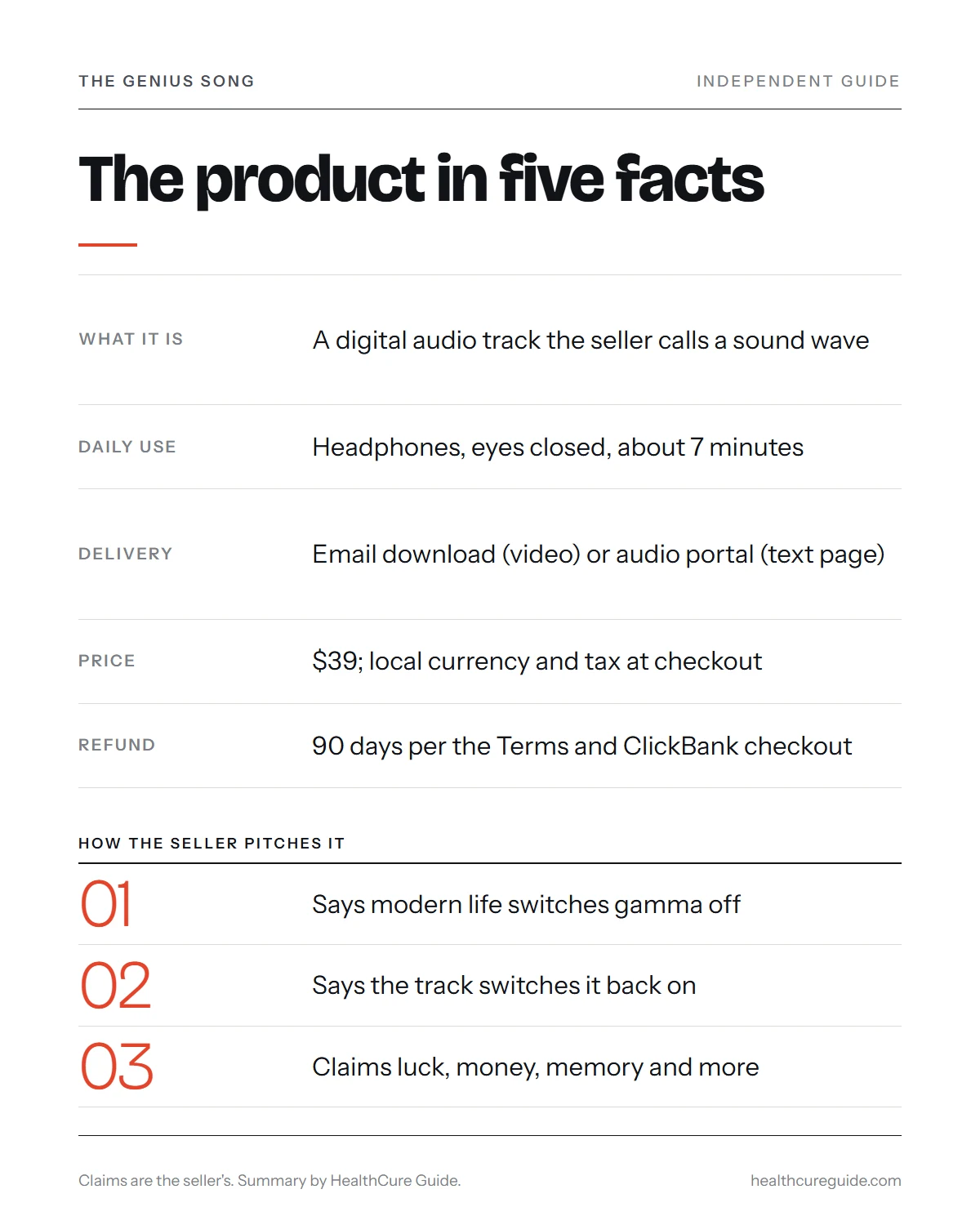
Think of it as a short daily listening session sold as a download. The seller calls it a “sound wave” built with “brain entrainment”, which is the idea that rhythmic sound can nudge the brain’s own rhythms to follow it. The video says the team took an hour of entrainment and compressed it into a seven minute track, then named that track The Genius Song.
There are no lyrics in the usual sense, and it is not a song you would hear on the radio. The name is a branding choice. The listening instructions are simple: headphones on, eyes closed, seven minutes a day.
Everything beyond that is the seller’s explanation of why you should want it. That explanation is the part worth reading slowly.
What you receive for $39
The order box on the sales page crosses out three higher figures ($200, $100 and $49) and offers the track “Today Just For $39”. The Terms of Sale confirm the $39 figure. What sits behind that price, according to the seller:
| Part of the offer | Seller’s description | Our check |
|---|---|---|
| Main audio | A track of about 7 minutes, for daily use | Only the seller’s description; we did not buy it |
| Delivery | Emailed within minutes (video) or a Private Audio Portal login (text page) | The checkout calls it a digital product with immediate access |
| Extras | Up to four digital bonuses | Video and text page give different lists |
| Refund | 90 days | Stated in the Terms and on the ClickBank checkout |
| Shipping | None | Checkout marks it as not shippable |
On the extras: the video announces “three free bonuses”, yet goes on to name four: The Genius Child (an audio meant to help kids focus), a classic book over 100 years old about attracting financial success, a guided visualization by someone the seller calls a top-rated Calm app creator, and a five-habit printable infographic. The written /text/ version advertises four bonuses but lists only three: the classic book, something called the “Genius Visualization”, and an infographic titled “Create Your Ideal Future”. The two pages simply do not match, so treat the bonuses as uncertain extras.
Outside the US, expect ClickBank to show the price in your own currency with local tax added on top, which can leave the total above $39.
How the seller explains it: gamma and the “7-second trick”
The pitch rests on one idea. The video says adults carry a gamma brain wave that has gone quiet because of modern life, and that listening to the track can switch it back on by “connecting several regions of your brain”. It calls gamma “the super brain wave”.
Around that idea the video builds a long chain of research stories: a claim that MIT discovered one brain wave shared by every lucky, wealthy and successful person, a “brand new discovery in 2026”, a paper said to be published at the end of 2025, a British study about children guessing who was calling, Edison’s supposed gamma device, and billionaires rising at 4 AM. None of these are linked or cited on the page in a way a reader could check, and we found no published study showing that successful people share a single brain wave.
There is also a mismatch in the hook. The headline talks about a “seven second brain trick” or morning ritual, but the product is a seven minute track. The video never explains a separate seven-second step.
The claimed results are broad: eureka moments, faster learning, better memory, luck, promotions, money, better relationships, children’s grades, even weight loss and quitting smoking. The presenter promises results from the first listen (“starts working the very first time”). In fairness, when the presenter tells a casino story, he adds that “there is, of course, no evidence” the track caused it. That line applies to the rest of the list too.
How you are told to use it
The seller’s instructions take one sentence: put on headphones, close your eyes and listen for seven minutes each day. The video adds that you can save the track to a phone or computer, and that missing a day is fine.
Our own advice, as a safety note rather than a product instruction:
- Keep the volume at a comfortable level, never loud.
- Do not listen while driving, cycling or operating machinery, since the track is designed for eyes-closed listening.
- If you have epilepsy, a history of seizures, or any hearing problem, ask a doctor before using audio entrainment products.
If you try it, a simple notebook works better than memory. Write down how you slept, how focused you felt and anything else you hoped would change, then look back after a few weeks. That gives you something real to compare against the claims before the refund window closes.
What The Genius Song is not
A lot of confusion around the name comes from what people assume it is. Based on the seller’s own pages, it is none of the following.
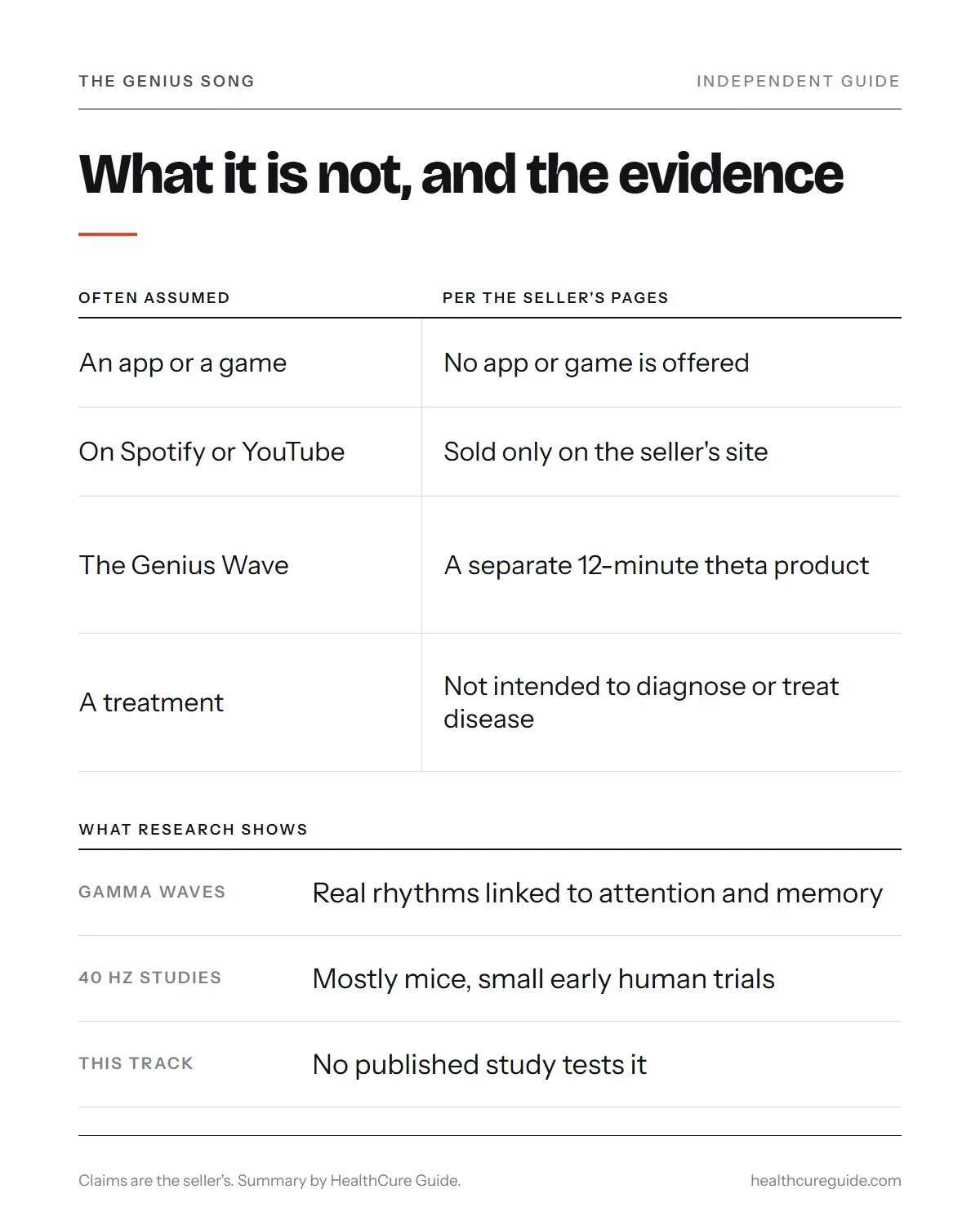
- Not an app or a game. No app is offered on the site, the checkout or in the video.
- Not on Spotify, YouTube or Amazon. The video says the seller sells it only through its own website and that tracks found on those platforms are not the same.
- Not a lyrics or music site entry. People searching song lyrics sites will find unrelated pages that share the word genius.
- Not The Genius Wave. The same seller also sells The Genius Wave, pitched on its own page as a 12-minute theta session. It is a separate checkout item.
- Not a treatment. The fine print on the site rules this out: “not intended to diagnose, treat, cure, or prevent any disease”.
That last point matters most. The anecdotes in the video include migraines disappearing and joint pain easing, but the fine print says the product is not a medical tool, and you should not treat it as one.
Who sells it and how buying works
According to the Terms, the business behind the site is Happy Consumer LLC, which is based in Puerto Rico, and Puerto Rico law governs the agreement. Buyers must be 18 or over. Payment runs through ClickBank, a large online retailer for digital products, which takes the money, issues the receipt and handles refunds. Your card statement should read “CLKBANK*Genius Song”.
One practical detail before you click anything: the official site’s home page currently promotes a sister product, The Genius Wave, while the Genius Song presentation itself lives on the same site’s /video/ page. If you land on a page selling The Genius Wave, that is the reason. Check the product name on the ClickBank checkout before paying. Our page-by-page look at the seller’s site covers each section in detail.
The video’s presenter, who uses the pen name Dr. Robert Lake, is described elsewhere on the site as a NASA-trained neuroscientist. The site’s disclaimer is what tells you the name is a pen name, so none of those credentials can be verified, and we do not treat them as fact.
The same goes for the customer numbers. Treat the customer numbers with the same caution. The presenter puts the figure at 18,366, whereas the /text/ headline prefers 19,389. Neither figure is verified, both come from the seller, and they contradict each other.
What the evidence says about the idea behind it
Start with what holds up. Gamma activity exists: on an EEG it shows as quick oscillations somewhere around 30 to 100 Hz, and scientists tie it to how the brain handles attention and memory. A few things are reasonably well documented:
- At MIT, a lab has tested flickering light and sound at 40 Hz, largely in mice bred to model Alzheimer’s, plus a handful of small first-stage studies in people. That work is about brain health in disease models, not IQ, luck or income.
- Long-term meditators have been recorded with strong gamma activity (Lutz and colleagues, 2004). This is probably the root of the “monks” story in many brain-wave sales videos.
- Binaural-beat research points in two directions. A 2019 meta-analysis came out with a medium-sized combined effect across the cognition, anxiety and pain measures it covered, but a 2023 review of entrainment studies found that most of them did not actually show the brain rhythm shifting toward the beat.
What is missing is any published test of The Genius Song itself. Nobody outside the seller has shown that this specific track changes brain activity, let alone fortunes. The Terms admit as much in their own way: a section headed “For Entertainment Purposes Only” admits that entrainment “is not an exact science”. Oddly, the same document also claims its entrainment statements are backed by established research, so the seller’s position depends on which paragraph you read.
Testimonials and how to read them
The video features several customer stories and a set of named questions from viewers. The Terms explain how to treat them: names have been changed, pen names are used, parts of the marketing are dramatized, and feedback can be acted out by actors, avatars or digital representations. Some of the people may be friends or family of the founders, some were paid, and their results are described as exceptional rather than typical.
That does not mean every listener is unhappy. It means the stories on the sales page are advertising, and you should weigh them that way. We do not repeat or name them here.
Is it something you would want?
It may appeal to you if you enjoy short guided-audio routines, you like the ritual of a daily seven-minute break, and you are comfortable paying $39 for something that has a written refund period. In that case the risk is mostly time and the bother of a refund request.
Skip it if you are hoping for a proven tool for memory, money, weight or pain. Nothing in the evidence supports those outcomes for this track, and the seller’s own Terms call it entertainment.
If you do buy, keep the ClickBank receipt. The site has a separate refund page that describes a 60-day policy for “NeuroActivate” bottles with an Ohio return address, which looks like a leftover from another product and does not fit a digital track. The Terms and the ClickBank checkout both give 90 days, and ClickBank’s order support (1-800-390-6035) is the route to use. You can read more about how we evaluate products like this on our methodology page.
Related reading
Common questions
Is The Genius Song a real song with lyrics?
No. Despite the name, the seller describes it as a sound wave turned into a digital audio track, meant for listening with headphones and eyes closed. Nothing on the sales pages mentions lyrics, a singer or a melody you would hum along to. It has no connection to song lyric websites that share the word genius in their name.
How many minutes a day is The Genius Song meant to be played?
The seller says about seven minutes a day. The video describes squeezing an hour of brain entrainment into a seven minute sound wave, and it says skipping a day is 'okay'. We did not buy the track, so we cannot confirm the real running time of the file you receive.
Is The Genius Song the same product as The Genius Wave?
No. Both are sold from the same website and ClickBank account, but the seller's pages describe The Genius Wave as a 12-minute theta session and The Genius Song as a 7-minute gamma track. They have separate checkout items. Check the item name on the ClickBank page before you pay so you get the one you meant to buy.
Do I need an app or special player for The Genius Song?
The seller offers no app. The video talks about downloading the track to a phone or computer, while the written sales page mentions a Private Audio Portal you can stream from. Either way, a normal device with headphones is what the instructions assume. The file format is never stated on the pages we read.
What does gamma mean in the sales pitch?
Gamma is a real, fast brain rhythm, roughly 30 to 100 Hz, that researchers link to attention and memory processing. The seller goes further and calls it a 'super brain wave' that modern life switches off. That second part is the seller's story. No published study has tested whether this track changes anyone's gamma activity.
Can The Genius Song help with migraines, smoking or weight?
The sales video tells anecdotes about those things, but they are claims, not evidence. The site's own fine print says the product is 'not intended to diagnose, treat, cure, or prevent any disease', and its Terms frame it as entertainment. If you have a health problem, see a doctor rather than relying on an audio track.
Who presents The Genius Song video?
A man introduced as Dr. Robert Lake. The site's own disclaimer explains that this is a pen name used with the consent of an unnamed neuroscientist. Because the real person is not identified, the credentials mentioned in the video, such as NASA training and decades as a neuroscientist, cannot be checked and should be read as part of the pitch.