FemiCore Directions: Reading the Label Line by Line
The directions for FemiCore are one short sentence. This guide reads that sentence slowly, phrase by phrase, then looks at the gaps around it and turns them into questions you can take to a pharmacist, with a one-page summary at the end.
- Written by
- HealthCure Guide Editorial Team
- Reviewed by
- HealthCure Guide Editorial Team
- Updated
- Reading time
- 8 min read

This guide contains affiliate links. If you buy through them we earn a commission at no extra cost to you. It does not change the verdict. Disclosure.
FemiCore directions fit on a single line, which makes them easy to follow and easy to misread. Short directions leave a lot unsaid, and people tend to fill the gaps with guesses. This page reads the instruction phrase by phrase, explains what each part means in practice, then lists what the directions do not tell you and who can answer those questions.
It is a label-reading guide, not a routine planner. For a 90-day routine with checkpoints, see our practical routine guide. For the supplement panel, ingredients and storage, see the FemiCore supplement guide.
HealthCure Guide is independent and is not the seller. The store buttons on this page pay us a commission when someone orders through them.
FemiCore directions, as the seller gives them
Here is everything the seller states about use, split into its parts.
| Phrase | Source | Type |
|---|---|---|
| “1 capsule” | Seller’s direction | How much |
| “every morning” | Seller’s direction | When |
| “with a big glass of water” | Seller’s direction | With what |
| At least 3 months before judging | Seller’s advice | How long, minimum |
| See a physician first when pregnant or nursing, taking medication, or living with a medical condition | Official site | Who should ask first |
Wording on bottles can differ slightly from wording on a website, and labels can change between batches. Treat the phrases above as a guide and check them against the bottle in your hand. Where the two differ, follow the bottle and ask support about the difference.
“One capsule”: the whole serving
One capsule is the full daily serving. Each bottle holds 30, so a bottle lasts a month.
What it means. The capsule contains all nine ingredients in a proprietary blend: four plant ingredients (cranberry extract, bearberry, granular berberine and Mimosa pudica) and five Lactobacillus species. The label gives no amount for any of them.
What it does not mean. It is not a starting dose to build on. Nothing the seller says supports a second capsule, and a second one would double your intake of berberine and bearberry, the two ingredients with the most cautions attached.
Practical reading. One a day, every day, and if you are not sure whether you have taken today’s, skip rather than risk two.
“Every morning”: the timing
What it means. The seller ties the capsule to the start of the day. It gives no reason for the timing.
What it does not say. Before or after breakfast, how early, or what to do if you work nights. It also says nothing about spacing the capsule from morning medicines.
Practical reading. Choose one fixed point in your morning and keep it. If a new probiotic upsets your stomach, after breakfast is a sensible choice. If you take medicines in the morning, ask a pharmacist where the capsule should sit among them before you start.
“With a big glass of water”
What it means. The capsule is swallowed whole with a generous drink, not dry and not with a sip.
What it does not say. How big “big” is, or whether other drinks will do. The seller names water, so water is the safe reading.
Practical reading. A full glass is a fair interpretation. If you are on a fluid limit for a heart or kidney condition, ask your doctor how the glass fits into it. Many women with bladder symptoms are tempted to cut back on fluids generally; the direction is a reminder that a capsule is not a reason to go short on water.
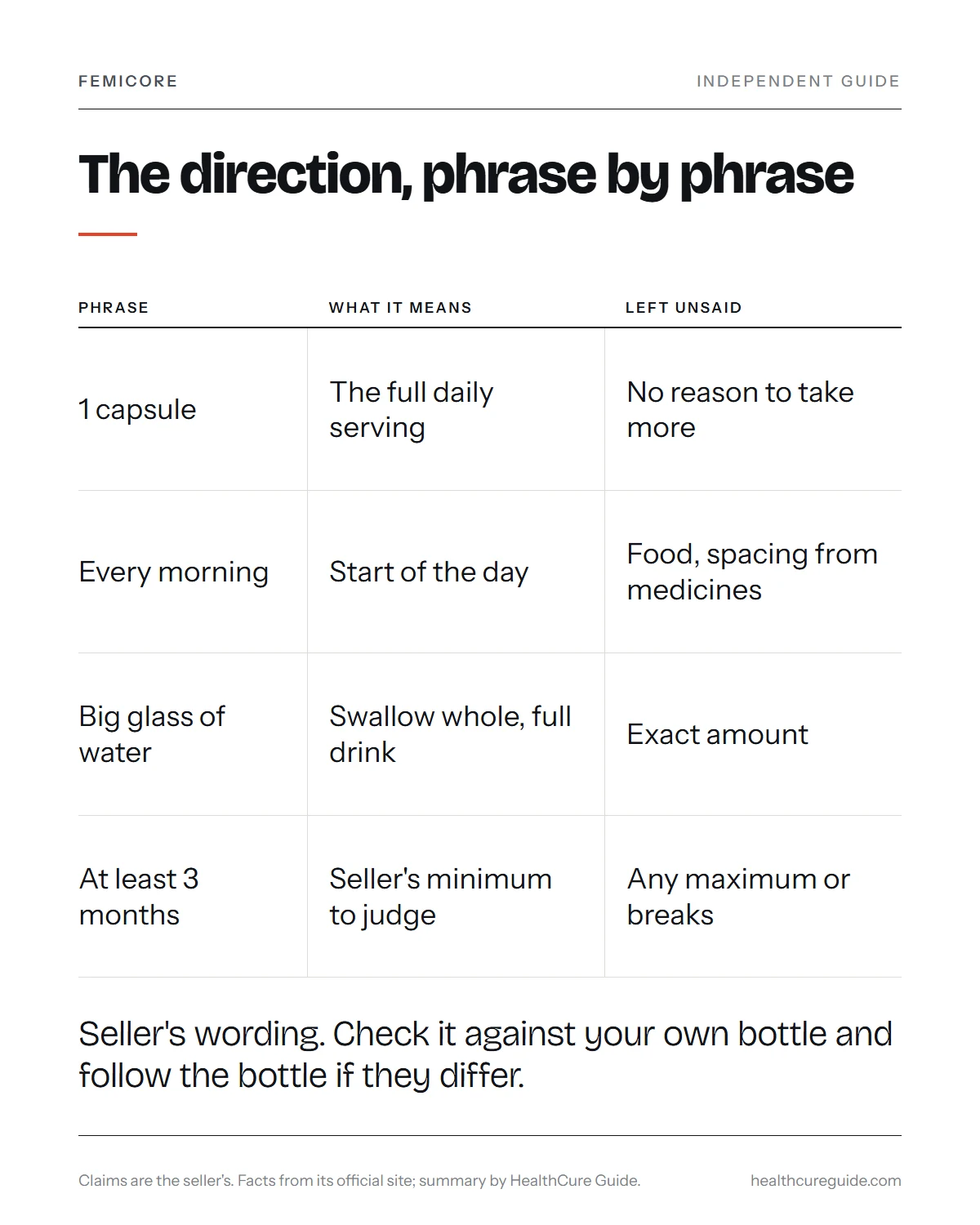
“At least 3 months”: the seller’s advice on duration
What it means. The seller advises giving it at least three months before deciding whether it helps. That is a minimum for judging, not a recommended course length.
What it does not say. A maximum, a break schedule, or what to do after three months.
Why this one needs care. The money-back period is 60 days, and the clock starts when the parcel is delivered. If you want the option of a refund, you have to decide before the three-month point the seller suggests. The refund also requires returning every bottle from the order with the packing slip, and you pay the return postage.
There is also no trial of the finished formula, so the three-month figure is the seller’s advice, not a result from a study of FemiCore.
The words printed around the directions
A label says more than its directions, and the surrounding words shape how people read them.
- “Healthy urinary system, Bladder control support, Microbiome balance.” These are the label’s three claims. They are support claims made by the seller, not treatment claims, and the evidence behind them is uneven.
- “Clinically researched ingredients.” This refers to research on the ingredients in general. It does not mean the capsule itself has been studied.
- Seals on the official site. Five badges. Two describe the ingredients (Non-GMO; Natural ingredients), two describe the plant (GMP Certified; Made in an FDA registered facility), and one the origin (Made in USA, with imported ingredients). Neither the maker nor the certifying body is named. Every supplement sold in the US sits under the same FDA rules for supplements; a registered facility tells you about the factory, not about this formula.
- “No stimulants” and “non-GMO.” The seller’s own descriptions of the formula.
What the directions do not say
This is where most of the useful questions sit. None of these gaps is unusual for a supplement, but each one is worth an answer before you start.
| Not covered | Why it matters | Who can answer |
|---|---|---|
| Food | A new probiotic can upset the stomach at first | Your own trial; a pharmacist if it persists |
| Missed dose | People double up to catch up | Skip it; never take two at once |
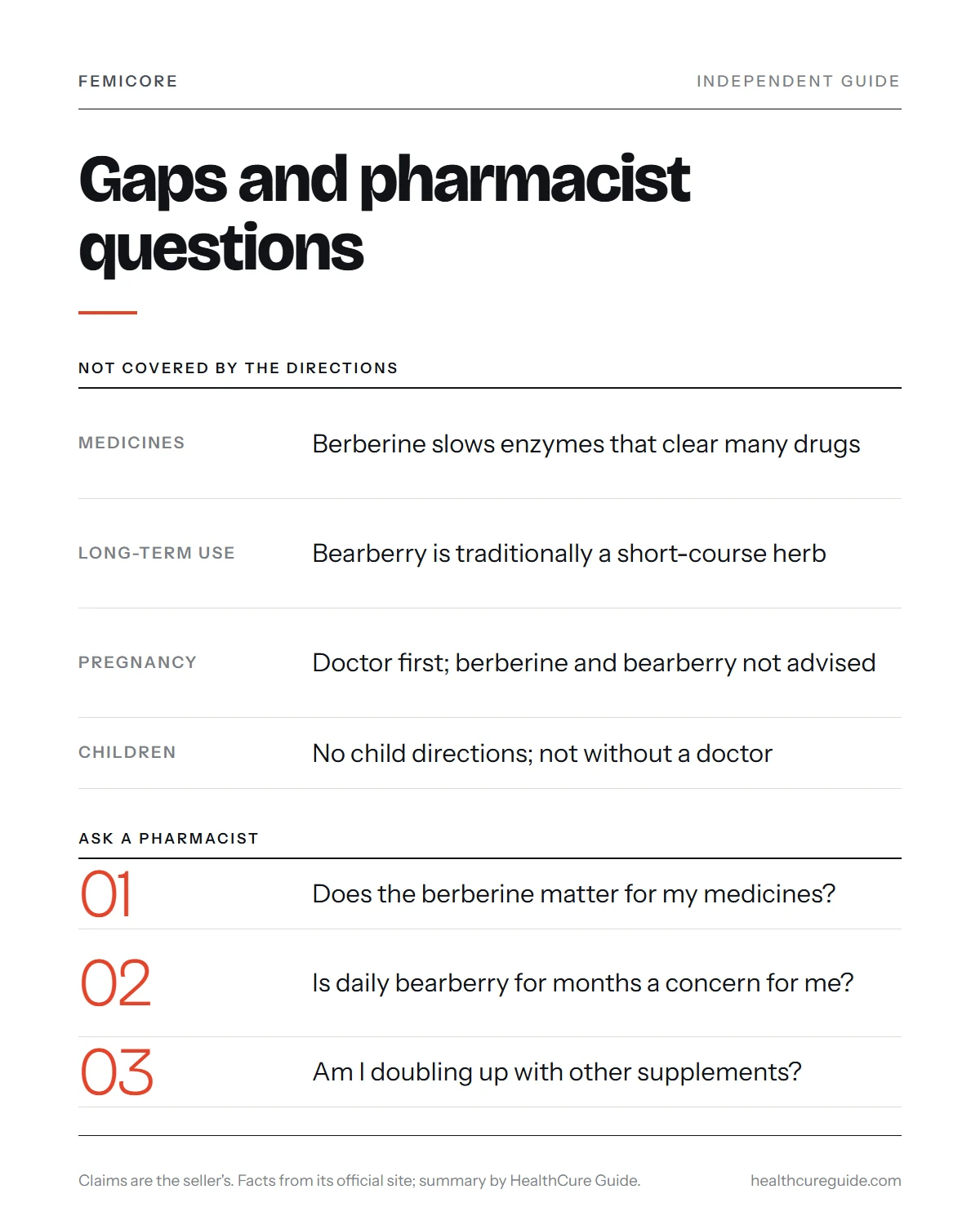
| Spacing from medicines | Berberine slows enzymes that clear many drugs | Pharmacist |
| Diabetes or blood pressure medicine | Berberine can lower blood sugar and may lower blood pressure | Pharmacist or doctor |
| Warfarin | Cranberry has case reports with warfarin | Doctor, with INR checks |
| Lithium | Bearberry has a lithium interaction | Doctor |
| Maximum duration | Bearberry is traditionally a short-course herb | Doctor |
| Pregnancy and breastfeeding | Berberine is unsafe; bearberry should be avoided | Doctor, before any use |
| Kidney disease | Bearberry should be avoided; cranberry has oxalate | Doctor |
| Children | Bearberry is not for children; no child directions exist | Doctor |
| Weak immune system | Rare probiotic infections in severely immunocompromised people | Doctor |
| Storage | Five ingredients are live bacteria | The storage line on your bottle |
If any row applies to you, the directions on their own are not enough. Each ingredient’s cautions are explained at more length in our guide to possible side effects of the formula.
Questions to put to a pharmacist
Take the bottle, or a photo of the label, and a list of everything you take, including other supplements. Then ask:
- “This has berberine in it, amount not stated. Does that matter for any of my medicines?”
- “Should I take it at a different time from my morning tablets, or is spacing not enough here?”
- “I take medicine for blood sugar, blood pressure or blood thinning. Is this a good idea for me?”
- “It contains bearberry. Is daily use for three months or more a concern for me?”
- “I already take a probiotic, a cranberry product or something with berberine. Am I doubling up?”
- “Is there anything about my kidneys or my health history that makes this a bad fit?”
- “If my stomach is upset in the first two weeks, when should I stop?”
- “What symptoms would mean I should stop and see a doctor?”
A pharmacist cannot judge the exact dose of any ingredient, because the label does not give it. That is worth saying out loud, so the advice you get allows for it.
When the directions stop applying
Some situations override any label. Put the bottle away and ask for medical advice when:
- your stomach is still unsettled roughly two weeks in
- a rash or any other reaction shows up
- you find out you are pregnant
Other signs call for a prompt appointment whatever you are taking: urine with blood in it, a temperature or shivering, flank pain, stinging as urine passes, bladder control that suddenly gets worse, or an older relative with urinary trouble who seems newly muddled. No supplement routine should push that visit back.
Reading directions on a bottle you did not buy direct
The directions only mean something if the bottle is genuine. Per the seller, the official website is the only place FemiCore is sold, and the big marketplaces (Amazon, Walmart, eBay) are not authorised, so a marketplace bottle may be old stock or a fake. Its label could carry different wording, an older formula or no lot number at all, and you would have no way to check how it was stored. If the label on a bottle like that differs from what the seller describes, do not take the bottle at its word. The refund only covers orders from the official store, so a marketplace bottle also leaves you without the 60-day safety net.
The directions on one page
| Item | What the label or seller says | What to do |
|---|---|---|
| Amount | One capsule | Never more than one a day |
| Time | Every morning | Pick a fixed point; ask about spacing from medicines |
| With | A big glass of water | A full glass; check if you have a fluid limit |
| Food | Not stated | After breakfast if your stomach is sensitive |
| Missed dose | Not stated | Skip it; carry on next morning |
| Minimum use | At least 3 months before judging | Decide on a refund by about day 50 |
| Maximum use | Not stated | Ask a doctor about long-term bearberry |
| Medicines | Consult a physician | Pharmacist check before the first capsule |
| Pregnancy, nursing | Consult a physician | Doctor first; berberine and bearberry are not advised |
| Children | Not stated | Not without a doctor’s advice |
| Warning symptoms | Not stated | Doctor, not a supplement |
Keep this table with the bottle. The full picture on the product, including who it suits, is in our FemiCore buyer guide.
Common questions
What exactly do the directions for FemiCore say?
As the seller gives them, the instruction is one capsule every morning with a big glass of water. Separately, the seller advises using it for at least 3 months before judging whether it helps, and its site advises asking a physician first when pregnant or nursing, taking medication, or living with a medical condition. Compare this with the wording printed on your own bottle.
Do the directions say how far apart to take FemiCore and my medicines?
No. The directions give no spacing advice for medicines at all. That matters most for berberine, which slows the CYP3A4 and CYP2D6 enzymes that clear many drugs from the body. An interaction of that kind is about how the drug is processed, so spacing doses apart may not be the whole answer. A pharmacist can check your specific medicines.
Is there a maximum length of time to keep taking it?
The directions do not set one. The seller gives a minimum, at least 3 months before judging, but no upper limit and no advice on breaks. European herbal regulators describe bearberry, one of the nine ingredients, for short courses of about a week rather than continuous use. If you plan a long course, ask a doctor about bearberry specifically.
Can a teenager or child follow the same directions?
The directions do not mention children or teenagers, and the product is marketed to women. Bearberry is not advised for children, and the individual doses in the blend are not disclosed. Do not give it to anyone under 18 without a doctor's advice. Urinary symptoms in a child are a reason to see a doctor, not to try an adult supplement.
Does 'every morning' mean before or after breakfast?
The directions do not say. They name the time of day and the glass of water, and nothing about food. If your stomach reacts to a new probiotic, taking the capsule after breakfast is a reasonable thing to try. Whichever you choose, keep it the same each day so the routine is easy to follow.
What should I do if my bottle's directions differ from what the website says?
Follow the bottle and ask the seller's support to explain the difference, quoting your order id and the lot number. Different wording on a bottle bought from a marketplace is another reason to doubt where it came from, since the seller says FemiCore is not an authorised product on Amazon, Walmart or eBay.
Which professional should I ask about the directions, a doctor or a pharmacist?
Either is helpful, for different jobs. A pharmacist is quickest for interactions with your current medicines and for practical points such as timing. A doctor is the right person if you have kidney disease, are pregnant or breastfeeding, or have new urinary symptoms such as blood in the urine, fever or side pain, which need checking before any supplement.