FemiCore Supplement: Label, Dosage, Storage and Use
Before you swallow the first capsule, it helps to know what is in your hand: what the label says, what it leaves out, how to take it, how to keep the probiotics alive and what not to stack it with.
- Written by
- HealthCure Guide Editorial Team
- Reviewed by
- HealthCure Guide Editorial Team
- Updated
- Reading time
- 8 min read
This guide contains affiliate links. If you buy through them we earn a commission at no extra cost to you. It does not change the verdict. Disclosure.
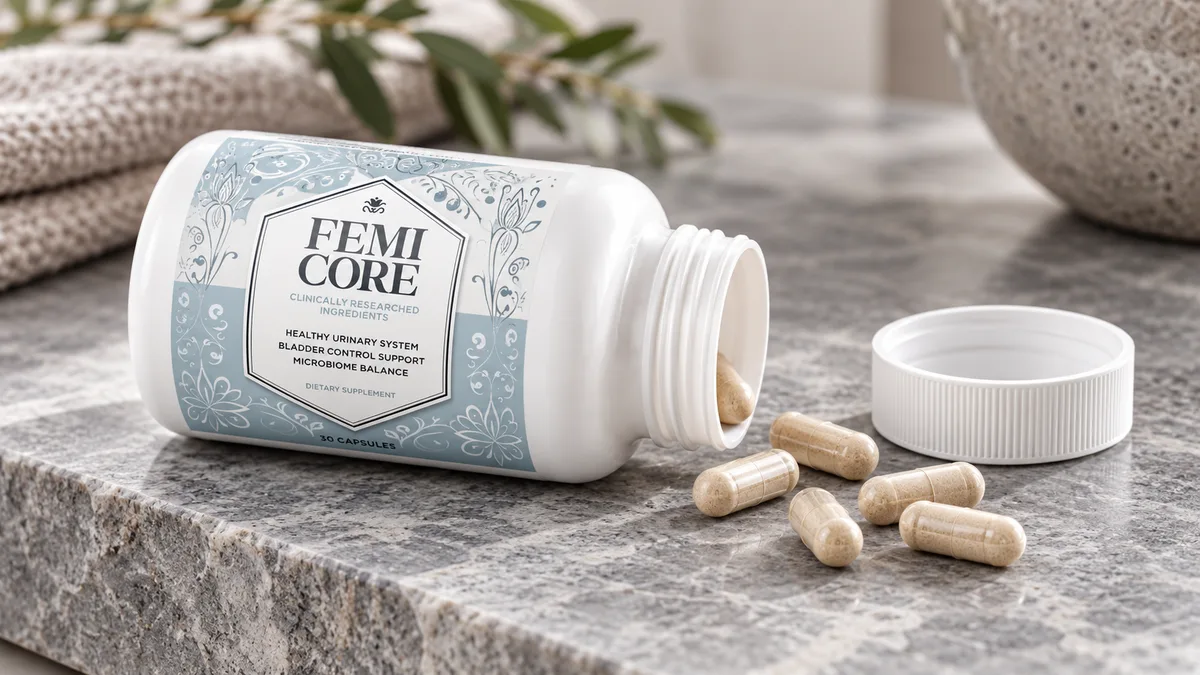
This guide is about the FemiCore supplement as a physical product: the capsule, the label on the bottle and the daily routine that goes with it. It is the page to read once the box has arrived, or just before you order, if you want to know exactly what you are committing to each morning. Whether the formula works, and what each ingredient does, are covered in other guides that we link to along the way.
Links to the store are affiliate links, so we may earn a commission if you buy. That does not affect anything we write here.
The FemiCore supplement at a glance
| Detail | What it is |
|---|---|
| Form | Capsule |
| Capsules per bottle | 30 |
| Serving size | 1 capsule |
| When | Each morning, with water |
| Supply per bottle | 30 days |
| Ingredients | 9, in a proprietary blend |
| Plant ingredients | Mimosa Pudica, Bearberry (Uva Ursi), Cranberry extract, Granular Berberine |
| Probiotic strains | L. crispatus, L. acidophilus, L. plantarum, L. gasseri, L. casei |
| Manufacturing (manufacturer’s claims) | Manufactured in the USA with imported ingredients, GMP-certified, FDA-registered facility, non-GMO, no stimulants |
One point on that last row. An FDA-registered facility is a factory on a government list, which is a legal requirement for makers of food and supplements. It does not mean the FDA has reviewed or approved FemiCore. No dietary supplement is FDA-approved.
Reading the FemiCore supplement facts label
Every dietary supplement sold in the US carries a Supplement Facts panel. Knowing how to read FemiCore’s tells you as much about what is missing as about what is there.
What the label tells you
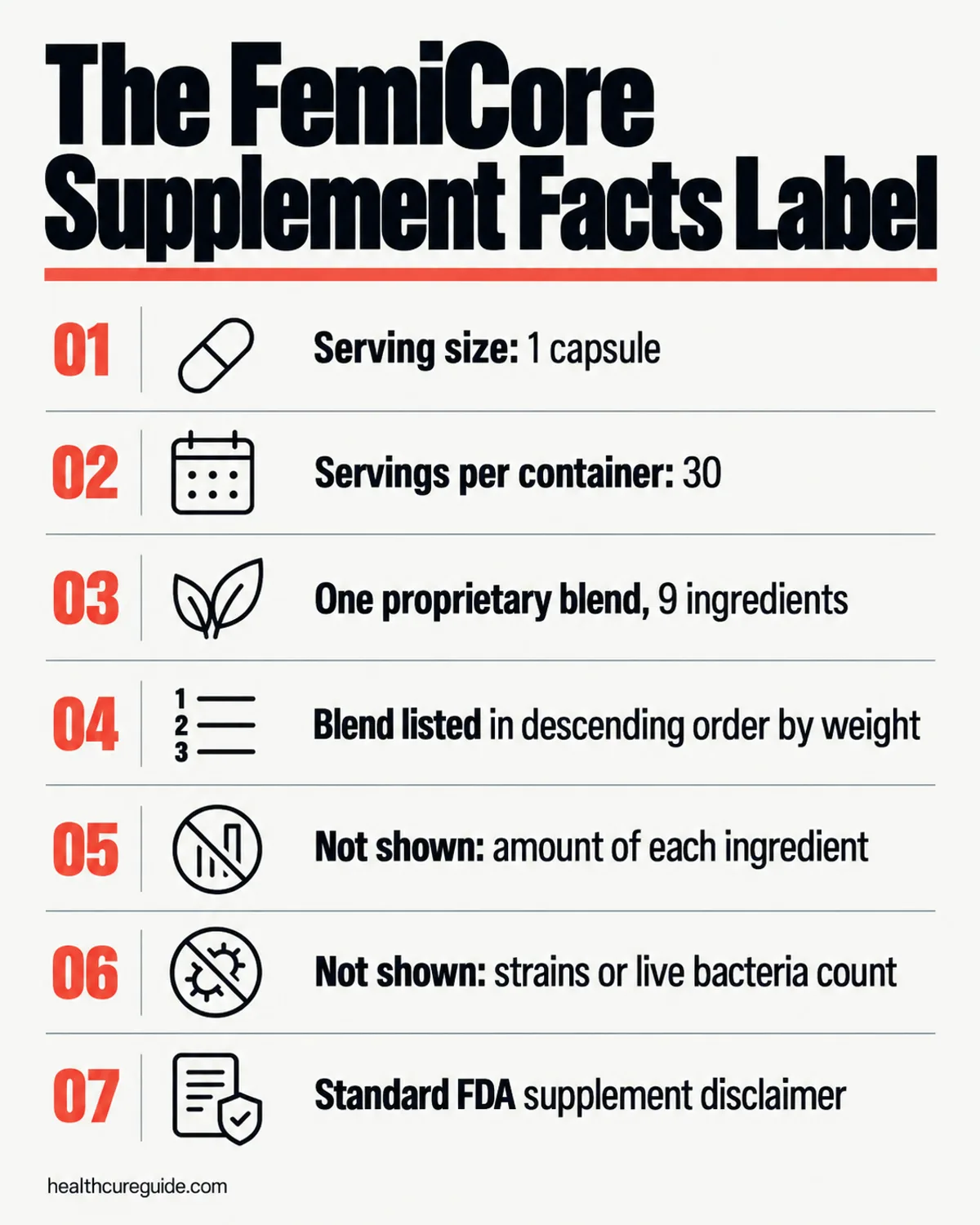
- Serving size and servings per container. One capsule per serving, 30 servings per bottle.
- The blend and its ingredients. All nine ingredients appear under a single proprietary blend. US labelling rules require ingredients in a proprietary blend to be listed in descending order by weight, so the ingredient printed first is present in the largest amount. Look at the order on your own bottle; it is the only clue to relative quantities you will get.
- Directions. One capsule daily. There is no loading dose.
- The standard supplement disclaimer, which says the product’s statements have not been evaluated by the FDA and that it is not intended to diagnose, treat, cure or prevent any disease.
What the label does not tell you
- How much of each ingredient is in a capsule. You know there is cranberry; you do not know whether it is a large or token amount.
- How many live bacteria each capsule contains, or whether that count is guaranteed at manufacture or at the best-by date.
- Which strains of each Lactobacillus species are used. Probiotic effects are strain-specific, and the research on L. crispatus for urinary health was done with a particular strain.
- How the cranberry is standardised, which is how most cranberry research describes its doses.
- The berberine amount, which matters most for people on medication.
None of this is unusual for a proprietary blend, and it is legal. It does mean you cannot compare FemiCore’s doses with the doses used in studies. Our FemiCore ingredients list covers what each ingredient is and what the research says about it.
Five things to check on your own bottle
- The serving size reads one capsule and the count reads 30.
- The seal under the cap is intact when the bottle arrives.
- There is a lot number and a best-by date.
- The storage instruction, so you know whether the maker asks for anything beyond a cool, dry place.
- The other-ingredients line, which lists the capsule material and any processing aids, if you avoid particular ingredients for dietary reasons.
How to take the FemiCore supplement
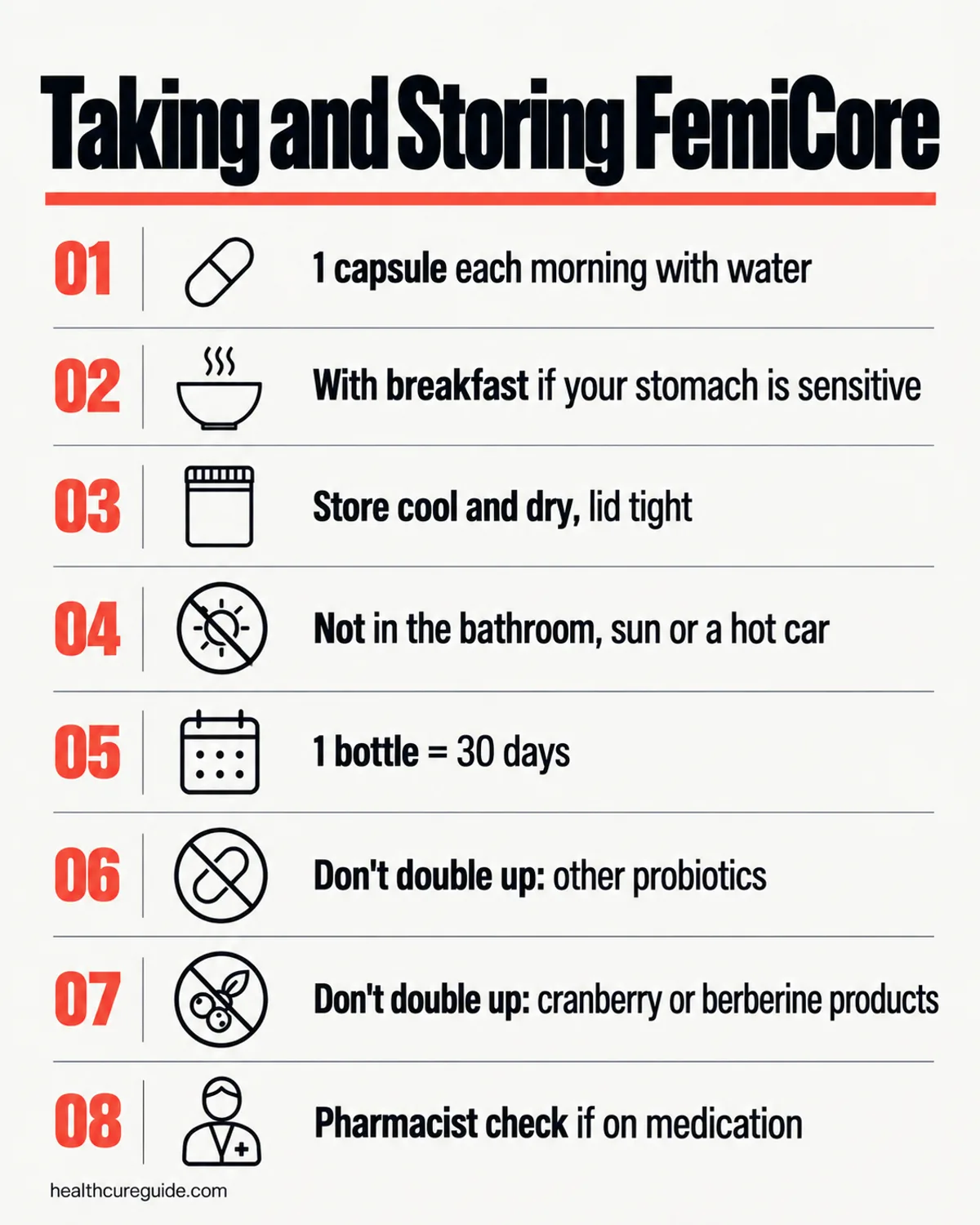
The routine is short. One capsule, each morning, with a glass of water. A few practical points make it easier to stick to:
- Keep the same time every day. Leaving the bottle next to the kettle or your toothbrush (outside the bathroom, see storage below) helps.
- If your stomach is sensitive, take it with breakfast. Mild bloating or a change in bowel habit is common in the first days of any multi-strain probiotic. If it persists or is more than mild, stop and speak to a pharmacist.
- If you miss a day, take the next capsule as normal. Do not double up.
- Do not take more than the label says. A higher dose has not been shown to work faster, and it raises the intake of berberine and bearberry.
- Give it time. The seller advises using it for at least 3 months before deciding. A simple diary of daytime trips, night-time trips and leaks, started before the first capsule, gives you something objective to compare against.
Storing a probiotic supplement properly
Five of FemiCore’s nine ingredients are live bacteria, and live bacteria lose viability with heat and moisture. That makes storage more important than it is for, say, a mineral tablet. Follow the instruction on your label first. In general:
- Keep the bottle somewhere cool and dry, such as a kitchen cupboard away from the oven.
- Keep it out of the bathroom. Steam from showers is exactly the moisture you want to avoid.
- Do not leave it in direct sun, on a windowsill, near a radiator or in a car.
- Close the lid tightly after each use, and leave any moisture-absorbing sachet in the bottle.
- When travelling, carry it in hand luggage rather than in a hot boot or a checked bag left on a tarmac.
The same logic explains why the source of the bottle matters. FemiCore is sold only through its official website. A bottle from an unknown reseller may have been stored anywhere, and you would have no way of knowing.
How long a bottle lasts
At one capsule a day, a bottle lasts 30 days. The package you choose decides how long you are covered, and how much each day costs.
| Package | Capsules | Days covered | Total (US) | About per day |
|---|---|---|---|---|
| 2 bottles | 60 | 60 | $158 + $9.99 shipping | $2.80 |
| 3 bottles | 90 | 90 | $207, free shipping | $2.30 |
| 6 bottles | 180 | 180 | $294, free shipping | $1.63 |
Two timing points are worth planning around. First, delivery takes 5 to 7 business days in the US and 10 to 15 business days to Canada, the UK, Ireland, Australia and New Zealand, where shipping is $15.95. If you want an unbroken run, reorder about two weeks before the last bottle is empty. Second, the 60-day money-back guarantee runs from the day your order is delivered, not from the day you open the first bottle. If you are using it as a trial, note that date somewhere you will see it.
The guarantee itself is straightforward: contact support within 60 days, return all bottles, opened or not, with the packing slip, and the purchase price is refunded to your original payment method. Return shipping is at your own cost. If you are still deciding how to place the order, our step-by-step guide to the FemiCore order process walks through it.
Combining FemiCore with other supplements and medicines
FemiCore is a multi-ingredient product, so the main risk with combinations is accidental doubling. The table below covers the overlaps worth checking.
| If you also take | What to consider |
|---|---|
| Another probiotic | You would be stacking Lactobacillus products. There is rarely a reason to run two at once; pick one so you can tell what is helping. |
| A cranberry supplement or daily cranberry juice | FemiCore already contains cranberry extract. Doubling makes the total hard to judge. Cranberry and warfarin is a known interaction. |
| Berberine, barberry or goldenseal products | All are sources of berberine. Do not stack them. Berberine can affect blood sugar and interact with several medications. |
| Herbal urinary blends | Check for bearberry (uva ursi). It is intended for short-term use and is not advised in pregnancy or kidney disease. |
| Diabetes, blood pressure or blood-thinning medication | Speak to a pharmacist before starting, mainly because of berberine. |
The safest way to add FemiCore to an existing routine is to show a pharmacist the labels of everything you take. It takes five minutes and covers interactions this table cannot. The full ingredient-by-ingredient safety picture is in our guide to FemiCore side effects.
Who should ask a clinician before starting
The label routine is simple, but it is not for everyone. Get advice from a doctor or pharmacist first if you are pregnant or breastfeeding, have kidney disease, take any of the medications above, or have a weakened immune system. And if your symptoms are new, painful or severe, or you notice blood in your urine or a fever, get those checked rather than starting a supplement. A capsule should never delay a diagnosis.
For everyone else, the practical summary is short: one capsule each morning, stored cool and dry, no doubling up, and a diary to judge it by at the end of the trial. If you want the evidence and our overall verdict before you commit, our FemiCore reviews guide has both.
Common questions
What is the serving size of the FemiCore supplement?
One capsule. The label direction is one capsule a day, taken in the morning with water. Each bottle contains 30 capsules, so a bottle is 30 servings and a 30-day supply. There is no instruction to take more than one capsule a day, and doubling up is not a way to speed things along.
What does the FemiCore supplement facts label show?
It shows the serving size, the number of servings per container and a proprietary blend that names nine ingredients: Mimosa Pudica, Bearberry (Uva Ursi), Cranberry extract, Granular Berberine and five Lactobacillus strains. Under US labelling rules a proprietary blend lists its ingredients in descending order by weight, but the amount of each individual ingredient is not given.
Should FemiCore be stored in the fridge?
Follow the storage line printed on your bottle. As a general rule for probiotic supplements, keep it somewhere cool and dry with the lid closed, away from the steam of a bathroom, direct sun, radiators and hot cars. Heat and moisture are what shorten the life of live bacteria, so avoid both.
How long does one bottle of FemiCore last?
Thirty days at one capsule a day. Two bottles cover 60 days, three bottles 90 days and six bottles 180 days. Since US orders take 5 to 7 business days to arrive and international orders 10 to 15, reorder about two weeks before your last bottle runs out if you want to avoid a gap.
Can I take FemiCore with a multivitamin or other supplements?
The combinations to check are the overlapping ones: another probiotic, a separate cranberry product, anything containing berberine, barberry or goldenseal, and herbal urinary blends that contain bearberry. Doubling those ingredients makes the total dose harder to judge. If you take several supplements, show the labels to a pharmacist before adding FemiCore.
Can I take FemiCore with prescription medication?
Ask a pharmacist or doctor first. Berberine can interact with medication for diabetes, blood pressure and blood thinning, and cranberry with warfarin. Bearberry is meant for short-term use and is not advised in pregnancy or kidney disease. These cautions apply whatever brand the ingredients come in.
What if I miss a dose of FemiCore?
Take the next capsule at your usual time the following morning and carry on. There is no benefit in taking two capsules to catch up. FemiCore is a daily routine product, and an occasional missed day does not matter much; long gaps make it harder to judge whether it is helping.