FemiCore Side Effects: Ingredient-by-Ingredient Safety
Most women who take FemiCore will notice nothing worse than a few days of digestive adjustment. A smaller group, mainly those on certain medicines, pregnant or living with kidney disease, should not start it without medical advice. This guide sorts one group from the other.
- Written by
- HealthCure Guide Editorial Team
- Reviewed by
- HealthCure Guide Editorial Team
- Updated
- Reading time
- 7 min read

This guide contains affiliate links. If you buy through them we earn a commission at no extra cost to you. It does not change the verdict. Disclosure.
Searching for FemiCore side effects usually means you are close to ordering and want to know what could go wrong. That is the right instinct. A supplement with nine active ingredients, and no published dose for any of them, deserves more care than a single-ingredient product. Below we go through what each ingredient can do on the safety side, who is most at risk, and what to do if something does not feel right.
This page is about safety only. If you want to know what the ingredients are designed to do, our FemiCore ingredients list covers that. We earn a commission on orders through our store links; it does not change what we say about risk.
FemiCore side effects at a glance
| Ingredient | Most likely effect | Who needs to be careful |
|---|---|---|
| Five Lactobacillus probiotics | Bloating, wind, bowel changes in the first days | People with weakened immunity |
| Granular Berberine | Stomach upset, constipation or loose stools | Diabetes, blood pressure or blood-thinner users; pregnancy and breastfeeding |
| Bearberry (Uva Ursi) | Stomach upset; concern with long-term use | Pregnancy, breastfeeding, kidney disease |
| Cranberry extract | Usually well tolerated | Warfarin users |
| Mimosa Pudica | Little human data | Pregnancy and breastfeeding (unknown safety) |
What FemiCore does not contain matters too. The manufacturer says it has no stimulants and is non-GMO, so jitteriness, raised heart rate and sleep problems of the kind caused by caffeine-based products are not expected.
The first two weeks: probiotic adjustment
Five live bacterial species arrive in your gut each morning, and your existing gut bacteria take time to adjust. The usual signs are:
- a bloated or full feeling, often in the afternoon
- more wind than usual
- softer stools, or occasionally the opposite
These effects are a normal part of starting most multi-strain probiotics and usually fade within days. A few practical steps help. Take the capsule with breakfast and a full glass of water rather than on an empty stomach. Keep the rest of your diet steady for the first fortnight, so you can tell what is causing what. If you are also starting a new fibre supplement or diet, stagger them.
One group should not treat this lightly: anyone with a weakened immune system, for example during chemotherapy, on immunosuppressant drugs or with a central line. Live-bacteria supplements are not routinely advised for them without medical approval.
Berberine: the ingredient most likely to interact
If one ingredient on the FemiCore label deserves a conversation with a pharmacist, it is berberine.
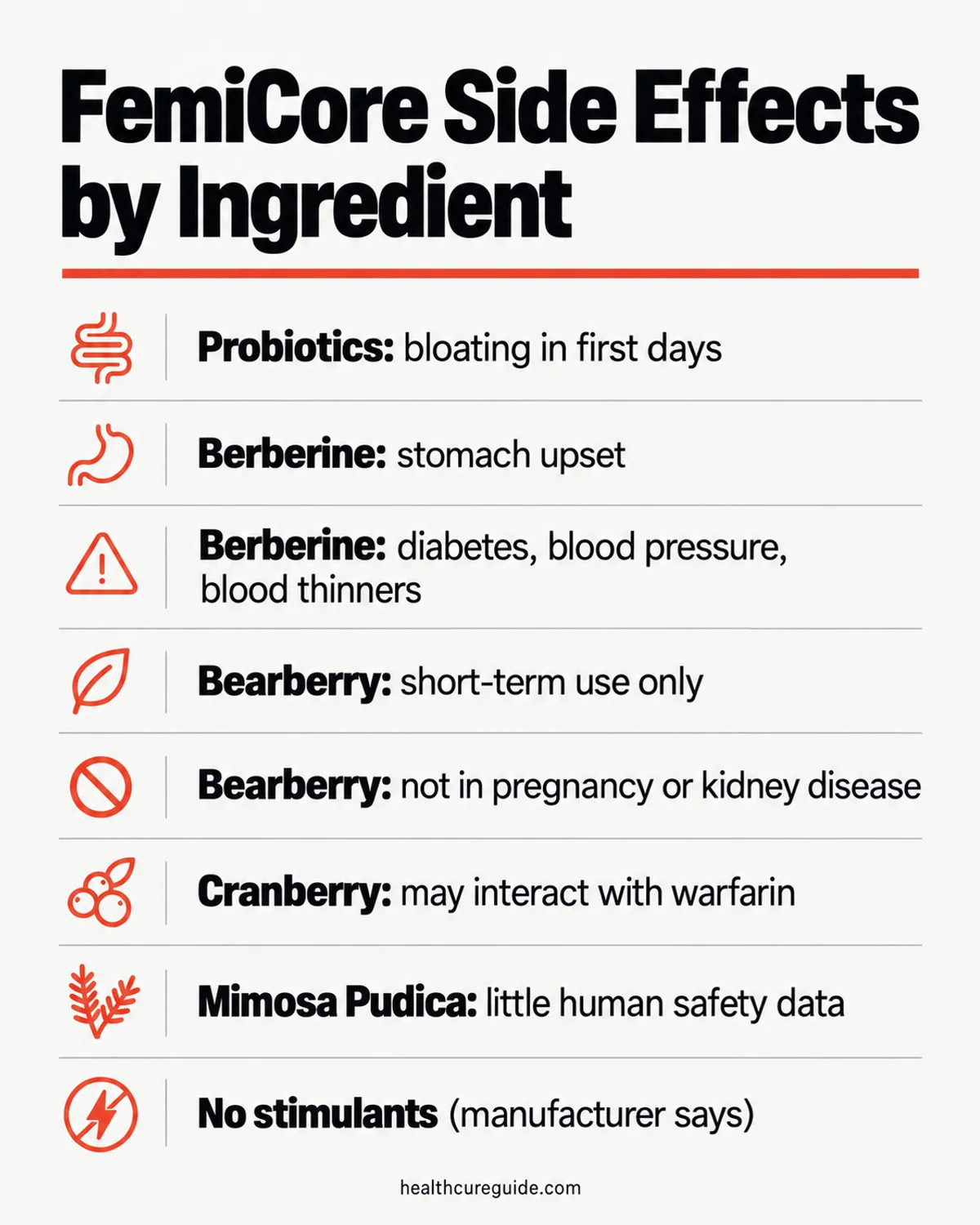
Stomach effects
Berberine can cause cramping, constipation, loose stools or nausea in some people, especially at higher doses. Combined with the probiotic adjustment above, this is the most likely reason someone stops FemiCore in the first week.
Blood sugar
Berberine can lower blood glucose. On its own that is one reason it is popular. Alongside metformin, insulin, sulfonylureas or other diabetes medication, it could add to their effect and push blood sugar too low. Signs of low blood sugar include shakiness, sweating, sudden hunger and confusion.
Blood pressure and blood thinners
Berberine can add to the effect of blood pressure medication and may interact with anticoagulant and antiplatelet drugs. It also affects liver enzymes that process many prescription medicines, which is why the safe answer for anyone on regular medication is to check first.
Pregnancy
Berberine is not considered safe in pregnancy or while breastfeeding.
Bearberry: a short-course herb in a daily capsule
Bearberry, also called uva ursi, is traditionally used in short courses for urinary complaints. The NCCIH fact sheet notes that it is meant for short-term use and that long-term use may be unsafe. It is not advised in pregnancy, while breastfeeding or for people with kidney disease.
That creates a genuine tension. FemiCore is designed as a daily supplement over months, and its bearberry content is not disclosed. With nine ingredients in one capsule the amount may be small, but the label does not let you confirm it. If you plan to take FemiCore for longer than a trial period, raise this with your doctor, especially if you have any history of liver or kidney problems.
Cranberry and warfarin
Cranberry is the best-tolerated ingredient in the formula. The one caution with real weight is warfarin: cranberry products may increase its effect, which raises bleeding risk. If you take warfarin, your INR is monitored for a reason, and adding any cranberry supplement should be agreed with the clinic that manages it.
Large amounts of cranberry can upset the stomach in some people, but at the level likely to be in one mixed capsule this is unlikely to be a problem.
Mimosa Pudica: little data either way
Mimosa Pudica has traditional use behind it but very little human research, and that includes safety research. No specific side effect stands out in the evidence we can cite, which mostly reflects how little it has been studied. The sensible reading is “unknown” rather than “safe”, which is another reason the formula is not suitable in pregnancy.
Who should talk to a doctor before taking FemiCore
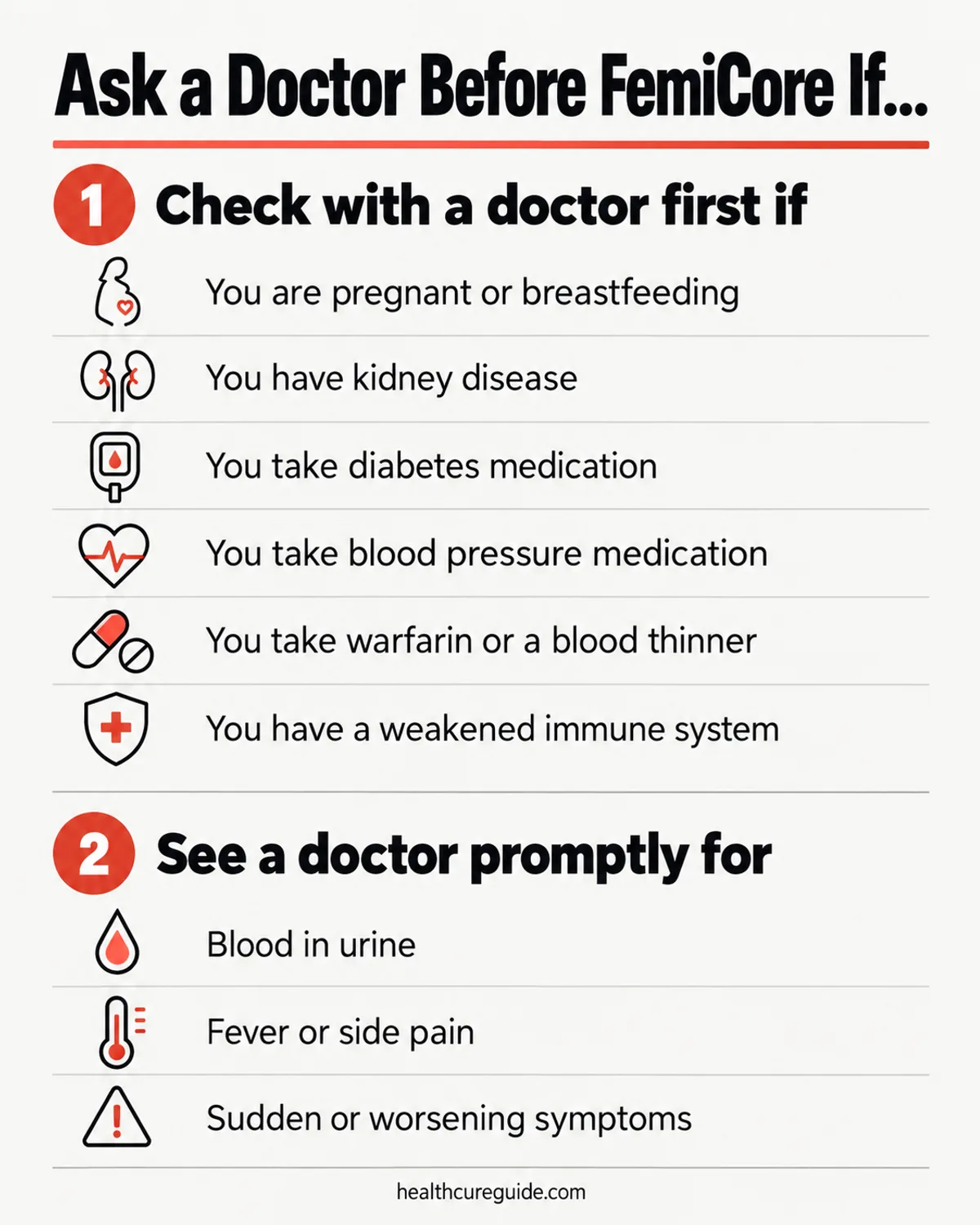
Bring the bottle, or a photo of the label, to the conversation. These are the situations where advice comes first:
| Your situation | Why it matters |
|---|---|
| Pregnant, trying to conceive or breastfeeding | Berberine and bearberry are not advised; Mimosa Pudica safety is unknown |
| Kidney disease or reduced kidney function | Bearberry is not advised |
| Taking diabetes medication | Berberine can lower blood sugar further |
| Taking blood pressure medication | Berberine may add to the effect |
| Taking warfarin or another blood thinner | Cranberry and berberine may interact |
| On several prescription medicines | Berberine affects how some drugs are processed |
| Weakened immune system | Live probiotics need medical approval |
| Under 18 | The product is designed for adult women |
Symptoms that need a doctor before any supplement
Some urinary symptoms are signs of a problem that a capsule cannot and should not mask. See a doctor promptly, and do not start FemiCore as a substitute, if you have blood in your urine, a fever or chills, pain in your back or side, burning or pain when you pass urine, or bladder symptoms that started suddenly or are getting worse.
What to do if you notice a side effect
Mild digestive upset in week one. Carry on with the capsule at breakfast for a few days. If it settles, it was probably adjustment.
Upset that lasts beyond a week or two, or gets worse. Stop. Let your gut settle, then decide with a pharmacist whether to try again.
Signs of an allergic reaction, such as a rash, itching, swelling of the face or lips, or difficulty breathing. Stop immediately and seek urgent medical help.
Shakiness, sweating or confusion while on diabetes medication. Treat it as possible low blood sugar, follow your usual plan, and contact your doctor before taking another capsule.
Unusual bruising or bleeding while on a blood thinner. Contact your prescriber.
Write down what you noticed and when you took the capsule. It helps whoever you speak to.
Why the proprietary blend makes safety harder to judge
Most safety questions about supplements come down to dose. A small amount of berberine is a different proposition from a large one, and the same goes for bearberry. FemiCore lists its nine ingredients as a proprietary blend without individual amounts, so neither you nor your doctor can read the risk straight off the label.
That does not make the product unsafe. It does mean the cautions above are worth taking seriously even if you feel well, because the margin is unknown. If your doctor wants specifics, the BuyGoods support contact in your order confirmation is the route to ask the manufacturer directly.
Side effects and the 60-day guarantee
If FemiCore does not agree with you, the guarantee works the same as for any other reason. Contact support within 60 days of delivery, return all bottles from the order, opened or not, with the packing slip, and the purchase price is refunded to your original payment method. Return shipping is at your own cost. Keep the box and slip from day one so stopping early does not cost you the refund. It applies only to orders from the official website, which our official website guide explains how to recognise.
Our view on FemiCore side effects
For most adult women, FemiCore looks like a low-drama supplement: no stimulants, no hormones, and a likely worst case of a short spell of digestive adjustment. The exceptions are specific and predictable. Berberine is the interaction risk, bearberry is the long-term and pregnancy question, and cranberry is the warfarin caution. If none of those apply to you and your symptoms are not red flags, the safety profile is reasonable. If any do apply, a ten-minute conversation with a pharmacist is the right first step. For the full picture of whether it is worth taking at all, see our FemiCore reviews.
Common questions
What is the most common FemiCore side effect?
Digestive adjustment from the five probiotic species: some bloating, wind or a change in bowel habit in the first days. It usually settles as your gut gets used to the new bacteria. Berberine can add mild stomach upset in some people. If symptoms are strong or do not settle within a week or two, stop taking it and speak to a doctor or pharmacist.
Can I take FemiCore with diabetes medication?
Not without medical advice. FemiCore contains berberine, which can lower blood sugar. Combined with metformin, insulin or other glucose-lowering drugs, it could push levels lower than intended. A doctor or pharmacist can tell you whether it is suitable and whether you need to monitor your blood sugar more closely.
Is FemiCore safe with warfarin or other blood thinners?
Ask your doctor first. Cranberry may increase the effect of warfarin, and berberine can interact with blood-thinning medication. Because the label does not state how much of either is in a capsule, your prescriber cannot easily judge the risk from the bottle alone. Take the label with you to the appointment.
Can I take FemiCore while pregnant or breastfeeding?
It is not recommended. Berberine is not considered safe in pregnancy, bearberry is not advised in pregnancy, and Mimosa Pudica has little human safety data. The same caution applies while breastfeeding. Urinary symptoms in pregnancy should be assessed by your midwife or doctor.
Is FemiCore safe for people with kidney disease?
It is not advised without your kidney specialist's approval. Bearberry is not recommended in kidney disease, and any supplement that acts on the urinary tract deserves extra care when kidney function is reduced. Bring the full ingredient list to your next appointment.
Does FemiCore cause dependence or stimulant effects?
No stimulant effects are expected. The manufacturer says FemiCore contains no stimulants, and none of its nine ingredients is a caffeine source or a hormone. Nothing in the formula is known to cause dependence. If you stop taking it, any probiotic effect is likely to fade gradually rather than cause withdrawal symptoms.
What should I do if I get side effects after starting FemiCore?
For mild bloating, keep the dose with breakfast and give it a few days. For anything more, such as persistent stomach pain, a rash, swelling, dizziness or symptoms that worry you, stop and contact a doctor. If you decide FemiCore is not for you, the 60-day guarantee lets you return all bottles, opened or not, with the packing slip for a refund.